
Twenty minutes gets you a centerpiece that reads as a decorated evergreen from across the room. What it actually is: a wrapped foam cone, a pile of donut holes, and a toothpick count you’ll want to match to the cone, not the donuts. The christmas donut hole tree lives or dies on friction.
Press a fresh hole onto a pick and it grips; press a slick, thickly dusted one and it spins, drops, and takes neighbors down with it. That’s the whole tension of the build, and it shows up on the second row, not the first.
Buy them the day you assemble, test one before you commit, and the stacking stops being fussy. Everything else is filling gaps.
Why Wrap the Styrofoam Cone in Plastic?
A styrofoam cone is an armature, not a plate. You can’t serve anything that’s touched bare foam, so two layers of plastic wrap become the food-safe surface. Wrap it completely, top to bottom, with no foam showing.
The donut holes never make contact with the foam. That barrier also keeps the cone clean. When the tree comes apart, peel off the wrap, toss it, and the cone is ready for next December.
Without the wrap, you’d have a greasy, sugary cone that can’t be reused and a food-safety problem. So before any toothpick goes in, give the cone its plastic skin. A smooth, tight wrap also gives the toothpicks a little more grip than bare foam.
Run your hand over the wrapped cone. It should feel slick and firm, like a shrink-wrapped package. If the wrap shifts or bunches, start over.
This step takes two minutes and makes the whole project possible. Do it right and the rest is just stacking donuts.
How Do You Stack Donut Holes to Look Like a Tree?
Donut holes won’t line up in rows. They’re too round for that.
The trick is to tuck each new row into the gaps of the row below. Start with a continuous ring around the base, connecting each donut hole to the next.
That base ring sets the footprint. For the next row, place donut holes between the ones below, so each sits in a little valley.
Keep going upward, always filling the spaces instead of stacking directly on top. This staggering hides the cone and prevents flat spots. If you stack them vertically, you’ll see the white cone peek through and the tree will look lumpy.
Nestling gives you a rounded, full shape. The donut holes should touch but not squeeze.
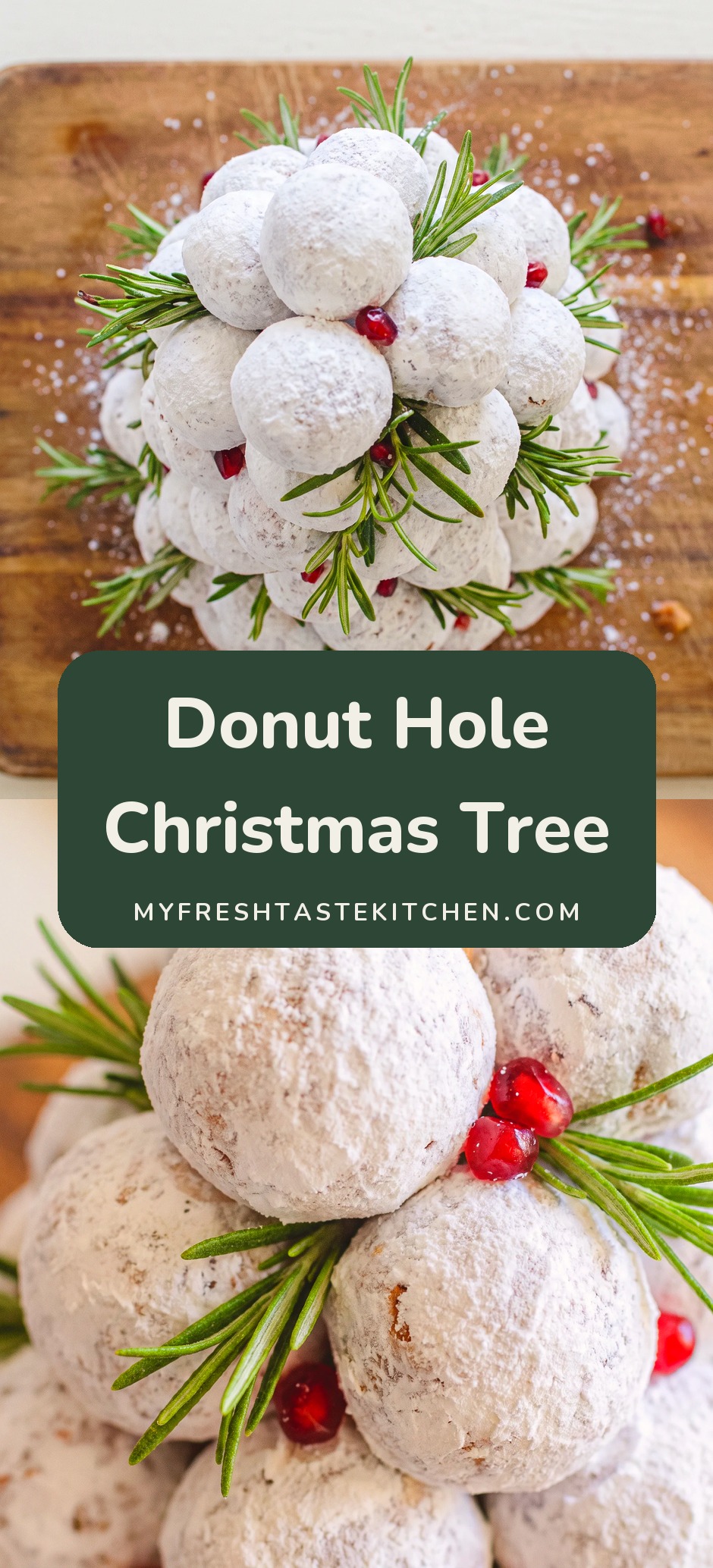
Work your way up until the cone disappears. A good tree shows no foam and no bare patches, just a bumpy green and white surface.
Why Add Rosemary and Pomegranate to a Donut Tree?
Even a well-stacked tree has gaps and a flat look. Rosemary fills the holes.
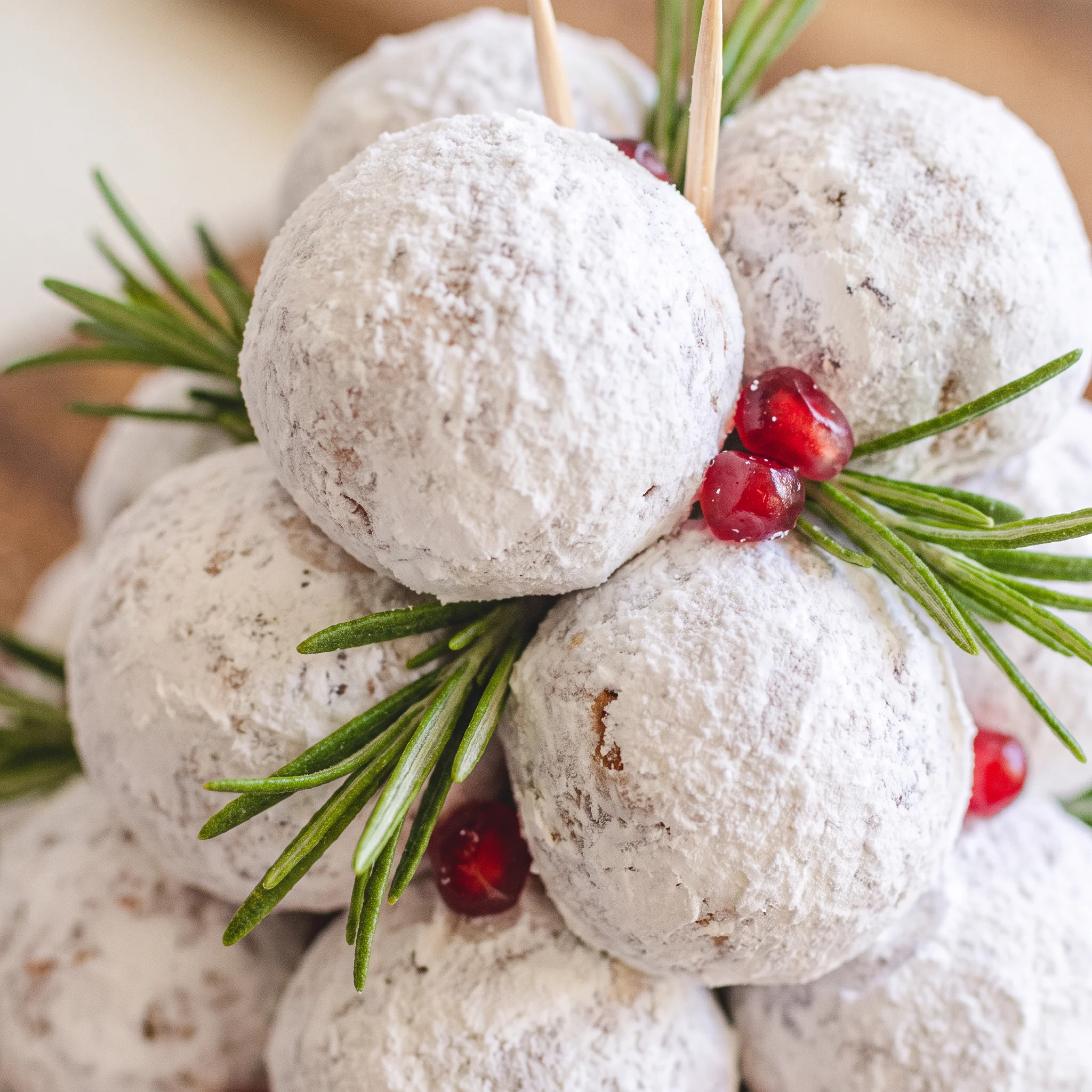
After the cone is covered, cut short sprigs and poke them into any spot where the donuts leave a visible gap. The green needles break up the pale donut surface and suggest branches. Pomegranate arils add red contrast.
Scatter them across the tree, pressing lightly so they stick. They look like ornaments. Powdered sugar goes on last, a dusting that mimics snow.
It’s a finish, not a glue. None of these are structural.
They fix the two problems a donut tower always has: bare spots and a monochrome color. Use enough rosemary to cover gaps but not so much that it looks like a hedge. A few arils go a long way.
When you’re done, the tree should read as green, white, and red from a few feet away. That’s the goal.
What Kind of Donut Holes Hold Up on a Toothpick?
The whole tree is an assembly, not a baking project. Success depends on the donut holes being fresh and firm.
A stale donut hole crumbles when you push it onto a toothpick. An overly moist one slides right off. You want them tender but sturdy, with a little spring.
Powdered sugar coating makes them slippery, so press gently and don’t twist. If the coating is heavy, brush off the excess before skewering. Sour cream donut holes tend to be a bit denser and hold better than the very light powdered kind.
Either works, but check one first. Push a toothpick through a test donut hole. It should stay put when you lift it.
If it falls apart or droops, that batch won’t work. Freshness matters more than brand.
Buy them the day you assemble. The tree can sit for a few hours, but the donut holes are the weak link.
What to Buy for a Donut Tree That Holds Together
Donut holes: Buy them the day you assemble, and pick the sour cream kind over the light powdered ones because they’re denser and grip the toothpicks.
Powdered sugar: If the coating is caked on thick, brush off the excess because a heavy dusting makes the donut holes slide right off the toothpick.
Fresh rosemary sprigs: You want stiff, woody sprigs, not the soft floppy tips, so the segments hold their shape when you poke them into gaps.
Pomegranate arils: Buy a whole pomegranate and pick the arils yourself, since the packaged cups are often leaking juice that stains the donut holes.
12-inch styrofoam cone: A white cone hides better than a green one, so any pale foam peeking through a gap reads as powdered sugar instead of a bright patch.
Judging the Build: Where the Tree Holds or Fails
Judging the first ring before you commit to the whole cone
The bottom ring sets the tree’s shape. After you place the first few donut holes, step back. They should touch without squeezing.
If they’re too far apart, the tree will look sparse and the cone will show through higher up. If they’re jammed together, they’ll push each other off the toothpicks. Aim for a continuous ring where each donut hole just kisses its neighbor.
Fix it now by nudging toothpicks. Once you start the second row, the base is locked.
Reading donut hole resistance when you press it onto the toothpick
As you push a donut hole onto a toothpick, feel the give. Fresh, firm donut holes slide on with steady pressure. If it crumbles at the edges, it’s stale and won’t hold.
If it squishes flat or the coating smears, it’s too moist or the coating is too thick. Set those aside. You can brush off excess powdered sugar to get a better grip.
One bad donut hole can drop and take others with it.
When the cone starts to disappear and gaps still show
The tree is covered when no white foam is visible from any angle. That’s the moment to stop adding donut holes. If you keep going, the tree gets lumpy and toothpicks start colliding.
But check for gaps first. Some spots between donut holes will still show the cone.
Those are for rosemary, not more donut holes. Poke short rosemary sprigs into the gaps.
The green fills the space and reads as branches. Don’t overfill; you want the donut holes to still show.
Sprinkling powdered sugar without turning the tree into a paste
Powdered sugar is the last step. It should look like a light dusting of snow, not a thick icing. Use a fine sieve and tap it gently.
If you sprinkle too heavily, the sugar absorbs moisture from the donut holes and turns gummy. You can’t undo it, but you can brush off excess with a dry pastry brush. The goal is a thin, even coat that catches the light.
More than that and the tree looks muddy.

Christmas Donut Hole Tree with Rosemary
Ingredients
Method
- Encase the styrofoam cone with two layers of plastic wrap.
- Keeping the cone upright, insert a toothpick approximately halfway into the cone’s bottom.
- Carefully press a donut hole onto the toothpick, lining up the donut hole with the cone’s bottom.
- Insert another toothpick near, but not immediately adjacent to, the first donut hole, allowing room for the next donut hole.
- Put another donut hole on the toothpick.
- Continue around the base in a straight line, connecting with the first donut hole.
- For later rows, nestle the donut holes in between to occupy the gaps.
- After the cone is fully covered, cut short segments of the rosemary sprigs.
- Insert the rosemary segments where gaps require filling.
- Decorate with pomegranate arils throughout and sprinkle with powdered sugar.
Swap the Donut Holes, Not the Cone: What Works on a Toothpick
Donut holes: Use plain glazed or jelly-filled donut holes, or a gluten-free variety if needed. Glazed holes are slippery and slide right off the toothpick, no matter how gently you press.
Jelly-filled ones are heavy and leak when pierced, leaving sticky spots that weaken the structure. A gluten-free donut hole often crumbles under pressure; test one first. Sour cream or powdered sugar donut holes are the only ones with the density to grip.
Powdered sugar coating: Brush off excess coating or skip it entirely. A thick layer of powdered sugar makes the donut holes slick, so they twist and fall when you stack them. Brushing some off gives the toothpick something to bite into.
You can dust the finished tree later for the same snowy look without sacrificing grip.
Fresh rosemary sprigs: Use stiff thyme sprigs or small bay leaves. Rosemary’s woody stems hold up when poked into gaps.
Thyme works if you use the thicker lower stems, but the leaves are tiny and won’t fill space as well. Bay leaves lie flat and give a different green, more formal look. Both are sturdy enough to stay put.
Pomegranate arils: Use dried cranberries or small red grapes. Pomegranate arils are juicy and pop when eaten, but they can bleed onto the donut holes. Dried cranberries are chewy and won’t leak, but they’re darker and less shiny.
Red grapes need to be halved and patted dry, or they’ll slide off. None of these changes the structure, just the look and the mess.
12-inch styrofoam cone: Use a different size cone, but adjust the number of donut holes and toothpicks accordingly. A taller cone needs more donut holes and toothpicks, and the base ring gets wider, so you might need a larger serving surface.
A shorter cone is more stable but holds fewer donut holes. The 12-inch size is a good balance for a centerpiece that still fits on a table.
Toothpicks: Use shorter toothpicks only if you trim them, but never longer ones. Longer toothpicks poke through the cone and can stab someone reaching for a donut hole. Shorter ones might not hold a donut hole securely, especially if it’s heavy.
Stick with standard toothpicks and insert them halfway into the cone.
Tips
- Squeeze one donut hole between your thumb and index finger before you build. It should spring back and leave the toothpick-sized dent shallow. If it flattens and stays flat, the batch is too soft and the holes will spin on the toothpicks once the tree gets a few rows high. If it cracks at the edge, they’re stale and will crumble at the piercing point. Test one from the middle of the box, not the top, since the ones on top dry out first. Buying 80 to 90 holes means you can spare one for the test and still cover a 12-inch cone.
- Count your toothpicks against the cone, not the donut holes. A 12-inch cone holds roughly 90 holes, and you have 90 toothpicks, so if one hole splits on the way onto its toothpick you cannot simply re-pierce it with the same pick; a second hole in the same spot leaves a loose, wobbly anchor. Push each toothpick in until only about 1/2 inch of the wood shows, which gives the donut hole enough shaft to grip without poking through the far side into the plastic wrap.
How Long Can a Donut Hole Tree Sit Out?
This tree is built to be eaten the day it’s assembled. The serving window is about 4 hours at room temperature, and the clock starts when the first donut hole goes on a toothpick, not when guests arrive. Powdered donut holes start drying at the cut surfaces within an hour or two, and the ones pressed onto toothpicks soften where the wood pierces them.
Past 4 hours, the coating turns tacky, the holes feel heavier, and a few will begin to slide down their toothpicks. The powdered sugar dusting goes on right before serving, not earlier, because it pulls moisture from the donut holes and turns gummy within about 30 minutes. If you need to hold the tree longer, refrigerate it uncovered for up to 8 hours; cold firms the donut holes and slows the slide, but the texture turns dense and the rosemary wilts.
Bring it out 15 minutes before serving. Don’t freeze the assembled tree.
The donut holes thaw wet and the toothpicks loosen. Leftovers don’t keep.
Once the tree comes apart, the donut holes are spent within a few hours. Build only what your group will eat.
The powdered sugar on the donut holes acts as a lubricant, so a toothpick that is not pushed deep enough will let the donut slide off. Stale donut holes are dry and crumble, while overly moist ones are too soft to hold their shape on the toothpick. Gentle, steady pressure is required to push the toothpick through without tearing the donut hole.
Frequently Asked Questions
Can I make this Christmas donut hole tree ahead of time?
You can, but only a few hours ahead. The serving window is about 4 hours at room temperature, and the clock starts when the first donut hole goes on a toothpick, not when guests arrive. If you need to hold it longer, refrigerate it uncovered for up to 8 hours; cold firms the donut holes and slows the slide, but the texture turns dense and the rosemary wilts.
Bring it out 15 minutes before serving. Don’t freeze the assembled tree.
How do I keep the donut holes from falling off the toothpicks?
The most likely fix is to brush off excess powdered sugar before skewering. A thick coating makes the donut holes slick, so they twist and fall when you stack them.
Also check freshness: a stale donut hole crumbles at the edges when you push it onto a toothpick, and an overly moist one squishes flat or smears. Both won’t hold. Sour cream donut holes tend to be denser and grip better than the very light powdered kind.
How many donut holes do I actually need for a 12-inch cone?
Plan on 80 to 90 donut holes, and buy the day you assemble. You’ll also need 90 toothpicks.
That count covers the cone fully without leaving bare foam. If you use a different size cone, adjust the number of donut holes and toothpicks accordingly. The 12-inch size is a good balance for a centerpiece that still fits on a table.
What makes this different from a traditional croquembouche or donut tower?
A croquembouche is built from cream puffs glued with caramel and often spun sugar, while a donut tower is usually just a stack. This tree uses a styrofoam cone wrapped in plastic as an armature, so the donut holes never touch bare foam.
Toothpicks hold each donut hole, and you tuck rows into the gaps instead of stacking directly on top. Rosemary sprigs fill any remaining gaps, and pomegranate arils add red contrast. Powdered sugar goes on last for a snowy finish.
The whole thing reads as green, white, and red from a few feet away.
