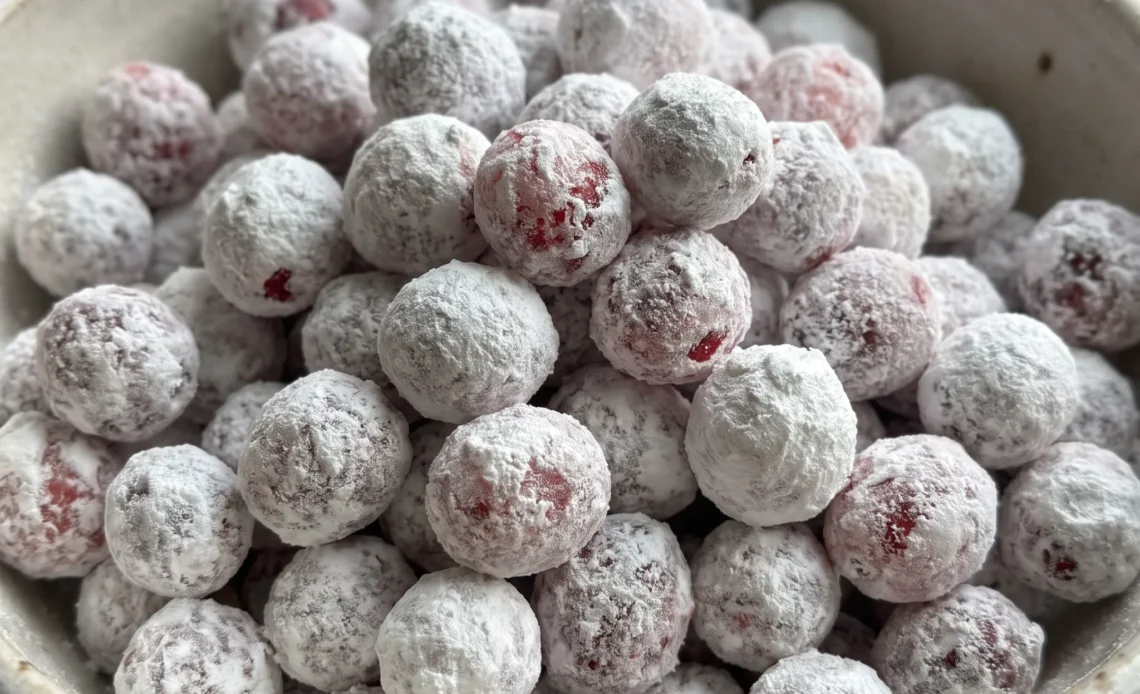
Most failures happen before the sugar ever touches a cranberry. The soak is the whole game: berries that go in tight and dry come out the same way, shed their coating in the oven, and leave you with bald, puckered fruit.
Get them plump enough to feel heavy and faintly tacky, and the rest mostly takes care of itself. From there it’s a short stay in a low oven to dry the surface, not cook the fruit, and the timing here is tighter than it looks.
Leave them too long and the centers go soft; pull them early and the shell stays damp and dissolves on your fingers. The candied cranberries you’re after crack under your teeth and flood your mouth with cold, sharp juice.
That contrast is the entire trick, and it lives or dies in two places: how much liquid the fruit absorbed, and how completely the surface dried.
When cranberries come out of the refrigerator, their surface is wet with syrup, and any powdered sugar that touches that moisture dissolves and clumps. The signal is visual and tactile: the sugar turns pasty and the berries stick together instead of separating into individually coated pieces. Once the sugar has dissolved into a paste, it cannot be salvaged by adding more sugar, because the excess will simply absorb the same surface moisture and clump again.
Why the Soak Does More Than Flavor
Cranberries straight from the bag are taut and bracing, with a skin that resists everything you try to put on them. Soaking gives them a chance to take on liquid and soften just enough that the tartness backs off. The fruit drinks in the sweet liquid, and you can feel the difference when you pick one up: it’s heavier, the surface slightly tacky.
That tackiness is what you want for the sugar to grab hold. If the berries were dry, powdered sugar would slide off or sit in dusty patches that never stick. The soak also mellows the sharpness enough that the final candied bite doesn’t make your mouth pucker.
Nothing about this step is cosmetic; it’s setting up the texture you’ll get later.
Coating Without Clumps
Powdered sugar will stick to anything wet, including itself. That’s why shaking the berries with sugar in a sealed bag works better than tossing them in a bowl. The bag keeps the sugar moving around each berry instead of letting it pile up in one spot.
You want a thin, even jacket on every piece, with no bare patches showing through. If a berry stays sticky after the first shake, it needs more sugar, but add it a spoonful at a time.
Too much at once and you get lumps that look like little snowballs, and those clumps won’t dry evenly. The goal is a uniform dusting that feels dry to the touch, not a thick crust.
That coating is what will firm up and protect the fruit.
Drying, Not Baking
The oven is not there to cook the cranberries. It’s there to pull moisture off the surface so the sugar coating sets into a thin shell. If you skip this step, the berries stay wet and the powdered sugar slowly dissolves into a sticky syrup.
A low oven does the job gently, without heating the fruit through or changing its fresh, tart flavor. You want the inside to stay juicy and the outside to lose that dampness.
Parchment paper keeps the berries from sticking to the pan and makes cleanup easy. A single layer matters because stacked berries trap steam underneath, and those spots stay soft. After a short stay in the oven, the coating should feel dry and slightly crisp when you touch one.
That’s your cue to pull them out.
The Bite That Keeps You Eating
What makes these berries hard to stop eating is the snap you get when you bite through the sugar shell, followed by a burst of tart juice inside. The soak plumps the fruit so the interior is softer and less aggressive, and the powdered sugar adds a thin, crunchy layer that contrasts with the soft center. Without that contrast, you’d just have sweet berries or tart berries, not both at once.
The drying step is what locks in that texture. It firms the coating so it doesn’t melt on your fingers, while the inside stays cool and wet. Each piece should taste bright first, then sweet, with a clean finish.
If the sugar coating is too thick, it masks the fruit; too thin, and the tartness dominates. When it’s right, you notice both in the same bite.

What to Watch in the Cranberries, the Soda, and the Sugar
Fresh cranberries: Bagged fresh berries, not frozen, give you the taut skin that softens just enough to hold a sugar jacket after soaking.
Sprite: Use a small 8 fl oz bottle or can of regular Sprite; the lemon-lime sweetness and carbonation do the work, so skip diet or flat soda.
Pineapple juice: A 6 fl oz can of unsweetened pineapple juice keeps the soak from turning candy-sweet before the sugar even hits the berries.
Powdered sugar: Two cups of standard powdered sugar, with no added cornstarch clumping, gives you the thin, dry jacket that sets in the oven.
Judging the Soak, the Coat, and the Dry
When the cranberries have taken on enough liquid
After the overnight soak, a cranberry should feel heavier and slightly tacky, not slick or waterlogged. Pick one up: if it drips, it’s too wet and the sugar will clump.
If it feels tight and dry, it hasn’t absorbed enough and the sugar won’t cling. You want a berry that’s plump but not leaking. If they’re too wet, blot gently with paper towels before coating.
Reading the sugar coating on each berry
The sugar should form a thin, even jacket that feels dry to the touch. If you see bare patches or the berry still feels sticky, add more powdered sugar a spoonful at a time and shake again.
Clumps mean too much sugar at once, which won’t dry evenly. A proper coat looks like a dusting of snow, not a thick crust. Stop shaking when each berry is uniformly covered.
Knowing when the coating has set in the oven
After 5 to 7 minutes at 200°F, the sugar should feel dry and slightly crisp when you touch one. If it’s still tacky, give them another minute, but don’t exceed 7 minutes or the berries will start to soften and lose their fresh bite.
The inside should stay cool and juicy. Pull them when the surface is no longer damp; they’ll firm up more as they cool.

Candied Cranberries Coated in Powdered Sugar
Ingredients
Method
- In a large bowl, combine the cranberries, Sprite, and pineapple juice. Cover the bowl, shake gently to blend, and refrigerate overnight so the flavors can meld.
- Strain the cranberries, keeping the juice for a cocktail or mocktail. Put the cranberries into a large zip-top bag, add powdered sugar, and shake gently until every cranberry is completely coated.
- Heat the oven to 200°F (95°C). Prepare a baking sheet with parchment paper and arrange the coated cranberries in a single layer on it.
- Bake the cranberries for 5–7 minutes to dry them. Let them cool entirely, then keep them in an airtight container in the fridge or a cool, dark pantry for up to one week.
Storage and Serving: When the Sugar Shell Is at Its Best
Eat these within the first two to three days, when the powdered sugar shell is still crisp and snaps against the soft, soaked interior. The fridge is the better home: an airtight container there holds them for up to a week, while a cool, dark pantry gives you roughly the same window but pushes the coating toward tacky faster, since any humidity in the air dissolves the sugar.
Day by day, the coating pulls moisture from the fruit inside, so by day four or five the shell softens and the outside turns faintly sticky. That shift isn’t spoilage, just a texture change. They’re still edible through day seven, but serve them in a bowl rather than by the handful, because the softened sugar clings to fingers.
Don’t freeze them. Ice crystals shatter the sugar shell and break down the fruit, leaving you with wet, collapsing berries.
There’s no finishing touch here: the sugar goes on during coating, then the berries chill in the fridge, and they’re ready to serve cold straight from that container.
What You Can Trade Out, and the One Thing You Can’t
Sprite: Any clear, sweet, carbonated lemon-lime or citrus soda, or ginger ale, measured the same 8 fl oz the recipe calls for. The bubbles and sugar do the same job, so the berries plump and turn tacky the way they should.
Ginger ale adds a faint spice that lingers under the tartness; lemon-lime stays neutral. Skip diet versions. Aspartame and sucralose don’t leave the same sticky surface, and the sugar jacket ends up patchy and pale instead of a clean dusting.
Pineapple juice: The same 6 fl oz of white grape juice, apple juice, or a light simple syrup cut with water. Pineapple brings a tart edge that cuts the soda’s sweetness, so the soak doesn’t read as straight candy before the powdered sugar even lands.
White grape and apple are sweeter and rounder, and the finished berry tastes flatter, more one-note. Simple syrup gets you plump berries but no fruit character at all. Orange juice works if you want it brighter, though the pulp clouds the soak and the berries pick up a faint bitterness from the pith.
Powdered sugar: Blitz granulated sugar in a blender or food processor until it’s a fine, drifting powder, then measure out the same 2 cups. Add a teaspoon of cornstarch per cup if the blend still feels gritty. Fresh-ground sugar coats and sets much like the bagged kind, and you can make as much as you need.
The catch is consistency: stop too soon and you’re shaking cranberries in sand, which leaves a coarse, uneven jacket that never fully dries. Sift it once before it goes in the bag and the result is close to store-bought.
Fresh cranberries: None. Frozen berries thaw into soft, leaking fruit, and dried cranberries are already sugary and leathery.
This is the one ingredient with no working replacement. The whole dish depends on a taut skin that softens just enough to take on liquid and hold a sugar shell, and freezing destroys that structure before you start. If fresh berries aren’t available, wait.
There’s no version of this that works with anything else.
Tips
- Sort the berries by weight before you soak them. A cranberry that feels light for its size has a hollow pocket of air inside, and that gap holds no liquid, so it stays dry and hard while its neighbors plump up. Those are the ones that shed their sugar in the oven.

Frequently Asked Questions
Can I make these candied cranberries ahead of time?
Yes, but plan for the whole timeline. The soak alone needs 480 minutes in the fridge, so start the night before. Once they’re dried and cooled, they keep in an airtight container in the fridge for up to a week.
For the crispest sugar shell, serve within two to three days.
Why are my candied cranberries still sticky after baking?
Most likely the berries were too wet going into the sugar, so the coating never had a dry surface to set. After the soak, if they drip when you pick one up, blot them gently with paper towels before coating. A second cause is underbaking: if the sugar still feels tacky after the full 5 to 7 minutes at 200°F, give them another minute, but pull them once the surface is dry to the touch.
How do I store candied cranberries to keep them from getting soggy?
An airtight container in the fridge is your best bet. The cold slows the moisture from the fruit migrating outward, so the shell stays crisp longer.
A cool, dark pantry works too, but any humidity in the air will soften the sugar faster. Either way, don’t freeze them; ice crystals shatter the shell and break down the fruit.
What’s the difference between these candied cranberries and traditional sugared cranberries?
Traditional sugared cranberries are usually just rolled in sugar after a simple syrup dip, no overnight soak and no oven step. Here, the berries sit in Sprite and pineapple juice for 480 minutes, which plumps them and adds a faint citrus-pineapple tang under the tartness. Then a short stay in a 200°F oven dries the sugar into a thin shell that snaps when you bite through.
The result is a juicier inside and a crisper outside than the quick version.
