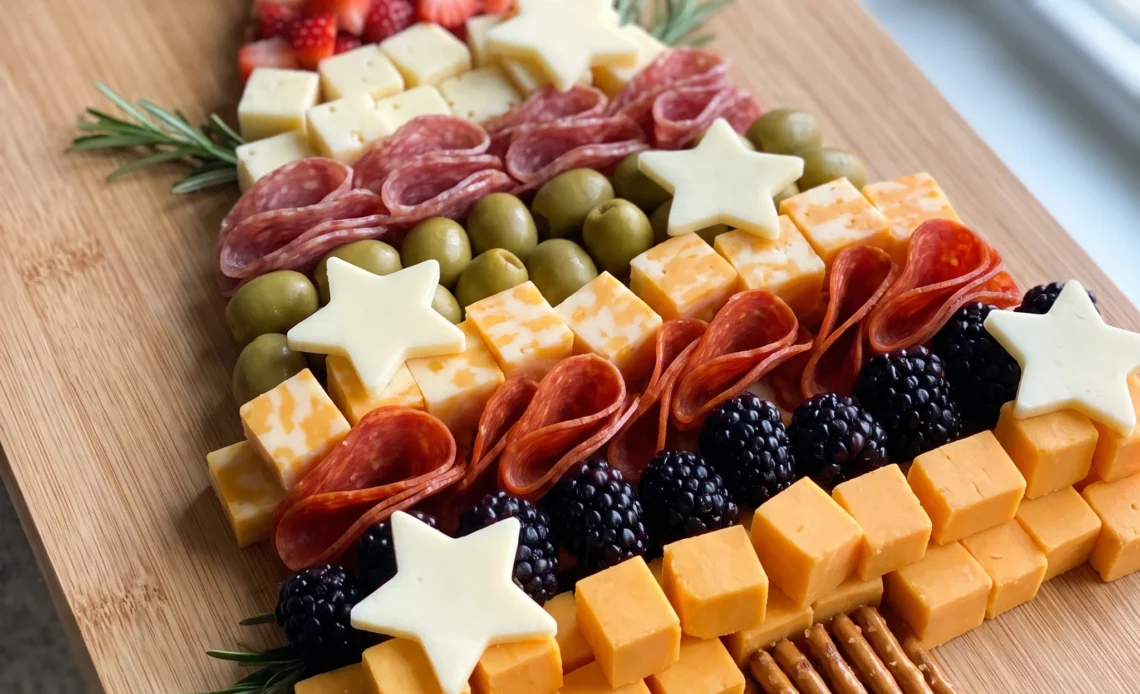
Row height is where a christmas tree charcuterie board goes wrong, and it goes wrong quietly. You stack a row that’s too tall for the one beneath it and everything above starts sliding a few minutes after the board hits the table, once people are already reaching in.
Keep each row shorter than the last and the taper does the structural work for you. A board this size takes half an hour to assemble and feeds a crowd, which is the real draw: it looks like you spent an afternoon on it.
It doesn’t hold forever, though. Berries weep, pretzels soften, and the whole thing eats best in its first couple of hours, so build it close to when you plan to serve.
Building a Tree That Holds Its Shape
A charcuterie board shaped like a Christmas tree only reads if the silhouette stays crisp and the pieces don’t slide. That starts with the footprint.
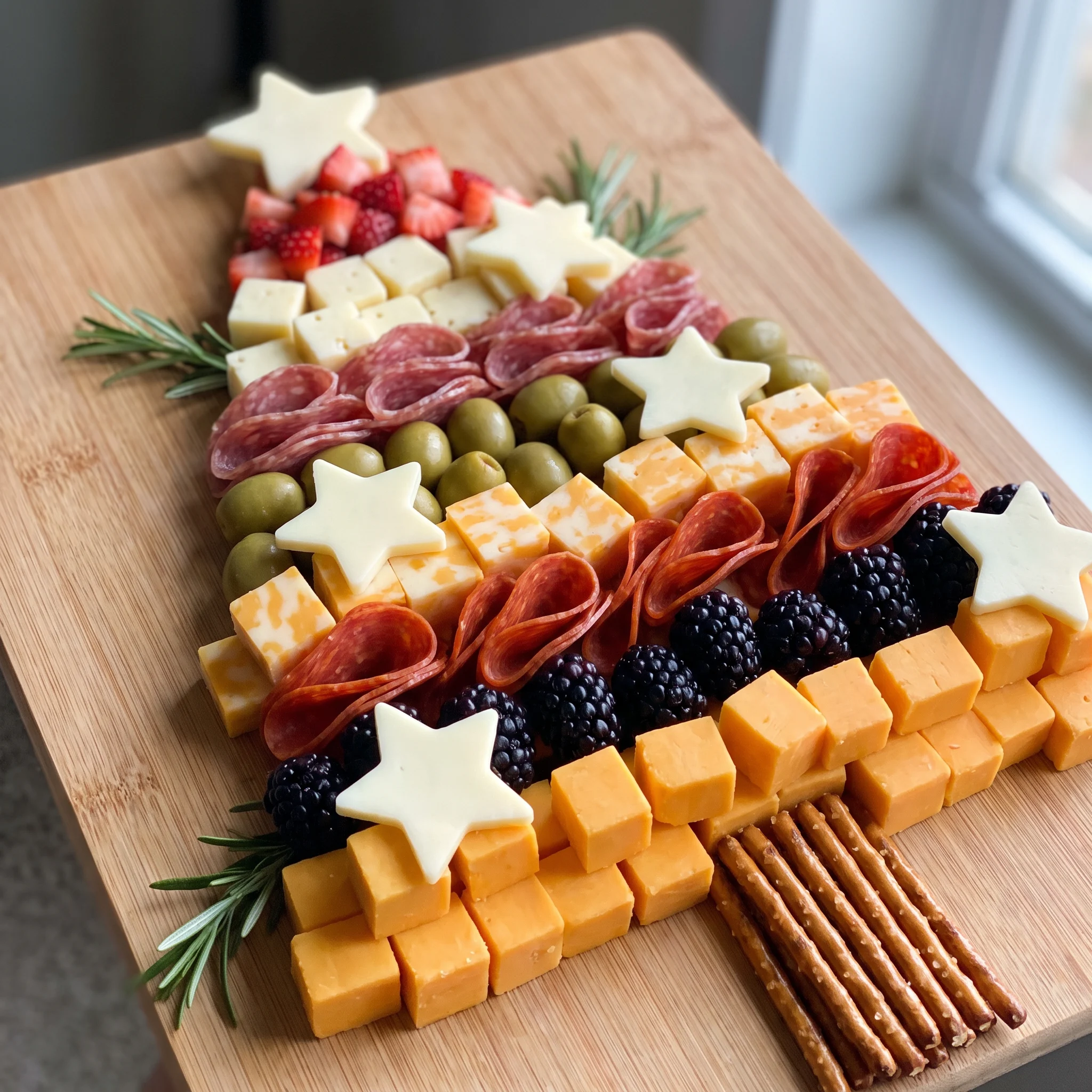
A wide base row, maybe 18 inches across, gives the rest of the tree something to sit on. Each row above it gets a little shorter, so the taper looks intentional and the weight stays low. The pretzel stick trunk at the bottom isn’t just for looks; it marks the center line and gives you a fixed reference so the tree doesn’t lean.
When you distribute cheese cubes and folded meats, keep the density even. Gaps in one spot make the tree look lopsided and cause neighboring pieces to shift.
You’re after a shape that holds from the first olive to the last provolone star. The board should feel solid when you set it down, not like a pile waiting to slump.
Color and Contrast on the Board
Green olives and rosemary sprigs do the heavy lifting for foliage; their deep, savory green reads as evergreen even from across the room. Provolone stars and diced strawberries bring the red and white accents that say Christmas without a single decoration.
But there’s a practical side to the palette. Blackberries and strawberries offer a juicy sweetness that cuts through salty cheese and cured meat. Without them, each bite leans heavy.
The cheese mix matters too: sharp cheddar brings a tang, Colby Jack is milder and creamier, Havarti is soft and buttery, and provolone, once cut into stars, adds a mild, slightly nutty note. That variety keeps snacking interesting past the first few picks.
You want each handful to have something salty, something sweet, and something fresh. The board should look festive and eat balanced, not just one note after another.
How Folding and Stacking Create Dimension
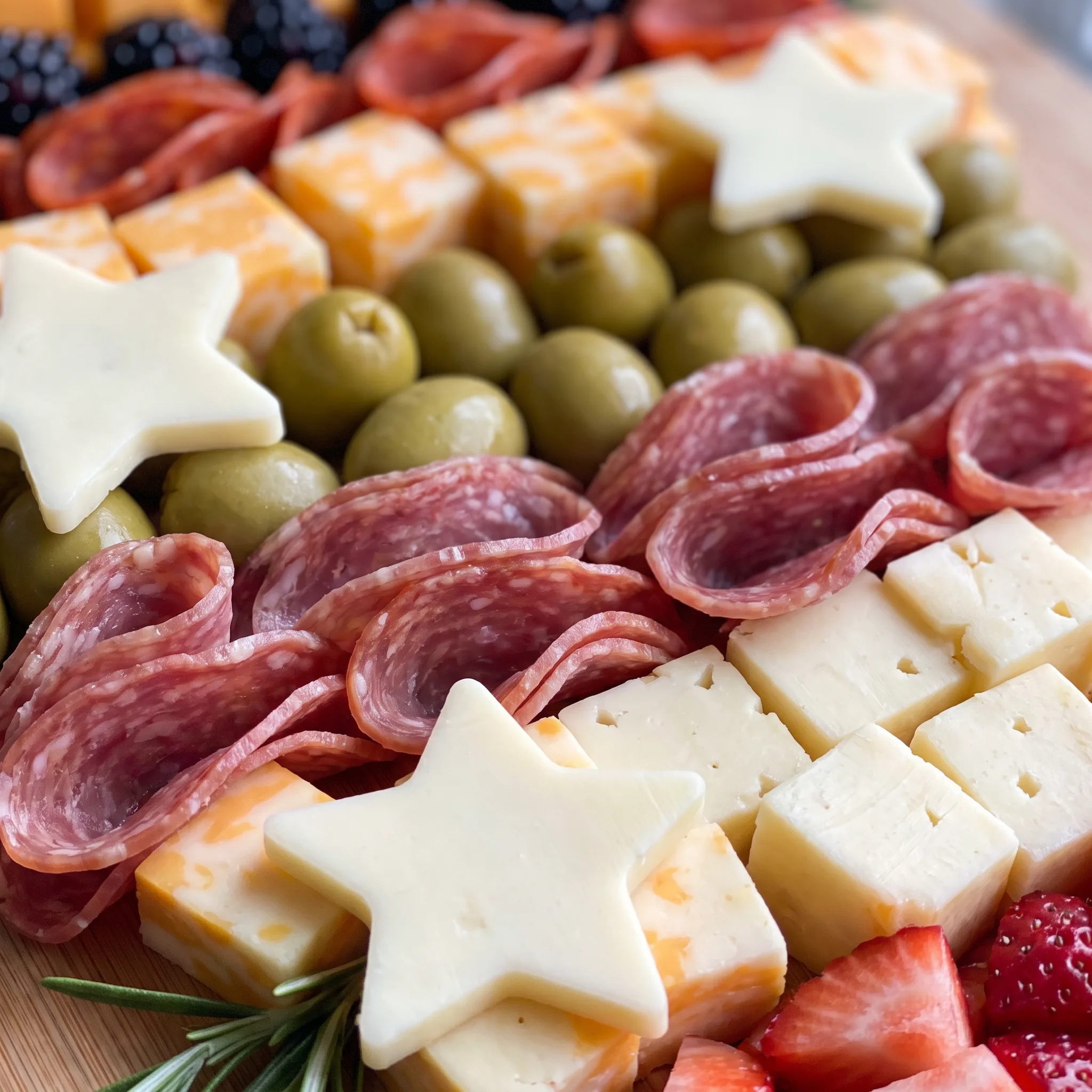
Flat slices of salami and pepperoni would lie there like paper. Fold each one in half, then in half again, and you get a ruffled quarter that stands up on its edge, catching light and creating shadows. That’s what gives the tree its branch-like texture.
Cubed cheeses work the same way: a cube has height and corners, so it stacks into a three-dimensional form, while a slice would just drape. When you place those folded meats and cheese cubes, vary the angles slightly. Straight rows look like a grid; a little tilt makes the tree feel organic.
The provolone stars, cut with a small cookie cutter, become ornaments. One goes at the very top as the topper, the rest dot the tree. This isn’t just decoration; the height and irregular shapes make the board look abundant, not flat.
You want guests to see a tree, not a pile.
Serving Temperature and Access
A board like this can sit out for a couple of hours, but if you’re not eating right away, refrigerate it. Cheese and cured meats taste best when they’re not ice-cold, so pull it out 15 to 20 minutes before serving.
That short rest brings the flavors forward without letting anything get warm and sweaty. The arrangement itself is built for grazing: leave small gaps between clusters so guests can pick a cube or a folded slice without knocking over the tree.
A large serving board, at least 18 by 24 inches, gives you room for the tree plus the rosemary sprigs around the edges. Crowding leads to collapses. When the board looks full but not packed, people can reach in from any side.
The tree should stay intact until the last blackberry is taken.
Pick the Right Form for a Tree That Reads
Sharp cheddar, Colby Jack, and Havarti: Buy blocks and cut them into cubes yourself, since pre-shredded or sliced cheese won’t stack into rows with any height.
Provolone slices: Get slices thick enough to hold a star shape when cut, or the points tear and the ornaments look ragged.
Peppered salami and large pepperoni: Choose large, wide slices so each one folds into a ruffled quarter with enough surface to stand up.
Green olives: Drain them well and pat dry, because wet olives leave slick spots that let neighboring cubes slide out of line.
Blackberries and strawberries: Pick firm berries and dice the strawberries just before building, since soft ones bleed and collapse under the weight above.
When building a charcuterie board in a tree shape, the structural integrity depends on a wide, stable base and gradually shorter rows to create a tapered silhouette. If the base is too narrow or ingredients are piled unevenly, the weight shifts and the tree can collapse or become lopsided. Also, using cubed cheeses and folded meats creates irregular shapes that may not interlock, leading to gaps and instability.
Judging the Tree as You Build It
When the base row is wide enough
The bottom row sets the whole tree. If it’s too narrow, say under 12 inches, the taper runs out too fast and the tree looks like a shrub. You want the base to span most of the board’s width, leaving just enough room for rosemary around the edges.
Check by eye: the base should be about twice the width of the row three levels up. If it’s not, add more cheddar cubes to widen it now.
Once the upper rows go on, fixing the base means dismantling the whole tree.
When to stop tapering and start the trunk
The pretzel sticks go at the bottom, but they’re also your guide for the tree’s vertical center. As you stack rows, keep each one centered over the row below.
If the top starts drifting left or right, the tree will lean and eventually topple. Check by looking straight down: the trunk should line up with the middle of the base and the middle of the top row. If it’s off, nudge the upper rows back into line before the tree gets too tall.
How full is too full
A packed board looks abundant, but if pieces are jammed together with no gaps, guests can’t pick one without knocking others loose. Leave small spaces between clusters, maybe a half-inch, so fingers and toothpicks can get in. If the tree looks solid with no breathing room, remove a few cubes or berries and redistribute.
The tree should feel generous, not cramped. Cramming also hides the shape, and the silhouette is what makes it a tree.
The provolone stars: topper or ornament
You cut four stars from the provolone. One goes at the very top as the topper, the rest dot the tree.
But if the top of the tree is too narrow, the topper star will look oversized and awkward. Judge by eye: the star should be about the same width as the top row of olives or cheese. If it’s wider, trim the star or add a few more pieces to the top row to broaden it.
The topper should sit flat, not balance on a point.
Christmas Tree Charcuterie Board with Cheese and Charcuterie
Ingredients
Method
- Take a small star-shaped cookie cutter and cut stars from the provolone slices; set them aside.
- Fold each slice of salami and pepperoni in half, then fold in half again to create decorative layers.
- Position the pretzel sticks at the bottom of a large serving board to form the tree trunk.
- Beginning at the bottom of the board, arrange the cubed cheddar cheese in a wide row to start the Christmas tree shape.
- Keep building the tree by layering the blackberries, folded pepperoni, and cubed Colby Jack cheese, making each row slightly shorter than the one below it.
- Complete the top half of the tree with rows of green olives, folded salami, cubed Havarti cheese, and diced strawberries, continuing to taper the shape as you reach the top.
- Adorn the tree with the provolone stars, placing one at the top as the tree topper.
- Arrange the rosemary sprigs around the board to resemble tree branches or festive greenery.
- Serve immediately or refrigerate until ready to serve.
Storage and the Serving Window
This board is at its best within two hours of assembly. Cut strawberries and blackberries release juice as they sit, and that moisture beads on the cheese cubes and slicks the olives. Pretzel sticks are the first to go: within a few hours they pull moisture from the air and the berries nearby, losing their snap and turning leathery.
Eat it fresh for the crispest texture.
Leftovers hold in the fridge, covered, for a day. Past that, the berries break down and the cured meat edges dry. Separate wet fruit from cheese and meat before storing; a lidded container traps the weeping juice against everything else.
Refrigeration dulls the cheese and meat, so let a stored portion sit out 15 to 20 minutes before eating.
Skip freezing the assembled board. Cheese turns crumbly and grainy, berries collapse, and pretzels go stale. The provolone stars go on at the end, right before serving, never earlier; they dry and curl within an hour.
Tips
- Blot the blackberries on a towel after rinsing, not just the strawberries. Each berry’s dimpled surface traps water that beads off onto the cubes below, and one wet blackberry in a row can loosen several pieces at once.
- Drain the olives in a colander and let them sit a few minutes, then spread them on a paper towel before they go on the board. Olives packed in brine carry liquid in their hollow centers, so a quick shake is not enough and that brine runs down the tree after the board is set out.
When You Swap the Cheese, the Meat, or the Trunk
Sharp cheddar, Colby Jack, and Havarti: Any firm melting cheese that cuts into clean cubes: Gruyère, Gouda, Jarlsberg, or a young Manchego. You keep the height and the stack, but the flavor shifts. Cheddar’s tang goes missing if you drop it entirely, so if you replace only one, start with the Havarti.
The rows will still hold because these cheeses are firm enough to cube. If you use a softer cheese, the cubes slump and the tree loses its shape.
Peppered salami and large pepperoni: Other cured meats that fold without cracking: soppressata, capicola, prosciutto, or a dry chorizo. The fold and ruffle still work, but the fat and spice change.
Prosciutto is thinner, so it folds smaller and may not stand as tall; you might need two slices per fold. Chorizo brings more heat and a coarser texture. Keep the slices wide enough to quarter.
Pretzel sticks (for the trunk): Sturdy breadsticks, a celery stalk cut to length, or a few thick carrot sticks. The trunk still marks the center line and gives you a reference for stacking.
Breadsticks are thicker and may need to be broken to size. Celery adds a fresh snap but can weep moisture, so pat it dry before laying it down.
The tree will still read as a tree as long as the trunk is straight and centered.
Provolone slices (for the stars): Any sliceable cheese that holds a cut shape: mild Swiss, low-moisture mozzarella, or white American. The stars need to keep their points.
Swiss is a bit softer and may tear at the tips, so chill it well before cutting. Mozzarella is firmer and cuts cleanly, but it lacks provolone’s slight nuttiness.
If you go dairy-free, use a firm plant-based cheese slice; it often cracks when bent, so press the cookie cutter straight down without twisting.
Frequently Asked Questions
Can I make this Christmas tree charcuterie board ahead of time?
Build it no earlier than the day you serve, and know that the two-hour window after assembly is where it eats best. The pretzels are the tell: they pull moisture from the air and from the berries sitting near them, going leathery within a few hours of the tree going up. If you want a head start, cube the cheddar, Colby Jack, and Havarti and fold the salami and pepperoni the night before, then keep those components covered in the fridge and do the actual stacking the day of.
The provolone stars go on last, right before the board hits the table.
How do I keep the tree shape from falling apart?
The taper is the structure, so if rows start slumping, the most likely cause is a row that isn’t shorter than the one beneath it. Look down the sides: each row should step in from the row below, and if one juts out past its neighbor, pull pieces off until it sits inside the line.
Slick spots are the second culprit, so pat the olives and berries dry before they go down; a wet olive under a cheese cube lets it slide out of place. Cubes rather than slices do the real work here, because corners catch on each other and lock the rows together.
What can I use instead of pretzel sticks for the trunk?
Sturdy breadsticks, a celery stalk cut to length, or a few thick carrot sticks all work in the same spot. Whatever you pick, it’s marking the center line of the tree, so the trunk needs to be straight and centered under the middle of the base row. Breadsticks are thicker than pretzels and may need breaking down to size.
If you use celery, pat it dry first, since it weeps moisture onto the board and slicks the pieces sitting near it.
How many people does this board serve?
Figure on 12 servings, at 340 calories each. That’s roughly an ounce of cheese per person across the cheddar, Colby Jack, and Havarti, plus the cured meat and the fruit, which lands as a solid appetizer portion rather than a full meal. For a crowd that’s grazing all evening alongside other food, it stretches further; for a table where this is the main nibble, count on it feeding exactly the number on the card.
Can I use different cheeses or meats?
Yes, and the shape survives the swap as long as you stay with firm cheeses that cut into clean cubes. Gruyère, Gouda, Jarlsberg, or a young Manchego all stack the same way the cheddar and Colby Jack do; go softer and the cubes slump and the rows lose their height.
On the meat side, soppressata, capicola, prosciutto, or dry chorizo all fold into that ruffled quarter, though prosciutto is thinner and may need two slices per fold to stand as tall. If you only change one cheese, start with the Havarti, since dropping the cheddar takes the tang out of every bite.
