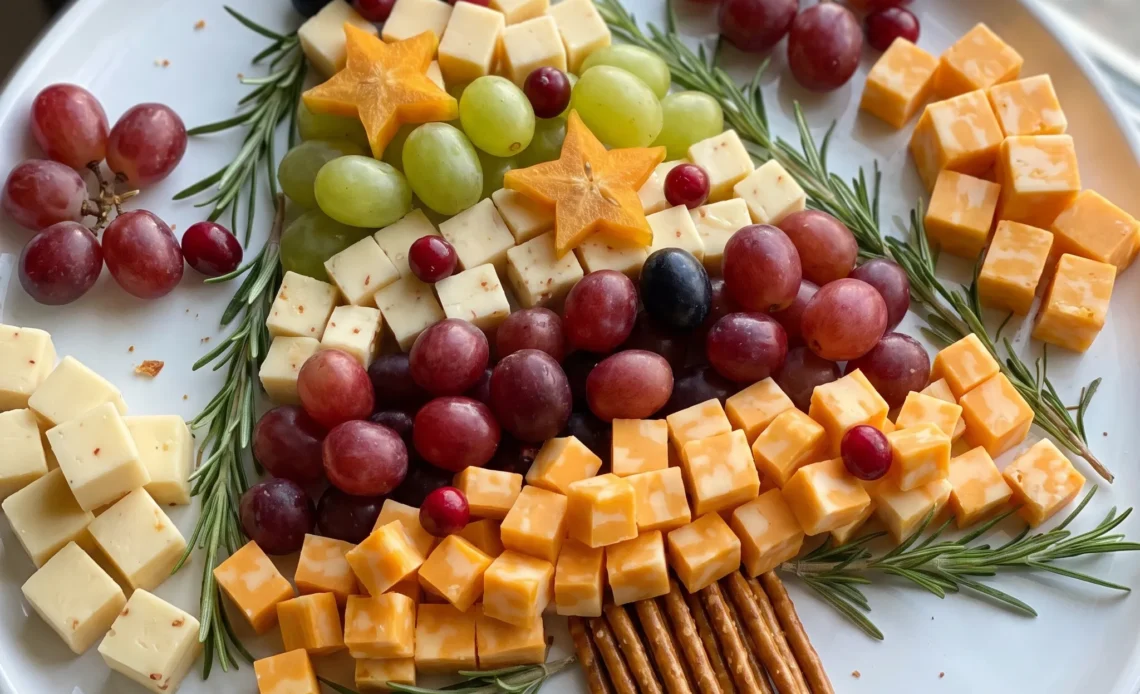
A cheese board arranged like a Christmas tree isn’t a gimmick if you treat the shape as the whole job. You’re building a picture first, a snack second, and the rosemary outline that reads as branches from across the room is the part cooks underestimate.
Rosemary sprigs aren’t a decoration you scatter at the end; they’re the armature the rest leans against. Get that frame wrong and no amount of red grapes rescues it.
The rows go in a specific order for a reason, and the taper tightens as you climb, which is where most christmas tree fruit and cheese platter attempts start to slump. It’s fussy work with real margin for error.
The reward is a platter people photograph before they eat.
Why do rosemary sprigs form the tree outline?
Rosemary sprigs set the tree’s outline, so you start at the top and widen the branches as you move down. Those sprigs aren’t just a garnish; they give you a green, pine-like border that defines the shape even before any fruit or cheese goes on.
You’ll likely need to tweak and reposition them once the edible pieces start filling in, because the outline is a flexible guide, not a rigid frame. The sprigs create the outer edges, and they’ll read as a Christmas tree from across the room as you build.
Keep the sprigs close enough that the tree looks full but not so tight that they crowd the fruit. If a sprig looks out of place, just move it. The whole platter is visual, so let your eye decide if the outline works.
What’s the right way to build the rows from bottom to top?
Start at the bottom of the tree and work upward, making each row narrower than the one before. That order keeps the tree tapering correctly and stops the top from getting overcrowded.
A suggested sequence: a row of cheese, then red grapes, another cheese row, green grapes, a final cheese row, then black grapes. After those rows, position kiwi slices in a triangular arrangement to form the tree’s top. This bottom-up approach creates a visual gradient and helps the structure stay stable as you add more pieces.
The rows don’t have to be straight; a little irregularity looks natural. Once the kiwi is in place, the tree’s shape should be clear. Step back and check if the taper looks right, and adjust any row that seems too wide or too narrow.
How do star fruit and cranberries finish the tree?
‘ Scatter additional star fruit slices randomly over the tree for extra sparkle. Cranberries sprinkled intermittently add red accents that pop against the green and white. If space permits, mixed nuts can act as the ‘pot’ at the base, with almonds arranged in a square shape covering the celery stem’s base.
Those nuts give the tree a grounded look and add texture. The star fruit and cranberries aren’t just decoration; they break up the large blocks of cheese and grapes. You can adjust the amounts to suit your eye.
When the star is in place and the cranberries are dotted around, the platter should look festive and complete.
Does the celery trunk and nut pot really matter?
Set the celery stalk at the base to serve as the tree trunk, any length that appears suitable. That trunk anchors the tree visually, turning a flat arrangement into a recognizable scene. The placement is visual and based on what looks good to you, so don’t overthink it.
Nuts, especially almonds, can be arranged in a square shape at the bottom of the celery stem to act as the pot, covering its base. That pot gives the tree a place to ‘grow’ from and hides the cut end of the celery.
Without a trunk, the tree might look like it’s floating. With it, the whole platter reads as a complete picture. Once the trunk and pot are set, the tree stands ready for the final chill.
What to Buy and How to Prep for the Tree
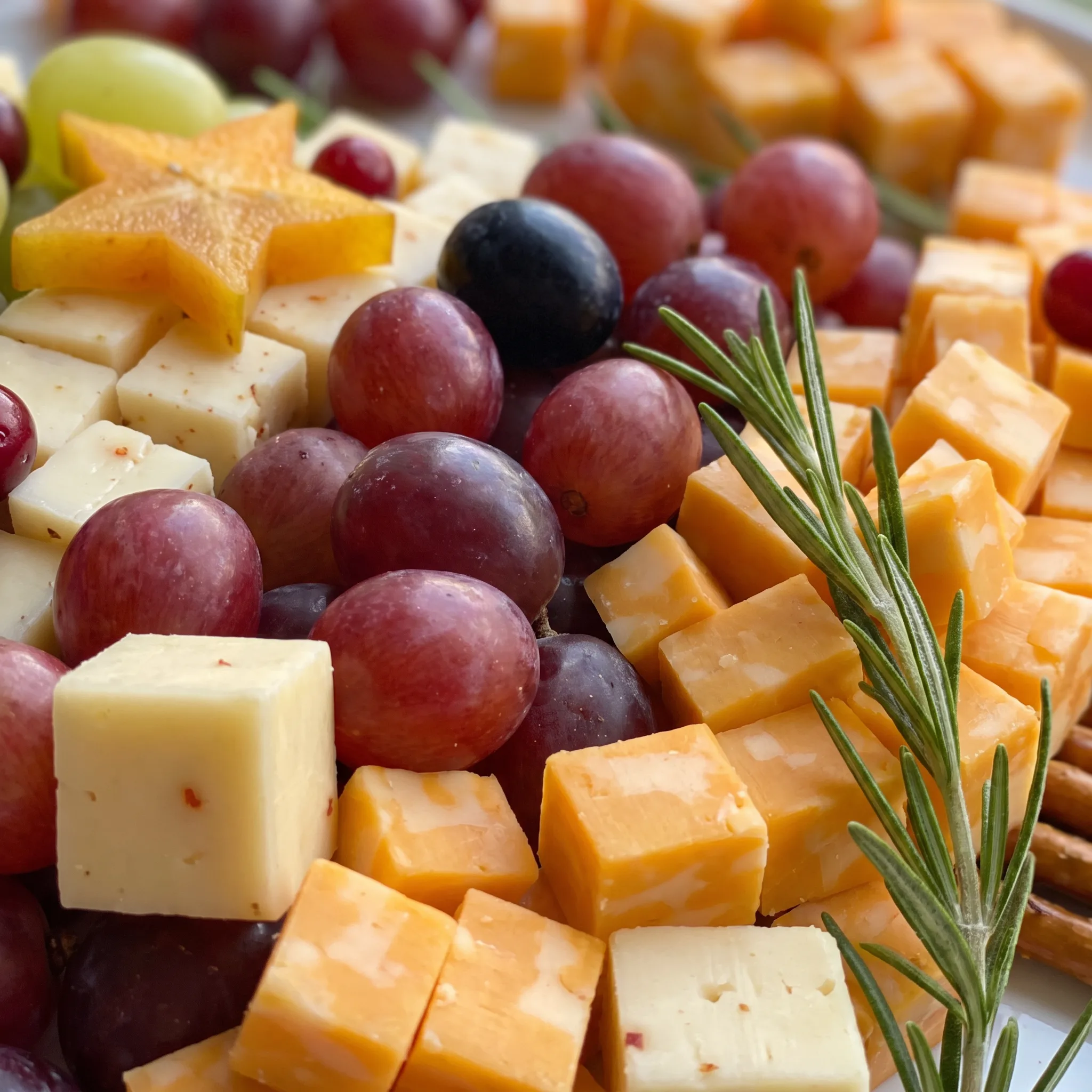
Rosemary sprigs: Buy sprigs with sturdy, flexible stems that hold their shape; dry, brittle ones snap and won’t frame the tree.
Seedless grapes: Red, green, and black grapes clipped into small clusters look fuller than loose ones and hold their place on the platter.
Sharp cheddar, Monterey Jack, and mild cheddar: Buy blocks and cut them yourself; pre-shredded or pre-cubed cheese has a dry, waxy surface that shows.
Star fruit: Choose firm, yellow fruit with crisp brown ridges; soft or browning star fruit slices collapse and lose their star shape.
Fresh cranberries: Pick berries that are firm, glossy, and bounce when dropped; soft or shriveled ones look dull against the green.
Judging the Tree as You Build It
When the rosemary outline starts to feel like a cage
The sprigs are a guide, not a boundary. If they’re so tight that grapes and cheese sit only in the center, the tree looks skimpy.
You want the edible pieces to nudge the rosemary outward in places, making the outline look organic. Reposition a sprig if a row feels cramped. If you ignore this, the shape stays rigid and small, and you end up with gaps between fruit and border.
Reading the taper before the top gets crowded
Each row should be visibly narrower than the one below. If you look at the last cheese row and can’t tell where the next grape row would fit without overlapping, you’ve gone too wide too soon.
The kiwi top needs a clear triangle of space. Miss that, and the tree looks like a blob.
Fix it by removing a few pieces from the widest rows and rebuilding upward.
The moment the cheese squares look too uniform
Sharp cheddar, Monterey Jack, and mild cheddar all cut to the same size can read as a single block if the colors are close. When you step back, the rows should still show distinct bands.
If two cheeses blend together, swap a few squares or offset them. The card says ¾-inch squares, but if your knife slips and you get a mix of sizes, that’s fine as long as the rows stay readable.
Where the nuts stop being a pot and become a pile
Almonds arranged in a square at the base of the celery should cover the cut end and sit flat. If they spill outward, they compete with the tree.
Push them back into a rough square. If the celery is long, the pot looks small; trim the stalk or add more nuts. The goal is a stable base that doesn’t distract from the taper above.
Checking the chill without wrecking the arrangement
After up to 4 hours in the fridge, the platter will be cold and the rosemary may droop. Before serving, look for any pieces that slid during chilling. Gently nudge them back into place with a fork or your fingers.
If condensation forms on the plastic wrap, pat it dry so it doesn’t drip onto the cheese. A quick reset takes seconds and keeps the tree looking intentional.
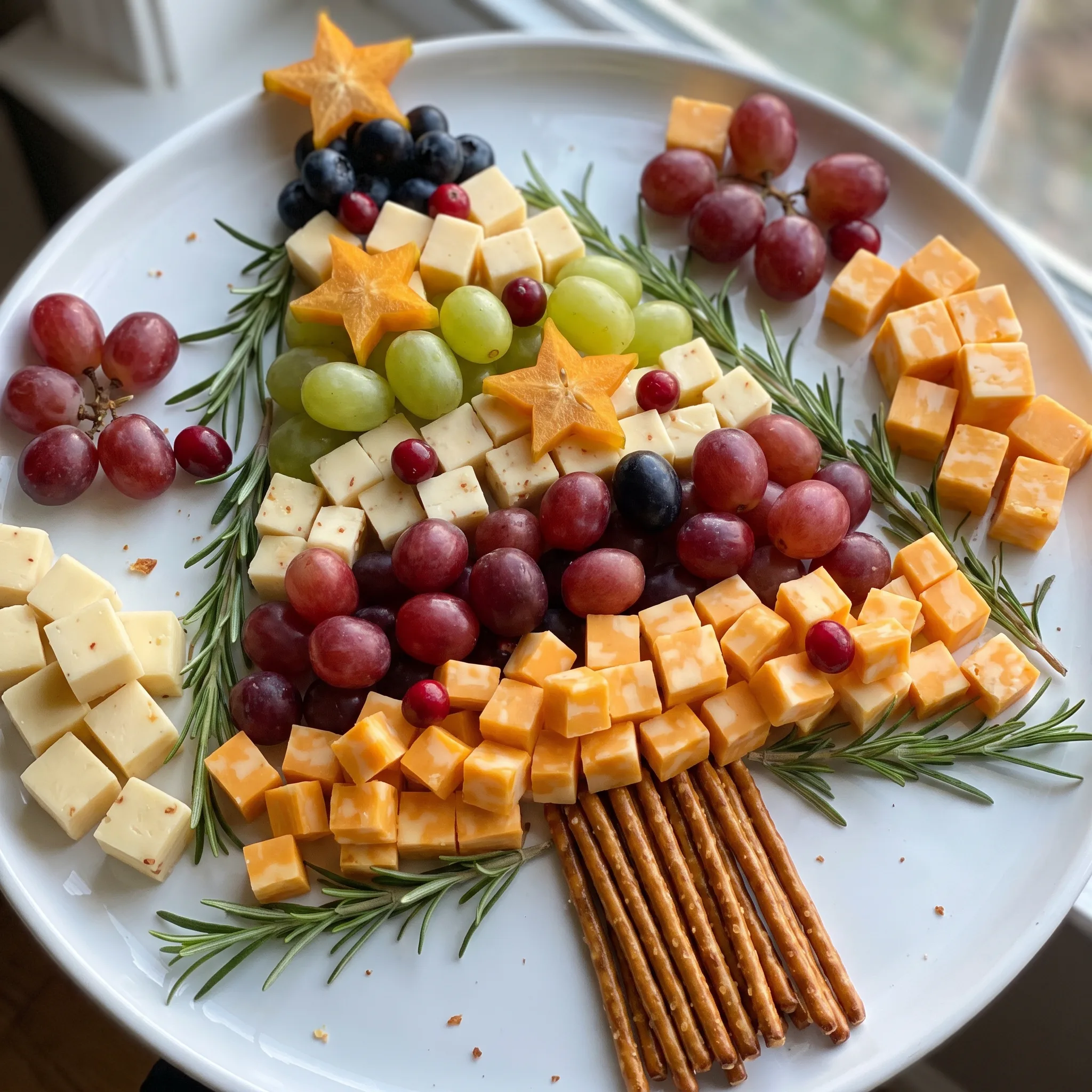
Christmas Tree Fruit and Cheese Platter
Ingredients
Method
- Create the tree’s outline with rosemary sprigs, beginning at the top and widening them as you move downward. You might need to tweak and reposition them once you begin adding the edible components.
- Set the celery stalk at the base to serve as the tree trunk, any length that appears suitable. This whole process is somewhat visual and based on what looks good to you.
- Commence at the bottom of your “tree”, with each row becoming narrower than the one before; I prefer to arrange a row of cheese, then red grapes, another cheese row, green grapes, a final cheese row, then black grapes. After that, position kiwi slices in a triangular arrangement to form the tree’s “top”.
- Put a single star fruit slice at the very peak for the star (see notes if star fruit is unavailable). Next, scatter additional star fruit slices over the “tree” at random. Sprinkle cranberries intermittently around the tree along with the mixed nuts. If space permits, the nuts can act as the “pot” from which the tree emerges. Almonds work best for this, arranged in a square shape at the bottom of the celery stem, covering its very base.
- Your creation is complete! You can put it together up to 4 hours before serving, cover with plastic wrap, and refrigerate until ready to serve.
Storage and Serving: The Four-Hour Window and Leftovers
Assemble the platter up to 4 hours before serving, cover with plastic wrap, and refrigerate. That window is the sweet spot: grapes stay firm and cold, cheese holds its cut edges, and rosemary keeps its shape without drying out.
Past 4 hours, the grapes start to weep and the cheese sweats, so aim to serve within that time. Leftovers keep in an airtight container in the fridge for up to 2 days.
The cheese will firm up and the grapes may soften, but they’re still fine for snacking. Don’t freeze the assembled platter; the grapes and cheese turn watery and grainy when thawed. If you have extra components, freeze the nuts and cranberries separately, but keep the fresh fruit and cheese in the fridge.
Serve the platter cold, straight from the fridge. If you added star fruit or nuts as a final touch, do that right before serving so they stay crisp and bright. For leftovers, let them sit at room temperature for 10 minutes before eating; the cheese softens and the fruit tastes less chilled.
Tips
- Anchor the grape clusters and cheese squares by pressing each piece lightly into the platter as you set it down, and build the bottom rows first so every higher row rests partly on the pieces below it. A cluster that only touches the platter edge, or a cheese square balanced on a single grape, will slide the moment the platter tilts for transport; seating each piece against its neighbors gives the tree enough friction to stay put when you carry it to the table.
What to Swap on a Christmas Tree Platter Without Losing the Shape
Star fruit: If star fruit is unavailable, cut a 1/4-inch thick slice from a cored fresh pineapple and trim it into a five-point star with a paring knife. You lose the crisp, slightly tart star fruit flavor, but the pineapple gives you the same bright yellow color and a firm bite that holds its shape at the peak. The star may look a little more rustic, but it reads as a star from across the room.
Don’t use canned pineapple rings; they’re too soft and wet, and they’ll slump on the cheese.
Sharp cheddar, Monterey Jack, and mild cheddar: For a dairy-free platter, replace all three cheeses with your favorite firm plant-based cheese blocks, cut to the same ¾-inch squares. The texture will be different: most dairy-free cheeses are softer and can crumble when you try to cut neat squares. They also don’t have the same sharp, tangy bite that contrasts with the grapes.
Expect a milder overall flavor, and the rows may not hold their shape as well. If you go this route, chill the blocks well before cutting and use a sharp knife to get the cleanest squares possible.
Rosemary sprigs: Don’t substitute rosemary. Its woody stems and piney aroma are what define the tree outline and give that Christmas-tree scent. If you can’t find fresh rosemary, you could use thyme sprigs, but they’re much smaller and you’d need a lot more to get the same visual effect.
Thyme will look like a fuzzy green border rather than distinct branches, and the outline won’t be as crisp. You might also try using thin strips of green bell pepper, but they won’t hold up as well and don’t have the same aromatic quality.
The rosemary is structural and aromatic, so it’s best to stick with it.
Celery stalk: A thick carrot or a pretzel rod can stand in for the celery trunk. Carrot gives you a sturdy, bright orange trunk that contrasts with the green tree, but it’s harder to trim to the right length and might not sit as flat. A pretzel rod adds a salty, crunchy element that some people enjoy, but it can get soggy if it sits in the fridge for the full 4 hours.
Neither has the same neutral, crisp texture as celery, so the trunk becomes more of a visual element than a snackable one. Stick with celery if you can; it’s the right shape and holds up to chilling.
When the platter is assembled more than a few hours ahead, the cut surfaces of the fruit and cheese release moisture that migrates into the rosemary and celery, causing them to wilt and lose their crisp structure. The grapes and cheese slices also slide under their own weight because the rosemary sprigs, which form the outline, are not anchored and can shift as the platter is moved. This turns the intended tree shape into a jumbled pile.
Frequently Asked Questions
Can I make this Christmas tree fruit and cheese platter ahead of time?
Assemble it up to 4 hours before serving, cover with plastic wrap, and refrigerate. That window is what the recipe allows, and it covers the chill time of 240 minutes. Building it earlier means cut cheese edges dry out and grapes start to look tired.
If you need to work further ahead, prep the components and hold them separately, then build the tree within that 4-hour window.
How far in advance can I assemble this platter without it getting soggy or wilted?
Four hours is the ceiling. Rosemary holds its needles that long, cheese keeps clean cut edges, and grapes stay firm rather than weeping onto the platter. Past that, moisture beads on the cheese and the rosemary starts to look limp.
If you’re serving later, keep the nuts and cranberries out until the last minute so they stay crisp.
What can I use if I can’t find star fruit?
Cut a fresh pineapple slice about 1/4 inch thick and trim it into a five-point star with a paring knife. You lose the tart snap of star fruit, but the yellow color reads the same from across the room and it holds its shape at the peak.
Skip canned rings; they’re too wet and soft and will slump against the cheese. The trimmed star looks a little more rustic, which is fine on a platter this casual.
How do I keep the grapes and cheese from sliding off the platter?
Clip grapes into small clusters rather than pulling them off the stems, and they’ll sit flatter and grip the platter instead of rolling. Cheese cut into 3/4-inch squares also stacks with less slip than thin slices.
Build each row so pieces nudge against each other and against the rosemary sprigs, which act as a low wall. If a cluster still wanders, tuck it against a cheese square rather than setting it in open space.
Is this platter supposed to be served cold or at room temperature?
Serve it cold, straight from the fridge. The grapes taste best firm and the cheese holds its cut edges when it’s chilled, which is why the recipe calls for that 240-minute chill. If you leave it out, the cheese sweats and the rows start to sag.
For leftovers, ten minutes on the counter softens the cheese just enough before eating.
