
Baked brie bites aren’t a mini version of the wheel you cut open at the table, though they borrow its shape. These are built one slice per cup, and the hard part is moisture: cranberry sauce, preserves, and maple syrup each behave differently against dough, and a spoonful that spreads to the edge instead of sitting mounded will soak the base before the pastry ever sets.
The payoff is four distinct toppings across a single tin, so a savory garlic butter bite sits beside the sweet ones and nobody gets the same mouthful twice. If you’ve watched a brie appetizer turn greasy on the platter, this is the fix worth learning.
In a mini muffin tin, the dough is thin and unsupported, so any free liquid from cranberry sauce, preserves, or melting brie sits directly against the raw pastry. As the dough bakes, that moisture keeps the starch from setting into a crisp crust, and the fat from the brie can pool and soak through the seams. The result is a collapsed, greasy cup instead of a flaky one.
Building each bite from the bottom up
Brie goes into the dough cups before anything else. A slice of the wheel sits flat against the pastry and, as it heats, softens into a barrier that keeps wet toppings from soaking through. Cranberry sauce, preserves, and maple syrup all go on next, but only a small spoonful each.
Spread them and you’ll push moisture into the dough, which bakes up limp instead of crisp. The four toppings divide evenly across the 24 cups: six cranberry, six maple bacon, six apricot walnut, six garlic butter herb.
Bacon, nuts, and pecan halves go on after the wet layer, so they stay crunchy rather than steaming under a blanket of sauce. When you pull the tin from the oven, each cup should hold its shape with a golden edge and a soft, molten center. That’s how you know the order worked.
When the dough choice changes everything
Crescent dough and puff pastry both work, but they bake into different bites. Crescent dough is softer and a little sweeter, with distinct flakes that pull apart. Puff pastry is laminated, so it puffs into crisp, buttery layers that shatter when you bite.
Either way, the dough has to form a solid cup. With crescent dough, press the seams closed before cutting, or the brie will leak out and burn on the tin.
Puff pastry usually comes on parchment, so unroll it straight onto that paper and cut there; no flour needed and no sticking. Cut equal squares so every cup bakes at the same rate. Smaller squares make thinner walls that crisp faster; larger ones give more dough to filling.
The goal is a cup that holds everything without turning tough.
Garlic butter that doesn’t burn
Melted butter mixed with crushed garlic goes onto the brie before baking. If you sprinkled raw garlic on top, it would scorch in the oven and turn acrid. Instead, the butter carries the garlic flavor gently into the cheese as it melts, and the fat coats the brie so it softens evenly.
Rosemary leaves torn from the stem release their oils without the bitterness that chopping can bring. That garlic butter herb cup is the only savory one in the batch, which makes it a useful counterpoint to the cranberry, maple bacon, and apricot walnut bites.
The butter also keeps the brie from drying out, so each bite stays creamy. When you taste one, the garlic should be mild and sweet, not sharp.
That’s the sign the butter did its job.
Why the mini muffin tin matters
A mini muffin tin gives you a high ratio of crust to filling. Each dough square gets pressed gently but firmly into a cup, creating a well that holds the brie and toppings without collapsing. If the dough tears or the edges are uneven, the cup bakes lopsided and the filling can spill.
A light coating of cooking spray ensures the pastry releases cleanly after baking. The small size means every bite has a balance of dough, brie, and topping. Too much dough and it’s bready; too little and the filling escapes.
When you press the dough, aim for an even thickness across the bottom and up the sides. The cups should look like tiny pastry shells, ready to hold their contents.
After baking, they’ll slide out easily, crisp and golden.
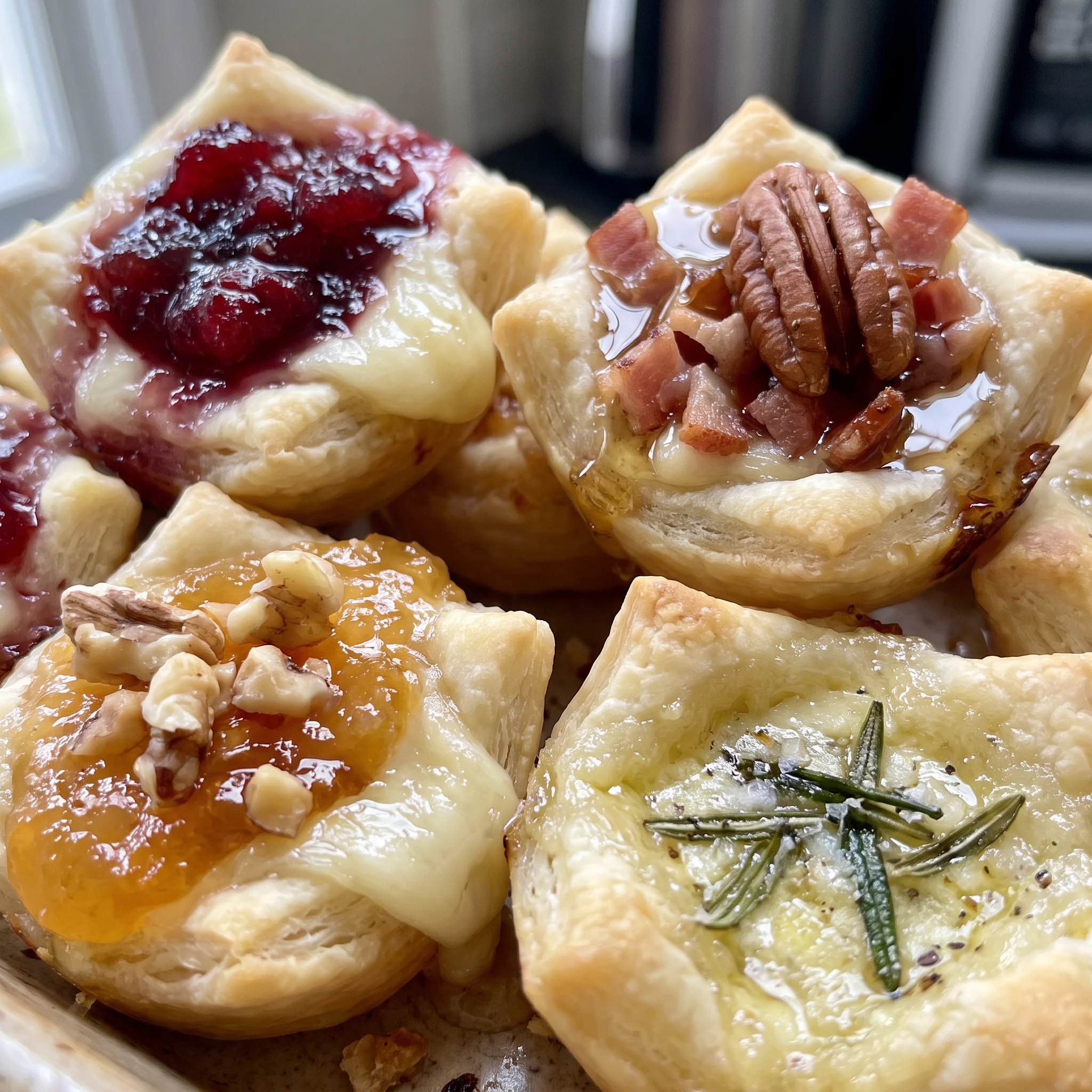
Four toppings, four different moisture problems
Whole berry cranberry sauce: The berries stay intact and don’t bleed as fast as jelly, but whole berry sauce is looser, so a level 6 tsp keeps the dough crisp.
Brie: A full 8 oz wheel gives you 24 even slices, and you want it cold from the fridge so the rind holds and the pieces don’t smear.
Pecan halves: Whole halves sit on top of the bacon and stay crisp, while chopped pieces sink into the maple syrup and go soft.
Crescent dough: The tube dough is sweeter and softer than puff pastry, and its seams need pressing closed or the brie leaks out and burns.
Rosemary: Torn leaves release their oils gently, where chopped rosemary turns bitter against the hot garlic butter.
Judging the bake when the brie is hidden
When the dough cups are ready for filling
After pressing each square into the mini muffin tin, look at the sides. They should hold their shape without slumping and feel dry, not tacky.
If the dough springs back or looks greasy, the cups are too warm from handling. Chill the tin for a few minutes before filling. If the edges tear, the brie will leak and burn.
Patch any tears with a small piece of dough.
How much topping is too much
A spoonful of cranberry sauce or preserves should sit mounded but not overflowing. If it spreads to the dough edge, it will bubble over and scorch.
The maple syrup drizzle should be just a thin thread. Bacon and nuts go on after the wet layer, so they stay crisp. If you see liquid pooling, remove some with a spoon before baking.
The moment the pastry turns golden
Set the timer for 10 minutes, then watch. The pastry should be golden brown at the edges and the brie soft when you press the center. If the tops are browning but the sides are pale, the dough is underbaked and will be limp.
If the brie leaks, it’s overbaked. Pull the tin when the edges are crisp and the cheese gives easily.
Releasing the bites without tearing
After baking, let the tin sit for 2 minutes. Then run a small offset spatula around each cup. If the dough sticks, it’s too hot; wait another minute.
If it tears, the cup wasn’t greased enough or the dough was too thin. Lift each bite straight up.
A gentle twist can crack the pastry. The bottom should be dry and golden, not wet.

Baked Brie Bites with Crescent Dough
Ingredients
Method
- Turn oven on to 375°F (190°C). Coat a mini muffin tin lightly with cooking spray.
- Get the dough ready: for crescent dough, unroll on a surface dusted with flour and press the seams closed. For puff pastry, unroll straight onto its parchment paper to avoid sticking. Slice the dough into 24 equal squares, then press each square gently into the mini muffin tin cups.
- Slice brie into 24 small pieces and put one in each dough cup.
- CRANBERRY: Add a spoonful of cranberry sauce to 6 cups. Sprinkle with salt and pepper.
- MAPLE BACON: In another 6 cups, add a spoonful of cooked diced bacon, 2 pecan halves, and a drizzle of maple syrup. Sprinkle with pepper.
- APRICOT WALNUT: In 6 cups, add a spoonful of preserves and crushed walnuts. Sprinkle with a pinch of salt.
- GARLIC BUTTER HERB: Combine butter and garlic. Top the remaining 6 cups with just over 1 teaspoonful of garlic butter mixture and 2–3 rosemary leaves. Sprinkle with salt and pepper.
- Bake until the pastry turns golden, about 10–15 minutes.
Swaps that keep the bite, and one that breaks it
Brie: Camembert or a double-cream cheese like Saint-André or Delice de Bourgogne. Camembert is the same size wheel and slices the same way, so you don’t change the count. It’s a touch saltier and runs faster in the oven, so pull the tin when the edges of the pastry are golden, even if the centers still look firm.
A double-cream cheese is softer at room temperature, so chill it well before slicing or the pieces smear and you lose the clean barrier that keeps the wet toppings off the dough. The flavor gets richer and less tangy, which matters most in the cranberry cups where the sauce needs something to push against.
Crescent dough: Puff pastry (2 sheets, semi-thawed) or a gluten-free all-purpose dough blend. Puff pastry gives you shatteringly crisp layers instead of the softer, sweeter pull of crescent dough.
Cut the same 24 squares, but don’t flour the work surface if your puff pastry comes on parchment; unroll it straight onto the paper and cut there. Gluten-free dough is the one swap that changes the structure: it tears more easily when you press it into the cups and browns faster, so check at 8 minutes and patch any tears with a scrap of dough before filling. Expect a slightly crumblier edge, not a flaky one.
Whole berry cranberry sauce: Another tart jam or jelly, like red currant, lingonberry, or a smooth cranberry jelly. The recipe uses 6 tsp total, so keep the same spoonful per cup no matter what you swap in.
A looser jam will bleed into the dough and make the bottom wet, so if yours is runny, drain off any liquid before spooning it in. A firm jelly sits still and won’t spread, which is actually easier, but it lacks the whole berries that give the cranberry cups their texture. Taste the jam first: if it’s very sweet, add a pinch more salt to that cup to balance it.
Maple syrup: Honey or dark corn syrup. Honey is thicker and sweeter, so use the same thin drizzle the recipe calls for and no more; it browns faster than maple, so watch those cups closely in the last few minutes. Dark corn syrup is less flavorful and mostly sweet, which flattens the maple bacon cup.
The bacon and pecan halves stay the same, and they’re what carry the bite anyway.
Tips
- Slice the cold brie wheel in half horizontally first, then cut each half into 12 wedges. You get 24 pieces of even thickness, and each one sits flat on the dough instead of tipping and letting the topping slide off.
- Press the dough squares into the cups with a small measuring spoon or the back of a 1/4 teaspoon rather than your fingertips. Your fingers leave dents and thin spots in the walls, and those thin spots are where the brie breaks through and burns onto the tin.
Storage and Serving: Texture Holds for an Hour
Serve these within 30 minutes of baking. Past that, the pastry loses its shatter and the brie firms toward the middle. Baked bites hold at room temperature for about 2 hours, but the nuts soften first, then the dough goes slack and greasy at the base.
Leftovers keep in the fridge, covered, up to 2 days. Cold brie turns waxy, so reheat on a sheet pan at 300°F for 6 to 8 minutes, just until the cheese gives when pressed.
Higher heat dries the brie and toughens the pastry. The garlic butter bite refreshes best this way; the cranberry and apricot ones stay wetter and can weep into the dough. Don’t freeze the assembled bites.
The brie separates and the pastry slumps. Freeze the sliced brie wheel alone, wrapped tight, up to 1 month, and build fresh from there.
Any drizzle or final topping goes on right before serving, not before storing, or it sinks and pools.

Frequently Asked Questions
Can I make these baked brie bites ahead of time?
Build them up to the point of baking, then stop. Pressed dough cups holding cold brie and their toppings can sit covered in the fridge, but understand what waiting costs you: the pastry drinks moisture from the sauce and preserves, so the base slackens and the baked edge never crisps the same way.
If you go this route, spoon the wet toppings in just before the tin goes into the oven and leave the nuts and pecan halves off until then, since they soften against a wet surface. The assembled bites don’t freeze; the brie separates and the pastry slumps.
Freeze the sliced wheel alone instead, wrapped tight up to a month, and build fresh from there.
Why did my baked brie bites leak or become soggy?
Leaks almost always trace to the dough cup, not the brie. A seam left open in crescent dough or a thin patch on the side gives the melted cheese a path out, and what escapes burns onto the tin while the cup empties.
Press the seams closed and patch any tear with a scrap of dough before filling. Soggy bottoms come from the other direction: a wet topping that spread to the dough edge instead of sitting mounded in the middle.
If you see liquid pooling in a cup, spoon some off before baking. Whole berry sauce is looser than jelly, so a level spoonful is the ceiling, not a starting point.
How are these different from traditional baked brie en croûte?
En croûte wraps one whole wheel in a single sheet of pastry and bakes it as a centerpiece you cut into at the table. These are built in a mini muffin tin, one slice of brie per cup, so every bite carries its own ratio of crust to cheese and you get four distinct toppings across the batch instead of one flavor throughout. The trade is that a big wheel stays molten longer and looks more dramatic when you open it; the small cups firm up faster and the pastry loses its shatter sooner.
Portioning also changes the topping math. Cranberry, maple bacon, apricot walnut, and garlic butter herb each land in six cups, so no single flavor dominates and a savory bite sits alongside the sweet ones.
