
This isn’t a dip you can throw together and serve. Whipped feta dip with roasted strawberries is a two-part assembly that rewards anyone who keeps the halves apart until the last minute, and punishes anyone who doesn’t. Roast the berries and their juices run sweet and tart; whip the feta and it goes cloud-soft and salty.
The trouble is timing. Combine them early and the juice bleeds into the cheese, thinning it and turning the whole bowl pink. The margin for error is real but narrow, and it lives in the chill and the assembly, not the ingredient list.
Get that right and the contrast of cool cream against jammy fruit is what empties the bowl at a party.
Concentrated Sweetness from the Oven
Fresh strawberries in a dip taste watery and dilute the feta. Roasting drives off moisture, so the berries’ natural sugars and acids intensify.
The balsamic vinegar and honey you toss with them before they go in add a tart-sweet backbone that keeps the fruit from turning cloying. As the berries collapse, they release a syrupy juice that pools on the baking sheet.
That liquid is not waste. Spoon it over the whipped feta along with the fruit, and it seeps into the dip’s surface, giving every swipe of bread a hit of sweet-tart brightness.
Without those juices, you’d have dry fruit sitting on top of the cheese. The roasting step changes strawberries from a garnish into the dip’s reason for being.
When you pull the tray from the oven, the berries should look shriveled and glossy, and the juices should coat the parchment. That’s what you want.
Texture Transformation
Feta straight from the block is crumbly and salty, which works on a salad but not as a dip. Whipping it with Greek yogurt and olive oil turns it into something smooth and spreadable.
The yogurt adds tang and thins the mixture without making it runny, since it’s thick and strained. Olive oil brings a fruity richness that rounds out the feta’s sharp edges and gives the dip a silky mouthfeel.
When you process these together, the feta breaks down completely, and the mixture becomes fluffy. You’ll see it lighten in color and hold soft peaks. That texture is what contrasts with the roasted strawberries: creamy against juicy, salty against sweet.
If you left out the yogurt, the feta would stay gritty. If you used milk instead, the dip would be too loose.
The balance here is what makes each bite feel complete. After a few minutes, stop and scrape; the goal is a uniform, cloud-like spread.
Temperature Contrast
Both components need time in the fridge before serving. The whipped feta firms up, so it holds its shape when you spoon it into a bowl. The roasted strawberries cool down, and their juices thicken slightly.
That temperature difference matters when you eat: the cold, creamy feta against the cool-but-not-cold fruit creates a refreshing contrast, especially if the bread is toasted warm. If the feta were warm, it would slump and separate. If the strawberries were hot, they’d melt the dip into a puddle.
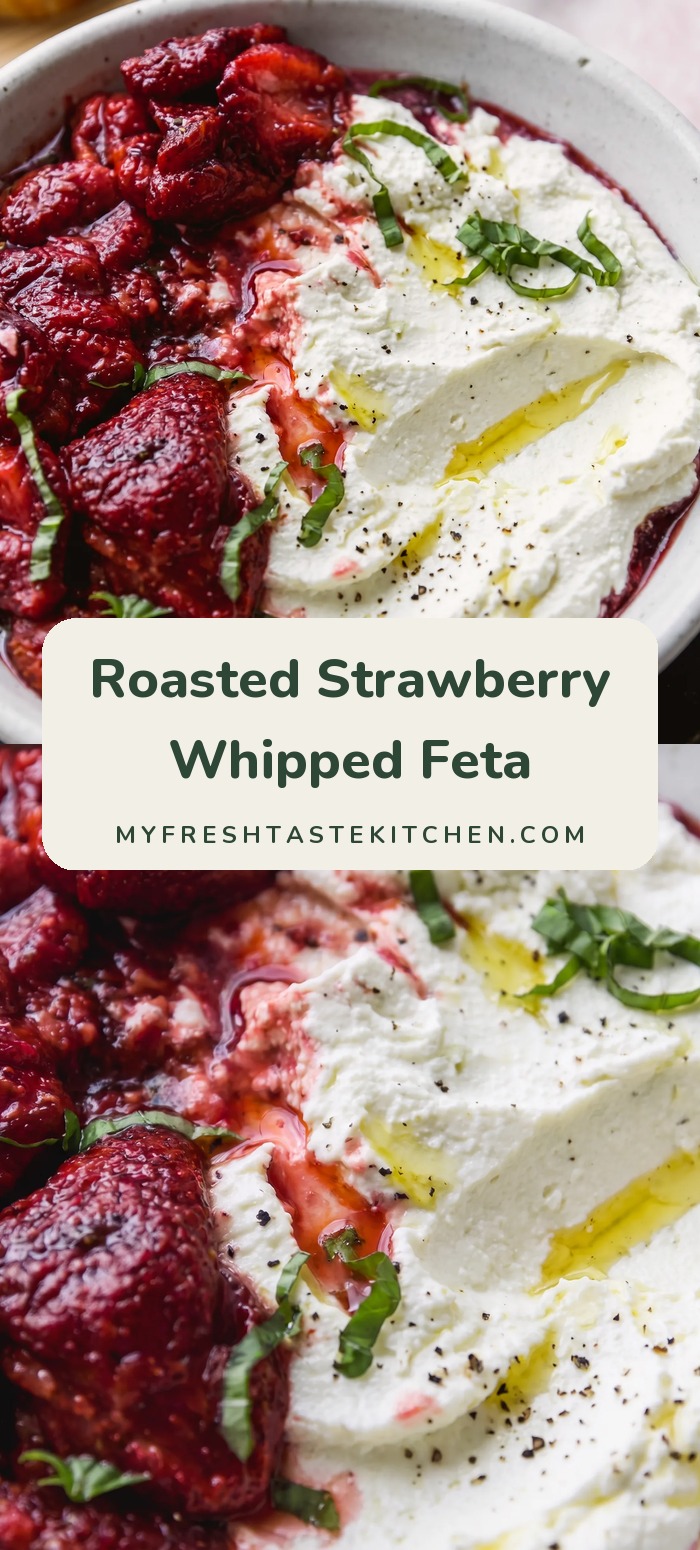
Keeping them separate until the last minute prevents the juices from bleeding too much and turning the whole thing pink. You want distinct layers: white feta, ruby berries.
That visual separation also means each scoop gets a bit of both. Once combined, the dip is best eaten soon, while the contrast is still sharp. The chill step isn’t optional; it’s what gives the dip its structure and appeal.
Serving with Contrast and Crunch
Crusty bread is the ideal vehicle here. Its neutral flavor doesn’t compete with the tangy feta or sweet berries, and its crunch contrasts with the creamy dip.
Toasted slices or torn chunks both work; the important thing is a sturdy crumb that won’t disintegrate when you scoop. Fresh basil scattered over the top adds a peppery, herbal note that cuts through the richness.
A final drizzle of olive oil gives a glossy finish and a fruity aroma that invites the first dip. Black pepper adds a subtle heat. Beyond bread, you could serve this with cucumber rounds, bell pepper strips, or crostini.
Some cooks like it with pita chips or even as a spread on a sandwich. The dip also works as a topping for grilled chicken or fish. Whatever you choose, assemble just before serving so the strawberries and feta stay distinct.
A final pinch of flaky salt on top can wake up all the flavors. The result should look abundant and a little messy, in the best way.

What to Buy and How to Prep the Ingredients That Matter
Feta cheese: Buy it in brine, not pre-crumbled, because the dry stuff never whips smooth and stays gritty.
Greek yogurt: Use plain, full-fat Greek yogurt; the fat-free kind is watery and thins the dip too much.
Strawberries: Pick berries that are fully red and slightly soft, as firm white-shouldered ones stay bland even after roasting.
Balsamic vinegar: Go for a cheap, everyday balsamic, since the expensive aged stuff is too syrupy and sweet here.
Crusty bread: Choose a loaf with a sturdy crust and open crumb, like sourdough or a good baguette, so it holds up to scooping.
Judging the Dip at the Moments That Matter
Reading the strawberries for doneness without a timer
At 30 minutes, start checking. The berries should look collapsed and glossy, with juices that have thickened enough to coat the parchment.
If they’re still firm and the liquid is thin, give them 5 more minutes, but no longer than 35 total. Past that, the fruit breaks down into a jammy paste that won’t hold its shape against the feta. Pull the tray when the juices run slow, like warm syrup.
Stopping the food processor at the right texture
The feta mixture goes from crumbly to smooth in a couple of minutes. Stop when it’s uniform and holds soft peaks on a spatula.
Scrape down the sides once or twice to catch dry pockets. If you keep processing past that, the dip can turn warm and slack, and it won’t firm up as well in the fridge.
A few small flecks of feta are fine; big dry chunks are not.
Chilling long enough for the feta to set
After 30 minutes in the fridge, the whipped feta should feel firm and hold a spoon’s impression. If it’s still loose, give it the full 60.
Under-chilled, it slumps on the plate and the strawberry juices bleed into it too fast. You want the dip to mound in the bowl, not spread.
The chill time is doing structural work, not just cooling it down.

Whipped Feta Dip with Roasted Strawberries
Ingredients
Method
- Set oven to 350°F (175°C) and prepare a large baking sheet by lining it with parchment paper.
- Rinse strawberries and cut off stems. Halve or quarter each berry, depending on size. Arrange berries on the prepared baking sheet.
- Combine balsamic vinegar and honey by whisking. Pour over strawberries and toss until coated. Distribute evenly on the baking sheet, then place in the oven and roast for about 30–35 minutes. They will begin to soften and release juices when done.
- In the meantime, prepare whipped feta by placing feta cheese, Greek yogurt, olive oil, and pepper in a food processor. Process for a few minutes until smooth, scraping down with a spatula as needed. Move to the refrigerator and chill for 30–60 minutes.
- Once strawberries have roasted, take them out of the oven and let cool for 5–10 minutes. Move them to a container, along with all the juices, and refrigerate, keeping separate from the whipped feta.
- At serving time, place the whipped feta in a large bowl and top with roasted strawberries. Accompany with toasted crusty bread for dipping. Finish with freshly chopped basil, an additional drizzle of olive oil, and a sprinkle of black pepper. See notes for other serving suggestions.
When Swapping Feta, Yogurt, or Honey, Watch the Balance
Feta cheese: For a creamier, less salty dip, replace feta with an equal weight of full-fat ricotta or fresh goat cheese. If using ricotta, add a pinch of salt to taste.
Ricotta gives a softer, milder spread that won’t firm up as much, so the dip may be looser after chilling. Goat cheese brings tang but can be chalky if not processed enough; whip it a bit longer.
Greek yogurt: For an even thicker dip, swap Greek yogurt for full-fat sour cream or labneh. Start with the same 1/2 cup and adjust after tasting. Sour cream adds richness and a slight tang, but it’s less strained than Greek yogurt, so the dip may be a touch softer.
Labneh is thicker and tangier, giving a denser set.
Honey: Use maple syrup or agave nectar in place of honey. Start with the same 2 teaspoons and adjust after tasting. Maple syrup brings a woodsy note that can complement the balsamic, while agave is more neutral.
Both are sweeter than honey, so you might need less, but start with the same amount and tweak after the berries roast.
Balsamic vinegar: Do not substitute another vinegar like red wine or apple cider. Balsamic’s sweet-tart profile is integral to the roasted strawberries. Other vinegars lack the syrupy sweetness and will make the berries taste harsh and acidic, throwing off the balance with the feta.
Strawberries: Frozen strawberries can work in a pinch, but don’t thaw them first. Roast from frozen, adding 5 to 10 minutes to the cook time. Frozen berries release more water, so the juices will be thinner and the fruit softer.
The dip will still taste good, but the texture won’t be as distinct.
Tips
- Pat the cut strawberries dry with paper towels before you toss them with the balsamic and honey. Water clinging to the surfaces steams off in the oven and keeps the berries from browning; dry fruit starts caramelizing right away, and the juices that collect on the parchment stay concentrated instead of watery.
- Toss the berries with the balsamic and honey in a bowl first, then spread them cut side down on the parchment. The cut face sitting against the hot sheet is where caramelization happens fastest, and a single layer with space between berries lets the released steam escape instead of pooling and stewing the fruit.
Storing the Two Halves, and the Window for Eating
Keep the whipped feta and the roasted strawberries in separate containers in the fridge. Together, the strawberry juices pool on the surface and thin the dip within an hour; the feta slackens and the whole thing turns pink and watery. Apart, the feta holds its firm, scoopable texture for about 3 days, and the strawberries keep for 4 to 5.
After that, the berries’ juices weep further and the fruit loses structure. The feta doesn’t freeze well; its emulsion breaks on thaw and turns grainy.
The roasted strawberries freeze fine for up to 2 months, so freeze those if you have extra. Assemble just before serving: spoon the feta into a bowl, top with the strawberries and their juices, then finish with basil, olive oil, and black pepper. Eat within 30 minutes for the sharpest contrast of cold, creamy feta against cool berries.
Leftovers stir together and eat fine the next day, though the layers are gone.
Roasted strawberries release a syrupy juice that is mostly water, sugar, and acid; if they sit on the whipped feta for more than a few minutes, that liquid migrates into the dairy base by osmosis and the dip turns soupy. Chilling both components separately and keeping them apart until serving slows this migration because the feta’s fat and protein matrix stays firm and the strawberry juice stays viscous. The recipe uses this two-container approach rather than assembling ahead, because the temperature contrast and the physical separation are what preserve the dip’s body.
Frequently Asked Questions
Can I roast the strawberries ahead of time and assemble later?
Roast them up to a few days out, but keep the berries and their juices in their own container until you’re ready to serve. Spooned over the feta in advance, those juices pool on the surface and slacken the dip within an hour. The feta itself holds its firm, scoopable texture for about 3 days, so the two halves travel fine side by side.
When you do assemble, the berries should still look shriveled and glossy, not collapsed into a paste.
Why did my whipped feta turn out grainy?
Start with feta packed in brine, because the pre-crumbled dry stuff never breaks down smooth no matter how long you run the processor. Dry pockets hiding against the bowl are the other usual culprit, so scrape down the sides once or twice as you go.
Big dry chunks mean keep going; a few small flecks are fine and disappear against the berries. If yours still feels sandy, the feta was the problem, not your technique.
How do I keep the strawberries from making the dip watery?
Keep them separate until the moment you serve, then spoon the fruit and its juices over the feta rather than stirring them through. Roasting already drives off most of the water, so what’s left on the tray should be slow, syrupy, and thick enough to coat the parchment.
If that liquid still looks thin, the berries went in too wet or came out early. Serve within about half an hour and the layers stay distinct instead of bleeding pink.
What’s the difference between this dip and traditional whipped feta?
Traditional whipped feta stops at the cheese, yogurt, and oil: salty, tangy, and creamy, usually served cold with a drizzle on top. Here the roasted strawberries sit on the surface as a sweet-tart counterpart, and their juices seep into the dip so each swipe of bread picks up both.
You get a contrast of textures and temperatures that a plain whipped feta doesn’t have. It reads more like a composed dish than a spread, which is why the bread needs a sturdy crust to scoop it.
