
A ham and potato casserole isn’t a dump-and-bake affair, no matter how it looks going into the dish. The layered version rewards some assembly: potatoes split into two tiers, ham scattered between them, a white sauce poured in stages so it reaches every piece instead of pooling at the bottom.
Get the sauce thick enough before it goes in and the rest mostly takes care of itself. Get it thin and you’ll pull a soupy pan from the oven, potatoes floating in liquid with a slick of cheese on top. The margin for error sits there, in the saucepan, not in the oven.
What comes out bubbling and sliceable is a full dinner from one dish, sturdy enough for a weeknight and good enough to put on a holiday table.
Built in Two Tiers
A casserole can be a single dump of ingredients, but then the middle turns dense and gluey while the edges dry out. Splitting the potatoes, ham, and sauce into two sets changes how it bakes.
The bottom tier of potatoes sits right on the hot dish, where they take on the sauce and soften first. The upper tier gets exposed to the oven air after the foil comes off, so those pieces brown at the edges and on top. Ham scattered between the tiers keeps its salt from pooling in one spot.
Each spoonful ends up with a mix of tender potato, firmer potato, ham, and sauce. The structure isn’t fussy, but it’s the reason every serving tastes even instead of like a plain steamed pile.
Sauce That Coats, Not Glues
The sauce here is a simple white sauce with cheese, built to cling to potatoes without turning pasty. Butter and flour cook together first, and that mixture is what gives the milk and broth something to thicken into. If you add the liquid all at once, you get lumps that never quite smooth out.
Broth goes in before the milk because it carries more flavor and loosens the roux gradually, so the milk can blend in without seizing. Simmering until the sauce coats the back of a spoon means it will set up in the oven.
A thin sauce runs to the bottom of the dish and leaves the potatoes sitting in liquid. When you pull a spoon through and the trail stays visible for a second, that’s the texture you want.
Stir in the cheese off the heat so it melts smoothly, then taste for salt.
Two-Phase Baking
Covering the dish with foil for the first stretch traps steam around the potatoes. That steam does the heavy lifting of cooking them through without drying out the ham or the sauce. The oven heat penetrates the covered dish more gently, so the potatoes soften evenly from edge to center.
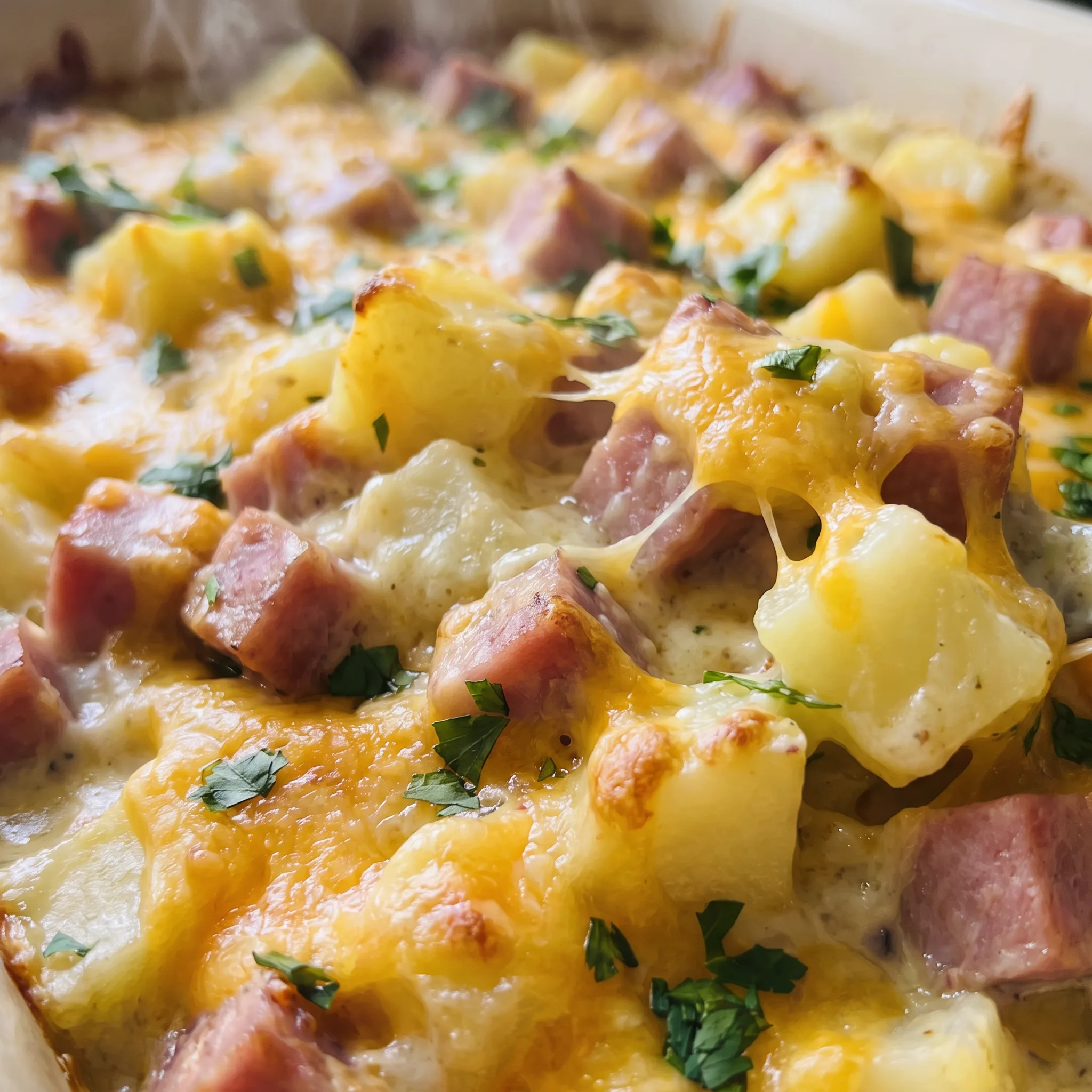
Once you pull the foil off, the top layer of cheese is exposed to dry heat. That’s when it bubbles and browns, and the exposed potatoes get a little crisp at the edges. Skip the covered phase and the cheese scorches before the potatoes are tender.
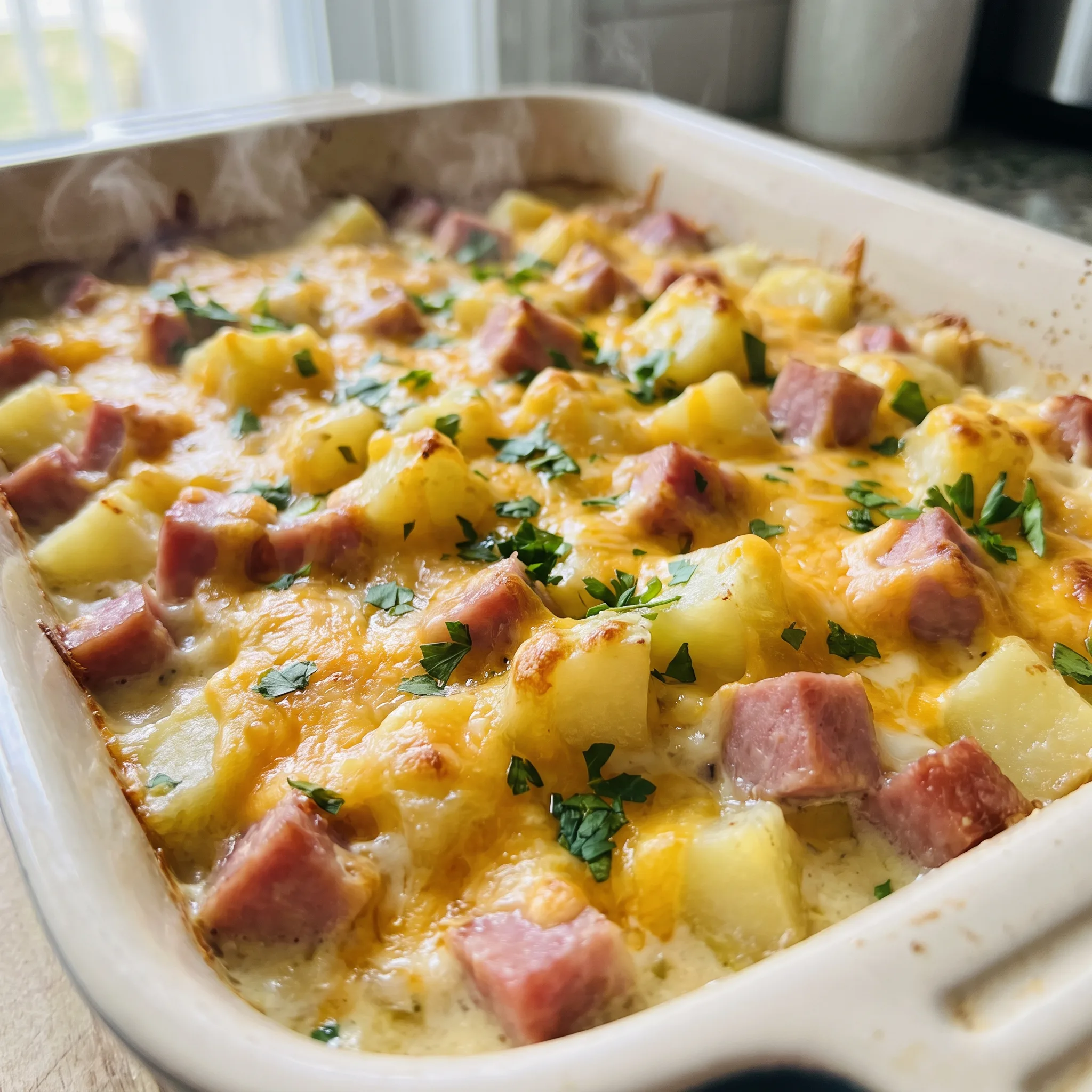
Skip the uncovered phase and you get a pale, wet top with no texture. The two stages work together: steam first for doneness, dry heat second for finish. The visual cue is a golden top with sauce bubbling up around the sides.
A Pause Before Serving
Straight from the oven, the sauce is loose and the potatoes are fragile. They’ve been through a long bake and need a few minutes for the starch to firm up and the sauce to thicken as it cools slightly. Resting lets the liquid that’s bubbling at the edges get reabsorbed into the potatoes instead of running across the plate when you cut in.
If you serve immediately, the first scoop collapses into a wet heap. After a short rest, the casserole holds its shape on the spoon and the layers stay distinct.
The cheese on top settles into a soft sheet rather than stretching into strings. This is also when the flavors even out, so the ham tastes seasoned rather than salty against the sauce. A clean cut with a serving spatula tells you it’s ready.
What to Check Before You Start Building Tiers
Potatoes: Waxy or Yukon Golds hold their dice through the full bake, while russets slump and cloud the sauce.
Diced ham: Buy it in a thick half-inch dice, since thin shaved ham dissolves into the sauce before the bake finishes.
Shredded cheddar: Sharp or extra-sharp gives you cheese flavor that survives the sauce and the long oven time.
Broth: Chicken, beef, or vegetable all work, so pick whichever one matches the ham you bought.
Milk: Whole milk thickens into a sauce that clings, where skim turns watery once it hits the oven.
How to Tell When This Casserole Is Done
When the sauce is thick enough to hold
As the sauce simmers, drag a spoon across the bottom of the pan. A clear trail that holds its shape for a second means it will set in the oven. If it’s still watery, keep stirring for another minute or two.
A thin sauce will seep to the bottom of the dish, leaving the potatoes sitting in liquid instead of coated.
The point where the potatoes are tender but not falling apart
After the covered bake, pierce the potatoes with a fork. You want no resistance at the center, but the pieces should still hold their shape. If they’re already crumbling, pull the dish early.
If they’re still firm, add a few minutes covered. Overcooked potatoes break down and make the filling pasty.
Reading the top for doneness
In the last 15 minutes, watch for the cheese to bubble and turn golden at the edges. The sauce should bubble up around the sides. If the cheese browns too fast, tent loosely with foil.
If it stays pale, leave it a bit longer. A bubbly, golden top tells you the heat has driven off excess moisture and the texture is set.
Why the rest matters
After 10 minutes out of the oven, the sauce thickens and the layers settle. Cut a small test portion: it should hold its shape on the spatula, not run. If it’s still loose, wait a few more minutes.
Serving too soon gives you a wet heap instead of distinct layers. The rest also lets the ham’s salt even out into the sauce.
Cheesy Ham and Potato Casserole
Ingredients
Method
- Heat the oven to 350°F (175°C). Grease an 8×8-inch or 7×10-inch baking dish with butter.
- Arrange half of the diced potatoes in a single layer in the bottom of the greased dish. Scatter 1 cup of the diced ham evenly over the potatoes.
- In a small saucepan over medium heat, sauté the butter and onions for 4 minutes, until the onions become soft. Add the garlic and sauté for 1 minute. Incorporate the flour, salt, and pepper by whisking; continue cooking for 1 minute more. Turn the heat down to medium-low.
- Gradually add the broth while whisking, then whisk in the milk until the mixture is smooth. Bring to a gentle simmer and stir in 1/2 cup of the cheese. Continue stirring until the sauce thickens. Adjust seasoning with salt and pepper to taste.
- Pour half of the sauce over the potatoes in the baking dish. Add the remaining potatoes on top, distribute the remaining 1 cup ham over the potatoes, and finish with the remaining cheese sauce.
- Tent with foil and bake for 45 minutes. Uncover, scatter the remaining 1/2 cup cheese on top, and continue baking for 15 minutes more, until the potatoes are tender when pierced with a fork and the cheese is bubbly.
- Take out of the oven and allow to rest for 10 minutes before serving. Garnish with fresh parsley. Serve warm.
Storing, Reheating, and Serving Leftovers
Cool leftovers within two hours, then refrigerate in a shallow container with a tight lid. The first night, the potatoes still hold their shape and the cheese topping stays soft but intact.
By the second day, the potatoes have pulled more sauce into themselves, so the casserole eats denser and the top goes slack. That shift is why the best window for eating this is the day it’s baked, after the 10 minute rest and while the cheese is still a soft sheet. Reheat single portions, not the whole dish, in a covered skillet over low heat with a splash of broth, or in the microwave at 50 percent power, stirring once.
Either way, let it sit a minute so the sauce thickens back to scoopable. Freeze portions only if you accept that the potatoes will weep on thawing; thaw overnight in the fridge and reheat as above. Scatter parsley on just before eating, never before storing, since it blackens in the cold.
What Swaps Keep the Bake Intact (and What Breaks It)
Milk: Whole milk is the default, but if you only have 2%, use it. For a dairy-free version, unsweetened oat milk or canned coconut milk (not the beverage) can stand in. Start with the same 1 cup the recipe calls for, then adjust after the sauce simmers: if it’s too thin, let it bubble a minute longer to reduce.
2% milk makes a slightly leaner sauce that still clings. Oat milk thickens similarly but can taste faintly sweet; coconut milk adds a distinct flavor that may fight the ham.
Skim milk turns watery in the oven, so avoid it unless you don’t mind a looser casserole. The sauce should coat a spoon before you pour it.
Broth: Chicken, beef, or vegetable broth all work. If you’re out, dissolve a bouillon cube in hot water (check the label for how much water per cube) or use the same amount of water plus a splash of soy sauce or Worcestershire. No need to change the quantity: still 3/4 cup.
The broth brings the savory backbone, so water alone leaves the sauce flat. Bouillon can be saltier, so taste before adding the final salt.
Beef broth deepens the flavor with ham; vegetable keeps it lighter. The sauce’s consistency won’t change.
Shredded cheddar: For dairy-free, use a shredded vegan cheddar that melts, or try smoked gouda or Gruyère if you eat dairy but want a different flavor. Keep the same 1 cup total (1/2 cup in the sauce, 1/2 cup on top). If using a hard, salty cheese like Parmesan, reduce to 3/4 cup total to avoid overpowering.
Cheddar gives a sharp tang and melts smoothly. Vegan cheese may need a longer stir to melt and can be grainy if overheated. Gouda is milder and meltier; Gruyère is nutty and browns well.
Parmesan won’t melt into strings, so the top will be crisper and saltier.
Diced ham: Cooked, diced bacon, sausage, or turkey work as substitutes. For a meatless version, use 2 cups of diced, sautéed mushrooms or a firm plant-based ham.
If using bacon, reduce to 1 1/2 cups because it’s saltier and richer. Ham provides salty, savory bites that season the whole dish. Bacon adds smokiness but can make the casserole saltier; adjust the added salt in the sauce.
Sausage brings its own spices. Mushrooms release water, so sauté them first until dry to avoid a soggy casserole.
Plant-based ham may need extra salt.
Tips
- Cut the potatoes into a 3/4-inch dice and keep every piece within about an eighth of an inch of that size. The 45 minutes covered plus 15 uncovered gives one window for doneness, so a mix of half-inch and one-inch chunks means the small pieces break down and cloud the sauce while the large ones stay firm at the center.
When the flour is whisked into the butter and onion mixture, it needs about a minute of cooking to coat the fat and lose its raw taste, but the real signal is visual: the roux should look like wet sand and smell faintly nutty, not like raw flour. If you pour in the broth all at once, the starch seizes into lumps that no amount of whisking will fully smooth out, and the sauce will stay grainy even after simmering. The point of no return is when the liquid hits the pan, once lumps form, you can only strain them out, not dissolve them.

Frequently Asked Questions
Can I make this ham and potato casserole ahead of time?
Yes, but the quality drops. The article says the best window is the day it’s baked, after the 10 minute rest. If you must, cool it fully within two hours, then refrigerate in a shallow container with a tight lid.
Reheat single portions, not the whole dish, in a covered skillet over low heat with a splash of broth, or in the microwave at 50 percent power, stirring once. Let it sit a minute so the sauce thickens back to scoopable.
Why did my casserole turn out watery?
The most likely cause is a sauce that wasn’t thick enough before it went into the dish. You want a clear trail that holds its shape for a second when you drag a spoon across the pan.
If the sauce is thin, it seeps to the bottom and the potatoes sit in liquid. As a secondary check, skim milk turns watery in the oven, so use whole milk. Also, if the potatoes were still firm and you pulled the dish early, the sauce won’t have had time to reduce.
Next time, let the sauce bubble a minute longer and use whole milk.
How is this different from scalloped potatoes?
Scalloped potatoes are usually just potatoes and a cream sauce, often with cheese on top, but no ham. This casserole builds two tiers of potatoes and ham with sauce between and on top, so every serving has even distribution. The ham also seasons the whole dish as it bakes.
That tiered structure is what keeps the middle from turning dense and gluey.
