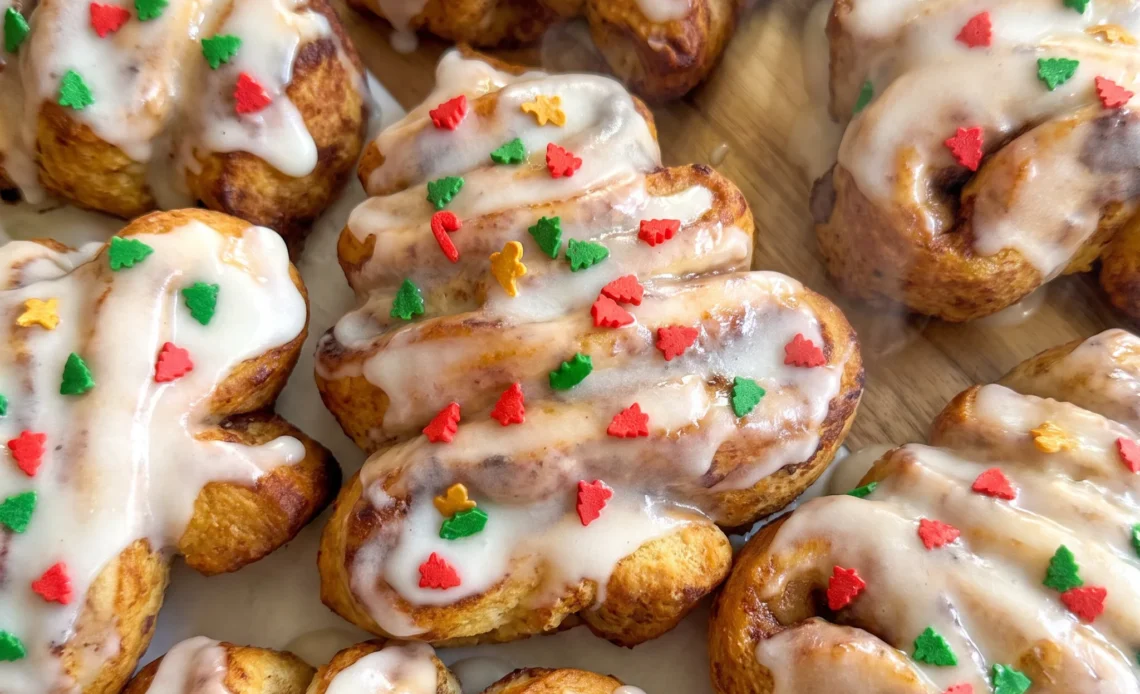
Not a batch of spirals. A pull-apart tree built from strips of dough you unroll and bend into a zigzag, so the branches fuse into one shape. The gamble is the shaping: dough that’s cold or tight springs back at the folds, and a weak pinch opens in the oven, leaving you to press it back together mid-bake.
Five rolls give a tree that fits a sheet pan with room for the taper, and the count matters more than you’d guess, because a crowded pan means raw centers and scorched edges. What you get is a Christmas tree cinnamon roll that people tear apart by the branch instead of slicing, icing dripping down the sides.
The icing waits until the crust is warm, not steaming, or it slides off.
Unrolling Dough into Tree Branches
A cinnamon roll baked as-is gives you a spiral, not a tree. Unroll each one and the strip of dough becomes something you can bend. Lay that strip in a zigzag, back and forth, narrowing as you go up, and the shape reads as branches.
The spiral has to go because a tight coil won’t fold into angles. Gentle pressure keeps the dough from stretching thin enough to tear. Once the zigzag is laid out, pinch the folds where the dough doubles back, especially at the top and along the sides.
Those pinches act like little anchors. Skip them and the dough springs apart in the oven, leaving you with a blob. The tree doesn’t need to be even.
Slight asymmetry looks more natural. What you’re after is a shape that holds together long enough to set in the heat.
Five Rolls Give the Right Tree Size
A standard can holds eight Grands! rolls. Five is the number that makes a tree that fits on a sheet pan without turning into a crowd.
Use all eight and the branches overlap, the center stays raw while the edges overbake, and the shape turns into a lumpy mass. Five also lets you control the taper: a wider base, a narrower top, clear branches.
The remaining three rolls don’t go to waste. Bake them in a small dish alongside the tree, or wrap and refrigerate for another morning. They’ll bake in less time than the tree because they’re separate.
If you’re feeding a bigger group, you could make two trees from two cans, but then you’re working with ten rolls and two pans. The five-roll tree serves five as a shareable centerpiece, and each person pulls off a branch.
Icing and Sprinkles Finish the Look
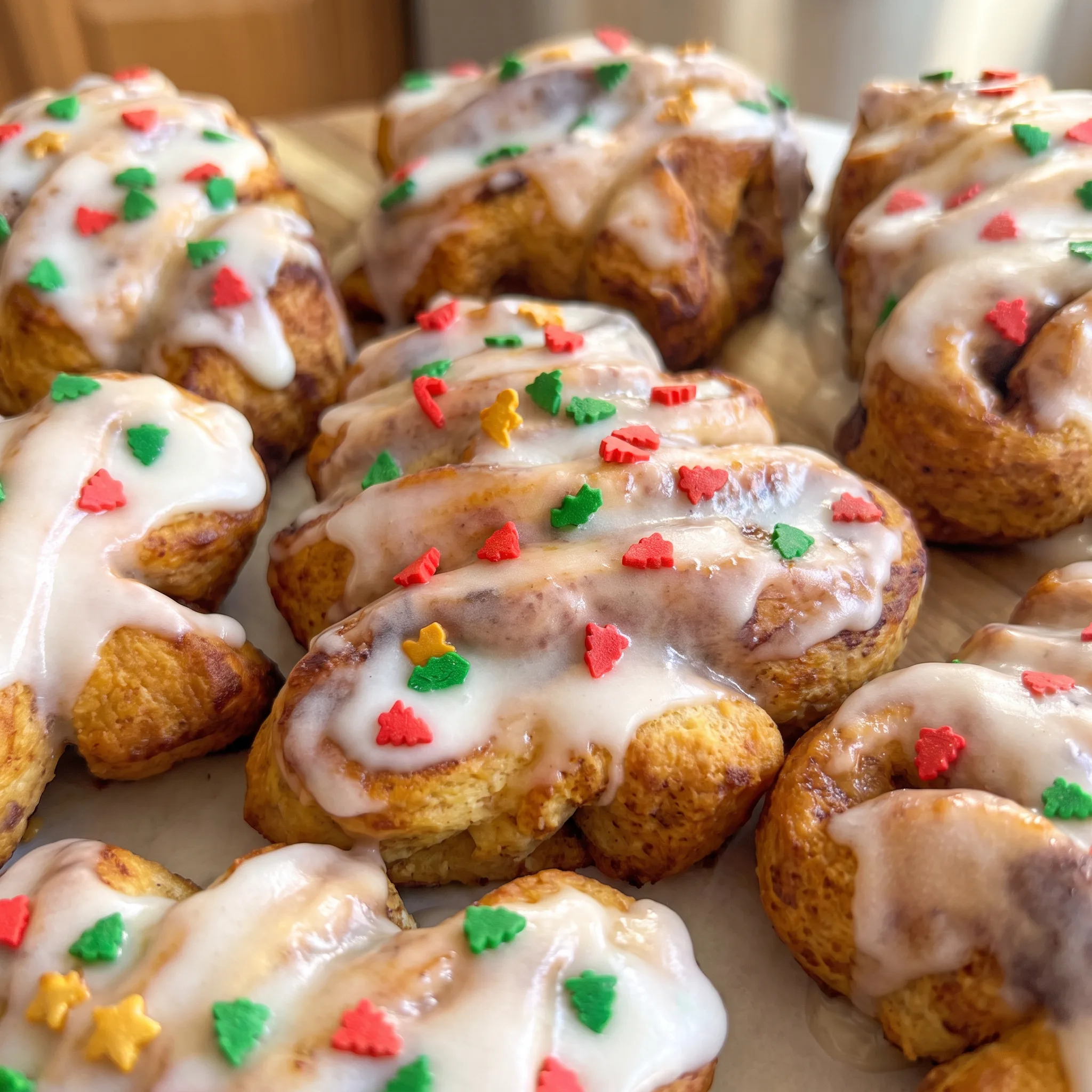
The icing that comes with the can is thin and sweet, and it needs a slightly cooled roll or it slides right off. Wait a couple of minutes after the pan leaves the oven. The dough is still warm enough to soften the icing so it spreads, but not so hot that it turns into a puddle.
Spread it over the tree in a back-and-forth motion, letting some drip down the sides to suggest snow. Christmas sprinkles add more than color. They give a little crunch against the soft dough, and the red and green bits break up the monotone surface.
Without them, the tree looks like a plain cinnamon roll shaped like a tree. The icing itself doesn’t just sit on top; it soaks slightly into the warm crust, carrying its vanilla sweetness into every bite.
That’s what balances the cinnamon.
Why a Connected Tree Pulls Apart
When you bake the rolls as one zigzag instead of separate spirals, the dough pieces fuse where they touch. That’s what makes the tree hold its shape.
It also means you serve it by pulling off a branch rather than cutting a slice. The connected shape changes how the heat moves through the pan. The center of the tree, where the dough is thickest, takes longer to set than the exposed edges.
If a branch starts to separate during baking, it’s usually because the pinch wasn’t firm enough or the dough sprang back. Pull the pan out, press the seam together with a spatula, and slide it back in.
No harm done. The benefit is a centerpiece that invites everyone to reach in. Each person gets a piece with icing and a bit of crust.
The tree stays intact until the first pull.
What to Grab for a Tree That Holds Its Branches
Pillsbury Grands! Cinnamon Rolls: Use the 8-count can; Grands! are larger and unroll into strips long enough to zigzag without thinning.
Icing (included): The packet that comes with the can is thin; if yours is stiff, warm the sealed packet in your hand.
Christmas sprinkles: The crunchy sugar kind, not the soft waxy shapes; the hard bits hold up against the warm icing.
Unrolling a cinnamon roll stretches the gluten strands that were set in a spiral, creating internal tension. In the oven, yeast and steam cause expansion, and because the zigzag strips only touch edge-to-edge rather than interlocking, that expansion pulls the seams apart. Pinching the dough at the contact points fuses the layers so the tree bakes as one connected piece instead of separate strips.
Reading the Dough as You Shape and Bake the Tree
Knowing when a pinch will hold
After you zigzag the strip, press the folds together. The dough should feel tacky and give slightly under your finger. If it springs back, the gluten is tight and the seam will open in the oven.
Let the strip rest a minute, then pinch again. A good pinch leaves a visible dent that doesn’t fill in. Without that, the tree unravels into separate spirals.
Spotting a tree that’s coming apart mid-bake
About halfway through the 23 to 27 minute bake, glance through the oven door. If a branch is lifting or a seam is gaping, pull the pan out.
Press the dough back together with a spatula, using the warm dough’s own stickiness. Work fast; the oven loses heat. Slide it back in.
A tree that separates early won’t fuse again on its own.
Judging doneness by color, not the clock
The card gives 23 to 27 minutes, but the tree’s thickness varies. Look for an even golden brown across the top, with the deepest crevices set. Pale dough in the center means it needs more time.
Dark edges mean it’s done now. If the top browns before the center sets, tent foil over it.
Overbaked dough turns tough and dry.
When the icing will spread without running off
The included icing is thin. If the tree is too hot, it slides to the pan. Wait until the pan is warm but not steaming, about two minutes.
Touch the crust: it should feel warm, not hot. Spread back and forth; some drips are fine. Too cool and the icing sits in a lump instead of coating the branches.
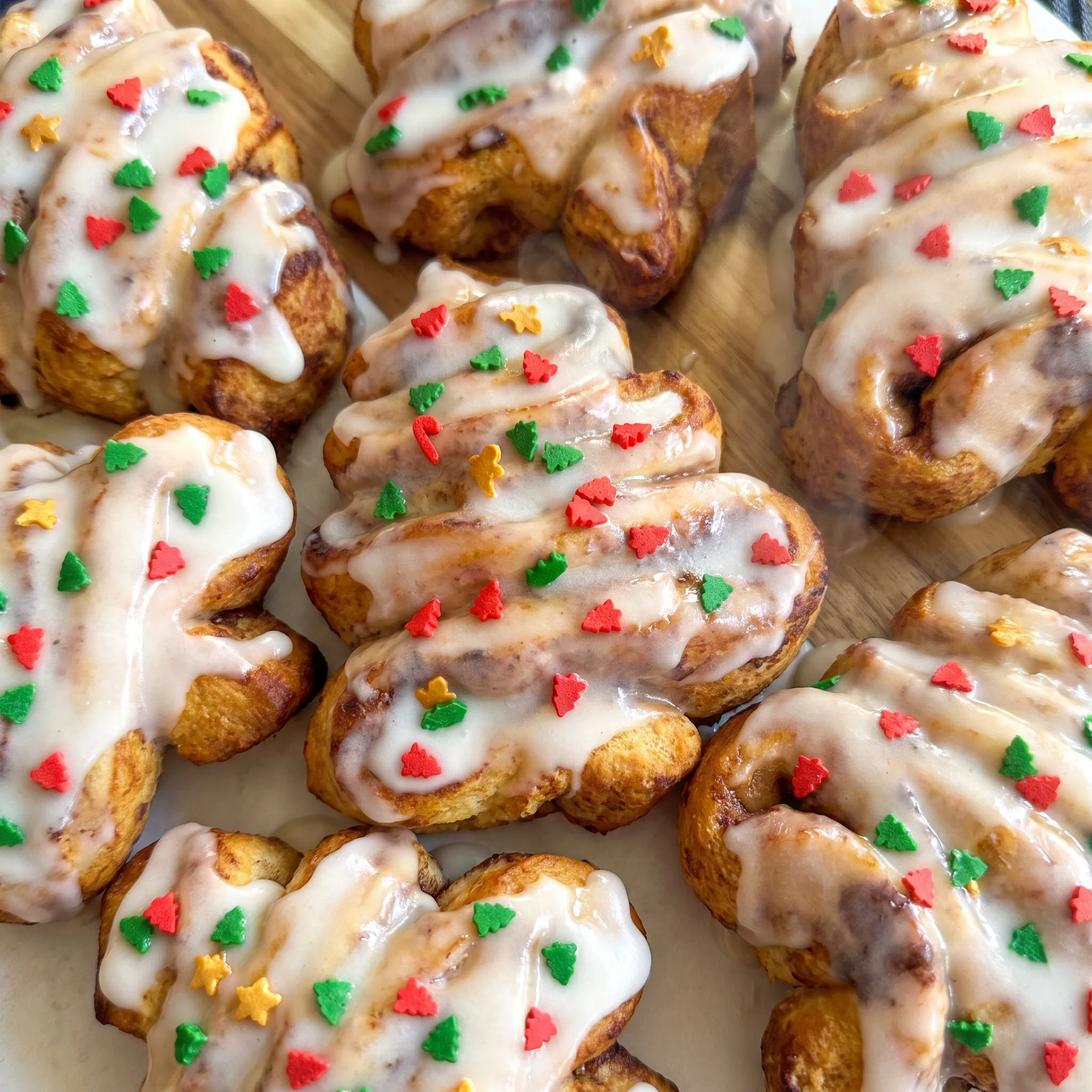
Christmas Tree Cinnamon Rolls
Ingredients
Method
- Set oven to 350°F (175°C) to preheat.
- Coat a baking pan with non-stick spray or use parchment paper as a liner.
- Separate the cinnamon rolls from the opened can until you have 5 rolls.
- Take one roll at a time, unroll it, and lay it in a zigzag pattern on the baking pan to create a tree shape.
- Slightly pinch the tree to hold it together and avoid unraveling while baking.
- Should the tree begin to come apart during baking, take it out of the oven and carefully press it back together.
- Bake for 23-27 minutes, or until the surface is golden brown.
- Take out of the oven and allow to cool a bit.
- Spread icing, add sprinkles, and serve!
Substitutions That Hold the Tree, Not Just the Flavor
Refrigerated cinnamon rolls (Pillsbury Grands! or similar): Any brand of 8-count grands-style cinnamon rolls will work, but avoid flaky or crescent roll dough.
Grands! unroll into a single long strip you can zigzag and pinch. Flaky or crescent dough is laminated, so it tears along the layers when you try to unroll it and won’t hold a seam.
The tree falls apart into buttery shards. If you can only find a smaller can, say 5-count, use all of them; the tree will be smaller and bake a few minutes faster.
Included icing packet: Make a simple glaze: 1 cup powdered sugar whisked with 1 to 2 tablespoons milk or water until it coats a spoon. The packet is thin and pourable, so it drips down the branches. A homemade glaze can be mixed to the same consistency, but start with less liquid than you think.
Too thick and it sits in a lump; too thin and it runs off the tree. Add liquid a teaspoon at a time. The flavor is close, just less vanilla unless you add a drop.
Christmas sprinkles: Any small, crunchy sugar sprinkles or coarse sanding sugar. Skip soft waxy shapes.
Crunchy bits stay crisp against the warm icing and add texture. Soft shapes melt into the glaze and turn into colored streaks.
If you only have soft ones, scatter them after the icing has cooled for a few minutes so they keep their shape.
All-purpose flour in the dough (if you were considering a gluten-free roll): There isn’t a straight swap here. Gluten-free refrigerated cinnamon rolls that unroll are rare, and homemade GF dough behaves differently. The dough’s ability to stretch and hold a pinch comes from gluten.
A GF dough tends to crack when you bend it into zigzags, and the seams won’t stay closed. If you must go gluten-free, look for a GF cinnamon roll can that explicitly says ‘unrolls’ and expect a more fragile tree; pinch gently and bake on parchment so you can press it back together without sticking.
Storing and Serving the Christmas Tree Cinnamon Rolls
The tree is one connected pull-apart shape, so leftovers don’t go in a stack. Keep them in a single layer at room temperature, covered, for up to two days. A stacked pile traps steam, and the icing glues the branches into a soggy block.
Refrigeration firms the dough and dulls the cinnamon, so avoid it unless your kitchen runs hot. Reheat briefly in a 300°F oven or a few seconds in the microwave to soften the crumb; cold dough eats tough.
Serve within the first hour out of the oven for the best texture, when the crust still has a little crispness and the icing is soft. The icing and sprinkles go on after the tree cools a couple of minutes, once the pan is warm but not steaming, so they cling instead of sliding off.
Eat each portion by pulling off a branch, not slicing, to keep the tree intact.
Tips
- Pull the 5 rolls from the can and let them sit on the counter for 5 to 10 minutes before unrolling. Cold dough from the fridge cracks when you bend it into zigzags and springs back at the pinched folds, so the rest gives you strips that stretch without tearing and seams that stay closed.
- If the dough still resists after resting, roll each strip flat with a rolling pin to about 1/4 inch thick before zigzagging. The thinner sheet folds into sharper angles and bakes through in the same 23 to 27 minutes, where a thick unflattened strip leaves the center of the tree doughy while the edges brown.
Frequently Asked Questions
Can I make this Christmas tree cinnamon roll ahead of time?
Assembling the tree the night before and baking it in the morning doesn’t work well because the dough dries out and the pinched seams loosen as it sits. If you want to get a head start, bake the tree completely, let it cool, and keep it covered in a single layer at room temperature for up to two days. Then reheat it briefly in a 300°F oven to soften the crumb.
That way you’re not wrestling with raw dough when you’re trying to get breakfast on the table.
What if my tree falls apart while baking?
Pull the pan out of the oven right away and press the separated branches back together with a spatula. The dough is still hot and sticky, so it’ll fuse again if you work quickly. The most common reason a tree comes apart is that the initial pinches weren’t firm enough to anchor the folds.
Pinch until you see a dent that stays, and if the dough springs back, let it rest a minute and pinch again. The tree won’t reattach itself once it’s set, so catching it mid-bake is your only chance.
How is this different from regular cinnamon rolls?
Regular cinnamon rolls are baked as separate spirals, so you get individual rounds with a tight coil in the middle. This tree is one connected zigzag, so the pieces fuse where they touch and you serve it by pulling off a branch.
The shape also changes how it bakes: the center is thicker, so it takes longer to set than the edges. That’s why you watch for even golden brown across the top rather than relying on the clock.
