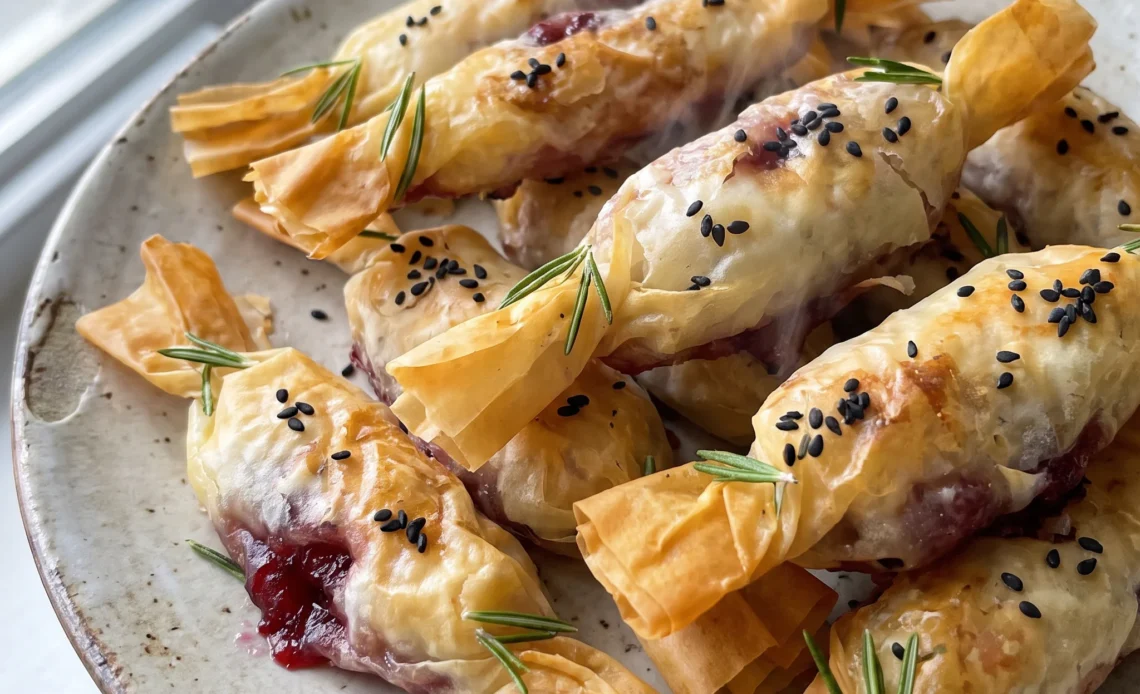
Filo shatters against your teeth while the brie gives underneath, and the whole thing disappears in two bites. Turning a wheel of baked brie into a passed appetizer sounds simple until you actually work with filo: it tears if you look at it wrong, and the filling has to stay put through a hot oven without steaming the pastry limp from the inside.
Get the ratios right and each cranberry brie filo cracker carries its own soft center and crisp shell, warm from the tray. Get them wrong and you’re scraping leaked jam off parchment. There’s a narrow window where everything lines up, and the rest of this piece walks through it.
Filo’s extreme thinness means any exposed square begins losing moisture immediately, and once the surface dries it loses the pliability needed to roll around the filling without cracking. Covering the unused squares with a damp towel keeps the local humidity high so the pastry stays supple, while brushing the square being worked on with melted butter adds a fat layer that both lubricates the dough and slows further moisture loss.
Filo Dries Out Fast
Filo pastry is thin enough to see through, which is what makes it crisp, and also what makes it fragile. Leave a sheet out for a few minutes and the edges curl and crack. The first crack is the one that matters: a torn square won’t roll without leaking filling onto the tray.
A damp towel over the stack slows that drying, and it doesn’t need to be soaking, just barely wet to the touch. Melted butter brushed on a square keeps it pliable while you work and gives the baked cracker its flaky separation.
Work with one square at a time and leave the rest covered; the stack stays soft and doesn’t fight you. Eventually you’ll see it: the squares that sat out too long split along the fold, and those go in the bin. Keep the towel in place and the stack stays usable to the last piece.
Find the Right Balance of Filling
Every cracker carries a slice of brie, a teaspoon of cranberry sauce, and a teaspoon of sliced almonds. Brie melts into a creamy layer that softens the pastry from the inside, so a thick slice turns the center limp before the edges brown.
Cranberry sauce brings sweetness and moisture; a heavy spoonful leaks out during baking and leaves a sticky patch on the parchment. The almonds stay crunchy and cut through the richness, which is why they’re not optional.
One teaspoon of cranberry and one of almonds per square is calibrated for 36 crackers: enough to taste each element, not so much that the pastry can’t hold. If you heap the filling, the ends won’t pinch shut and the cracker opens in the oven. A light hand keeps the ratio intact, and the baked cracker stays crisp with a soft center.
Black Sesame Seeds Do More Than Look Pretty
Black sesame seeds taste earthier than the white ones, with a slight bitterness that sharpens the sweet-tart cranberry and the rich brie. Scatter them over the buttered tops before the trays go in, and they toast while the pastry browns, turning fragrant and nutty.
That toast is what you smell first when you pull a tray out. Their dark color against the golden filo gives the crackers a finished look, but the flavor is the reason to use them. They also reinforce the nuttiness from the sliced almonds inside, so the cracker tastes consistent from crust to center.
A heavy sprinkle can overwhelm a small bite, so a light scattering is enough. If you skip them, the crackers still work, but they lose that bitter edge that keeps the sweetness in check.
Why Two Bites Works
These crackers are built for a party, not a plate. Cutting the filo into 36 squares gives you pieces that fit in one or two bites, which matters when people are standing with a drink in one hand. A smaller cracker also keeps the ratio of crisp pastry to filling in check: too large, and the center goes soft before you finish it.
The yield of 36 lines up with appetizer portions for a crowd, so you’re not left with a tray of half-eaten pieces. They’re meant to be passed and eaten warm, while the filo still shatters. If you cut them bigger, they turn into a knife-and-fork situation, which defeats the purpose.
Keep them small, and they disappear fast.
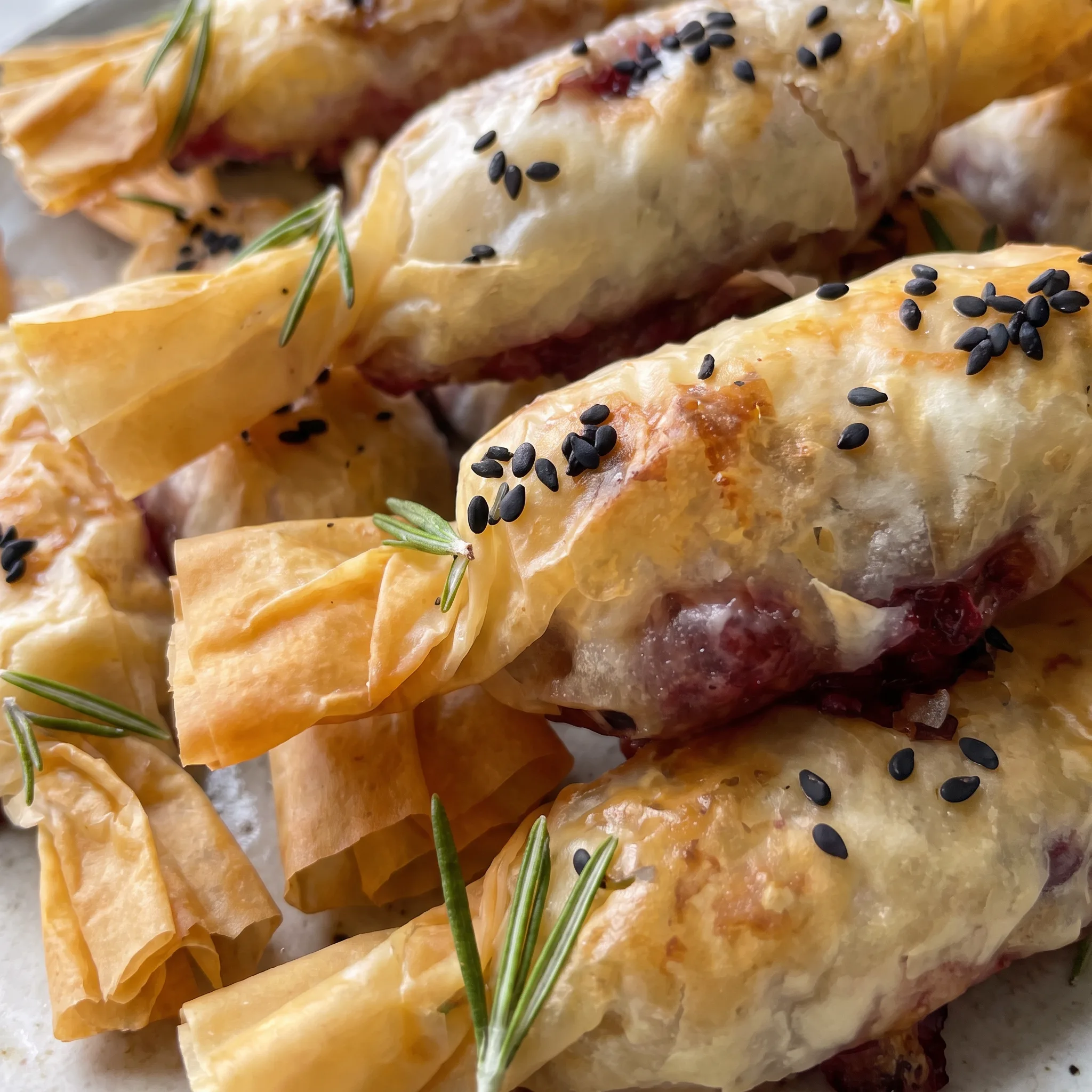
What to Buy for These Crackers
Filo pastry: Buy it frozen and thaw it overnight in the fridge; sheets thawed on the counter get damp and stick together.
Brie: A standard wheel works, but slice it cold so the pieces stay long instead of smearing into the filo.
Cranberry sauce: Whole-berry sauce gives visible fruit, while smooth jellied sauce spreads thinner and won’t weigh down the pastry.
Black sesame seeds: Check the date, since old seeds taste dusty and flat rather than earthy and toasted.
Judging the Bake: When to Pull the Trays
Reading the color of the filo
Filo goes from pale to golden to burnt in a couple of minutes. At 15 minutes, check the trays.
The crackers are done when the pastry is a deep, even gold, not just tinged. If the edges darken before the centers catch up, the oven is running hot or the trays are too close to the element. Rotate the trays and keep watching, because the line between golden and bitter is thin.
Feeling for crispness
A baked cracker should feel light and rigid when you lift it. If it bends, the pastry is still steamy and will soften as it cools. That happens when the brie releases too much moisture or the cranberry sauce is heavy.
You can’t fix it after baking, but you can avoid it next time by using thinner brie slices and measuring the cranberry. For now, return the tray for 2 to 3 minutes if the crackers still bend.
Listening for sizzle
As the crackers bake, the butter in the pastry should sizzle quietly. If you hear loud popping or see smoke, the oven is too hot or the trays are too close to the heat.
Pull the trays, lower the temperature by 25°F, and continue baking. The sizzle tells you the butter is rendering and the pastry is crisping, not burning.
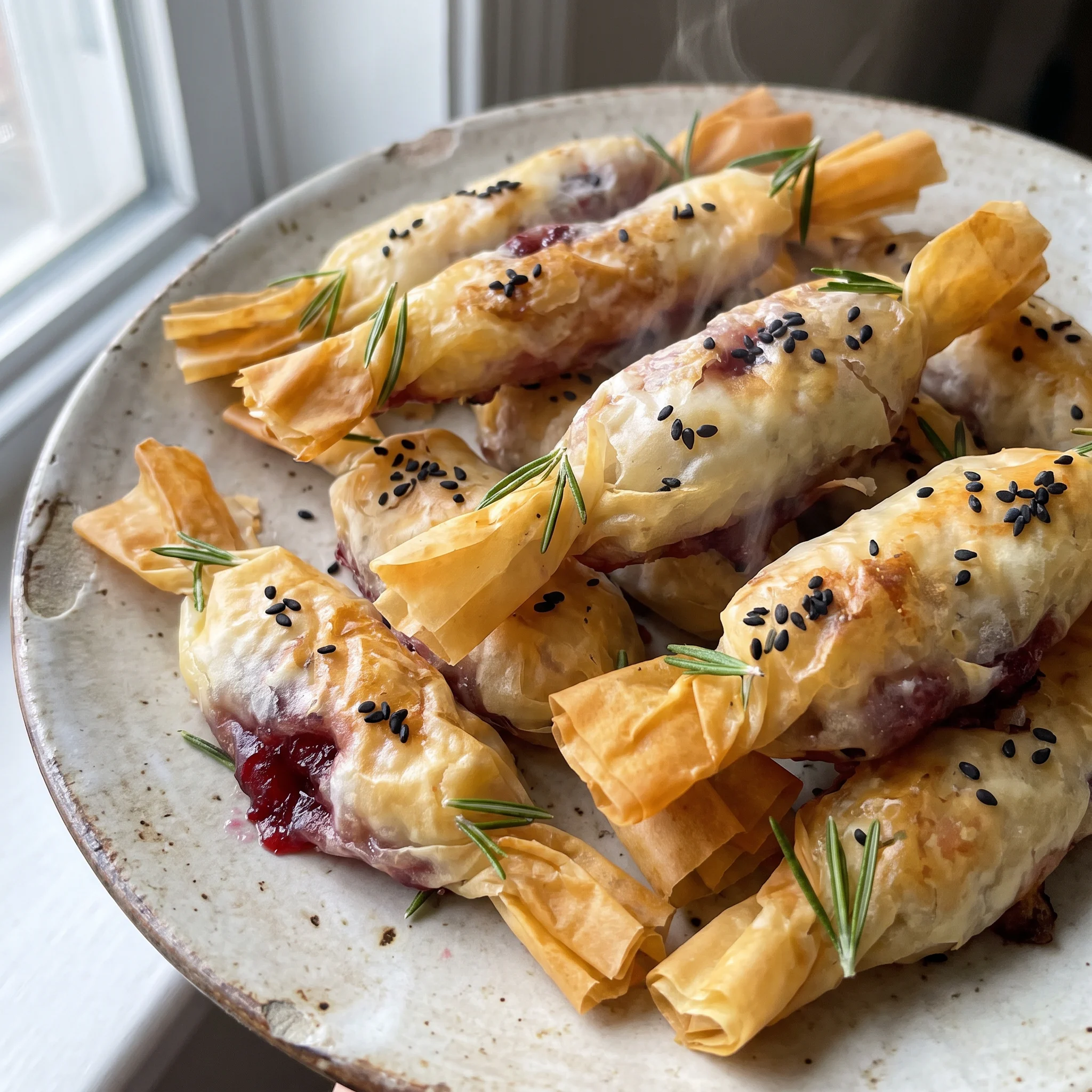
Cranberry Brie Filo Crackers
Ingredients
Method
- Set oven to 350°F (175°C). Prepare two baking trays by lining them with parchment paper and set aside.
- Lay thawed filo sheets on a flat surface. Cut into 3 equal portions lengthwise, then halve each crosswise to get 36 squares.
- Take one pastry square and place it on a flat surface; use a damp towel to cover the rest. Apply melted butter to the square. At one end, add a brie slice, 1 tsp cranberry sauce, and 1 tsp almond flakes. Roll the pastry and pinch both ends to create a cracker. Do the same with the remaining filo squares.
- Move filo crackers onto the prepared baking trays. Coat with the remaining melted butter and scatter black sesame seeds on top. Bake for 15–20 minutes, until golden.
- Top with rosemary leaves or chives.
What Swaps Hold and What Falls Apart
Brie: Camembert or a firm triple-cream. Camembert melts about the same, a touch earthier, and it’ll still soften the filo from the inside.
A firm triple-cream stays sliceable cold, which is what you want, because soft brie smears and the brie-to-pastry ratio drifts. Skip anything runny like a ripe washed-rind; it weeps onto the tray before the pastry sets.
Cranberry sauce: Whole-berry cranberry sauce or fig jam. Whole-berry keeps visible fruit and spreads thicker, so measure the same teaspoon and it won’t leak.
Fig jam is sweeter and denser; use a scant teaspoon or the cracker turns candy-sweet and the brie disappears. Jellied sauce works too, but it spreads thinner and reads more as a glaze than a filling.
Sliced almonds: Chopped pistachios. Pistachios bring a greener, slightly saltier crunch that cuts the richness just as well. Chop them to roughly the size of a sliced almond, because bigger pieces poke through the filo and tear it as you roll.
Keep the same one teaspoon per cracker; a heavier hand unbalances the bite.
Filo pastry: Thawed puff pastry. Puff pastry gives a thicker, more buttery cracker that browns faster and puffs unevenly. Cut squares about the same size as the filo, but expect a yield closer to 24 than 36 because puff sheets are smaller and thicker.
You’ll also need a little more butter to brush the tops. Gluten-free filo exists but behaves like wet paper; it tears on the roll and bakes up pale and brittle, so I’d leave it alone here.
Eat Them Hot, Then Bring Leftovers Back
Filo has one crisp window, and it closes fast. Serve these within 30 to 45 minutes of pulling the trays, while the pastry still shatters and the brie stays soft.
The rosemary or chives go on right after baking, before the crackers cool, so the herbs warm against the filling instead of sitting raw on top. After an hour, the brie’s moisture works into the pastry and the shatter turns to a soft chew. Leftovers keep in an airtight container at room temperature for a day.
Refrigerating them is worse: the cold pulls moisture into the filo, and they go limp within hours. To re-crisp, spread them on a parchment-lined tray and bake at 350°F for 4 to 5 minutes, just until the pastry feels rigid again.
Any longer and the brie leaks while the sesame seeds scorch. The almonds soften slightly, but the filo comes back close to fresh. Don’t freeze these; the thawed pastry steams and loses its structure.
Tips
- Cut the brie cold, straight from the fridge, into long slices about 1/4 inch thick, then let them sit at room temperature for 10 minutes before rolling. Cold brie holds a clean edge under the knife, and the short rest takes the chill off so the slice bends around the filling instead of cracking the filo as you pinch the ends shut.
- Press each filled cracker seam-side down on the tray and leave an inch between them. The seam seals against the parchment as the butter sets in the first few minutes of baking, and the spacing keeps the released steam from softening the crackers next to it.
Frequently Asked Questions
Can I make these cranberry brie filo crackers ahead of time?
Assemble them on the trays, cover, and refrigerate for a few hours; the butter firms up and helps the pastry hold its shape. The trade-off is the brie and cranberry will weep a little into the filo while they sit, so the baked cracker won’t shatter quite as sharply.
If you want them as crisp as possible, roll them right before they go in. The article’s storage notes cover how to bring leftovers back, but for pre-bake, that short chill is the limit.
Why did my filo crackers turn out soggy?
Most often the brie slice was too thick; it releases water as it melts and steams the pastry from inside before the edges can crisp. Cut the brie thinner next time, and measure the cranberry sauce level, not heaped.
A secondary check is your oven: if the trays sat too low or the temperature ran under, the filo browns unevenly and the centers stay soft. Look for a deep even gold and a rigid feel when you lift one.
How do I keep the filo pastry from drying out while assembling?
Work on one square at a time and keep the rest under a towel that’s damp, not wet. The towel should feel cool and barely moist; if it’s dripping, the squares stick together and tear.
If a square does sit out and the edge curls, don’t try to flatten it back, just set it aside. The stack stays usable as long as you cover it between each roll.
What’s the difference between these and traditional baked brie en croûte?
Brie en croûte is one large wheel wrapped in pastry and baked as a single piece, then cut at the table. Here you’re making 36 individual two-bite crackers, so each one has its own pastry-to-filling ratio and crisps all the way through. That means the brie stays a soft layer rather than a molten center, and the cranberry and almonds are portioned per cracker.
The result is a passed appetizer, not a knife-and-fork dish.
Can I freeze these crackers before or after baking?
Don’t freeze them. The article’s storage section is clear that thawed filo steams and loses its structure, so you’d end up with limp pastry and a weeping filling.
If you want to get ahead, assemble and refrigerate for a few hours, then bake. For leftovers, a short re-crisp in the oven brings back most of the shatter.
