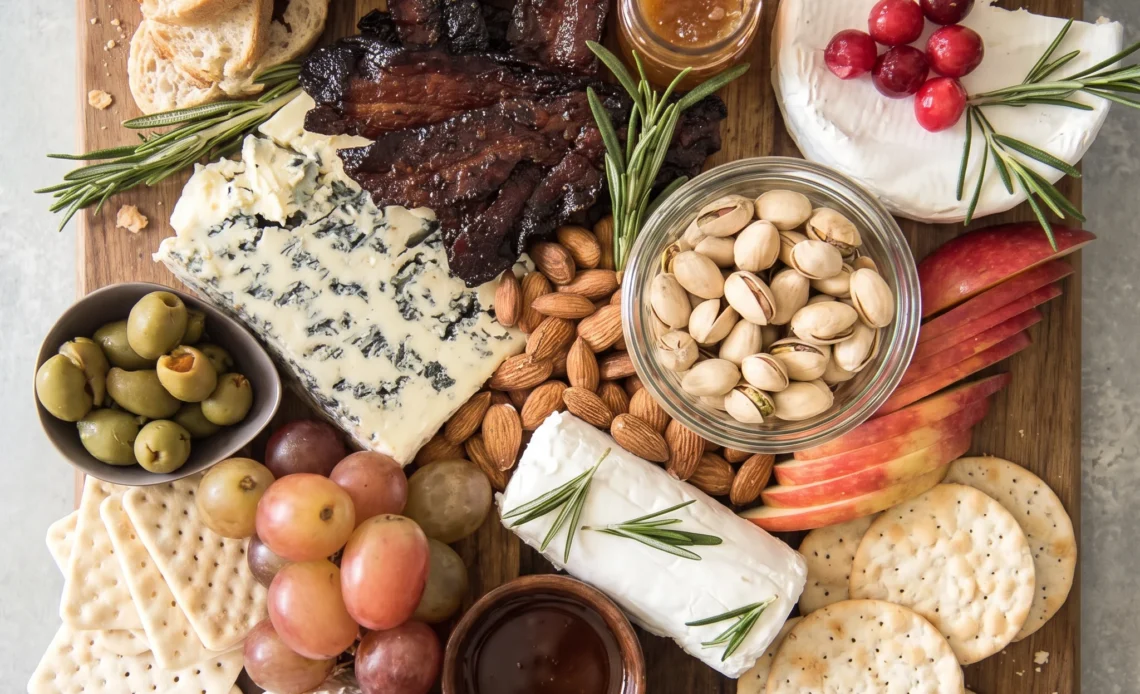
Not a cheese plate with some bacon next to it. This is one tray doing two jobs: a sticky, sweet-hot pile of maple sriracha bacon that people reach for first, surrounded by everything cool and creamy that keeps the heat in check. Most boards die from good intentions, an hour of fussy arranging that collapses the second anyone touches it.
This one leans on a few strong moves instead. The bacon can go wrong in a narrow window, so it rewards attention right at the end.
The rest is assembly, and assembly forgives. Set the cheeses down before anything small, build outward, taste as you go.
A maple sriracha bacon cheese board reads as generous because the salty, sweet, and tangy pieces argue with each other in a good way.
Why Bake Bacon on a Rack
Lay bacon strips directly on a foil-lined sheet and they end up poached in their own renderings, the undersides pale and flabby where they touched the fat, the glaze sliding off into the pool. A cooling rack set over that foil changes what the heat does.
Air moves under the strips as well as over, so the meat browns on both faces and the fat drips clear into the pan below. The glaze stays where you brushed it, clinging and thickening instead of dissolving.
Strips come out flat rather than curled, because nothing is frying in place. You can hear the difference too: fat hitting the foil beneath, a steady sputter that tells you it is rendering, not steaming.
That rack is not extra cleanup for nothing. Crumple the foil under it and the pan wipes out in seconds.
The bacon finishes crisp through the middle with a snap when you break a slice, and no greasy film on your fingers when you pick one up.
Two Coats, Better Glaze
One heavy brushing of maple and sriracha before the bacon goes in sounds efficient, and it fails. All that sugar sits on the surface for the entire bake, and by the time the meat is done the coating has gone from amber to black at the edges, bitter where it caught. Brushing in two stages fixes that.
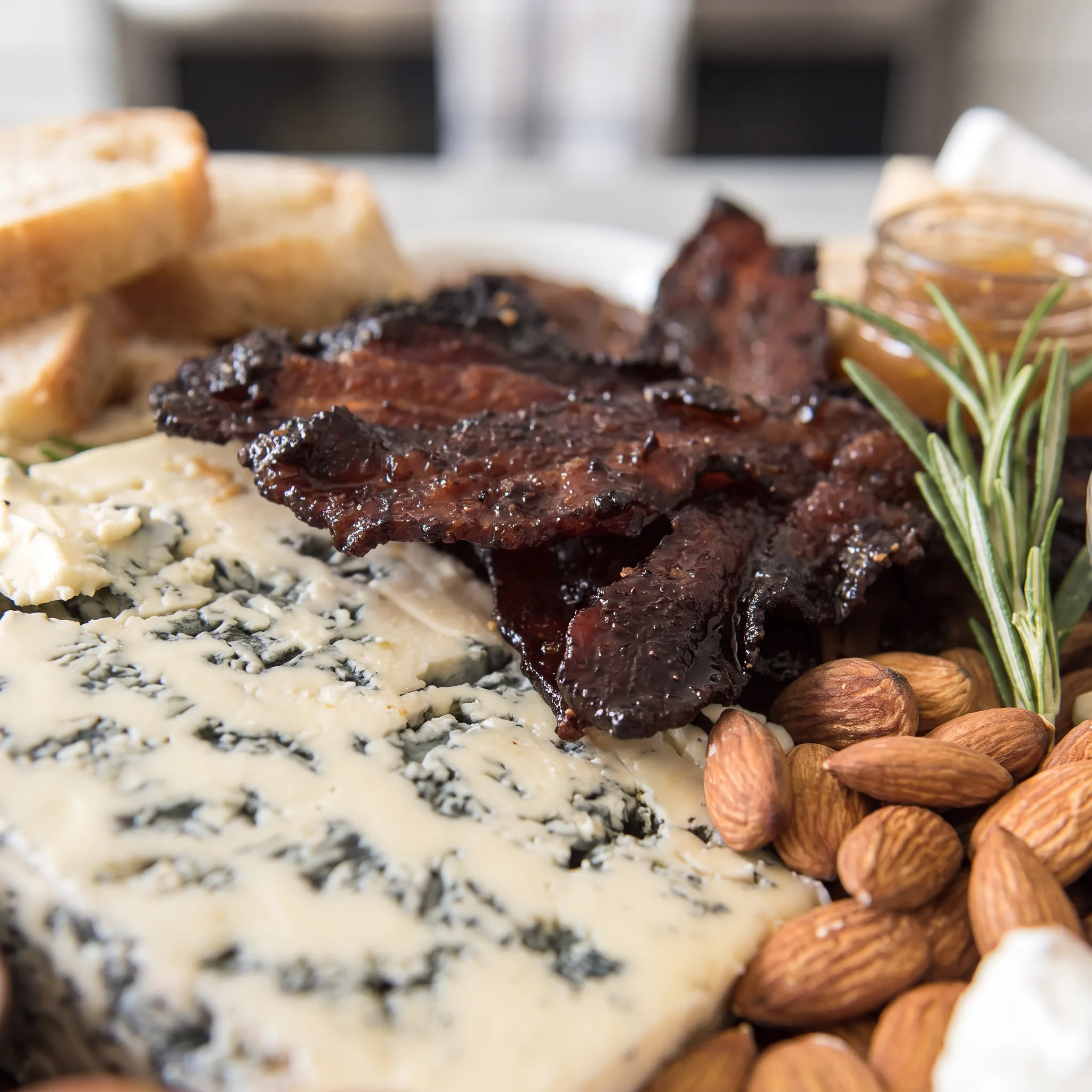
The first coat goes on raw, so the syrup soaks into the surface and seasons the meat as it cooks. The second brushing happens partway through, once the bacon has firmed and lost some water, and that layer stays on top, thickening into a sticky, lacquered shell. The finished strips look glossy, not wet, with a deep red-brown sheen.
If your glaze darkens too fast in the last minutes, that is the sugar telling you it is done. Pull the pan. The bacon will crisp further as it cools on the rack, and the coating sets to a candy-like snap.
Build the Board Around the Cheeses
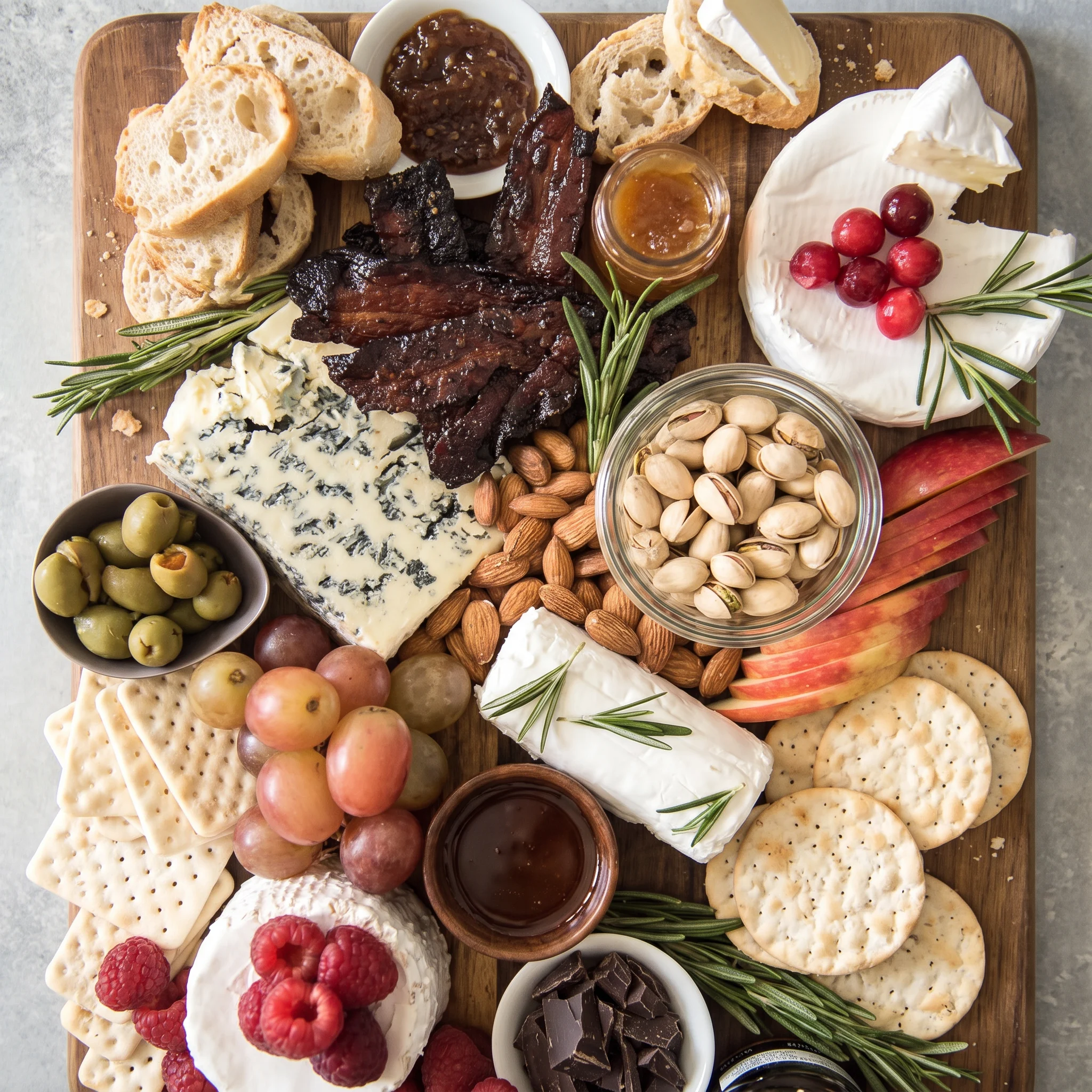
Start with the cheeses and nothing else. Set the brie, blue, triple cream, and goat log down first, spaced apart with room to cut, because once the small items go on you will not want to move them.
Those four anchor the board and dictate where everything else lands. The jams and honey go near the mild cheeses they flatter; the olives and mustards sit closer to the blue and goat, which can take the punch.
Crackers and baguette slices fill the gaps between, and the fruit and nuts tuck into corners. Leave visible board between clusters. A packed board reads as a pile; a spaced one reads as abundance.
You want a hand to move across it and find something creamy next to something crunchy, something sweet next to something salty, without digging. When the last grape and pistachio are down, step back. If any one item dominates the view, slide it aside and rebalance.
Sweet Heat Meets Creamy and Tangy
Maple syrup brings a dark caramel sweetness that coats the tongue, and sriracha cuts through it with a clean chili burn that fades rather than lingers. Together on bacon, they hit salty, sweet, and hot in one bite. That is what makes the strips work as a board element, not just a snack.
Against brie or triple cream, the heat softens into the butterfat and the whole thing tastes rounder. Against blue or goat, the tang pushes back and the burn sharpens, which is why those stronger cheeses need the honey and pear jam nearby to reset your palate. The fruit does the same job: raspberries and grapes echo the glaze’s sweetness without repeating its spice.
Olives and roasted almonds pull in the other direction, salty and savory, so a bite of bacon and cheese does not tip too far sweet. Every combination on the board has a counterpart, and that is what keeps a grazer coming back.
The Ingredients That Make or Break This Board
Bacon: Regular-cut bacon works best here; thick-cut stays chewy under the glaze and won’t crisp through.
Maple syrup: Use real maple syrup, not pancake syrup, which is corn syrup with flavoring and burns faster under heat.
Sriracha: The garlic in sriracha mellows in the oven, so the heat you taste raw is not the heat you get baked.
Brie: A wheel that gives slightly when pressed is ripe; a firm one won’t soften at room temperature on the board.
Blue cheese: Buy a wedge cut from a larger wheel so you get the blue veins, not a pre-crumbled tub of dry pieces.
Reading the Bacon and Building a Board That Works
The moment the glaze turns from sticky to scorched
The sugar in the maple syrup will go from amber to dark brown to black in under a minute. At 10 minutes, the bacon is still pale and the first coat is soaking in.
The second brushing goes on then. After that, watch the edges: when they smell toasted rather than sweet, pull the pan.
If the glaze bubbles hard and hisses at the edges, it is seconds from bitter. The bacon crisps further as it cools, so take it out when it looks slightly underdone.
Judging doneness by feel, not just time
The card gives 10 to 15 more minutes, but that range exists because bacon thickness varies. Press a strip with the back of a spatula.
If it bends without resistance, it needs more time. When it stiffens and the fat looks translucent rather than white, it is close.
The glaze should look lacquered, not wet. If you wait until it is rigid in the oven, it will be brittle and dry once it cools. Pull it when it has a slight give.
When to stop moving cheese and start filling gaps
The cheeses go down first, spaced apart. The mistake is rearranging them after the crackers and fruit go on. Once you add small items, moving a wheel of brie leaves a greasy smear and displaces everything.
Set the four cheeses where they look balanced from the start, then fill the empty board around them. If a cluster feels crowded, slide a few grapes or almonds to another gap instead of shifting the cheese.
Tasting the board as you build
Every addition changes how the bacon reads. A slice of bacon with brie tastes rounder; with blue, the heat sharpens.
If the board starts to look too sweet from jams and fruit, add more olives or mustard. If it looks too salty, tuck in pear jam or honey. You are not decorating; you are balancing.
Step back and scan for any one color or texture that dominates. Move a handful of pistachios or a cluster of raspberries to even it out.
Maple Sriracha Candied Bacon Cheese Board
Ingredients
Method
- Set oven temperature to 400°F (205°C). Cover a baking sheet with aluminum foil. Position a cooling rack over the foil, then arrange the raw bacon strips on the rack, ensuring they are not touching.
- Combine maple syrup and sriracha in a small bowl, whisking until blended. Brush the mixture over each bacon strip using a pastry brush.
- Transfer the bacon to the oven and bake for 10 minutes. Take it out and brush with the leftover sauce, then put it back in the oven and continue baking for 10-15 more minutes, until it reaches your preferred level of doneness.
- Place the cheeses on the board, then use the jams, fruits, nuts, and crackers to fill the remaining gaps.
Storage and Serving: Timing the Glaze and the Board
The maple sriracha glaze turns tacky and soft at room temperature, so the bacon is at its best within two hours of baking. After that, the coating dulls and the strips lose their snap.
Leftover bacon keeps in the fridge for up to three days in a paper towel-lined container, but the glaze firms up and the texture goes chewy. Reheat it briefly in a 350°F oven or a dry skillet for a few minutes to bring back some crispness; the microwave will only make it limp. The bacon freezes well for up to two months, though the glaze may weep slightly when thawed.
As for the board, assemble it close to serving. The cheeses need time to come to room temperature, about 30 minutes, so their flavors open up and they soften for spreading. But the crackers and fruit should not sit out longer than an hour or they’ll go soggy or dry out.
If you’re making ahead, prep the components and store them separately, then arrange everything just before guests arrive. The bacon can be baked ahead and reheated, but the board itself waits until the last minute.
Tips
- Slide a thin spatula or offset knife under each strip and lift it straight up onto a plate or paper towel, rather than grabbing an end with tongs. The coating is still liquid at that point, and tongs squeeze the strip and leave a bare patch where the glaze was.
- Brush the second coat of maple-sriracha over the bacon at the 10-minute mark, then leave the strips on the rack to cool for about 5 minutes before you move them. The residual heat in the rack finishes setting the glaze to a tacky shell, so it stays on the meat instead of pooling on the plate.
When Swapping Helps and When It Wrecks the Bacon
Bacon: Thick-cut bacon. Thick-cut needs longer in the oven, so start checking at 15 minutes after the second brushing.
The meat stays chewier because the extra thickness insulates the center from the heat that crisps the edges. The glaze sits on top longer too, so watch for scorching after 20 minutes.
Maple syrup: Pancake syrup. Pancake syrup is corn syrup with maple flavoring.
It burns faster and darker under the broiler-like heat of the oven, so brush it on thinner and pull the bacon as soon as the edges smell toasted. The finished glaze tastes sweeter and less complex, with none of the caramel depth real maple brings.
Sriracha: Gochujang or another chili paste. Gochujang is thicker and carries fermented soybean sweetness.
Thin it with a teaspoon of water before mixing with the maple syrup so it brushes on evenly. The heat comes on slower and lingers longer than sriracha, and the color darkens the glaze to a deeper red. Start with the same 2 teaspoons the recipe uses, then adjust after tasting the raw mixture.
Cheeses: Any soft-ripened wheel for Brie, any creamy blue for the wedge, another triple cream, or a fresh chèvre for the goat log. Swap based on what looks ripe at the counter. A soft-ripened wheel that gives to a gentle press will soften on the board; a firm one stays rubbery.
Blue cheese needs to be cut from a wheel so the veins run through it, not pre-crumbled. Triple cream and Brie behave alike, so either can stand in for the other.
Goat cheese brings a tang that cuts the bacon’s sweetness, so if you replace it with something milder, add more mustard or olives to keep the board in balance.
Baking bacon directly on a foil-lined sheet traps it in its own rendered fat, so the underside fries and the glaze that drips off pools and burns; a rack lifts the strips so fat drips away and hot air circulates on all sides. The trade-off is between a flat surface, which gives more contact for fat to collect, and a rack, which gives even rendering but lets the glaze drip. This recipe uses the rack method because it keeps the maple-sriracha coating on the bacon rather than in the pan.
Frequently Asked Questions
Can I make the maple sriracha bacon ahead of time?
Yes, but think in hours, not days. The coating goes tacky and soft at room temperature, so bake the strips within about two hours of serving if you want that snap when you break a slice. If you need to work further out, refrigerate the bacon up to three days in a paper towel-lined container, then reheat it briefly in a 350°F oven or a dry skillet, which brings back some crispness where the microwave just leaves it limp.
Freezing works too, up to two months, though the glaze may weep a little as it thaws.
How do I keep the bacon from burning in the oven?
Your nose is the best timer here. When the edges start smelling toasted rather than sweet, pull the pan, because the sugar in the maple syrup goes from amber to black fast once it tips.
If the glaze bubbles hard and hisses at the edges, you are seconds away from bitter. Trust the look over the clock: the coating should read lacquered, never wet, and the strips will crisp a bit more as they cool on the rack. If you used pancake syrup instead of real maple, it darkens even quicker, so brush it on thinner and watch closer.
What’s the difference between this candied bacon and regular bacon?
Regular bacon is salty and savory, full stop. This one carries a two-stage maple sriracha glaze that turns sticky and lacquered in the oven, so each strip hits sweet, hot, and salty in the same bite.
That range is what makes it work as a board element rather than just a side: against brie or triple cream the heat softens into the butterfat, and against blue or goat it sharpens, which is why the honey and pear jam sit nearby to reset your palate. The trade-off is texture.
The glaze stays tacky at room temperature, so the snap fades faster than it would on plain bacon.
How should I serve this cheese board if I’m bringing it to a party?
Prep the components at home and assemble on site, because crackers and fruit go soggy or dry out after about an hour on the board. Let the cheeses sit out 30 minutes before guests arrive so they soften and open up, but leave the arranging until the last minute.
Pack the jams, honey, olives, and nuts in separate containers, and carry the bacon in its own paper towel-lined box so the glaze doesn’t smear. Once you’re there, set the four cheeses down first with room to cut, then fill the gaps around them.
If you baked the bacon earlier, a few minutes in a 350°F oven or a dry skillet brings back some crispness before it goes on the board.
