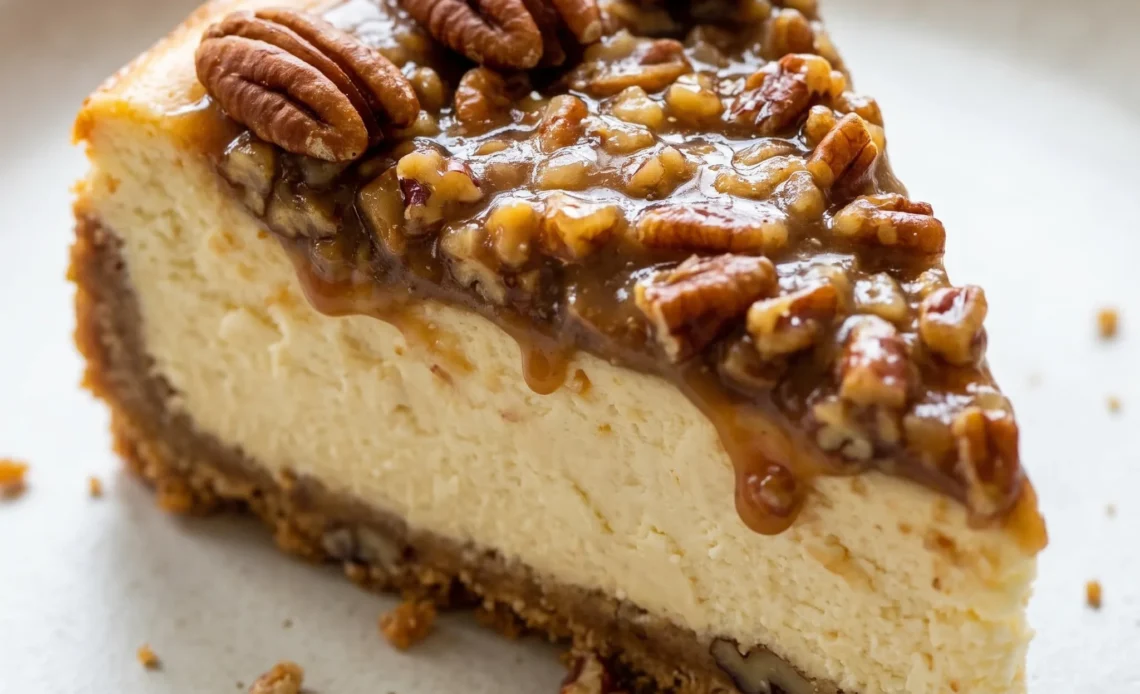
The trickiest part of a pecan pie cheesecake isn’t the cheesecake or the topping, it’s keeping the two layers separate and intact. Bake the filling too long and it cracks; don’t bake it enough and the topping sinks.
Nail that balance and you’ve got a dessert that’s both creamy and gooey, with a nutty crust that actually holds up. This pecan pie cheesecake is the holiday showstopper that doesn’t need a fork fight.
It’s rich enough that thin slices are the way to go, and the texture payoff is worth the patience. If you’ve ever had a cheesecake crack or a topping that runs over the crust, this recipe is built to avoid those exact pitfalls.
A Gentle First Bake
The cheesecake goes into a 300°F oven for 40 minutes before the topping ever touches it. That low heat sets the structure without browning the top, which keeps the texture creamy and crack-free. You can see the edges firm up while the center still jiggles slightly.
That partial set is what allows the pecan layer to sit on top later without sinking or disturbing the filling. If you tried to bake the whole thing hot and fast, the surface would brown and dome, and cracks would follow as it cools.
This first bake is the quiet foundation; it does the slow work so the final bake only has to finish the job.
Stovetop Syrup
The topping starts as a syrup on the stove, not in the oven. Brown sugar, corn syrup, butter, and rum bubble together into a thick, cohesive base. That cooking step drives off excess moisture and caramelizes the sugars, so the topping sets firm during the final bake instead of staying runny.
Then the syrup cools before eggs go in. Hot syrup would scramble them; cooling lets the eggs blend in smoothly. The result is a topping that slicks over the cheesecake in a glossy layer and holds its shape when cut.
Built-Up Crust
The crust climbs the sides of the pan because it has to hold both the filling and the topping. If it only covered the bottom, the cheesecake would overflow and the topping would leak out. Pre-baking firms the crust so it doesn’t turn soggy from the wet filling.
The ground pecans in the crust add flavor and give it a sturdier crumb than graham crackers alone. Pressed high and baked, it becomes a barrier that keeps the layers contained and dry.
Chill for Clean Slices
Four hours in the fridge is the minimum for this cheesecake to set completely. While it chills, the filling firms and the topping sets, so a knife can cut through without smearing.
The topping needs that time to meld with the cheesecake below. If you’re after really tidy slices, freeze it for an hour or two first, that firms everything enough for sharp edges. Let the slices sit out for 30 minutes after cutting, and you get the full texture without the wait.
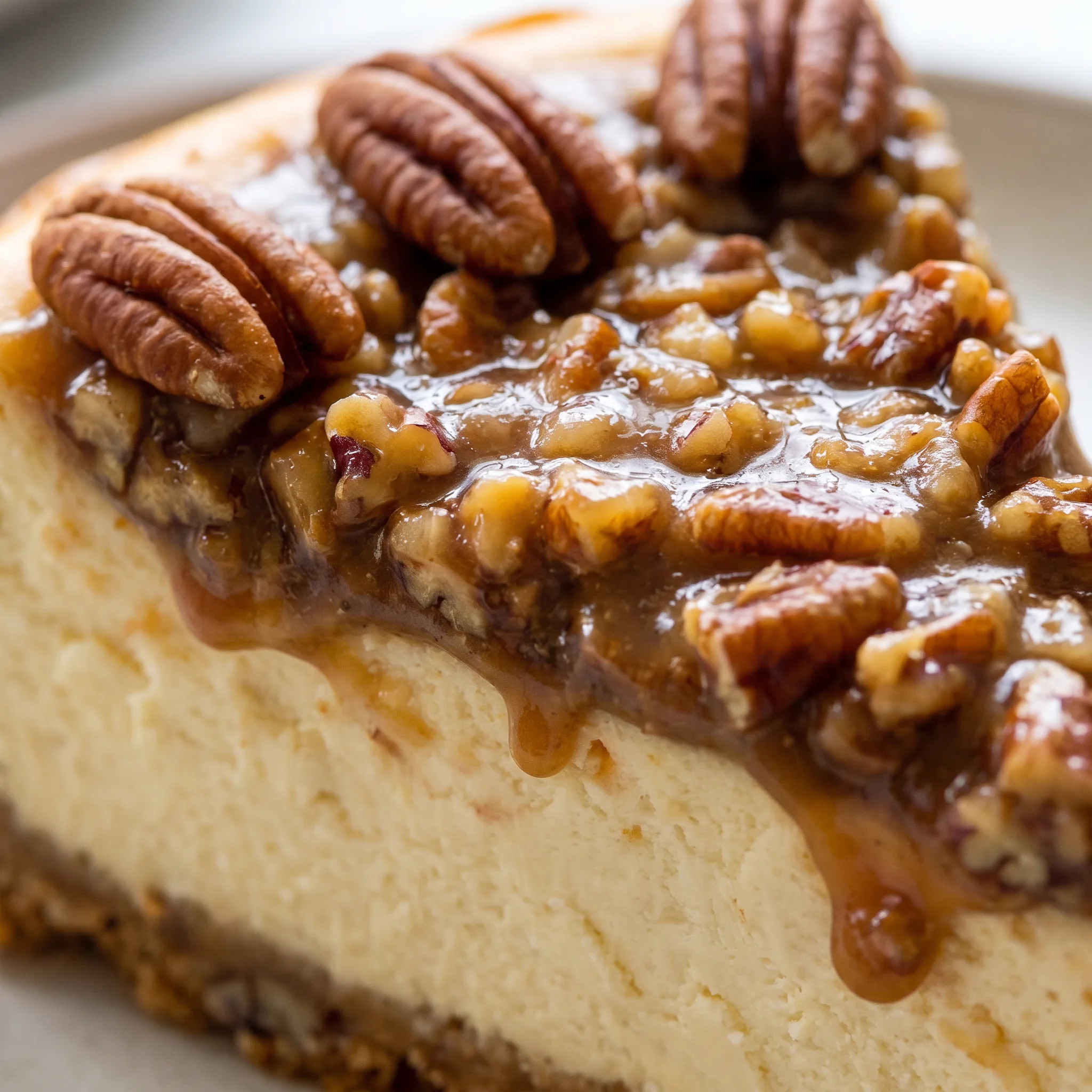
Ingredients That Earn Their Keep
pecans: Buy raw, unsalted pecans. The crust needs them finely processed; the topping needs roughly chopped.
dark corn syrup: Dark corn syrup gives the topping deeper color and flavor than light. Don’t use molasses or honey here.
cream cheese: Use full-fat block cream cheese, not the tub kind. It must be at room temperature for a smooth filling.
dark rum: The rum adds a warm note. If you skip it, the topping loses depth, but the recipe still works.
graham cracker crumbs: Process whole crackers for fresh crumbs. Pack the crumbs when measuring to keep the crust sturdy.
The cheesecake filling is only partially set after its initial bake, so the crust must act as a barrier to hold the liquid topping. If the topping is poured above the crust’s edge or the crust is not pressed high enough, the syrup can leak underneath, ruining the crust’s crispness and causing sticking.
Reading the Cheesecake Before the Topping Goes On
The wobble that means it’s ready
After 40 minutes at 300°F, the edges should look set and dull, while the center still quivers when you gently shake the pan. That wobble is not a failure; it’s the sign the filling has cooked enough to support the topping without sinking.
If the center looks liquid or sloshes, give it another 5 minutes. If it’s fully firm, the cheesecake may crack later, but it’s still salvageable.
Topping that won’t run over the crust
The pecan mixture should mound slightly, not pool. Spoon it on slowly, letting it settle between the pecans.
If the syrup climbs past the crust’s rim, it will leak during baking and glue the pan to the cake. Stop adding if the level nears the top. A little extra topping left in the bowl is better than a crust that soaks and sticks.
Watching the topping set without burning
During the final 40 to 50 minutes, the topping darkens from pale amber to deep golden brown. Peek through the oven door; the surface should look glossy and barely bubbling.
If the edges brown faster than the center, lay a foil ring over the rim. The topping is done when it’s uniformly browned and the center doesn’t jiggle when tapped.
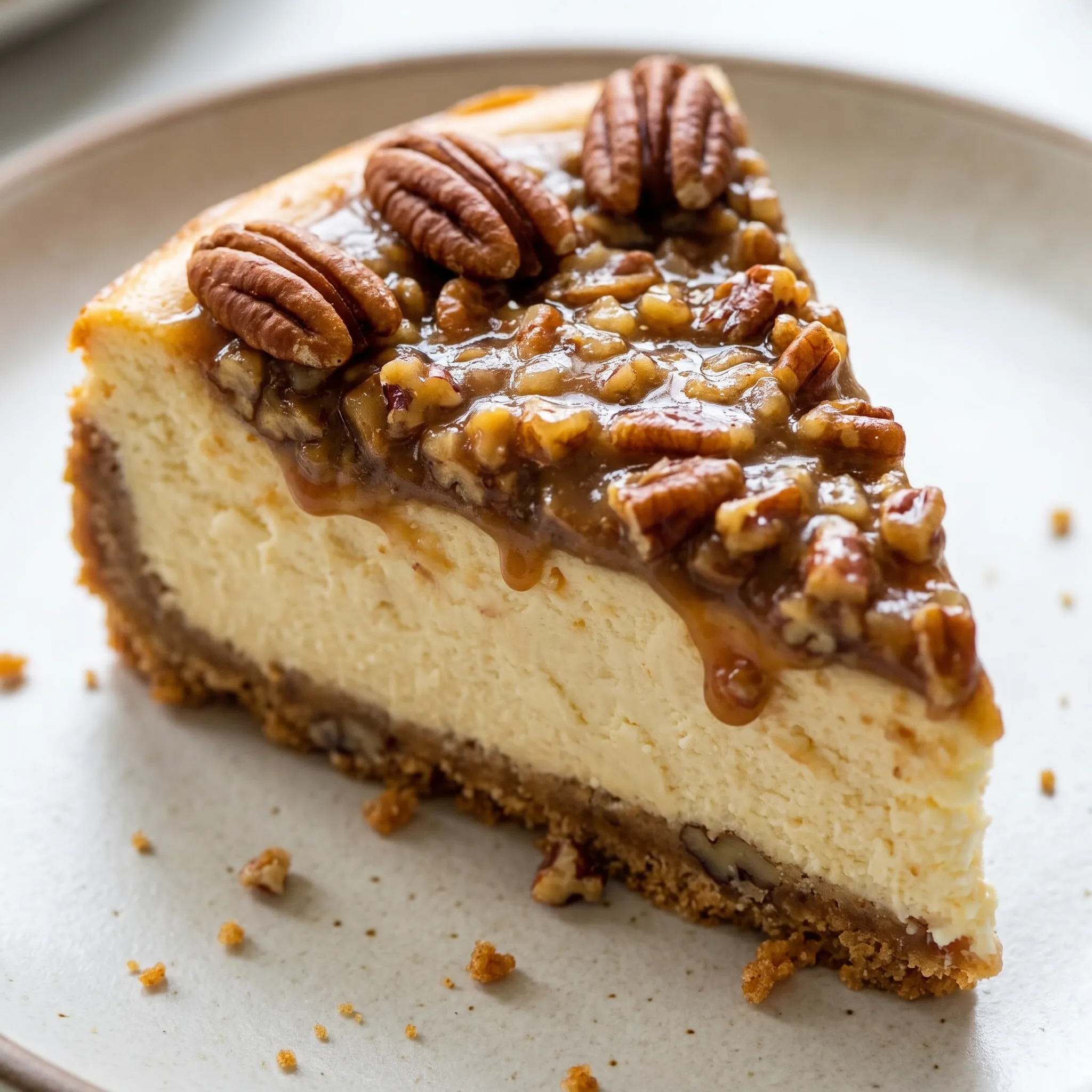
Pecan Pie Cheesecake with Graham Cracker Crust
Ingredients
Method
- Position the oven rack centrally, then heat the oven to 350°F (175°C). Line the bottom and sides of a 9-inch springform pan with parchment or foil. Spray lightly with nonstick coating. Wrap the pan’s exterior bottom with foil and put aside.
- Mix graham cracker crumbs, ground pecans, brown sugar, and melted butter until uniform. Press the mixture firmly into the bottom and along the sides of the prepared pan, reaching at least 3/4 up the sides to accommodate the filling and topping.
- Bake for 10 minutes. Let it cool before making the filling.
- Reduce the oven temperature to 300°F (150°C).
- In a large bowl, beat the cream cheese with an electric mixer on medium speed until smooth, about 1 minute.
- Add sugar, sour cream, vanilla, and salt. Mix on medium speed until well combined.
- Fold in the eggs gently with a spatula. Pour the filling over the crust and spread evenly.
- Bake for 40 minutes. While it bakes, start the topping.
- In a medium saucepan, stir together brown sugar, corn syrup, rum, and butter. Heat over medium, stirring constantly, until boiling. Let it boil for 2 more minutes.
- Take off heat and cool. In another bowl, whisk eggs, salt, and heavy cream.
- After the cheesecake has baked 40 minutes, remove from oven. Carefully mix the egg mixture into the cooled syrup, then fold in the chopped pecans.
- Gently spoon the pecan mixture over the cheesecake, making sure the syrup stays below the crust’s top edge to avoid leakage and a soggy crust.
- Put the cheesecake back in the oven and bake another 40-50 minutes, watching until the topping turns golden brown. If the edges brown too much, cover with foil.
- When done, transfer to a wire rack to cool completely. Then cover and refrigerate at least 4 hours.
- Release the springform pan sides. If stuck, run a butter knife around to loosen. Then lift off the outer ring.
- Carefully move the cheesecake to a serving plate. For cleaner slices, freeze for 1-2 hours before cutting.
- Use a sharp knife, wiping it clean between cuts. If frozen, let slices sit at room temperature for 30 minutes before serving.
Swaps That Work, and One That Won’t
graham cracker crumbs: Crushed vanilla wafers or shortbread cookies, same amount by weight. Either swap keeps the crust crisp and buttery. Vanilla wafers lean sweeter, shortbread adds a richer, more tender crumb.
You still need the pecans in the crust; they’re what give it that nutty backbone and extra grip against the wet filling.
dark corn syrup: Maple syrup or honey, same volume, but expect a thinner, less set topping. Dark corn syrup is thick and neutral-sweet, which lets the brown sugar and rum come through.
Maple or honey bring their own flavor and more moisture. The topping may turn out softer and take longer to set in the fridge. If you go this route, don’t be surprised if the pecan layer slicks rather than slices.
dark rum: Bourbon or extra vanilla extract, same amount. Bourbon adds a similar warmth, though oakier. Vanilla keeps the topping sweet without the boozy edge.
The syrup won’t taste as complex, but it’ll still bake into a glossy, firm layer.
oat or almond-based), same amount by weight. Dairy-free blocks can work, but they’re softer and more prone to cracking. Check the label for a block style, not a tub, and let it come to room temperature just like the real thing.
The filling may set a bit looser, so don’t skip the chill time. If you need this cheesecake dairy-free, swap the sour cream for a full-fat coconut or oat version and use a plant-based butter in the crust and topping.
Storing and Serving
Once the cheesecake has fully chilled and set, it’s ready to serve. For the cleanest texture, slice it straight from the fridge with a sharp knife dipped in hot water and wiped dry between cuts. If you freeze it for an hour or two first, the slices come out even cleaner, but let them sit at room temperature for 30 minutes before eating so the filling softens to its intended creaminess.
Don’t skip the wait; a too-cold slice will taste firm and muted.
Store leftovers in the refrigerator, loosely covered, for up to 5 days. The cheesecake firms as it chills, which makes slicing neat, but it also gradually tightens the texture. After a day or two, it will still be creamy, just denser.
Let portions sit out for about 20 minutes before serving to restore some of the original softness.
For longer storage, freeze individual slices wrapped tightly in plastic wrap and then foil. They’ll hold for up to 3 months. Thaw overnight in the fridge, then bring to room temperature before serving.
The texture will be slightly less silky than fresh, but the flavors stay intact.
Tips
- Whisk the eggs in a small bowl until the yolks and whites are fully combined before folding them into the filling. This prevents streaks of egg white from appearing in the baked cheesecake and ensures the eggs disperse evenly with minimal stirring.
Frequently Asked Questions
Can I make this pecan pie cheesecake ahead of time?
Yes, you can, as long as you respect the chill time. Bake it fully, cool it completely, then refrigerate for the 4-hour minimum.
Leftovers keep in the fridge for up to 5 days, loosely covered. For longer storage, freeze individual slices wrapped in plastic and foil for up to 3 months. Thaw overnight in the fridge, then let slices sit at room temperature about 20 minutes before serving.
Why did my cheesecake crack on top?
Cracks usually come from overbaking or from a sudden temperature change. If the center was fully firm when you shook the pan, it likely baked too long. Another culprit is a cold draft hitting the hot cheesecake as it cools, cool it gradually on a wire rack away from windows.
The low 300°F oven and the gentle first bake are designed to prevent this, so check for doneness at the 40-minute mark.
How do I know when the cheesecake is done baking?
After the final bake, the topping should be deep golden brown and barely bubbling, and the center shouldn’t jiggle when you tap the pan. The edges will look set and dull, while a slight wobble in the center is fine, it will firm up as it chills. If the edges brown too fast, cover them with foil.
Can I use a different type of nut instead of pecans?
You can swap in walnuts or hazelnuts, but expect a different flavor and texture. Walnuts are more bitter and less sweet; hazelnuts add a distinct earthy note. The crust needs the nuts finely processed to hold its structure, so adjust the processing time.
The topping’s texture will change too, pecans stay firmer when baked, while walnuts soften more.
What’s the difference between this and a traditional pecan pie?
This is a cheesecake with a pecan pie topping, so you get a creamy, tangy filling instead of the gooey custard of a pecan pie. The crust is a baked graham cracker and pecan shell rather than a pastry.
The topping cooks on top of the cheesecake at a low temperature, so it sets into a glossy layer without the deep caramelization of a pie. It’s richer and more substantial, best served in thin slices.
