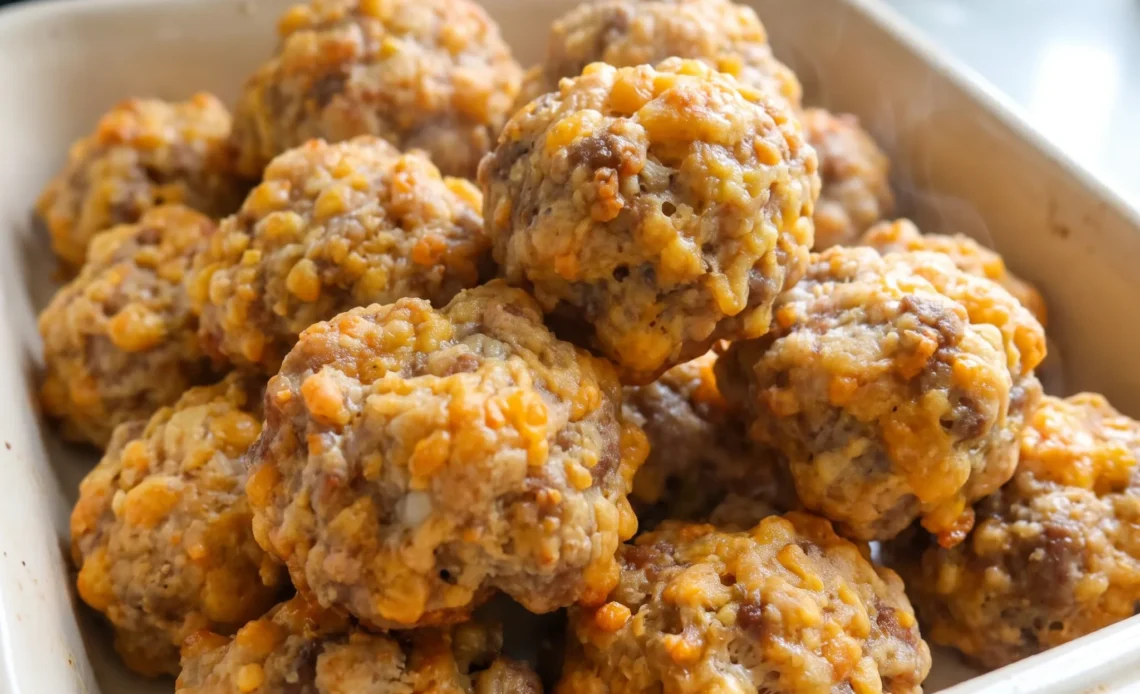
Sausage balls earn their reputation on speed: one bowl, a quick shape by hand, and a hot oven does the rest while you set out everything else. The trouble cooks hit isn’t the mixing. It’s reading the raw dough before it ever sees heat, because the same batch can bake up tender or slump flat depending on a feel in your palm that no timer captures.
The recipe leans on a blend that’s more cheese and sausage than it is binder, so the margin between a mixture that holds a rough clump and one that smears like paste is narrow, and the oven bakes that mistake in. Nothing here is fussy, but it’s honest about where a batch can go sideways. Bite-size, napkin-only, made for a crowd that eats standing up.
Sausage balls are a high-fat dough: the sausage and cheddar both render fat in the oven, and the Bisquick must absorb that fat while forming a structure light enough to stay tender. Overmixing develops gluten strands that tighten the dough, squeezing fat out during baking so the balls spread and turn greasy; underworking leaves dry pockets that crack. The mixture should be handled just until it holds together, with visible flecks of fat still intact.
Bisquick Holds the Whole Thing Together
That two cups of Bisquick isn’t filler. It’s the only thing in the bowl that sets up and gives a sausage ball its shape.
Drop it to one cup and you get a loose, wet pile that slumps on the sheet and greases out around the edges instead of holding a round. Cheese brings fat and moisture, four cups of it, and sausage brings more of both.
Those two alone would never firm up. The small pour of milk loosens the mix just enough that it gathers into something you can press in your palm. Skip the milk and you’re fighting dry pockets that won’t close.
Add more and the dough turns slack and spreads. This ratio is the line between a ball that stays put and one that flattens into a greasy puddle.
Sharp Cheddar and Spicy Sausage Set the Flavor
The heat in the sausage is the flavor backbone here. Mild breakfast sausage would leave you with something bland and forgettable, so the recipe leans on the spicy kind for a kick that survives the bake. Sharp cheddar does the same job on the other side, cutting through the pork fat with a tang that a mild cheese can’t match.
When the fat renders, it carries both seasonings through every bite. One thing cooks overlook: block cheese you shred yourself melts into the mix, while the pre-shredded bag has a coating that keeps the strands from knitting, and the balls can crumble apart when you shape them.
Take a bite while they’re still warm and the sausage and cheddar hit together, salty, spicy, rich.
Texture Comes Down to a Light Hand
A good sausage ball is crisp at the edge and tender through the middle. Get there by stopping when the mixture just comes together, with no dry streaks left in the bowl. Keep working it past that and the Bisquick starts to toughen, and you end up with something dense and bready instead of soft.
Squeeze a handful: it should hold its shape and feel a little tacky. Too dry and the balls crack as they bake, too wet and they slump and spread.
Roll them all the same size so they finish together. Small ones dry out before the big ones are done.
When you pull a tray of evenly shaped balls, they should sound hollow when tapped and give slightly under a fingertip, not resist like a rock.
Why They Show Up at Every Southern Party
These things are built for a crowd. The recipe makes 24, and doubling it is as simple as doubling everything in the bowl. Shape them ahead, freeze the unbaked balls on a sheet, then bag them, and bake straight from frozen when guests arrive, adding a few extra minutes to the timer.
They hold at room temperature for hours, so they work on a buffet where nobody wants to hover over a hot tray. Warm or cooled, they’re just as good.
Bite-size and neat, no fork, no plate, just a napkin. That’s why they turn up at holidays, game days, and every shower and potluck in between. People reach for two before they’ve even said hello.
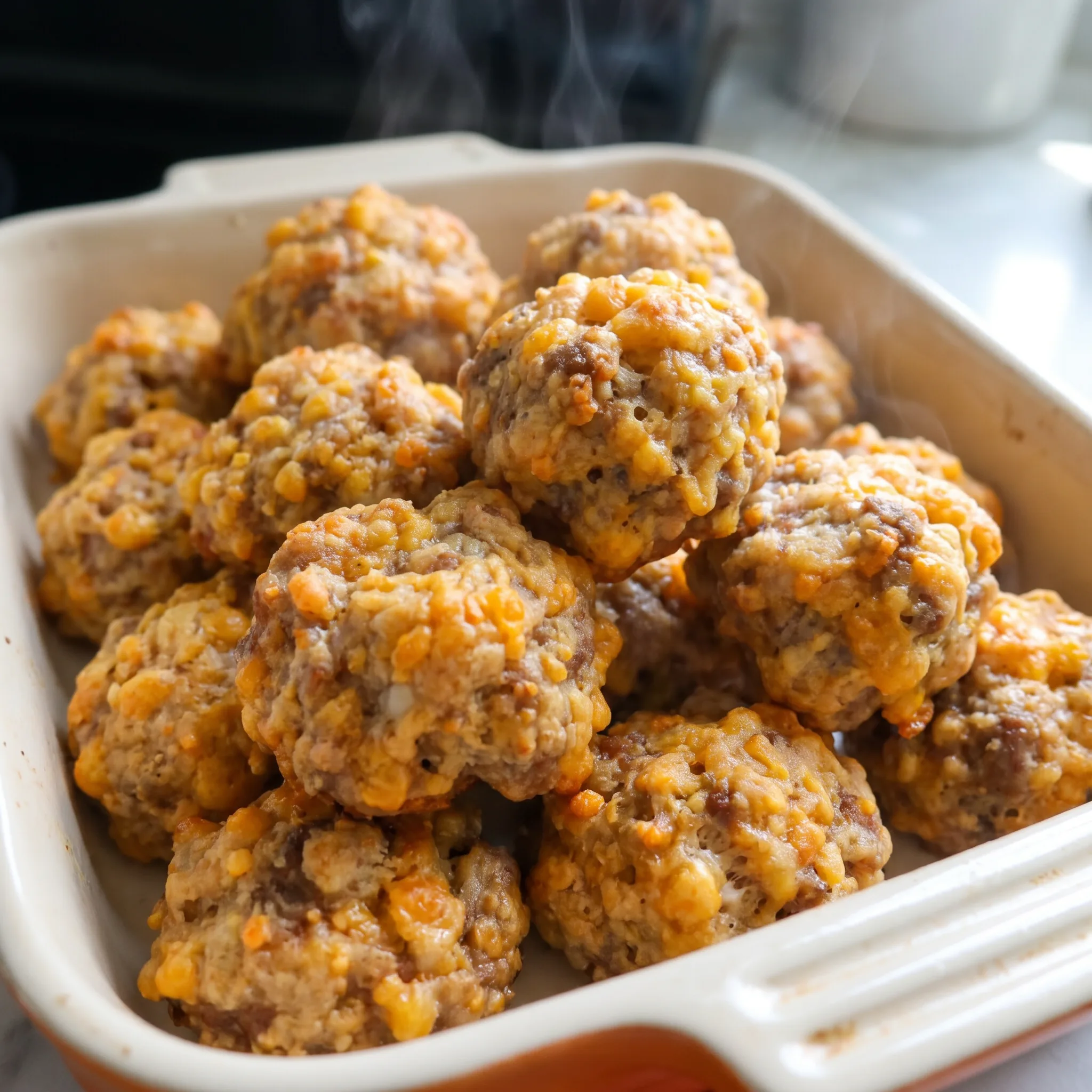
What to Reach For in the Aisle (and Why)
Bisquick: It’s the only ingredient here that sets up and holds a shape, so buy the box, not a homemade biscuit mix with different ratios.
Cheddar cheese: Shred a block yourself; the pre-shredded bag has a coating that keeps strands from knitting and balls crumble when shaped.
Spicy sausage: Go hot, not mild; the kick survives the bake and mild leaves you with something bland and forgettable.
Milk: Even a small pour matters here, so use dairy milk rather than a thin plant milk that won’t bind the same way.
The Two Moments That Decide How These Balls Turn Out
Reading the mixture before you shape it
Stop mixing when no dry Bisquick streaks remain and the mass holds together in a rough clump. Squeeze a handful: it should stick to itself, feel slightly tacky, and leave your palm greasy rather than wet.
If it crumbles, add milk a teaspoon at a time. If it smears like paste, you’ve overmixed; the baked balls will be dense, not tender. This is the only chance to fix the dough before shaping.
Judging when they’re done, not just when the timer says so
At 350°F (175°C), start checking at 20 minutes. The signal is color: a light golden brown on the peaks and around the bottom edge.
Pale tops mean the inside is still doughy; deep brown means the cheese has broken and the balls will taste greasy. If they’re browning unevenly, rotate the pan.
Pull them when the color is right, even if that’s before 25 minutes.
Checking for doneness without cutting one open
Tap a ball with your finger. It should sound hollow and feel firm at the edges but give slightly when pressed in the center. If it feels soft and spongy all over, give it a few more minutes.
If it’s rock-hard, you’ve gone too far. A skewer inserted into the center should come out clean, with no wet crumbs clinging. That’s the only reliable way to know the sausage is cooked through.
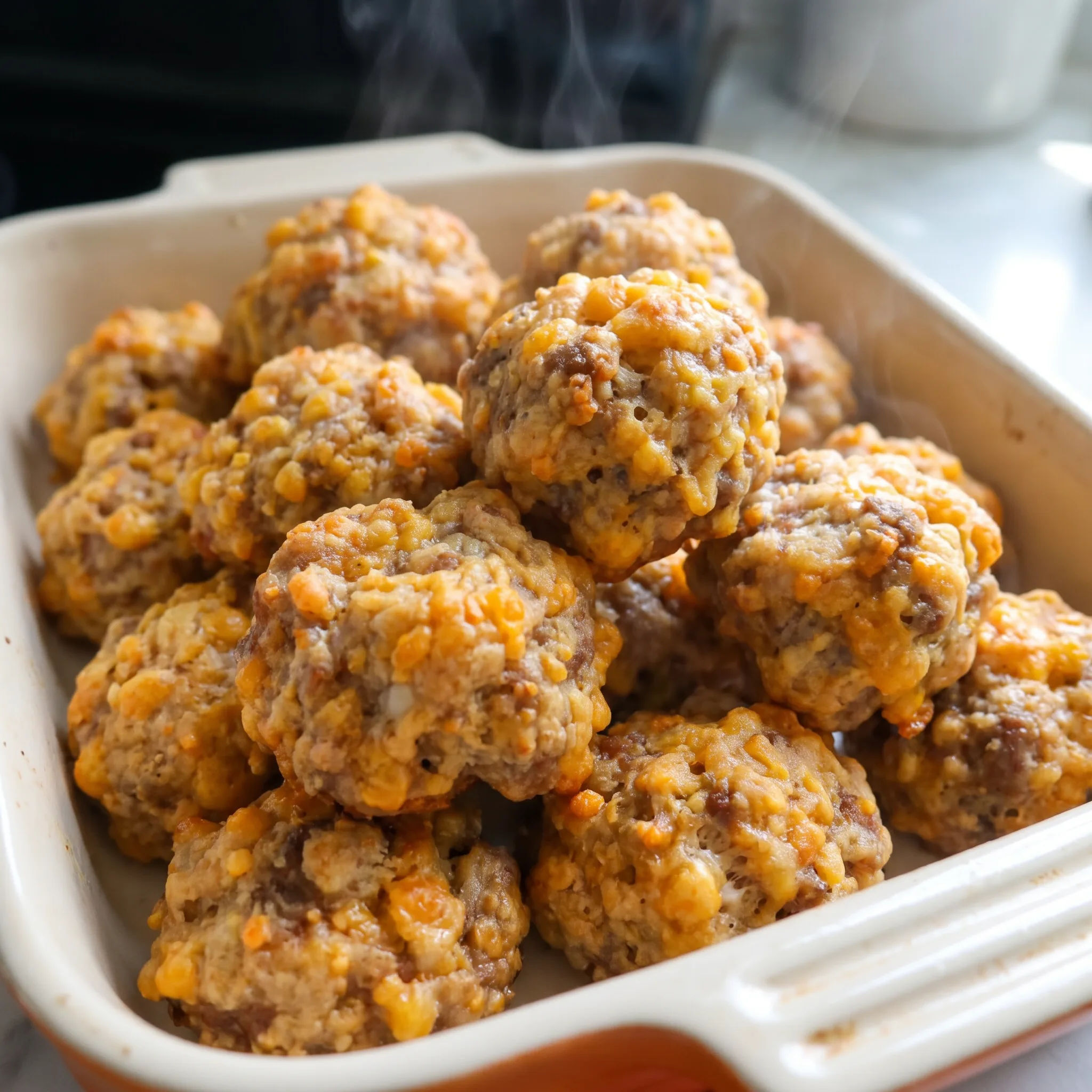
Southern Sausage Balls with Cheddar and Bisquick
Ingredients
Method
- In a large bowl, combine all the ingredients together.
- Shape the mixture into balls by hand or with a small scoop.
- Place them 2 inches apart on a baking sheet lined with parchment paper.
- Bake at 350°F (175°C) for 20-25 minutes or until lightly browned.
Storing and Serving Sausage Balls
Eat them within an hour of baking for the best contrast: crisp shell, tender center. After that the crust softens as moisture moves from the sausage and cheese outward, and by the second hour they’re uniformly soft.
They’re still fine at room temperature for about two hours on a party tray, which is the realistic serving window for a buffet. Beyond that, refrigerate.
In the fridge, keep them in an airtight container for up to four days. The cold firms the fat and dulls the texture, so reheat at 350°F (175°C) for 6 to 8 minutes to bring back some edge. They won’t fully crisp again, but they warm through without drying.
Freeze baked balls in a single layer, then bag them for up to two months. Reheat from frozen at 350°F (175°C) for 12 to 15 minutes. Unbaked shaped balls freeze well too; bake those straight from frozen, adding 5 minutes.
Any finishing touch, a dip or a dusting of spice, goes on just before serving, never on stored balls.
Tips
- Let the sausage and the shredded cheddar sit out for about 20 minutes before you mix. Cold sausage is firm and the cheese is stiff, so combining four cups of cheese with a pound of cold meat takes a lot of squeezing to bring together, and that extra handling is what toughens the Bisquick. Cool, not cold, ingredients break up with a few stirs, so a small scoop drops even balls without you mashing the dough to get there.
- Scoop with a level 1-tablespoon measure and pack it just to the rim. That portion divides the batch into roughly 24 balls, which is what the yield assumes, and it keeps every ball the same size so the small ones don’t dry out before the large ones brown. A heaping scoop pushes you toward 18 or 20 oversized balls that need longer in the oven and dry at the edges.
Swap the Sausage or Cheese, but Don’t Touch the Bisquick
Spicy sausage: Hot Italian sausage or a mix of sweet and hot. Italian sausage brings fennel and a different heat, so the flavor drifts from the breakfast-sausage profile these are known for. Sweet sausage alone leaves the balls flat; if you want less heat, use half hot and half sweet so the seasoning still carries through the pork fat.
Cheddar cheese: Monterey Jack or pepper Jack for a milder or spicier bite. Jack melts smoothly but has less tang, so the balls taste richer and less sharp. Pepper Jack adds its own heat, which can double up with spicy sausage.
Either way, shred a block yourself; the pre-shredded bag has a coating that keeps the strands from knitting, and the balls crumble when shaped.
Bisquick: Gluten-free Bisquick or a from-scratch mix. Gluten-free Bisquick absorbs liquid differently, so start with the same 2 cups but expect the dough to feel drier.
Add milk a teaspoon at a time until it holds together. A homemade biscuit mix with a different fat-to-flour ratio won’t set the same way; the balls may spread or stay doughy in the center.
Milk: Oat milk or another plant milk. Oat milk binds almost as well as dairy, so use the same 1/4 cup. Almond or rice milk is thinner and won’t bring the mixture together the same way; you may need an extra splash, but add it slowly or the dough turns slack and the balls flatten in the oven.
Frequently Asked Questions
Can I make sausage balls ahead of time and bake them later?
Shape them, freeze them on a sheet, then bag the frozen balls. Bake straight from frozen, adding 5 minutes to the timer.
That’s the make-ahead move that actually works. If you’re only holding them a few hours, refrigerate the shaped balls, but know the cold dough bakes up a little denser than fresh. The texture won’t be identical, but it saves you the last-minute scramble.
Why did my sausage balls turn out dry and crumbly?
The most common culprit is overmixing. Once the Bisquick is fully incorporated, stop; keep working the dough and it toughens, and the baked balls turn dense and dry instead of tender.
If your mix still crumbles when you squeeze a handful, add milk a teaspoon at a time until it holds together. A second check: pre-shredded cheese has a coating that keeps the strands from knitting, so the balls can fall apart. Shred a block yourself and the mixture binds better.
How do I keep sausage balls from spreading too much in the oven?
Spread comes from a dough that’s too wet or too warm. If the mixture smears like paste when you squeeze it, you’ve added too much milk; work in a little more Bisquick, a tablespoon at a time, until it holds a rough clump. Also, keep the shaped balls cool before they hit the oven.
On a hot day, a few minutes in the fridge firms the fat so they hold their round. And space them 2 inches apart on parchment; crowding steams them and they slump into each other.
