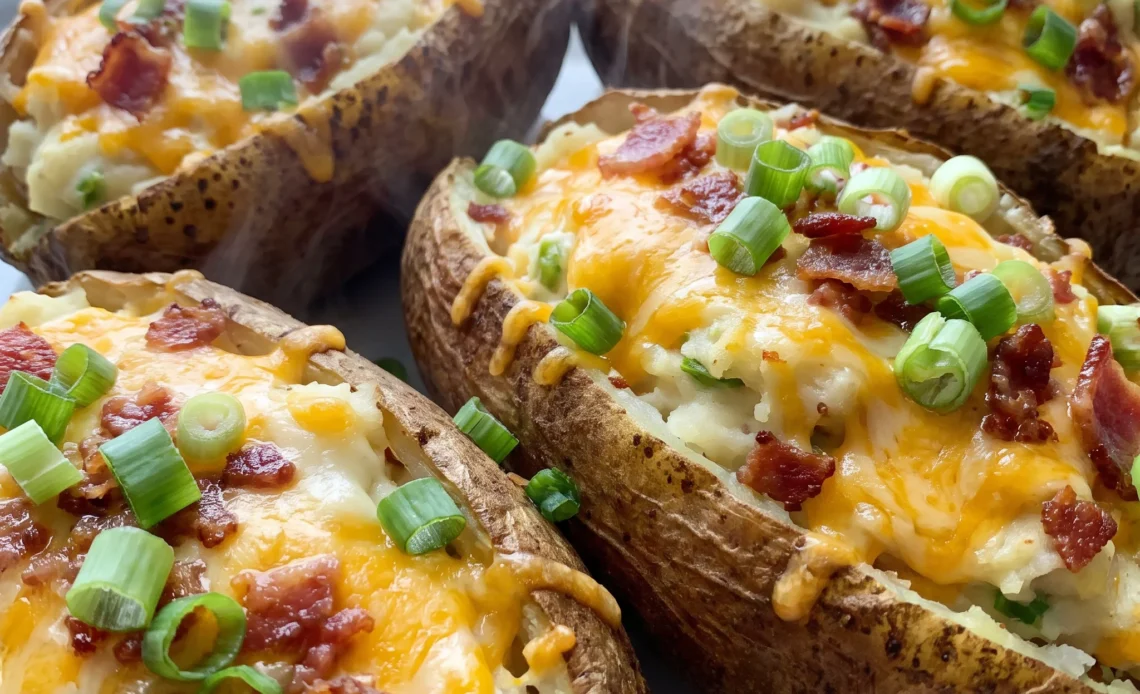
A fork pressed into the top should sink through bubbling cheddar and meet just a little give before it hits the crisp shell underneath. Get that and you’ve pulled off the trick of the whole dish, which is that a loaded baked potato looks like a side and eats like dinner.
The margin for error is real: the filling can turn pasty, the shell can go slack, the toppings can sit there cold and unmelted if the parts don’t come together in the right order. What separates loaded baked potatoes from a plain one with cheese dumped on top comes down to a few decisions that are easy to get wrong and just as easy to get right once you know what to look for.
Everything below is about those decisions, and about what each one actually does to the bite you’re about to take.
Cooked russet potatoes are high in starch, and mashing them aggressively or for too long ruptures the swollen starch granules, releasing amylose that forms a dense, gluey paste. The butter and sour cream in this recipe coat the starch granules and limit how much they can bind to each other, but that protection only works if the flesh is mashed just until smooth with some small chunks remaining. Over-mashing defeats the fat’s coating action and produces a filling that tastes pasty rather than fluffy.
A Proper Shell Holds Everything
Leave a quarter inch of potato against the skin and the whole thing stays upright. Scoop too close to the peel and the shell goes floppy, tearing when you press the filling back in. That wall isn’t wasted potato.
It’s the reason a loaded potato can sit on a plate without spilling its contents across the rim. The skin also gives the second bake something to grip. Soft shells collapse under a heavy scoop of cheddar and bacon, and the filling leaks out the bottom before the cheese even melts.
A sturdy base means the potato keeps its shape through the oven and onto the plate. You’ll know the wall is right when the shell holds its curve after you’ve pressed the mash back inside.
If it buckles, the scoop went too deep. Next time, aim to leave a visible ring of flesh all the way around.
Dairy Makes the Mash Creamy, Not Gluey
Butter and sour cream aren’t just flavor. They coat the potato’s starch so the mash stays silky instead of turning sticky. Skip them and you get a dense, pasty filling that sits like paste in the shell.
The milk loosens things further, enough to fold in cheese without the mixture clumping. Sour cream brings a tang that cuts the saltiness of bacon and cheddar, so each bite doesn’t taste flat. Stop mashing while you can still see small lumps.
Overworked potatoes release more starch and the texture goes from fluffy to heavy. A few lumps also give the filling some body, so it doesn’t turn into puree that oozes out of the shell. Taste a spoonful before you fold in the cheese.
It should be seasoned enough to eat on its own, but not so rich that the toppings disappear.
The Second Bake Brings It Together
Putting the stuffed potatoes back in the oven does more than warm them through. The cheese needs direct heat to melt and fuse with the filling, and the filling needs time to heat so the first bite is hot all the way down. Without that second pass, you’d have cold sour cream against cold bacon and unmelted shreds on top.
The oven also dries the surface just enough that the cheese sets into a cohesive layer instead of sliding off in strings. You’re looking for a uniform pull when you lift a forkful, not separate bands of potato and topping.
If you want a deeper golden crust, a short broil works, but stay nearby. The line between bubbly and burnt is thin, and the cheese can go from to acrid in under a minute.
Pull them when the edges just start to brown.
Sharp Cheddar, Bacon, and a Fresh Finish
Sharp cheddar does the heavy lifting against all that butter and sour cream. Its bite keeps the potato from tasting one-note rich, and the fat in the cheese carries the smoke from the bacon.
Bacon adds crunch and salt, but also a savory depth that plain salt can’t match. Together they make each forkful taste like more than the sum of its parts.
Green onions scatter on last, and their raw onion punch wakes up your palate between bites. Without them, the whole thing can feel heavy by the second half. They also add a little green against the orange and brown, which makes the plate look cared for.
Use the white and light green parts too; they’ve got more bite than the hollow green tops. Serve right away, while the onions are still crisp and the cheese is at its gooiest.

What to Buy for Loaded Baked Potatoes
Russet potatoes: Pick large, evenly shaped russets around 10 ounces each, since their high starch bakes fluffy and holds up to scooping.
Thick-cut bacon: Thick-cut strips give you substantial pieces that stay crisp in the filling instead of disappearing into salty crumbs.
Sharp cheddar cheese: Buy a block and shred it yourself, as pre-shredded cheese often contains anti-caking agents that melt poorly.
Sour cream: Full-fat sour cream brings the tang that balances the richness; low-fat versions can turn watery when baked.
Judging the Loaded Baked Potato: What to Watch at Each Turn
When a potato is done baking
A skewer should slide in with no resistance at all, like pushing through soft butter. If it meets any pushback, even a little, the starches haven’t fully swelled and the flesh will be dense instead of fluffy. Check at 55 minutes, then every 5.
A potato that’s underdone won’t mash smoothly; you’ll get lumps that stay hard. If you hit resistance at 65 minutes, give it 5 more and check again.
How much flesh to leave in the shell
You want a quarter-inch wall all around. After scooping, hold the shell in your hand and press gently: it should feel like a sturdy bowl, not a wet paper towel. If it flexes too much, you’ve gone too deep.
The fix is to stop scooping and leave more flesh, even if that means less filling. A floppy shell will tear when you pack the mash back in, and the whole thing leaks.
The texture of the mash before you fold
Stop mashing when you can still see small lumps the size of a pea. Overworking releases starch and the filling turns gluey, which ruins the fluffy contrast with the crisp skin. Taste a spoonful: it should be seasoned enough to eat alone, but not so rich that the bacon and cheese get lost.
If it tastes flat, add a pinch more salt before the cheese goes in.
When the cheese has melted and the tops are bubbling
In the second bake, the cheese should be fully liquid and the edges of the potato just starting to brown. That’s your signal to pull them.
If you wait for a deep golden crust, the filling dries out and the cheese turns greasy. The broiler can speed this up, but stay close: the line between bubbly and burnt is about 30 seconds. If the cheese is melted but the tops aren’t bubbling, give it one more minute.

Loaded Baked Potatoes with Cheese and Bacon
Ingredients
Method
- Set oven to 425°F (220°C). Wash the russet potatoes thoroughly and dry them with a towel. Use a fork to pierce each potato 5–6 times so steam can escape. Coat each potato lightly with olive oil and season with ½ teaspoon kosher salt. Put them right on a baking sheet lined with foil or directly on the oven rack. Bake for 55–65 minutes, until a skewer slides in without resistance.
- While the potatoes are in the oven, cook the bacon in a skillet over medium heat until it turns golden and crispy, roughly 6–8 minutes. Move it to paper towels to drain, then break it into small pieces or chop it.
- Take the soft potatoes out of the oven. Cut each one lengthwise, being careful not to slice all the way through. Remove the inside flesh into a bowl, keeping about a ¼-inch shell. If you like, save a bit of cheese to sprinkle on the shells afterward.
- Into the bowl with the potato flesh, put the softened butter, sour cream, milk, garlic powder, ¼ teaspoon salt, and ¼ teaspoon pepper. Mash until smooth but with some small chunks left. Fold in half of the shredded cheddar and half of the bacon bits.
- Put the potato mixture with cheese and bacon back into the shells. Top each with the rest of the cheese and bacon.
- Place the stuffed potatoes back in the oven and bake for 10–12 minutes, until the cheese has completely melted, the edges are a bit golden, and the tops are bubbling. If you want them crispier, broil for another 1–2 minutes, keeping a close eye on them.
- Take them out of the oven and let them cool for a moment. Scatter the sliced green onions over the top and serve while hot. Pair with baked potato sides like steamed broccoli or a fresh salad to cut the richness.
Storing and Reheating Loaded Baked Potatoes
These are best within 20 minutes of the second bake. The shell stays crisp, the cheese pulls, and the green onions keep their snap. Scatter the onions only on the portions you’re eating right now; they go limp and bitter in the fridge.
Cool leftovers uncovered for about 30 minutes, then refrigerate in a sealed container for up to 3 days. The shell softens first, usually by day two, and the filling stiffens as the butter and sour cream set. Reheat at 375°F on a baking sheet for 12 to 15 minutes.
The dry oven heat re-crisps the skin and melts the cheese again; a microwave leaves the shell rubbery and the center unevenly hot. Skip the freezer.
The dairy filling separates and the potato flesh turns watery, so there’s nothing worth saving. Add fresh green onions after reheating, never before.
Tips
- Buy bacon sliced between 1/8 and 3/16 inch thick, not the paper-thin kind. Thin strips curl up and cook through before the fat renders, so the pieces stay chewy in the filling. Thick-cut renders slowly, giving up its fat while the meat firms, which is what makes it crumble cleanly instead of smearing.
- Start the bacon in a cold skillet over medium heat rather than dropping it into a hot pan. The gradual temperature rise renders the fat evenly and leaves the strips flat, so they chop into distinct pieces. Cook it during the potato bake and you’ll have the crumble cooled and ready before the flesh comes out of the oven.
Swap the Toppings, Keep the Base
Sharp cheddar cheese: Pepper jack, shredded. Pepper jack melts similarly but brings a clear, lingering heat that cuts through the butter and sour cream. Use the same 1 cup total, split between filling and topping.
Some brands are saltier, so taste the mash before adding the full ¼ teaspoon of salt.
Thick-cut bacon: Turkey bacon. Turkey bacon crisps up but stays leaner, so you lose some of the rendered fat that carries smoke and salt. Cook it longer than the 6 to 8 minutes, until it’s stiff and well-browned, otherwise it’ll turn rubbery in the filling.
Crumble it fine so it distributes evenly.
tempeh or coconut-based strips). These won’t render fat the same way, so the filling may taste a bit drier. Add an extra tablespoon of butter or sour cream to compensate.
Cook the strips until they’re deeply browned and crisp; a soft strip will just disappear into the mash.
Sour cream: Plain full-fat Greek yogurt. Greek yogurt brings a sharper tang and slightly thicker body.
It can separate if overheated, but the short second bake is gentle enough. Use the same ½ cup; if the mash feels stiff, add an extra splash of milk.
Frequently Asked Questions
Can I make loaded baked potatoes ahead of time and reheat them later?
You can prep the parts, but the potato itself is at its best within 20 minutes of the second bake. If you want a head start, bake, scoop, and mix the filling, then stop before the second bake and refrigerate the stuffed shells covered for up to a day.
Finish them in a 375°F oven until the cheese melts and the tops bubble. Reheating a fully baked one works for leftovers, but the shell softens first and the filling stiffens as the butter and sour cream set.
Why did my loaded baked potatoes turn out dry or gluey?
Gluey almost always means the mash got worked too long, and the starch turned pasty instead of fluffy. Stop while you can still see small lumps about the size of a pea. Dry is a different problem: the flesh was underbaked, so it never swelled into something soft enough to mash smooth.
A skewer should slide in with no resistance at all, and if it meets any pushback, the potato needs more time. The filling can also read dry if the dairy went in cold or short, since the butter and sour cream are what keep the mash silky. Taste a spoonful before the cheese goes in and check that it’s seasoned enough to eat on its own.
How are loaded baked potatoes different from twice-baked potatoes?
They’re the same technique, and the name mostly tracks how far you take it. A loaded baked potato is split open, topped with cheese, bacon, and sour cream, and often served right after the first bake. A twice-baked potato gets scooped, the flesh mashed with butter and dairy, packed back into the shell, and returned to the oven so the cheese melts and the top browns.
This recipe is the twice-baked version: 55 to 65 minutes for the first bake, then 10 to 12 more for the second. The refill is what separates them, since the filling is mixed and seasoned before it ever goes back in.
