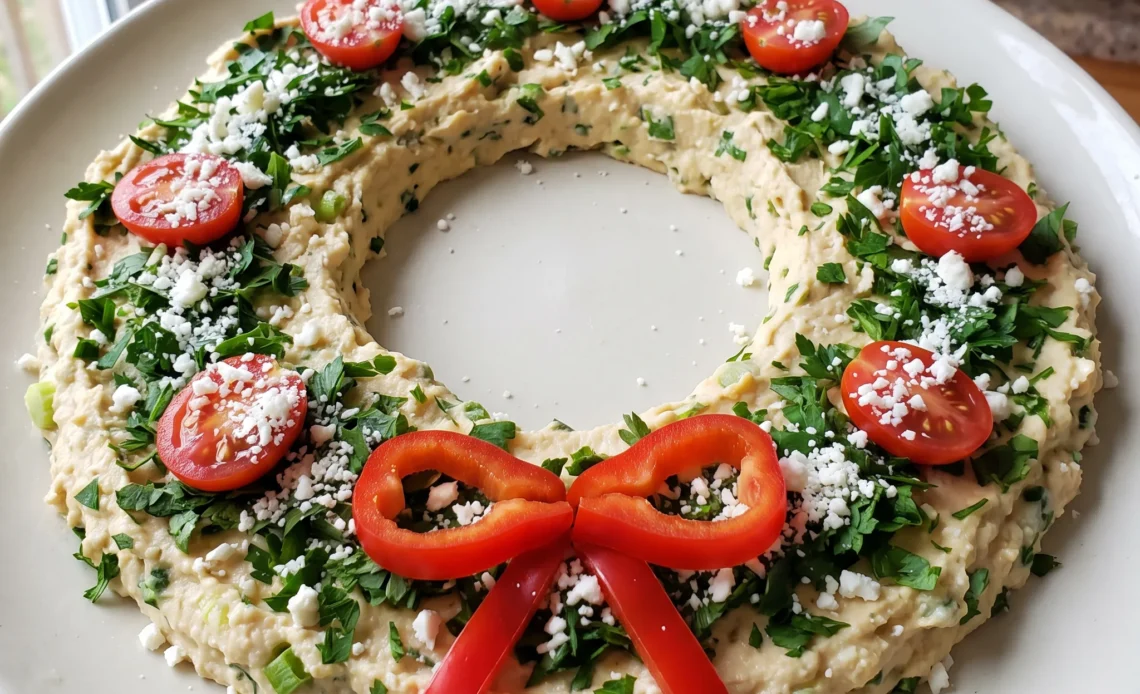
A ring of hummus under a green cap of parsley, tomatoes set in like ornaments, and a drift of feta that reads as snow. What you notice first is how deliberate it looks, and how little of that comes from skill. The hummus has to be stiff enough to hold the ring’s walls; a loose container slumps and the center hole sags before you’ve finished garnishing.
Same story with the parsley, which needs just enough oil to clump instead of scatter, and with the tomatoes, which sit on the green rather than sink into it. Get those textures right and this christmas hummus wreath looks assembled by someone with a plan.
Get them wrong and you’re spooning garnish back into place while guests are already reaching across it.
Cherry tomato halves are mostly water and have a smooth, wet cut surface. When placed directly on soft hummus, their weight and the lack of a rigid base cause them to sink, especially as the hummus warms and softens. This displacement not only ruins the ornament effect but also releases tomato juice, which can make the hummus watery and cause the tomatoes to slide.
Why Use a Bowl or Glass to Shape the Wreath?
A small bowl or drinking glass is the mold that forms the center hole. Placing it dead center on a large round platter gives you a clean, even ring, no freehand guesswork. If you plan to set a bowl of pita chips or veggies in the middle, use that same bowl as your guide.
The hole ends up the right size, not too tight or too wide. Spread the hummus mixture in a circle all around the bowl. Then remove it with a gentle upward twist.
If it sticks, a toothpick tip under the edge helps it release. You get a uniform wreath shape that looks deliberate, not lopsided. The platter stays neat, and the ring holds its form for garnishing.
That even circle is what makes the wreath read as a wreath.
What Does the Parsley Layer Actually Do?
Tossing parsley with oil and salt does more than season. The oil coats each leaf, so the parsley clings together and stays put on the hummus.
Without that coating, it would scatter and slide. Spoon it in a circle on top of the hummus, leaving a small border of hummus showing all around.
That border frames the green and keeps the edge tidy. The parsley layer is not just a pretty face. It gives the tomato halves a bed to sit on, so they don’t sink into the soft hummus.
Each tomato stays where you place it, cut side down, looking like a Christmas ornament. You get a clean separation between the hummus base and the bright red tomatoes, with a fresh green flavor in every bite.
Making the Red Pepper Bow: Worth the Effort?
The bow is optional, but it’s the one garnish that makes the wreath look finished. You need a red pepper with broad, flat sides. A skinny or curved pepper won’t give the cookie cutter enough flat surface to cut cleanly.
Cut one wide side off the pepper, then press a metal bow-shaped cookie cutter firmly through the slice. The result is a neat, recognizable bow.
If the pepper is too soft, the cut edges will be ragged. A firm pepper gives crisp lines.
Place the bow on the wreath, and it instantly reads as a wreath, not just a ring of hummus. The bow adds a festive touch without much extra work. Once it’s on, the whole platter looks intentional.
How Much Feta for the Snow Dusting?
The final dusting of feta is what makes the wreath look frosted. Use very finely crumbled feta, not the chunky stuff. Fine crumbles scatter like snow; big chunks sit like pebbles.
Start with a light sprinkle over the entire wreath. You want just a dusting, enough to catch the eye but not so much that it hides the parsley, tomatoes, or bow.
If your wreath is on the smaller side, use less; a larger ring can take a bit more. Judge by looking: the feta should look like a fresh snowfall, not a blanket. Once it’s on, the wreath is ready to serve.
The contrast of white against green and red is what sells the Christmas look.
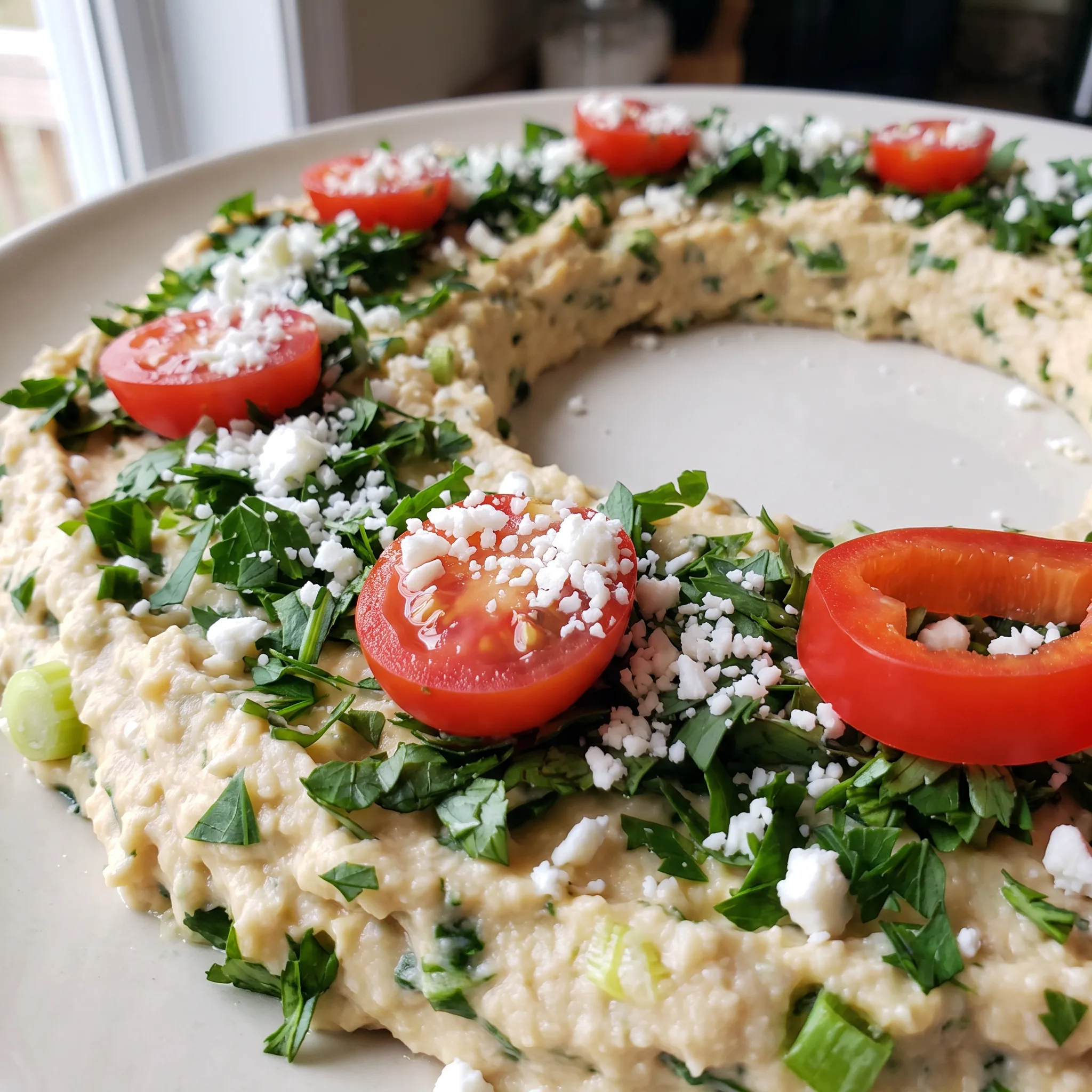
What to Look For at the Store: The Ingredients That Make or Break the Wreath
Store-bought plain hummus: Buy a thick, scoopable hummus; if it’s loose or runny, the ring will slump and the center hole won’t stay open.
Reduced-fat crumbled feta cheese: For the snow dusting, use the finest crumbles you can find; big chunks sit like pebbles instead of scattering like snow.
Italian flat-leaf parsley: Choose flat-leaf over curly; its broader leaves coat more evenly with oil and give a cleaner, less bulky layer.
Cherry tomatoes: Pick firm, ripe cherry tomatoes; soft ones will collapse when you press them into the parsley layer.
Red pepper (optional): For the bow, choose a pepper with broad, flat sides; a skinny or curved one won’t give the cookie cutter enough flat surface.
Judging the Wreath as You Build It
When the hummus mixture is spreadable enough to hold the ring
Store-bought hummus varies in stiffness. If it’s loose or runny, the ring will slump and the center hole won’t stay open.
Stir the hummus with the feta and green onions first, then look at how it falls off the scraper. It should mound slightly and hold a soft peak, not spread out like batter.
If it’s too soft, refrigerate it for 10 minutes to firm it up before spreading. A firmer mixture gives you walls that stay put while you garnish.
Reading the parsley coating: enough oil to make it cling
The parsley needs just enough oil to look glossy and clump together, not wet or dripping. After tossing with 1 teaspoon oil and 1/16 teaspoon salt, grab a pinch.
It should hold together lightly when you press it, and leaves should look evenly coated, not patchy. If it’s dry, it’ll scatter when you spoon it on; if it’s too oily, it’ll slide off the hummus. Add a few more drops of oil only if needed, and toss again.
Placing tomatoes so they sit on the parsley, not in the hummus
Cherry tomato halves can sink if the parsley layer is too thin or the hummus too soft. Press each half, cut-side down, just until it stops. You want the tomato to rest on the parsley, not disappear into the hummus.
If it sinks, the parsley layer isn’t thick enough; add a bit more parsley under that spot. A tomato that sits proud looks like an ornament; one that sinks looks like a crater.
Cutting the red pepper bow: firmness and flatness matter
A red pepper with broad, flat sides gives you a clean cut. If the pepper is soft or curved, the cookie cutter will crush it or leave ragged edges. Press the cutter firmly through the slice in one motion, don’t twist.
If the pepper gives too much, the bow won’t hold its shape. You can test a small piece first: it should snap, not bend. If it bends, the bow will look limp.
Use the firmest pepper you have.
Dusting the feta snow without burying the wreath
Finely crumbled feta should fall like snow, not clump. Sprinkle from a height so it distributes evenly. You want a light dusting that lets the green parsley and red tomatoes show through.
If you can’t see the parsley anymore, you’ve gone too far. Stop, and if needed, use a fork to gently flick away excess. The wreath should look frosted, not blanketed.
Judge by eye: the colors should still read clearly.
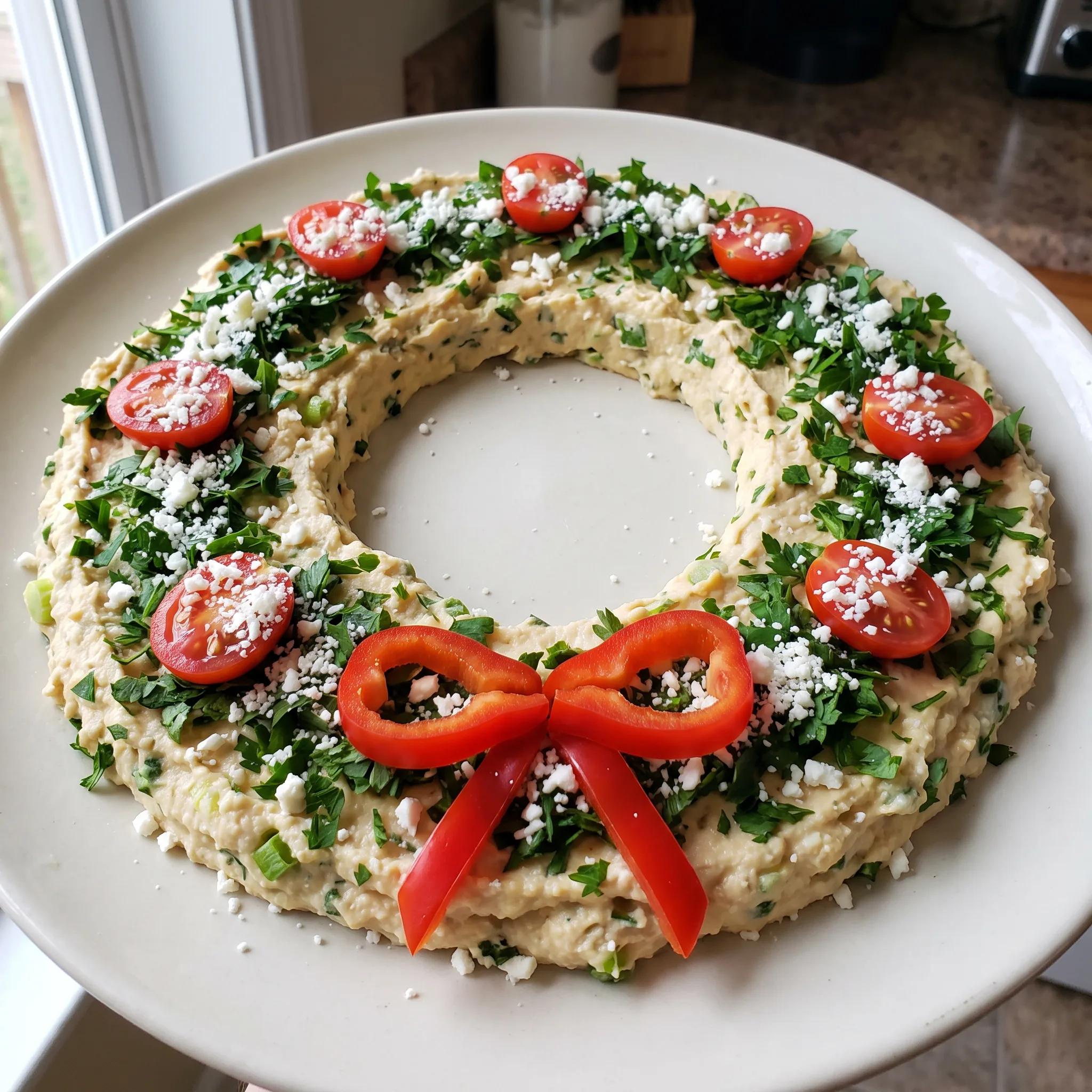
Christmas Hummus Wreath with Feta and Tomatoes
Ingredients
Method
- In a medium bowl, combine the hummus, 1/2 cup feta, and green onions.
- Place a small bowl or drinking glass in the center of a large round platter (about 12.5 inches in diameter). If you plan to place a bowl of pita chips or veggies at the center of the finished wreath, use that bowl (or a similarly sized glass) to ensure the hole in the middle of the wreath is the right size. Use a rubber scraper to spread the hummus mixture in a circle all around the bowl/glass. Remove the bowl/glass from the center using a gentle, upward twisting motion. If needed, carefully insert the tip of a toothpick under the edge of the bowl/glass to help it release.
- In another small bowl, toss the parsley, oil, and salt until the parsley is thoroughly coated and the oil and salt are evenly distributed. Spoon the parsley mixture in a circle on top of the hummus layer, leaving a small border of hummus showing all around.
- Place the halved cherry tomatoes, cut-side down, randomly throughout the parsley layer, so they look like Christmas ornaments.
- If making the optional bow out of red pepper, cut one broad, flat side off the pepper, and gently but firmly press a metal, bow-shaped cookie cutter through the pepper slice to cut out the bow. Place the bow on the wreath.
- Sprinkle the entire wreath lightly with a dusting of 1 to 1 1/2 tablespoons very finely crumbled feta, to look like snow. Adjust the exact amount of feta depending on the diameter of your wreath – you want it to look like just a light dusting, without using so much feta that it hides the other ingredients.
- Serve immediately with dippers of your choice, or cover and refrigerate for up to 1-2 days. (See make-ahead tips below.)
Swapping the Hummus, Feta, or Parsley Changes the Wreath More Than You’d Think
Store-bought plain hummus: A different hummus flavor, like roasted red pepper, garlic, or lemon. Those flavors bring their own salt and liquid.
Roasted red pepper hummus is looser and often saltier, so the ring may slump and the overall seasoning will shift. You might not need the 1/16 teaspoon kosher salt.
If you make your own hummus, it can be thicker; you may need to stir in a tablespoon or two of water to get it spreadable. Start with the same 17-ounce container and adjust after tasting.
Reduced-fat crumbled feta cheese: Full-fat feta, or a dairy-free feta alternative. Full-fat feta is creamier and saltier; it will make the hummus mixture richer and may throw off the salt balance.
Use the same 1/2 cup, but taste before adding extra salt. Dairy-free feta often doesn’t crumble as finely, so the snow dusting will look chunkier. For the snow, stick with the reduced-fat if you can; it crumbles finer and looks more like snow.
Italian flat-leaf parsley: Curly parsley or another soft herb like cilantro or dill. Curly parsley is bulkier and won’t coat as evenly with oil; you’ll get a thicker, less tidy layer.
Cilantro or dill will change the flavor profile entirely. Use the same 3/4 cup, but chop curly parsley finer and toss well. If you use a different herb, taste after mixing with oil and salt to make sure it’s not overpowering.
Cherry tomatoes: Grape tomatoes or small chunks of red bell pepper. Grape tomatoes are usually firmer and smaller; you may need more to cover the wreath.
Red bell pepper pieces won’t have the same juicy pop and may not sit as securely on the parsley. Use enough to look like ornaments, about 4 1/2 tomatoes if halved cherry, and press gently so they don’t sink.
Tips
- If your cherry tomatoes feel heavy for their size or their skins shine with moisture, they were likely misted at the store and their cut faces will weep onto the parsley within minutes. Buy dry, firm tomatoes, or pat them and let them sit cut-side up on a paper towel for five minutes before pressing them into the wreath.
- With only 4 1/2 tomatoes needed for the wreath, buy a small vine cluster rather than a pint. Vine tomatoes are usually picked riper and firmer than bulk-packed ones, and you will not have a half-pint of softening tomatoes left to use up.
Storage and Serving: The Wreath’s Short Window
Serve the hummus wreath within two hours of assembling it. That’s when the parsley is still bright, the tomatoes sit proud on the parsley, and the hummus holds the ring’s shape with a clean center hole. Past two hours at room temperature, the parsley wilts and the tomatoes start to release liquid into the hummus.
If you make it ahead, cover the platter and refrigerate for up to one to two days. Cold firms the hummus, which helps the ring keep its shape, but the parsley softens and the tomatoes lose their snap. The hummus may weep slightly; pour off any pooled liquid before serving.
The feta snow goes on right before serving. Refrigerated, it absorbs moisture and turns pasty, losing the dry, powdery look that reads as snow.
For leftovers, scoop the wreath into a container; it holds one to two days. Stir the components together before eating. Don’t freeze it.
The parsley and tomatoes break down completely, and the feta turns grainy.
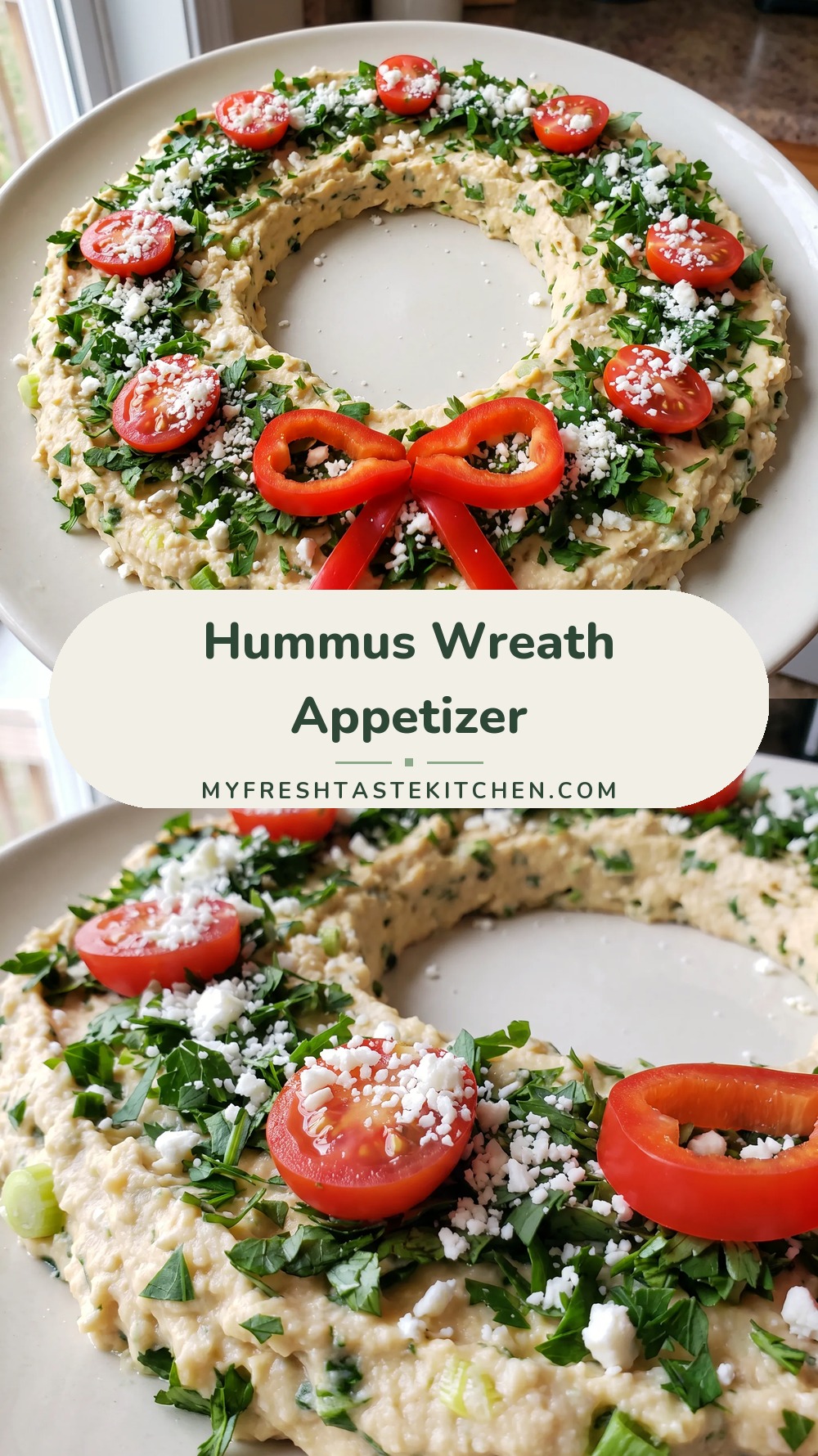
Frequently Asked Questions
Can I make this hummus wreath ahead of time?
Yes, cover the platter and refrigerate it for up to a day or two. Cold firms the hummus, so the ring holds its shape and the center hole stays clean, but the parsley softens and the tomatoes lose their snap. Hold the feta snow until right before serving, since it turns pasty in the fridge and loses the dry look that reads as snow.
If liquid pools on the platter, pour it off before it goes out.
How do I keep the cherry tomatoes from making the hummus watery?
Press each half cut-side down just until it stops on the parsley, rather than pushing it into the hummus. The parsley layer is what keeps the tomato off the hummus, so a tomato resting proud on the green releases far less liquid than one sunk to its shoulders. If a tomato has already cratered, that spot needs more parsley underneath before you set the next one.
Any juice that does bead up can be blotted with the corner of a paper towel.
What can I use instead of a bowl to make the hole in the center?
A drinking glass works, and it’s often easier to lift out with a gentle upward twist. What matters is the diameter: if you plan to set a bowl of pita chips or veggies in the middle later, use that same bowl as your guide so the hole ends up the right size. A glass narrower than your serving bowl leaves a hole too tight to drop the bowl into.
If the rim sticks when you pull it, slide a toothpick tip under the edge to break the seal.
How long can this sit out at a party?
Two hours is the window, and it’s worth watching the clock. Within that time the parsley stays bright, the tomatoes sit proud on the green, and the ring keeps its clean center hole. Past two hours the parsley wilts and the tomatoes start leaking into the hummus.
If the platter needs to stay out longer, set it over a bowl of ice rather than leaving it at room temperature.
Is this hummus wreath served cold or at room temperature?
Room temperature, straight from the counter. Cold hummus is stiff and tastes flatter, and the tomatoes come across as dull.
If it’s been refrigerated, give it about half an hour out before guests arrive so the hummus loosens to a spreadable consistency. The one exception is the feta snow, which goes on last, right before serving.
