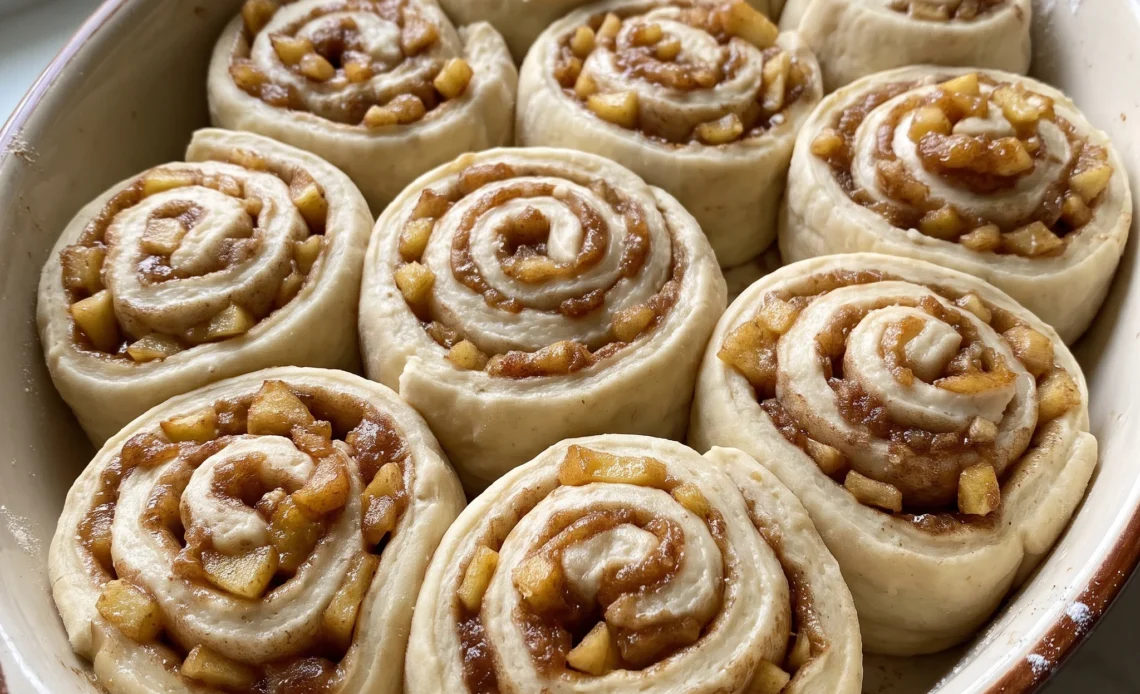
What separates a caramel apple cinnamon roll from the ones you pull apart on a weekend morning is the filling: apples cooked down in a skillet until they hold their shape, then spread across buttered dough before each strip gets rolled. It sounds straightforward. It isn’t.
The filling has to be the right temperature and thickness, or it soaks the dough and the spirals collapse. Even cooks who’ve made cinnamon rolls for years hit that wall the first time. Get the apples right and the rest follows: a soft, buttery crumb with caramel folded into the icing and drizzled over the top.
The recipe below walks through the whole thing, including where it tends to go sideways.
Why does the apple filling need to cool before it goes on the dough?
Apples throw off a lot of liquid when they cook. Brown sugar and butter pull it out further, and without something to hold that juice, it pools under the dough and turns the center of each roll wet.
Cornstarch in a slurry does that holding. When the filling comes off the heat it should look glossy and thick, not soupy, and a spoon dragged through it leaves a trail that closes slowly. Warm filling is the enemy at assembly.
It softens the butter layer underneath, so the dough slides instead of gripping, and the roll collapses as you shape it. Chilled filling is stiff, hard to spread, and tears the dough. Let it sit at room temperature until it mounds on a spoon without running.
At that point it spreads like a thick jam. If it still feels cool to the touch, give it another ten minutes.
How do you tell when the dough has enough flour?
A dough that’s tacky grabs your hand but releases clean when you pull away. A sticky one leaves a film, and every fold turns into a wrestling match. Butter and applesauce both add water and fat, so the flour amount is a moving target from one bag to the next.
Stop the mixer when the dough clears the bowl sides and feels soft but not wet. If it smears across your palm, sprinkle in a tablespoon of flour, mix it through, and check again. Two extra tablespoons is usually the ceiling before the rolls turn tight and bready.
Fat coats the flour proteins, so a rich dough like this one takes longer to come together than a lean bread. After a short rest, it stops fighting back and rolls out without shrinking. You want it relaxed and slightly cool, not warm and puffy.
Cutting strips beats one long log for filling-heavy rolls
A single log forces you to spread filling across a wide sheet, then wrestle the whole thing into a cylinder while the filling squeezes toward the ends. Cut the rectangle into strips first and each piece rolls on its own, which means every spiral carries the same amount of apple. The butter layer matters too.
Spread it edge to edge, leaving a half-inch border on the far side so the seam sticks. Filling goes on next, in a thin even coat, no mounds. Twelve strips in a 9×13 pan gives each roll room to expand without shoving its neighbor.
Crowd them and the centers stay doughy while the edges overbake. You want a little gap between spirals before they go in. Once baked, they should touch, pull apart cleanly, and show apple in every turn.
What homemade caramel does that a jar can’t
Sugar taken to a deep amber tastes like more than sweet. It picks up a faint bitterness and a toasted edge that a jar of sauce never has, and that edge is what keeps a sugar-heavy roll from tasting flat.
Butter and cream stirred in at the end turn that dark syrup into something pourable. It looks thin right off the heat, then thickens as it sits, so don’t panic and add more cream. Salt goes in last to sharpen everything.
Half of it ends up folded into the cream cheese icing, where it loosens the tang and adds a caramel note you can’t get from sugar alone. The rest gets drizzled over the finished rolls, still warm and runny.
Two caramel moments in one bite, one baked in, one on top, and they read differently. The sauce thickens more as it cools, so reheat it briefly if it sets up.
The icing question
Cream cheese and butter give the topping a tang that cuts the brown sugar and apple underneath. Without that bite, the whole roll tastes like one long note.
Caramel sauce stirred into the icing carries flavor without thinning it, but too much and it slides off the rolls and pools in the pan. Powdered sugar brings it back to a spreadable thickness. Timing is the lever.
Spoon it on while the rolls are still warm and it melts into the spirals, filling the gaps and turning glossy. Wait too long and it sits on top like frosting, which is fine if you want a cleaner look. Ten minutes out of the oven is the sweet spot: warm enough to seep, cool enough to cling.
Leftovers keep in the fridge, though the icing firms up and the rolls need a quick reheat.
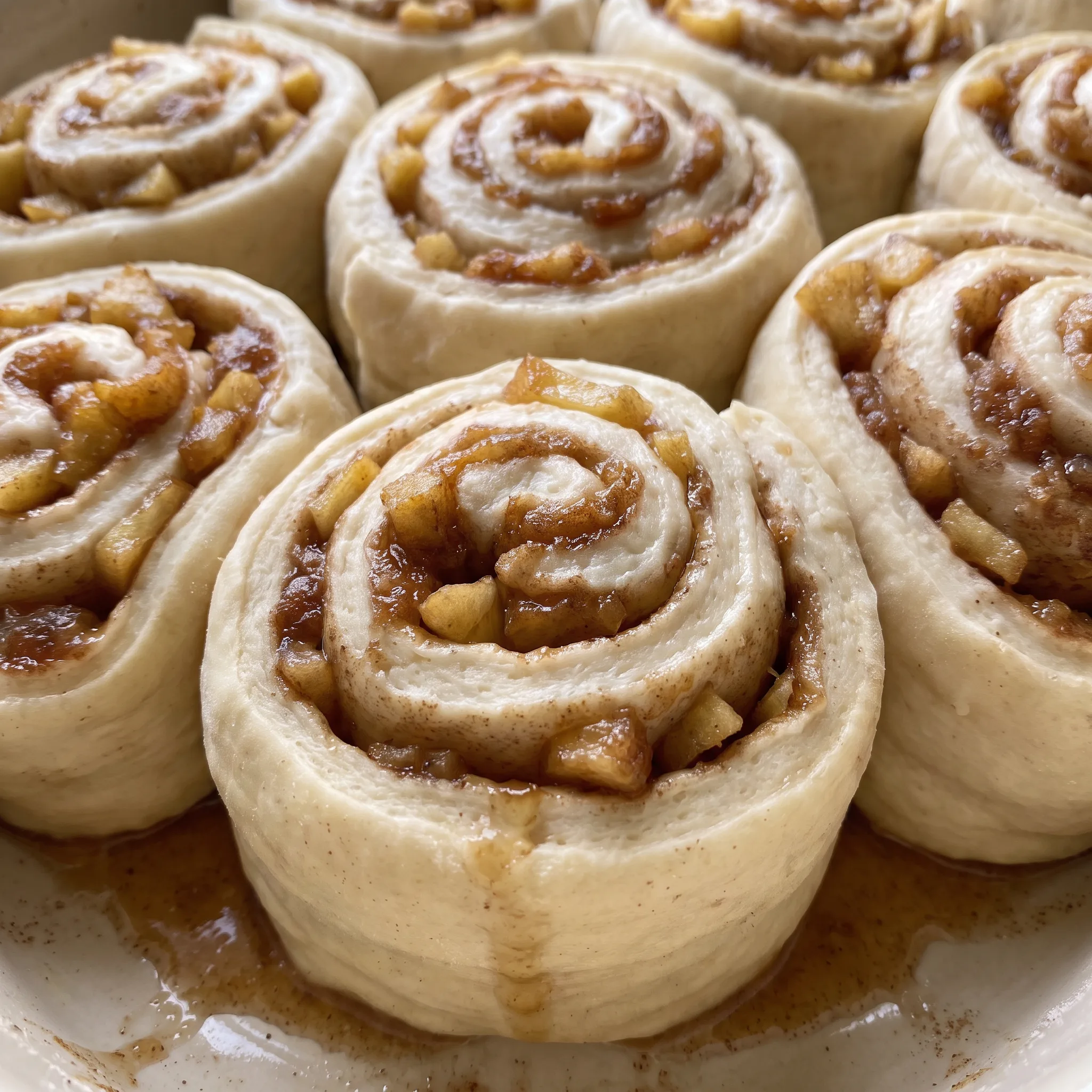
The four ingredients in these rolls that decide how they turn out
Honeycrisp apples: These hold a firm bite after cooking, so you get apple pieces in every spiral instead of a soft filling that spreads to nothing.
Cornstarch: Whisked with the 1/4 cup water into a slurry, it’s the only thing standing between juicy apples and a wet pan of dough.
Instant dry yeast: The 4 1/2 tsp goes straight into the flour with no proofing, so check the date on the packet before you commit a batch of dough to it.
Applesauce: Unsweetened only, since the 1/2 cup already carries sugar and the filling brings plenty more on its own.
Heavy whipping cream: Room temperature, because cold cream hitting hot amber sugar seizes the caramel into lumps that never smooth out.
Three places where caramel apple cinnamon rolls go wrong
When the caramel turns the right shade of amber
Sugar goes from pale gold to deep amber in under a minute. The color you’re after is the one that looks like an old copper penny, and the smell should be toasted, not sharp.
Pull it off the heat at that point. Any darker and the bitterness stops being a background note and takes over the whole batch.
If it does go too far, start over. There’s no stirring it back.
Reading the dough after the first mix
Butter and applesauce make this dough slack, so the window between tacky and sticky is narrow. Press a clean finger into it.
It should grab slightly and release without leaving a film. If your finger comes away shiny, sprinkle in a tablespoon of flour and mix it through. Two extra tablespoons is usually the limit before the baked rolls turn tight and dry.
Judging the rise by feel, not by the clock
The dough is ready when a light press with two fingers leaves a dent that springs back slowly, not one that vanishes or stays put. Under-risen dough bakes dense and the spirals won’t separate. Over-risen dough smells of yeast and collapses when you move it.
The warmth from the oven speeds this up, so check at 20 minutes and trust your hand over the timer.
Knowing when the filling is thick enough to spread
Off the heat, the filling should mound on a spoon and hold a trail that closes slowly. If it runs off the spoon like syrup, it needs more time over medium heat.
Spread it warm and it soaks the dough, making the rolls soggy and hard to shape. Cold filling tears the dough. Room temperature is the only workable window, and it should feel like thick jam.
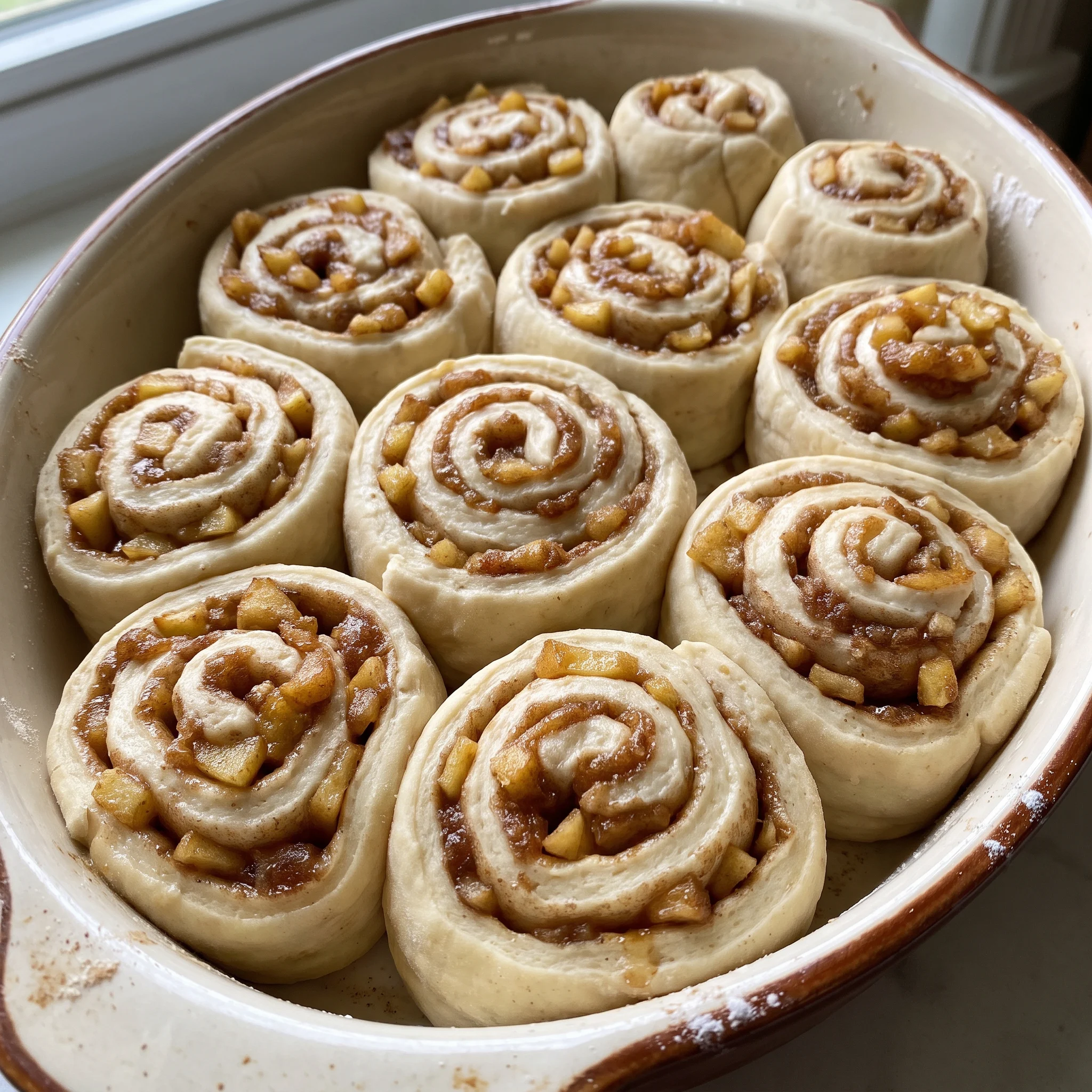
Caramel Apple Cinnamon Rolls
Ingredients
Method
- Begin with the caramel apple filling since it requires cooling time. Take 4 large apples (approximately 1000 g before peeling and coring), peel them, remove the cores, and chop into small chunks (about 1 cm cubes).
- Place the apple chunks, 1/2 cup unsalted butter, 1 1/2 cups packed light brown sugar, 1 tsp cinnamon, and 1/4 tsp salt into a large skillet. Set over medium-high heat, stirring occasionally. Once the mixture starts bubbling, lower the heat to medium.
- In a small bowl, combine 1/4 cup water and 1/4 cup cornstarch, whisking to form a slurry. Add this to the apple mixture and continue cooking for 5–10 minutes, stirring occasionally, until the apples become tender (check with a fork).
- Move the filling to a large bowl or tray (a wider container speeds cooling) and refrigerate. After it has cooled completely, keep it in an airtight container in the fridge for up to 1 week (it does not freeze well). Make sure the filling is at room temperature and has thickened before spreading on the dough; otherwise rolling becomes difficult.
- In a large bowl or the bowl of a stand mixer, whisk together 4 1/4 cups flour, 2 packets (4 1/2 tsp) instant dry yeast, and 1 tsp salt.
- In a separate medium bowl, stir together 1 cup milk, 1/2 cup unsweetened applesauce, 1/2 cup room-temperature unsalted butter, and 1/2 cup granulated sugar. Microwave for about 1 minute and stir to combine. The butter should be mostly melted; the mixture should feel warm but not hot (excessive heat will kill the yeast).
- Gradually pour the warm milk mixture into the flour mixture and mix on medium-low speed using a dough hook or wooden spoon. Scrape down the sides to incorporate all the flour. Keep mixing on medium-low for a couple of minutes until the dough becomes more elastic and smooth.
- Check the dough with your finger: it should be tacky but not stick or leave residue. If it is sticky and hard to roll, mix in flour 1 Tbsp at a time until tacky but no longer sticky (usually 1–2 additional Tbsp). The dough should pull away from the bowl sides when ready to rest.
- Cover the bowl with plastic wrap and let it sit for 10–20 minutes to relax the gluten, making it easier to roll out.
- If baking the same day, preheat the oven to 200°F (95°C) to help the rolls rise, and line a 9×13-inch pan.
- Put the dough on a lightly floured surface and roll it into a large rectangle about 24 in x 18 in (use a ruler). Evenly spread 1/2 cup softened butter over the dough, then spread the cooled filling on top.
- Using a pastry cutter, pizza cutter, or long knife, cut 12 equal strips (about 2 inches wide), then roll each strip individually. Place them in the prepared 9×13-inch pan. Alternatively, roll the dough into a log and cut with dental floss.
- If making the night before, cover the rolls tightly with plastic wrap and refrigerate overnight. The next morning, take them out of the fridge, preheat the oven to 200°F (95°C), turn off the oven, cover the rolls with foil, and let them rise in the warm oven for about 30 minutes.
- If making the same day, turn off the preheated 200°F (95°C) oven, cover the rolls with foil, and let them rise in the oven for about 30 minutes. Ensure the oven is OFF before placing the rolls inside to rise.
- The rolls should look puffier and larger. Preheat the oven to 350°F (175°C). Remove the foil and bake for 28–34 minutes, until golden brown, rotating the pan halfway through for even baking.
- While the rolls rise and bake, prepare the homemade caramel. Store-bought caramel sauce works if you are short on time, but this takes about 10 minutes and is worth it.
- Place a medium saucepan over medium heat. Once hot, pour in 1 cup sugar gradually, adding 1/4 cup at a time. Wait until the sugar is mostly dissolved before adding the next portion. As the sugar melts, it deepens in color.
- Stir occasionally until the sugar is fully dissolved and deep amber, then turn off the heat.
- Slowly mix in 6 Tbsp butter (2 Tbsp at a time), then stir in 1/4 cup heavy cream and 1/4 tsp salt. The mixture will be thin but thickens as it cools.
- Pour into a separate container and set aside to cool. If made in advance, store in an airtight container for up to 2 weeks. When ready to use, heat in the microwave in 15-second intervals until workable.
- Make the caramel cream cheese icing: mix 1/4 cup room-temperature cream cheese, 1/4 cup softened butter, 1/4 cup caramel sauce, 2 tsp vanilla extract, and 1/4 tsp salt with a spoon or electric hand mixer.
- Add 1 1/2 cups powdered sugar to the cream cheese mixture and stir until smooth.
- Let the cinnamon rolls cool for about 10 minutes, then spoon the icing over the rolls, drizzle the remaining caramel on top, and enjoy warm. Leftover rolls can be stored in an airtight container at room temperature for a few hours or in the fridge for up to 5 days.
How to Store and Reheat Caramel Apple Cinnamon Rolls
Iced rolls hold at room temperature for a few hours only. The cream cheese icing and the caramel both contain dairy, so beyond that window they belong in the fridge, where they keep up to 5 days. Cold changes them: the icing firms and the caramel turns chewy, while the bread tightens.
That’s expected. For a single roll, microwave 20 to 30 seconds, just until the icing softens and the spiral separates without drying at the edges. A whole pan reheats covered with foil at 300°F (150°C) for 10 to 12 minutes.
Eat within 15 minutes of reheating; the caramel stays pliable and the apple filling tastes fresh again. The caramel sauce alone keeps 2 weeks airtight and reheats in 15-second bursts. The apple filling keeps 1 week in the fridge but does not freeze well, and neither do the assembled rolls: the dairy icing and filled dough degrade.
Freeze only plain baked rolls, wrapped tight, up to 1 month, then thaw overnight in the fridge and reheat before icing.
What to swap in caramel apple cinnamon rolls, and where a swap quietly ruins the batch
Applesauce or eggs in the dough: Use 2 large eggs in place of the 1/2 cup unsweetened applesauce, or go the other way and use applesauce in place of the eggs. Both are already listed as options, so you’re not inventing anything. Just don’t use sweetened applesauce or a chunky style.
Eggs give the dough a tighter crumb and a bit more structure, so the spirals hold their shape and the rolls feel slightly richer. Applesauce keeps the dough softer and a touch sweeter, and it browns a little faster in the oven because of the extra sugar. If you’re already using sweetened applesauce, the rolls come out sweeter than the recipe intends and the filling reads flatter.
With eggs, watch the flour: the dough often needs that extra tablespoon or two to stop being sticky.
Honeycrisp apples: Use a firm, tart-sweet apple that holds up: Braeburn, Jonagold, Pink Lady, or even a good Granny Smith if you want more tartness. Skip Red and anything labeled soft or mealy. Honeycrisp keeps a distinct bite after cooking, which is why you get apple pieces in every spiral rather than a filling that spreads to nothing.
A softer apple breaks down in the skillet and turns the filling into applesauce, which then makes the rolls wet in the center. Granny Smith will taste sharper against the brown sugar and caramel, which some people prefer.
Use the same amount by weight: 1000 g before peeling and coring, about 4 large apples.
Instant dry yeast: Active dry yeast works, but you have to wake it up first. Warm the milk to about 110°F, stir in a pinch of the granulated sugar, sprinkle the yeast over, and let it sit 5 to 10 minutes until foamy.
Then proceed with the recipe. Use the same 4 1/2 tsp. Instant yeast goes straight into the flour and starts working immediately.
Active dry is slower and needs that proofing step, so if you skip it the dough can sit there doing nothing for an hour. Once proofed, the rise and the final texture are close enough that you won’t notice.
Fresh cake yeast is a different animal and not worth the math here. If your packet is past its date, buy new: no swap rescues dead yeast.
Store-bought caramel sauce: Use 1/4 cup of a thick, good-quality jarred caramel in the icing and for drizzling. Don’t try to replace the homemade caramel with something thin like ice cream topping.
You lose the toasted, faintly bitter edge that homemade caramel gets from taking sugar to deep amber. The icing still tastes like caramel, just sweeter and flatter. If the jarred sauce is thin, it will slide off the warm rolls and pool in the pan, so check the consistency: it should coat a spoon.
The 1/4 cup in the icing is the amount that works without thinning the cream cheese too far. For drizzling, warm it briefly if it’s stiff.
Tips
- Taste the filling after it cools completely, not while it’s hot. Sugar, salt, and apple acidity read differently at room temperature, and the filling is going onto a sweet, buttery dough with caramel on top, so a filling that tastes balanced on its own will disappear under all that sugar. If it tastes flat, add a pinch of fine salt. If it tastes cloying, squeeze in a teaspoon of lemon juice, stir, and taste again. You are seasoning 1000 g of apples that will be spread across 12 rolls, so a small correction here changes every bite.
The most common mistake is spreading the apple filling while it is still warm. The heat melts the butter on the dough and releases steam, making the dough sticky and prone to tearing; the filling also thins out and seeps, so the rolls cannot hold their shape. Even if the filling was cooked correctly, residual warmth undermines the structure needed for clean rolling.
Frequently Asked Questions
Can I make these caramel apple cinnamon rolls ahead of time?
Yes, and the dough handles an overnight rest well. The card gives you a night-before path: shape the rolls, cover them tightly with plastic wrap, and refrigerate. Next morning, warm the oven to 200°F, turn it off, cover the rolls with foil, and let them sit in that residual heat for about 30 minutes.
The apple filling can be cooked up to a week ahead and kept in the fridge, so you’re only assembling on day two. What you can’t do is freeze the assembled pan; the filled dough and the icing both suffer, and the storage notes say so.
Why did my cinnamon rolls turn out dry?
Dry rolls usually mean too much flour got worked into the dough, and this dough is easy to over-flour because the butter and applesauce make it slack. The card’s own test is the finger check: tacky but not sticky, and if you added flour past the two-tablespoon ceiling, the baked spirals come out tight and bready. A second cause is overbaking.
The rolls are done when they’re golden brown, and the pan gets rotated halfway so one side doesn’t dry out while the other catches up. If they’re already baked and dry, a short reheat with the icing on top brings back some softness, but the crumb won’t fully recover.
How do I prevent the filling from leaking out during baking?
The filling leaks when it’s too loose going onto the dough, and the cornstarch slurry is what keeps the apple juices in check. Cook the apples until a fork slides through and the mixture mounds on a spoon, then let it come to room temperature before spreading. A thin even coat, no mounds, gives the strips a better chance of sealing.
Roll each strip snugly so the seam sits underneath in the pan. Some caramel and apple will bubble out at the edges; that’s normal and it’s what makes the pan sticky and good.
What’s the difference between these and classic cinnamon rolls?
Classic rolls are dough, butter, cinnamon sugar, and icing. Here the cinnamon is a background note in a cooked apple filling that gets spread on the dough, and the whole thing is finished twice with caramel: some baked in, some drizzled on top. The icing is cream cheese loosened with that same caramel instead of a plain vanilla glaze, which gives it a tang and a darker color.
You’re also baking in a 9×13 pan with twelve strips rolled individually rather than one log cut into rounds.
How should I store and reheat leftover caramel apple cinnamon rolls?
Once iced, they hold at room temperature for a few hours, then they need the fridge, where they keep up to 5 days. Expect the icing to firm and the caramel to turn chewy; that reverses on reheating. One roll goes in the microwave for 20 to 30 seconds, just until the icing softens and the spiral pulls apart.
A whole pan wants foil over the top and 300°F for 10 to 12 minutes. Eat within 15 minutes of reheating while the caramel is still pliable.
