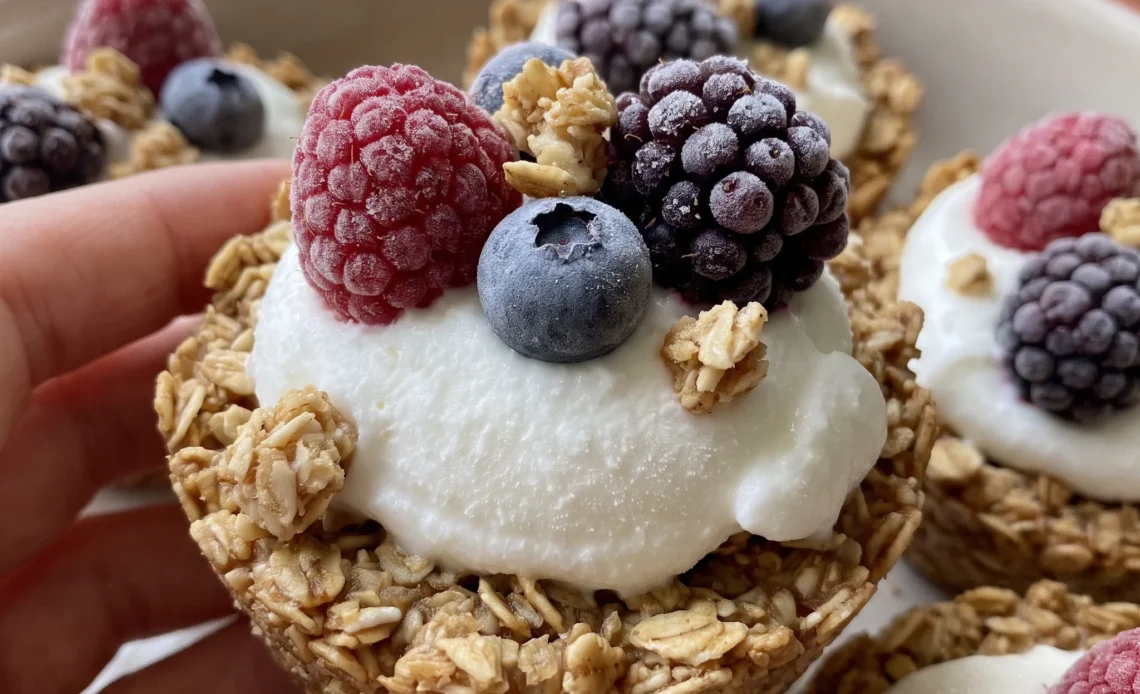
Most people press the granola mixture too lightly, then wonder why the whole thing collapses on the first bite. The base is where frozen yogurt granola cups live or die. A loose press leaves air pockets, and air pockets become fault lines.
You can’t fix that once the yogurt goes on top. What separates a cup that stays intact from one that crumbles in your hand is how compact that granola layer feels before anything else touches it. Press until it stops giving.
If it springs back, you’re not done. The yogurt freezes dense and creamy, closer to soft-serve than you’d expect, but only if the base underneath can take the weight. Skip that and you’re left with a puddle.
Almond butter and honey do their part, but they can’t compensate for a half-hearted press. Get the base right and the rest follows.
Why a Firm Base Matters
A frozen, hand-held treat falls apart the moment you bite it if the base doesn’t hold together. Pressing the granola mixture into a compact, sturdy layer is what gives the cup its structure. Almond butter and honey act as binders, turning oats and cinnamon into a sticky dough that clings to itself.
That density also creates a barrier, keeping the yogurt layer from leaking or separating as it freezes. Without that solid foundation, the cup would crumble in your hand before you even get a taste. The base needs to be firm enough to support the topping but not so hard it resists a bite.
When you press it down, you’re building the architecture of the whole treat. Skipping this step means you’re left with loose granola and a puddle of yogurt. So take a moment to really pack it in.
The result is a cup that stays intact from the first crunch to the last.
Freezing changes everything
Greek yogurt freezes into something dense and creamy, close to soft-serve ice cream, because its high protein and low water content keep large ice crystals from forming. That texture contrasts sharply with the crunchy granola base, giving each bite a mix of smooth and crisp. But freezing also turns the yogurt rock-hard if left too long.
A brief thaw before serving brings it back to a scoopable consistency, so you get that creamy mouthfeel without waiting forever. The berries, too, change: their juiciness becomes icy, adding a cold burst that cuts through the richness. Without that thaw, you’d be gnawing on a brick.
The granola stays crunchy even after freezing, which is why this works as a make-ahead treat. The interplay of temperatures and textures is what makes these cups satisfying. So don’t skip the thaw; it’s the difference between a pleasant dessert and a dental hazard.
Honey and almond butter balance
Honey brings moisture and sweetness, but it also helps the base hold together. Almond butter adds fat and richness, preventing the oats from drying out and turning crumbly.
The ratio between them is a balancing act: too little binder and the granola won’t stick, leaving you with a loose pile; too much and the base becomes dense and oily, weighing down the cup. You want a sticky dough that clumps when pressed, not a greasy paste.
Taste the mixture before freezing; it should be sweet enough to complement the tart yogurt, but not cloying. Adjust with a little more honey or almond butter if needed.
The goal is a base that’s sturdy yet tender, with a nutty flavor that pairs well with the yogurt and berries. Get this ratio right, and the cups will hold up. Get it wrong, and you’ll know at first bite.
Berries add contrast and color
Fresh berries do more than look pretty on top. Their natural acidity cuts through the creamy, sweet yogurt and the nutty granola, keeping each bite from feeling heavy.
Added before freezing, they adhere to the yogurt and provide a pop of color that makes the cups inviting. Once frozen, berries become icy and firm, their juiciness turning into a cold crunch that contrasts with the smooth yogurt. That texture shift is part of the appeal, a little surprise in every bite.
Without them, the cups would be one-dimensional, all creamy and sweet. The berries bring a bright, tart note that wakes up your palate. So scatter them on generously; they’re not just a garnish.
They’re a key player in the overall balance, and they make the cups look as good as they taste.
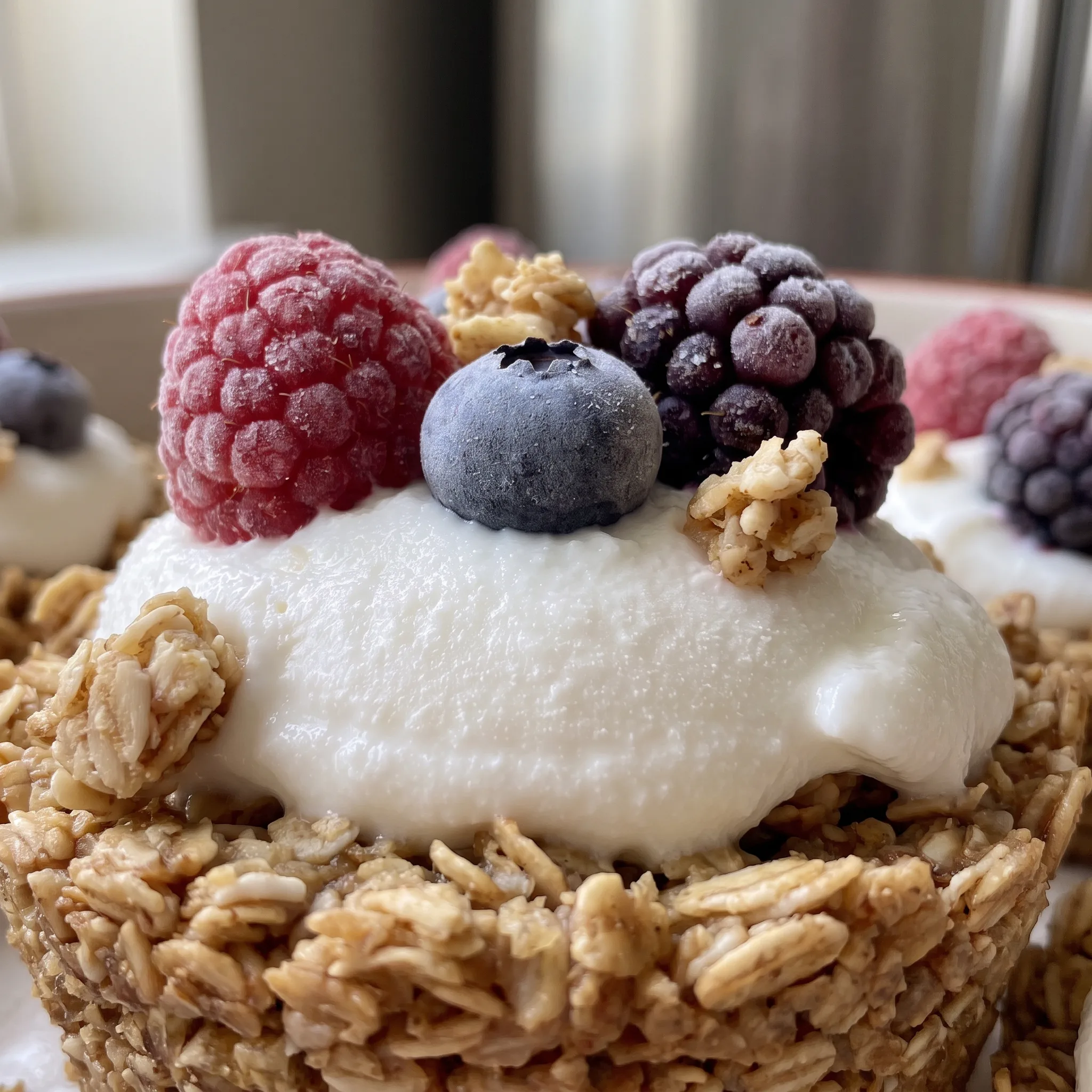
What to Look for in the Yogurt and Oats
Greek yogurt: Use full-fat Greek yogurt; low-fat or regular yogurt freezes into icy shards instead of a creamy texture.
Old-fashioned rolled oats: Old-fashioned rolled oats give the base structure; quick oats turn into a paste and make the cups dense.
Almond butter: Stir natural almond butter well before measuring; the oil separates and a dry scoop leaves the base crumbly.
Honey: Honey that has crystallized won’t blend smoothly, so warm the jar slightly if it looks grainy.
Fresh berries: Small berries like raspberries or blueberries freeze better than large strawberries, which get icy and hard.
How to judge the press, the freeze, and the thaw
Reading the granola dough before it goes in the pan
The mixture should clump when you squeeze a handful and hold that shape without crumbling. If it cracks at the edges, the oats are underbound and the base will shatter when you bite it. A tablespoon more almond butter or honey fixes it.
If it feels slick and leaves an oily sheen on your palm, you’ve overshot and the base will taste heavy. Add a spoonful of oats to bring it back.
Pressing hard enough to build a base that survives the bite
You’re not just distributing the granola, you’re compacting it into a disk that won’t collapse under the yogurt. Press with your fingertips until the surface feels solid and doesn’t spring back. If it still looks loose or you can see individual oats shifting, keep pressing.
A half-hearted press leaves air pockets, and those become weak spots where the base breaks apart later.
Judging the freeze time by texture, not the clock
Four hours in the freezer gets the yogurt solid enough to hold its shape, but the exact moment depends on your freezer’s coldness and how full the pan is. At four hours, the yogurt should feel firm to a light touch, not rock-hard.
If it’s still soft in the center, give it another hour. Overfreezing makes the yogurt chalky and difficult to eat, even after thawing.
The thaw that brings the yogurt back to creamy
Straight from the freezer, the yogurt is too hard to bite through and the berries are icy pellets. Let the cups sit at room temperature until the yogurt gives slightly when pressed, about 10 to 15 minutes.
You want a soft-serve texture, not melted. If you wait too long, the base softens and the cup loses its structure.
Check one cup before serving the rest.
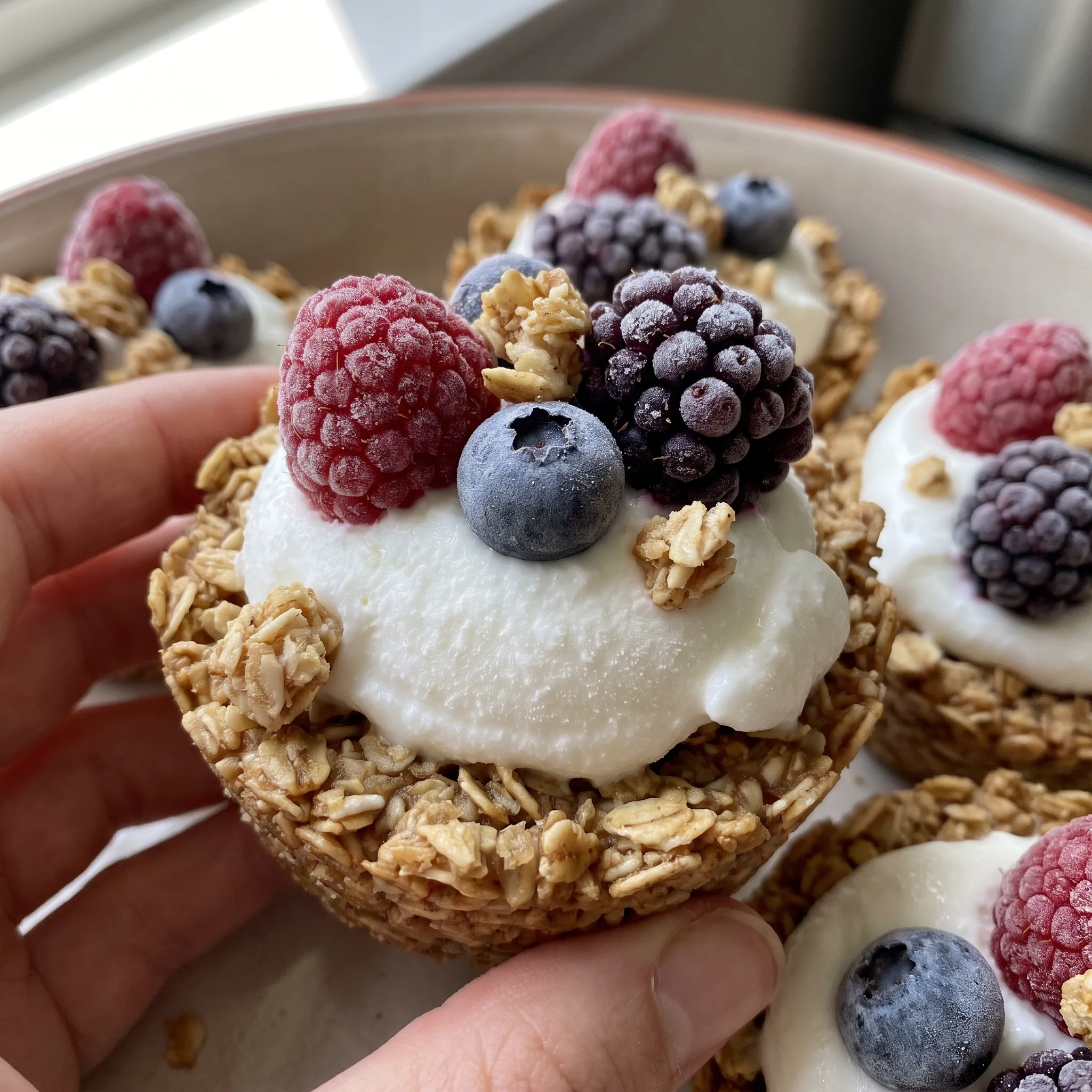
Frozen Yogurt Granola Cups with Berries
Ingredients
Method
- In a bowl, stir together the oats, cinnamon, almond butter, honey, and vanilla extract until a sticky dough forms. If the mixture seems too dry, add more almond butter and honey.
- Use paper liners to line a muffin pan. Drop a spoonful of the granola dough into each cup and press down firmly with your fingers to form a compact, sturdy base.
- Add yogurt on top of each base, then finish with berries and any leftover granola.
- Freeze for at least 4 hours to set. Thaw before serving.
Notes
What Swaps Keep These Cups From Falling Apart
Greek yogurt: For dairy-free, use a thick coconut yogurt or a strained non-dairy yogurt. Start with the same 1 1/2 cups (340g) the recipe uses, then adjust after tasting and freezing a test cup.
Coconut yogurt freezes firmer and can turn icy if it’s watery, so strain it first if it looks loose. The cups will still hold, but the texture won’t be as creamy as with Greek yogurt.
Honey: Maple syrup or agave can replace the honey. Use the same 3, 4 tablespoons (63, 84g) to start, then adjust to taste before freezing.
Maple syrup is thinner, so the granola dough may need an extra spoonful of almond butter to clump. The flavor will be a bit less floral, and the base may be slightly softer.
Almond butter: Peanut butter or sunflower seed butter works, but stick to the same 1/4 cup (64g). Don’t swap for a powdered nut butter or a low-fat spread.
Peanut butter brings a stronger flavor that can overpower the berries. Sunflower seed butter can turn green after freezing, which looks off but tastes fine. Both hold the base together.
Old-fashioned rolled oats: Do not swap for quick oats or steel-cut oats. There’s no good substitute here.
Quick oats turn into a paste and make the cups dense; steel-cut oats stay hard and won’t bind. The base needs the structure of rolled oats to stay sturdy.
Tips
- Squeeze a small handful of the granola dough before it goes into the pan. It should hold the shape your fingers made without cracking or shedding loose oats. If it crumbles, the base will crumble the same way once the yogurt sits on top, so stir in another tablespoon of almond butter or honey and squeeze again.
- If the dough squeezes into a ball but feels greasy and leaves a slick film on your palm, add a tablespoon of oats. The 3/4 cup (60g) of oats is the only thing absorbing the 1/4 cup (64g) of almond butter and up to 4 tablespoons (84g) of honey, and a dough that is all binder will press into a dense disk that freezes hard and resists a bite.
Storage, Thaw Window, and Serving
Keep the cups in the freezer, not the fridge. The card gives a 4-hour freeze to set them, and that same cold is what holds them together afterward; move them to the fridge and the yogurt slumps off the base within a day.
Stack them in an airtight container with parchment between layers, or leave them in the lined muffin pan covered tightly. They hold their best texture for about a week.
Past that, ice crystals grow, the yogurt turns grainy and chalky, and the oats slowly pull moisture and soften. Berries go on before the freeze, as written, so there’s no finishing touch to add later.
Eat them within 10 to 15 minutes of pulling from the freezer, once the yogurt gives slightly under a finger. That window is when the yogurt reads creamy and the base still snaps. Much longer and the base sogs under the melting topping.
The granola base relies on almond butter and honey to create a sticky dough that holds the oats together. If the mixture is too dry, pressing it into the muffin liners produces a loose, crumbly layer that lacks structural integrity. The recipe uses a flexible range of honey (3, 4 tbsp) and instructs adding more almond butter and honey if the mixture seems dry, ensuring the base can be pressed into a firm, compact layer that supports the yogurt and berries.
Frequently Asked Questions
How long do frozen yogurt granola cups last in the freezer?
They hold their best texture for about a week. Past that, ice crystals grow inside the yogurt layer, which is exactly what turns it grainy and chalky, and the oats slowly pull moisture and go soft under the topping.
Keep them in an airtight container with parchment between the layers, or leave them in the lined muffin pan covered tightly. The fridge is not the place for them at any point.
Can I make these frozen yogurt granola cups ahead of time for a party?
Yes, that’s the whole design of the recipe. You get 8 servings out of one pan, and the 4-hour freeze to set them doubles as the storage condition afterward. Berries go on before the freeze, as written, so there’s no finishing touch to add later, which means you pull the pan out and you’re done.
Just leave them in the freezer until you’re ready to serve, then give them the 10 to 15 minutes to soften.
Why did my frozen yogurt granola cups turn out icy or grainy?
Check the yogurt first, since that’s the usual culprit. Low-fat yogurt or regular yogurt carries more water, and that water freezes into icy shards instead of the dense, creamy texture full-fat Greek yogurt gives. If the yogurt was right, the other cause is time: past about a week in the freezer, ice crystals grow on their own and the yogurt turns grainy and chalky no matter what you started with.
A third possibility, less common, is a swap like a watery coconut yogurt that needed straining first.
Do I need to thaw frozen yogurt granola cups before eating?
Yes, and the window matters more than the thaw itself. Straight from the freezer the yogurt is too hard to bite through and the berries are icy pellets, so let them sit at room temperature until the yogurt gives slightly under a finger, roughly 10 to 15 minutes.
That’s when the yogurt reads creamy and the base still snaps. Wait much longer and the base sogs under the melting topping.
How are frozen yogurt granola cups different from traditional yogurt parfaits?
A parfait is assembled cold and eaten right away, with loose granola that goes soft the moment the yogurt touches it. Here the granola is pressed into a compact base with almond butter and honey, so it stays crunchy through the freeze and holds the whole thing in your hand. The yogurt layer freezes dense and creamy, close to soft-serve, which is a texture you never get in a parfait.
And a parfait can’t sit in the freezer for a week waiting for you, which these can.
