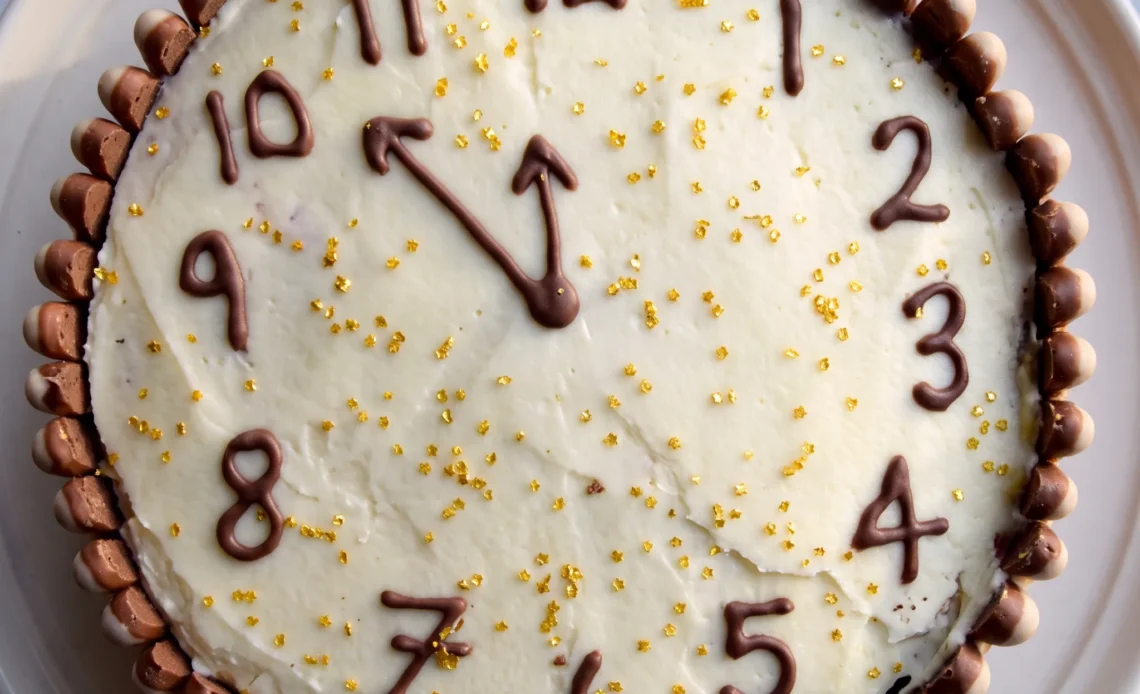
Timing matters more than anything else when you build a chocolate cherry cognac cake for New Year’s Eve, and not just the baking time. Get the buttercream right and the ring of chocolate fingers stands as a wall; get it slack and the whole thing lists before anyone’s poured a drink.
The clock face is drawn last, hands set a few minutes short of midnight, because a cake that already reads twelve looks finished before the party starts. What makes this one worth the effort is how the cognac settles into the cherry jam after a few hours, so the sponge, the fruit, and the spirit taste like one thing rather than three. That window, somewhere between assembly and the next day, is when it’s at its best.
Deliberate, a little theatrical, and it reads instantly as midnight.
Cocoa powder can be combined with the other cake ingredients in one go, but the starch and fat in the powder tend to clump and the chocolate flavor stays muted. Whisking it first with boiling water gelatinizes the starch, dissolves the cocoa solids, and releases the flavor compounds, producing a smooth, deeply chocolate batter. This recipe uses the hot-water method because the resulting sponge must be sturdy and full-flavored enough to support jam, buttercream, and a full ring of chocolate fingers.
How Do You Time the Clock on a New Year Cake?
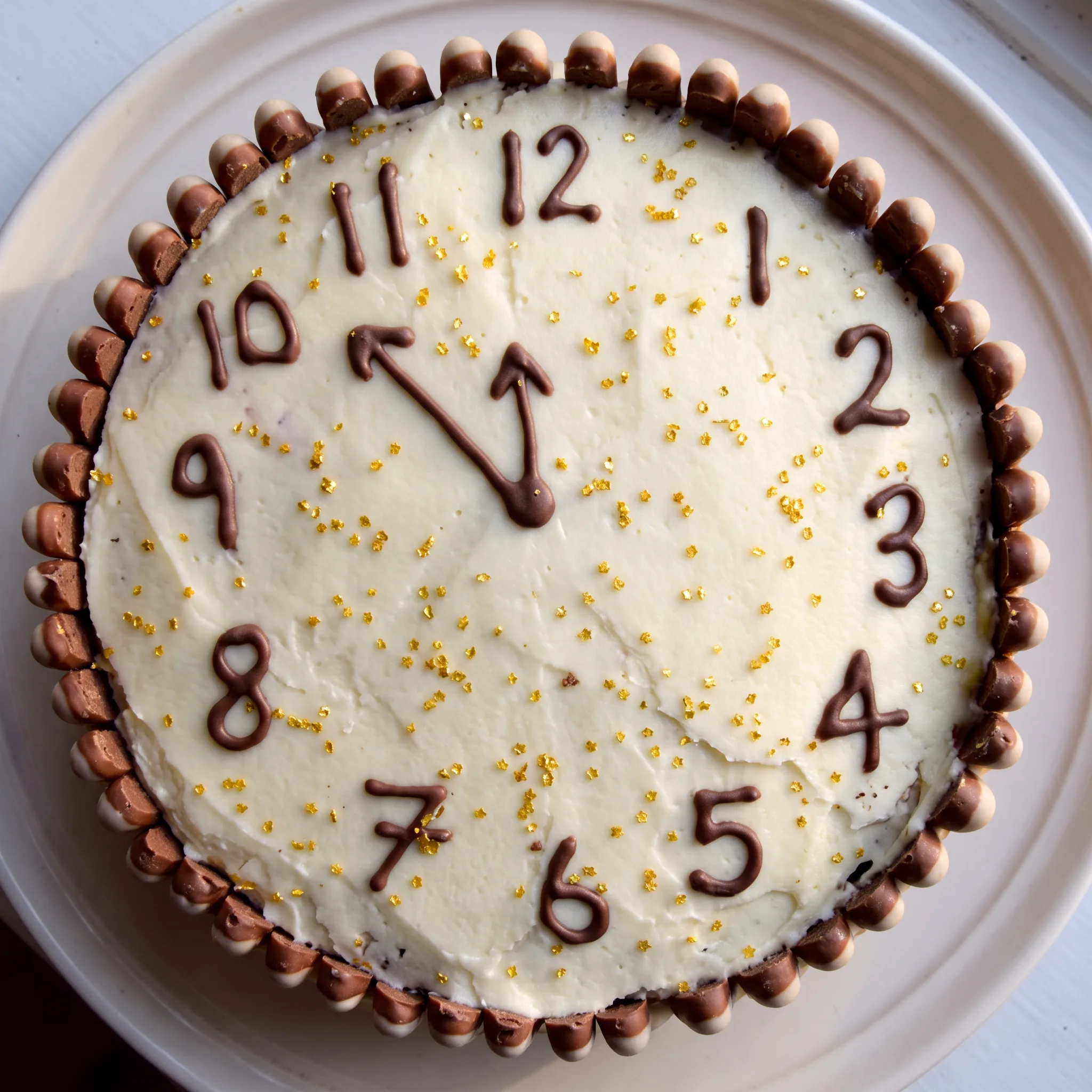
A ring of chocolate fingers becomes the cake’s outer wall as much as its decoration. Stand them upright, shoulder to shoulder, and they lock each other in place.
Any gap shows the buttercream, any tilt breaks the circle. Press each one into the frosting until it meets the cake stand. Work around the perimeter before the buttercream forms a skin, while it still has enough give to hold them.
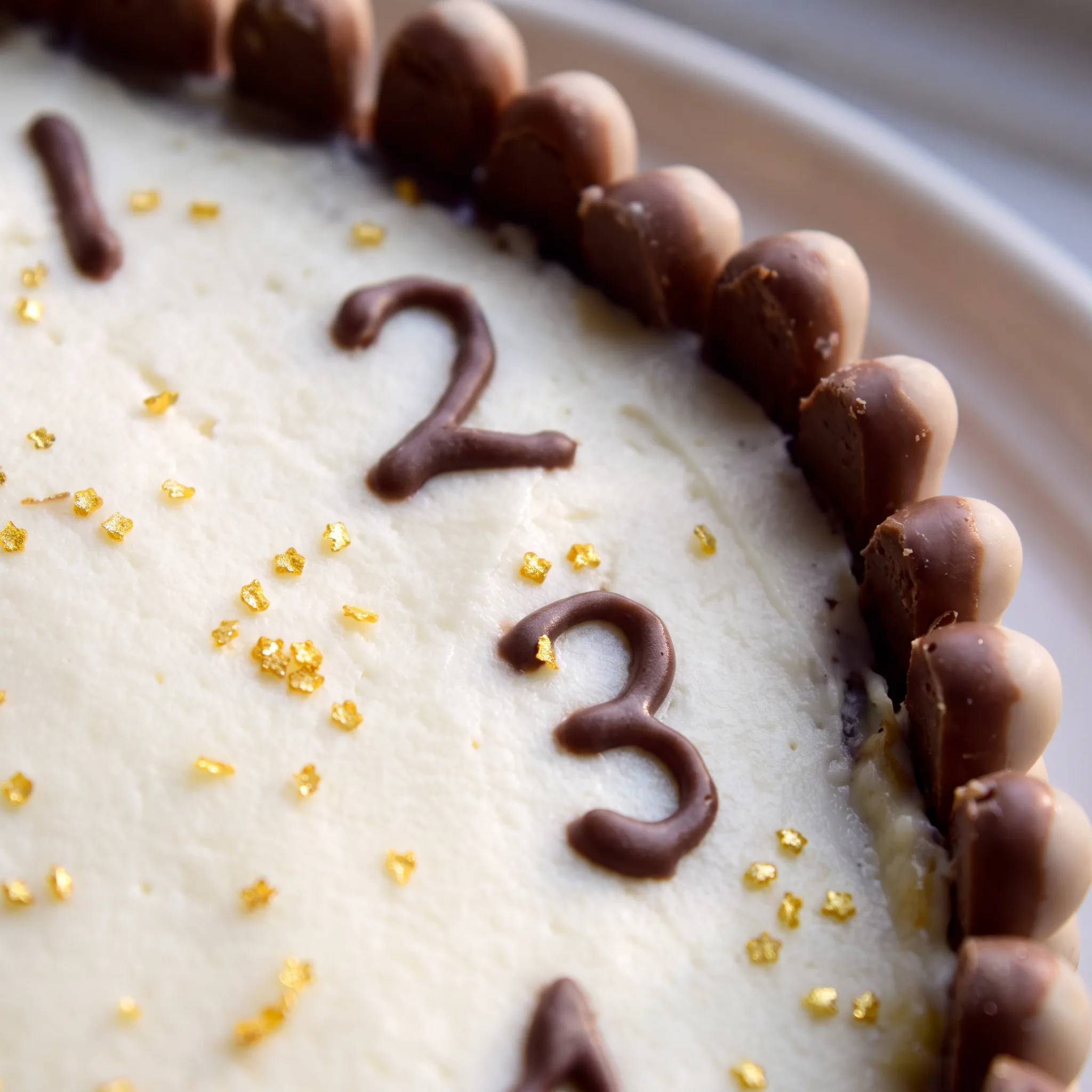
The clock face gets drawn afterward with milk chocolate writing icing. The time matters: a few minutes before twelve. That small gap before midnight reads as anticipation, and it’s the first thing anyone notices.
Scatter gold stars over the face, if you’re using them, so the countdown has some sparkle. If the hands point straight up at twelve, the cake looks like it’s already over.
The final look is neat, deliberate, a little theatrical, and it should read instantly as a New Year cake.
What Does Cognac Do to Buttercream?
Cognac goes straight into the buttercream, not brushed on later. It carries the flavor through the whole cake instead of leaving it on the surface. Three tablespoons also loosen the frosting, so it spreads with less drag and sits a touch softer on the tongue.
That softness is the thing to watch. The same buttercream gets used between the layers and over the sides, and the sides have to hold a full ring of chocolate fingers without slumping.
If it feels too slack after mixing, a short spell in the fridge firms it enough to work with. The cognac itself tastes sharp and spirity at first.
Give the assembled cake a few hours, and that edge settles into the cherry jam and the chocolate sponge, so the flavor reads as one thing rather than three. On the second day it’s rounder and more integrated, which is when I think it’s at its best.
Why Bloom Cocoa in Boiling Water First?
Cocoa powder straight from the tin tastes flat and dusty, and it clumps the moment it meets a wet ingredient. Whisking it with boiling water first turns it into a smooth, glossy paste that smells like dark chocolate rather than dry powder.
That paste carries a deeper, rounder chocolate flavor through the whole sponge, and it darkens the crumb to a proper cocoa brown. The batter that follows is soft but not fragile.
Baked in two pans and cooled completely, the sponge comes out with enough structure to take a thick layer of jam, a full coat of buttercream, and the weight of chocolate fingers around the edge. Cut a slice and it holds together on the fork.
Under all that decoration, the cake still tastes like chocolate rather than just sweet. That’s what the extra step buys you.
Why Keep Jam Away From the Edges?
Black cherry jam goes over the buttercream in a thin, even layer, stopped about 1 cm short of the rim. That margin isn’t fussiness.
When the top sponge goes on and presses down, the jam spreads outward, and without the gap it would push past the edge and run down the buttercream you’ve just smoothed. Keeping it back means the sides stay clean and the chocolate fingers have a dry-ish surface to grip.
The jam also does quiet work over time. Its moisture seeps into the sponge, softening the crumb and tying the cherry flavor to the chocolate.
That’s wanted, but only up to a point. Too much jam and the cake turns heavy and wet, the buttercream starts to slide, and the whole thing loses its shape.
A restrained layer gives you the fruit without the collapse. The cake should still cut cleanly the next day.
What to Buy and Prep Before You Start This Cake
Cocoa powder: Sift it if you see lumps, because the boiling water can only smooth out so much.
Self-raising flour: If you mix your own, use all-purpose flour with baking powder and salt as written in the notes.
Golden caster sugar: Granulated works and dissolves fine, but the sponge is a touch grittier.
Soft margarine: Straight from the fridge it won’t cream, so leave it out until it gives under your thumb.
Unsalted butter (for buttercream): Room temperature means it dents when pressed, not greasy or melting.
Cadbury chocolate fingers: Three boxes gives you enough to circle the cake without gaps.
The moments that decide whether this cake holds its shape and tastes like chocolate
When the cocoa paste goes from dry to glossy
Cocoa powder and boiling water need to be whisked until the mixture is completely smooth. Stop too early and you’ll see small dry pockets that never fully dissolve, leaving pale specks in the baked sponge.
The paste should look like thick, shiny chocolate sauce and smell rich, not dusty. If it still feels gritty to the touch, keep whisking.
This step takes a minute or two longer than you’d expect, but it’s the difference between a deep chocolate flavor and a flat one.
Judging the sponge by touch, not just the clock
At 25 minutes, press the center of the cake gently. It should spring back and feel firm, not leave a dent.
A tester inserted in the middle should come out with no crumbs. If the top wobbles or the tester has wet batter, give it 2 to 3 more minutes.
Opening the oven before 20 minutes risks a collapse, so wait until you’re close to the end. Overbaking dries the edges, so pull it as soon as those signs are met.
Reading the buttercream’s consistency before it touches the cake
After mixing the butter, sugar, and cognac, the buttercream should be smooth and spreadable but still hold a soft peak. If it slides off a spoon in a runny stream, it’s too warm or too loose. A short chill, 10 to 15 minutes, will firm it up without hardening it.
You need it soft enough to spread without tearing the sponge, but stiff enough to support the chocolate fingers later. If it feels greasy or separates, the butter was too warm; let it cool and beat again.
Leaving a margin when you spread the jam
Stop the jam about 1 cm short of the cake’s edge. When you set the top sponge on and press gently, the jam will spread outward. Without that gap, it pushes over the side and streaks the buttercream you just smoothed.
The same goes for the buttercream layer: keep it slightly inside the rim. A clean edge now means the chocolate fingers will sit flush against the cake, not on a slippery smear of jam.
Getting the chocolate fingers to stand as a wall
Press each finger into the buttercream until it touches the cake stand, then slide the next one right against it. Any gap between them shows the frosting behind, and a tilted finger will lean out of line.
Work quickly, before the buttercream forms a skin, so the fingers sink in easily. If one goes in crooked, pull it out and reset it. The ring should look even and deliberate, like a little fence around the cake.
Chocolate Cherry Cognac New Year Cake
Ingredients
Method
- Set oven to 350°F (175°C). For two 8-inch (20 cm) cake pans, cut a circle of baking parchment and place it in the bottom of each.
- Using a hand whisk or food mixer, combine cocoa powder and boiling water and beat until lump-free. Incorporate the rest of the cake ingredients and mix just until the batter is uniform. Evenly distribute between the pans.
- Drop each pan on the counter to eliminate air pockets. Bake for 25–30 minutes, until the sponge bounces back when pressed and a knife tip or cake tester inserted in the middle comes out with no crumbs. Refrain from opening the oven before 20 minutes or the cakes might collapse. Let cool on a wire rack; take out of pans once the metal is comfortable to touch.
- To make buttercream, stir room-temperature butter, icing sugar, and cognac together with a wooden spoon until creamy.
- For assembly, set the flattest sponge on a cake stand. Apply 1/4 of the buttercream, followed by an equal quantity of jam, keeping about 1 cm clear at the edges (jam will spread when the top sponge is placed).
- Apply another 1/4 of the buttercream on top of the cake, maintaining a clean smooth surface and extending it over the edge for a neat finish.
- Cover the cake sides with the remaining buttercream to provide a base for chocolate fingers. Arrange fingers around the perimeter, standing them upright.
- Prepare chocolate writing icing as directed on the package. Create a clock face and set the time to a few minutes before twelve. Scatter edible gold stars over the clock face, if using, and serve.
Notes
What You Can Swap in a Chocolate Cherry Cognac Cake, and What You Shouldn’t
Golden caster sugar: Granulated sugar, same weight (275 g). Granulated works and dissolves fine, but the sponge bakes up a touch grittier because the crystals are coarser.
You’ll notice it most on the first day. By the second, the moisture from the jam and buttercream softens that grain, though the crumb still won’t be quite as fine as with caster. If you only have granulated, use it; just don’t expect the same tender texture.
Soft margarine: Soft unsalted butter, same amount (100 g). Butter gives a heavier sponge. The cake will still rise and taste rich, but the crumb is denser and less springy than with margarine.
That extra weight matters here because the sponge has to hold a thick layer of jam, buttercream, and a ring of chocolate fingers. If you swap, handle the layers gently and consider a slightly shorter bake, since butter browns faster. The flavor is more buttery, which some prefer, but the texture is the trade-off.
Self-raising flour: Homemade mix: 1 1/2 cups (175 g) all-purpose flour + 2 1/4 tsp baking powder + 1/2 tsp salt. This blend mimics self-raising closely, but the salt is an addition that commercial self-raising usually lacks. It sharpens the chocolate flavor.
Whisk the three together thoroughly before adding to the batter; if you don’t, you’ll get pockets of baking powder that taste bitter. The rise should be similar, though the crumb might be marginally less uniform.
Cognac: Dark rum or brandy, same amount (3 tbsp). Rum brings a sweeter, more molasses-like note that plays well with cherry. Brandy is closer to cognac but a bit sharper.
Both loosen the buttercream the same way, so the spreading consistency won’t change. The alcohol doesn’t fully cook off here, so the flavor stays present. If you want to skip alcohol entirely, replace it with 2 tbsp milk plus 1 tsp vanilla, but the buttercream will be softer and less stable for holding the chocolate fingers; you may need to chill it longer before using.
How Long Does Chocolate Cherry Cognac Cake Keep?
This cake is at its best from a few hours after assembly through the next day, when the cognac has settled into the cherry jam and the sponge has drawn in some moisture. Eat it within two days for the texture the recipe is built around.
Keep it covered at room temperature, in a cake carrier or under a large inverted bowl, and it holds that window fine; the buttercream is stable enough that the fridge only dries the sponge and dulls the cognac. Leftovers past two days go in the fridge, where the crumb tightens and the buttercream stiffens. Cut slices cold, then let them sit out 20 to 30 minutes to soften.
The chocolate finger wall is the first thing to go: the fingers soften against the buttercream and start to lean by day three. Freezing does not work here.
The buttercream weeps on thaw, the jam soaks through, and the fingers never come back crisp. Draw the clock face and scatter the stars right before the cake goes out, not earlier, so the writing icing stays sharp and the stars keep their shine.
Tips
- Stand the chocolate fingers on a sheet of baking parchment while you sort them, and set aside any that are noticeably taller or shorter than the rest. Cadbury fingers vary a little box to box, and one tall finger in the ring pushes its neighbors out of line, so the wall reads as crooked before the clock is even drawn. Use the odd ones for a second row behind the front, where the height difference won’t show.
- Press each finger in with a slight downward and inward push, aiming the base at the cake rather than straight at the buttercream. Pushing straight in forces the frosting out at the bottom and the finger rides up; angling it in seats the base against the sponge, so the ring sits at one height all the way around and the tops line up flush for the clock face.
Frequently Asked Questions
Can I make this chocolate cherry cognac cake ahead of time?
You can bake the sponges a day ahead and keep them wrapped tight at room temperature. The buttercream is best made the day you assemble, since it firms up in the fridge and needs a short spell back at room temperature to spread without tearing the sponge. Assemble the cake the morning you plan to serve it.
The cake is at its best from a few hours after assembly through the next day, so building it the day before serving puts you right in that window. Draw the clock face and scatter the gold stars right before the cake goes out, not earlier, so the writing icing stays sharp.
Why did my chocolate fingers slide off the cake?
The buttercream on the sides was probably too soft or too thin to grip. If it felt slack when you spread it, a short chill firms it enough to hold the fingers, and you can also press each finger in until it meets the cake stand so it’s supported from below, not just stuck to the frosting.
Another common cause is jam that crept over the edge: stop the jam about 1 cm short of the rim, because when the top sponge goes on, the jam spreads outward and any that reaches the side leaves a slippery smear where the fingers can’t grab. If the cake sat out too long before you added the fingers, the buttercream may have formed a skin, so work quickly while it still has enough give.
How do I get the clock face to look neat on the cake?
Pipe the numbers and hands with a steady hand and a fine tip, and keep the design simple: a circle for the face, twelve small marks, and two hands pointing a few minutes before twelve. The milk chocolate writing icing sets as it sits, so if you make a mistake, wait a moment, lift it off with a small knife, and smooth the buttercream underneath before trying again.
Draw the clock after the chocolate fingers are in place, since the ring frames the face and gives you a boundary to work inside. Scatter the gold stars over the face right after the icing is drawn, while it’s still tacky enough to hold them.
What’s the difference between this New Year cake and a classic British chocolate cake?
A classic British chocolate cake is usually a plain chocolate sponge with a chocolate buttercream or ganache, sometimes filled with chocolate or vanilla, and finished with a simple swirl or a dusting of cocoa. This one leans on cherry jam between the layers and cognac in the buttercream, so the flavor is fruit and spirit rather than straight chocolate. The decoration is also built into the cake’s identity: a wall of chocolate fingers around the sides and a clock face drawn on top, which makes it read as a New Year cake rather than an everyday chocolate cake.
The sponge itself is a light cocoa sponge, not a dense chocolate fudge cake, so it can carry the jam, buttercream, and fingers without collapsing.
How long can I leave the cake out before serving?
Once assembled, the cake holds at room temperature for a few hours without any problem, and that’s actually when it’s at its best: the cognac settles into the cherry jam and the sponge draws in moisture. Keep it covered under a cake carrier or a large inverted bowl so the cut surfaces don’t dry out. If you need to hold it longer than that, the fridge is the place, but the crumb tightens and the buttercream stiffens, so let slices sit out 20 to 30 minutes before serving.
The chocolate finger wall is the first thing to go, softening against the buttercream and starting to lean by day three.
