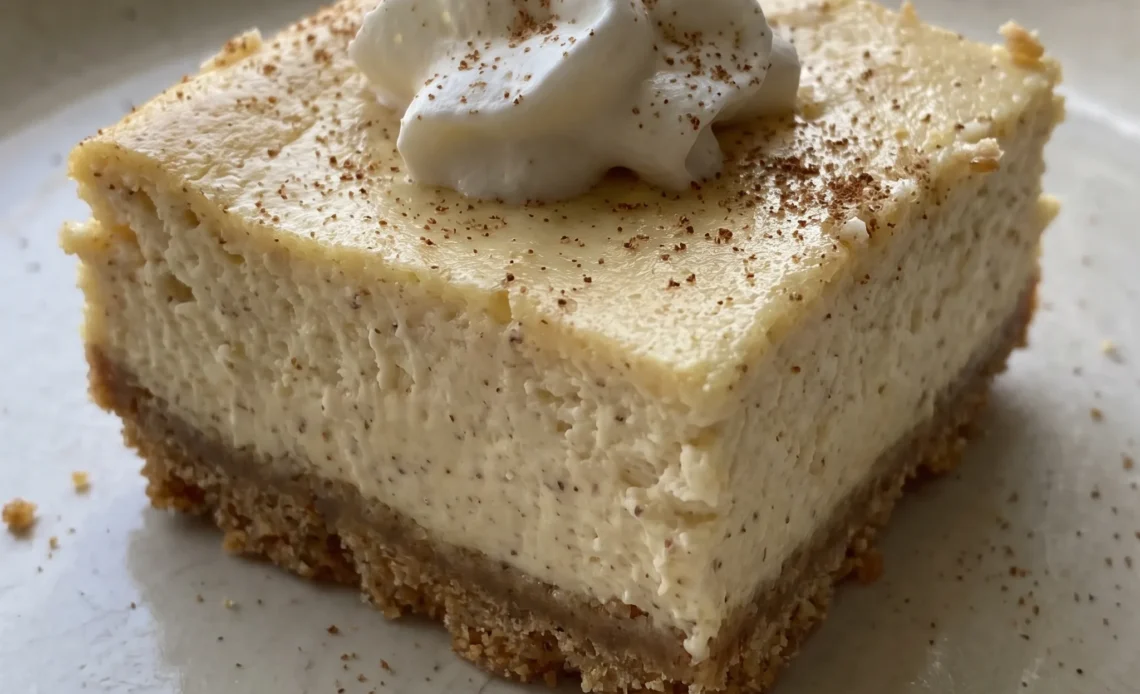
Heat is what decides whether eggnog cheesecake bars turn out silky or rubbery, and the filling gives you almost no warning before it crosses that line. A custard this soft sets from the outside in, so the edges can firm up and crack while the middle still sloshes.
Pull it while the center wobbles like firm gelatin and you get clean slices; wait for the surface to look fully set and you’ve already gone too far. The margin is narrow, which is why the water bath earns its extra pan and why the chill matters as much as the bake.
Nutmeg and a spoonful of bourbon carry the drink’s character into cold, sliceable squares, but texture is what people remember. Get the set right and the rest follows.
The most common mistake with these bars is skipping the water bath because it seems fussy and the recipe offers a faster no-water-bath option. Without the water bath, the pan’s edges absorb heat directly and the egg proteins in the custard coagulate too quickly, turning rubbery while the center remains liquid; the filling then cracks as it cools and contracts. The water bath insulates the batter, keeping it below a simmer so the eggs set gently and evenly into a smooth, sliceable custard.
Bake These in a Water Bath for a Silky Custard
Cheesecake fillings are essentially custards, and custards are sensitive to heat. In a dry oven, the edges of the batter reach a higher temperature faster than the center, which can cause them to set too firmly and turn rubbery while the middle remains underdone.
A water bath surrounds the pan with hot water, which absorbs and distributes heat evenly, keeping the entire custard at a gentler temperature. That slow, even cooking is what gives you a smooth, creamy texture from edge to center. Without this step, the bars are more likely to crack on top and develop a grainy mouthfeel.
The recipe includes a no-water-bath option with a shorter bake time, but that version carries a higher risk of these issues. When you slice into a properly baked water-bath cheesecake, the interior should look uniform and silky, not curdled or weeping. That’s the payoff for the extra pan of water.
Flour and Eggs Give the Filling Structure
Eggnog is a liquid, and liquid doesn’t set into a sliceable bar on its own. The flour in this recipe absorbs some of that excess moisture and helps the filling firm up as it bakes, without making it tough. The eggs and extra yolk provide the proteins that coagulate and give the custard structure, but the ratio matters.
Too few eggs and the bars stay soft; too many and they turn rubbery. Two whole eggs plus one yolk strike a balance, offering enough structure for clean slices while keeping the texture rich and creamy. The cream cheese adds body and a slight tang that balances the sweetness of the eggnog.
Without the flour, the bars would likely be too soft to lift out of the pan in one piece. When you cut into a properly set bar, it should hold its shape with a smooth, dense crumb, not slump or ooze.
Press and Prebake the Crust for a Sturdy Base
A cheesecake bar is only as good as its crust, and a crust that’s too loose or underbaked will crumble when you try to lift a slice. Pressing the graham cracker mixture firmly into the pan is crucial; you want it compact enough that it holds together under the weight of the filling.
Pre-baking for 10 minutes sets the crumbs and gives them a toasted flavor that pairs well with the nutmeg in the filling. It also creates a barrier that helps prevent the wet custard from soaking in. Let the crust cool completely before adding the filling, or the heat will start cooking the eggs prematurely.
Lining the pan with overhang makes it possible to lift the entire slab out for neat, even bars. When you bite into a finished bar, the crust should be crisp and cookie-like, not soggy or pasty.
Nutmeg and Bourbon Define the Eggnog Character
Eggnog’s unmistakable flavor comes from nutmeg, and a generous amount goes into the filling. It’s a warm, slightly sweet spice that cuts through the richness of the cream cheese and eggs. A dusting on top reinforces that aroma before the first bite.
If you opt for bourbon, it adds a subtle warmth and depth, a faint echo of the spirit without making the bars taste boozy. Vanilla extract rounds out the custard and supports the spice.
Leave these out and you’d essentially have plain cheesecake, pleasant but missing the point. The nutmeg should be freshly grated if possible; pre-ground loses its punch quickly.
When you taste a finished bar, the spice should be present but not overpowering, lingering in the background and mingling with the tang of the cream cheese. That’s what makes it taste like eggnog.
Chill Thoroughly Before Slicing
Right out of the oven, the filling is still soft and fragile. It needs to cool completely at room temperature first, which prevents condensation from forming on the surface and making the crust soggy. Then it must go into the refrigerator for several hours, or overnight.
During that time, the custard firms up and the flavors come together. Slicing too early will give you messy, collapsed bars with ragged edges. The long chill also makes the crust easier to cut cleanly.
When you’re ready to serve, lift the slab out using the foil overhang and use a sharp knife, wiping it between cuts for the neatest squares. The bars should be cold, firm, and hold their shape on the plate. Patience here is what turns a soft custard into a proper cheesecake bar.
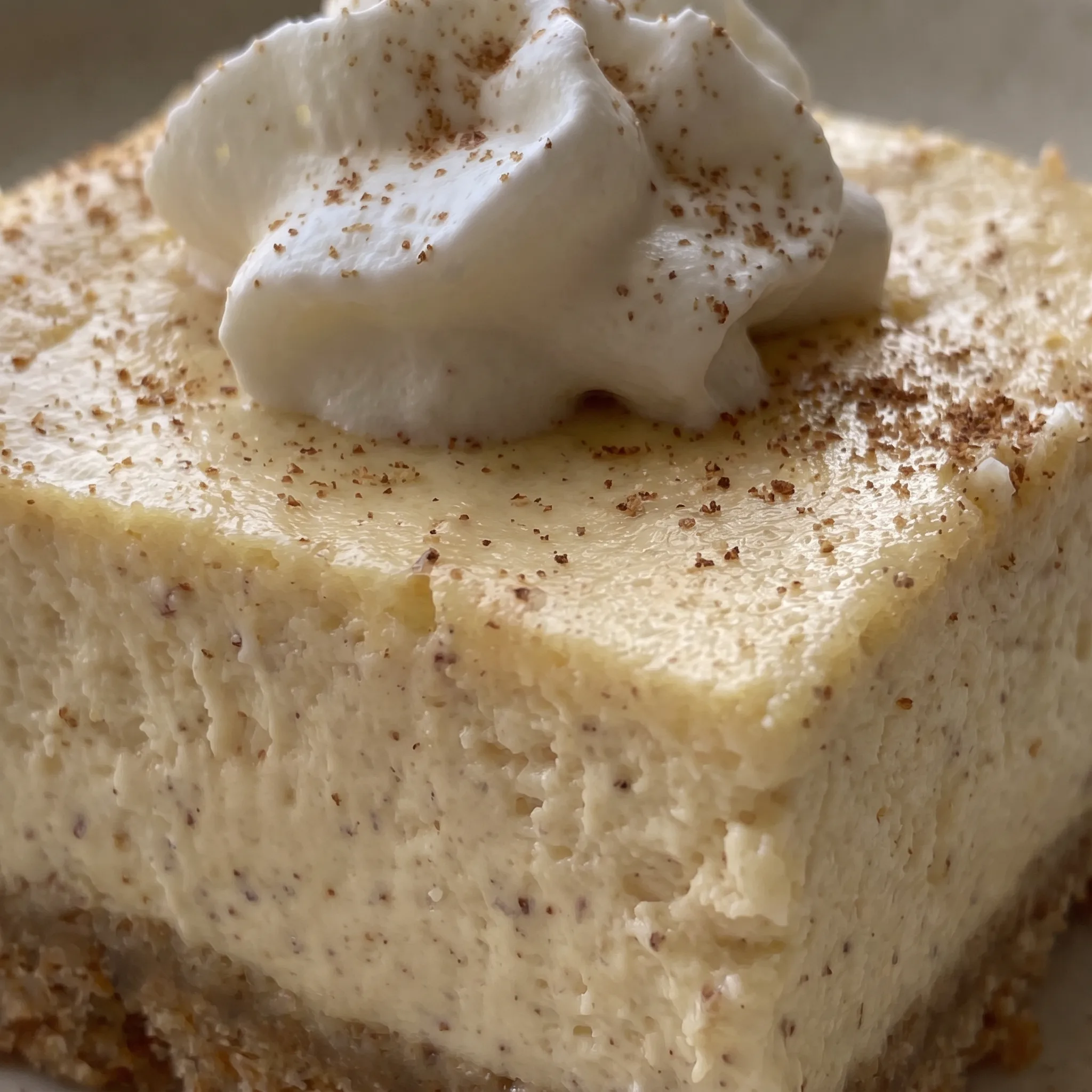
The Ingredients That Carry the Eggnog Flavor
Eggnog: Buy the refrigerated carton, not a shelf-stable canned version, since the fresh kind has real dairy and nutmeg already steeped in.
Nutmeg: Whole nutmeg grated on a Microplane hits harder than the pre-ground jar, which loses its punch within months of opening.
Cream cheese: Full-fat blocks only, softened on the counter, because the tub spread has extra water and gums that leave the filling slack.
Graham cracker crumbs: Pulse whole crackers in a food processor for uneven, sandy crumbs that press into a crust with more bite than the boxed dust.
Bourbon: A 1 tablespoon pour of a mid-shelf bottle is enough to warm the filling without turning it into a drink.
How to Read the Filling as It Bakes and Cools
Judging the set: when the center still wobbles
At 40 to 45 minutes, the center should jiggle like firm gelatin when you nudge the pan. The outer two inches will look set and slightly puffed. If the whole surface is liquid, give it 5 more minutes and check again.
If the edges have cracked and the center is flat, you’ve gone too far; the bars will still taste fine but the texture will be denser and less creamy. Pull it at the first sign of a wobble.
Cooling in the water bath: when to lift the pan out
As soon as the bars come out of the oven, lift the pan from the water bath and set it on a rack. Leaving it in the hot water keeps cooking the custard from below, which can push it past set and turn the edges rubbery. The water will still be hot; use both hands and keep the pan level.
The filling will look soft and maybe a bit wet on top, which is normal.
Chilling: the firmness test before slicing
After at least 3 hours in the fridge, press the center with a fingertip. It should feel cold and firm, with no give.
If it still yields, give it more time. Slicing early gives ragged, collapsed bars.
The crust will also firm up as it chills, so a clean cut is easier. For the neatest squares, wipe the knife between cuts.
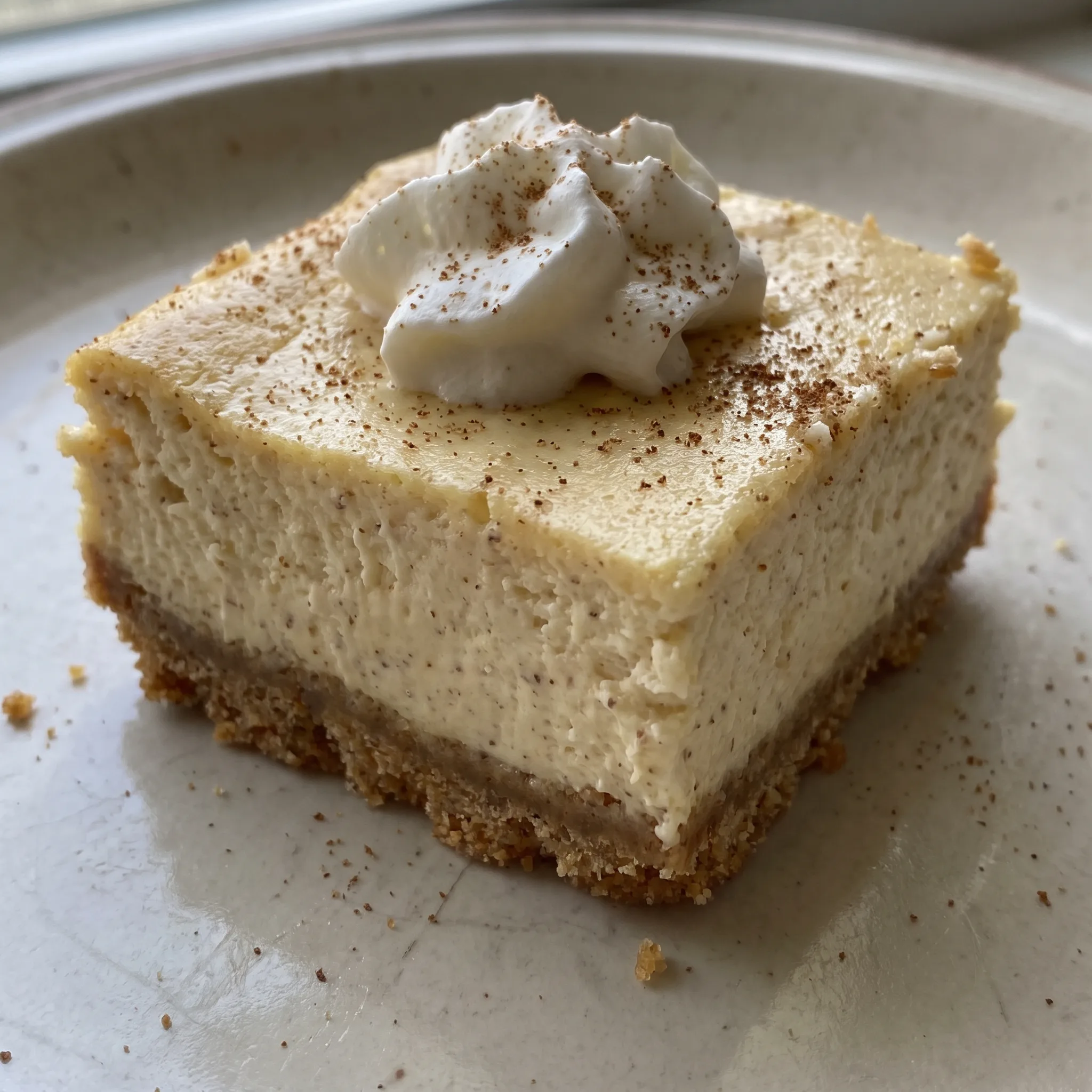
Eggnog Cheesecake Bars with Graham Cracker Crust
Ingredients
Method
- Turn oven on to 350°F (175°C). Use heavy-duty foil or parchment paper to line a 9×9-inch baking pan, allowing overhang on at least two sides, then apply a light coating of nonstick cooking spray.
- Stir together graham cracker crumbs, melted butter, sugar, and salt in a medium bowl until thoroughly mixed. Transfer this crumb mixture into the lined pan.
- Firmly compact the crumbs into the pan’s bottom with your hands or a spatula. Place in oven for 10 minutes.
- Using a mixer on medium speed, whip the cream cheese in a large bowl until light and fluffy, roughly 2 minutes. Incorporate the granulated sugar and continue beating for another couple of minutes until velvety.
- Add the eggs, egg yolk, eggnog, and vanilla; beat once more until fully blended and silky.
- If using bourbon, incorporate it now and beat until evenly distributed; if not, proceed without. Lastly, beat in the flour, nutmeg, and salt until lump-free.
- Transfer the eggnog cheesecake filling atop the graham cracker crust. For a water bath, set the baking pan inside a larger pan and pour in enough hot water to reach halfway up the sides of the baking pan.
- Bake until barely set, 40 to 45 minutes. Take the baking pan out of the water bath and move it to a wire rack. Allow to cool for 30 minutes, then chill for at least 3 hours or overnight.
- The cheesecake is ready when the center looks nearly set.
- When baking the bars without a water bath, bake for about 30 to 40 minutes.
- Take out of the oven and let cool on a baking rack for one hour. Refrigerate for at least 3 hours or overnight.
- Lift from the pan using the foil, and slice into 16 bars. Dust with nutmeg, or with graham crumbs and/or crystallized ginger, or leave plain.
Swap the Eggnog, Cream Cheese, and Bourbon Without Wrecking the Set
Cream cheese: Full-fat brick cream cheese is the default. Reduced-fat (Neufchâtel) can work, but expect a softer set and a slightly grainier texture. Fat-free cream cheese will not set into a sliceable bar; the filling stays wet and may never firm up, even after an overnight chill.
Full-fat gives the dense, creamy crumb that holds a clean cut. Reduced-fat loses some richness and may need an extra 10 minutes in the oven, but the bars will still taste fine. Fat-free turns the filling into a soupy custard that won’t hold its shape.
Eggnog: Store-bought refrigerated eggnog is the standard. Homemade eggnog can be used if it’s cooked and cooled; use the same 3/4 cup. Avoid shelf-stable canned eggnog, which often has stabilizers and a cooked flavor that dulls the nutmeg.
Refrigerated eggnog brings real dairy and spice. Homemade adds richness but may vary in sweetness, so taste the batter before baking. Canned eggnog can make the filling taste flat and overly sweet.
Bourbon: Leave it out for a non-alcoholic version, or replace with 1 tablespoon dark rum or 1 teaspoon vanilla extract. If using rum, start with 1 tablespoon; for vanilla, start with 1 teaspoon and adjust after tasting the batter. Bourbon adds warmth and depth.
Rum gives a similar but slightly sweeter note. Vanilla reinforces the custard but won’t mimic the boozy edge.
Omitting alcohol entirely leaves the eggnog and nutmeg to carry the flavor, which works fine.
All-purpose flour: For a gluten-free version, use 2 tablespoons of a gluten-free all-purpose blend that contains xanthan gum. Do not substitute with almond flour or coconut flour; they absorb liquid differently and will throw off the set.
A proper gluten-free blend with xanthan gum will bind the filling similarly to wheat flour. Almond or coconut flour will leave the bars greasy or crumbly because they don’t absorb moisture the same way.
Tips
- Chill the assembled pan on a flat shelf, not the door, and check that it sits level; a tilted pan lets the custard set with one edge thicker than the other, so your 4×4 grid of 16 bars will come out uneven no matter how clean the knife is.
Storage and Serving: Keeping the Bars Firm and Cold
These bars are at their best in the first two days, eaten straight from the fridge. That’s when the crust is still crisp and cookie-like against the dense, cold filling. The chill time the recipe calls for gets you to sliceable; serving them ice-cold dulls the nutmeg and bourbon, so let a portion sit out about ten minutes before it hits the plate.
The custard stays firm and clean-edged through day three. Past that, the graham base starts pulling moisture from the filling and softens from crisp to cakey. It’s a gradual change, not a sudden one, but it’s why leftovers hold best for three to four days in the fridge, covered tight or in an airtight container with parchment between layers.
After that, the crust goes slack and the filling can weep at the edges. Freeze only the filling-topped slab, well wrapped, up to one month; thaw overnight in the fridge. The crust won’t come back crisp, so expect a softer base.
Hold the nutmeg dusting, graham crumbs, or crystallized ginger until just before serving. They sit on top and pull moisture from the air, going damp within a few hours. Add the finish, then eat within the hour.
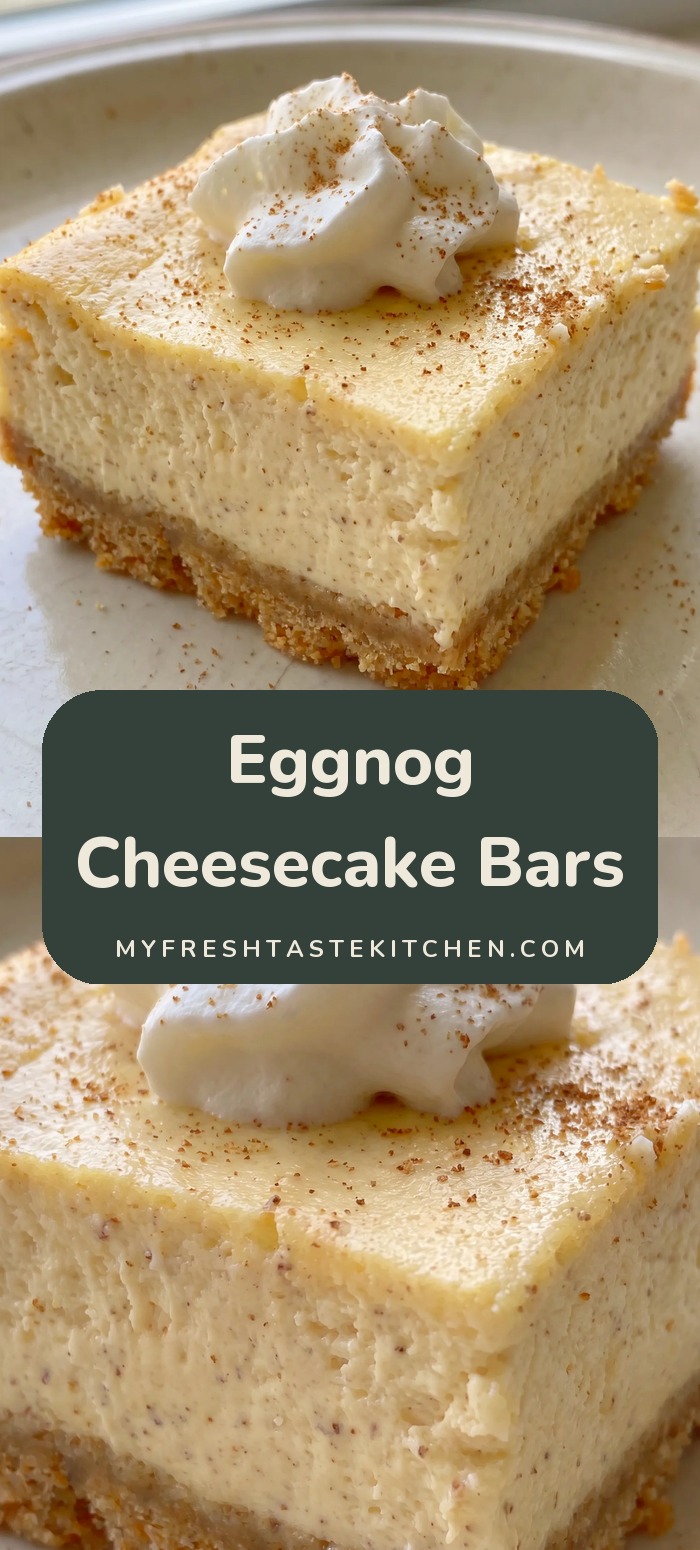
Frequently Asked Questions
Can I make these eggnog cheesecake bars ahead of time?
These bars are built for a day-ahead schedule. After they bake and cool, they need at least 3 hours in the fridge before you can slice them cleanly, so finishing them the night before you plan to serve is the simplest path.
The crust holds its crisp, cookie-like texture through day three, which means a batch made on Thursday is still in good shape on Saturday. Hold off on the nutmeg dusting or any crumb garnish until just before serving, since those toppings pull moisture from the air and go damp within a few hours.
Why did my cheesecake bars crack on top?
The most likely culprit is overbaking: the custard set past the point where the center still wobbles, and the surface pulled tight and split as it cooled. If you baked without the water bath, the dry heat hits the edges harder than the center, which makes that cracking far more likely.
Next time, check earlier and pull the pan when the middle jiggles like firm gelatin and only the outer two inches look set. The bars will still taste fine, just denser and less creamy than a properly pulled batch.
How do I know when the bars are done baking?
Judge by the wobble, not the clock. Nudge the pan and the center should move like firm gelatin, while the outer two inches look set and slightly puffed.
If the whole surface is still liquid, give it a few more minutes and check again; if the edges have cracked and the center is flat, you’ve gone past the mark. For the water bath version, that window lands around 40 to 45 minutes, and the no-water-bath version runs a bit shorter.
Can I skip the water bath?
Yes, and the recipe gives you a no-water-bath option. Without it, the dry oven heat hits the edges faster than the center, so you’re more likely to see cracking and a slightly grainy texture. The trade-off is convenience versus a silkier, more even custard.
If you skip it, watch the wobble closely, since the edges can set and crack before the middle is ready.
How do these compare to traditional cheesecake?
Think of them as a thinner, more portable version of the same custard. The filling is essentially a cheesecake batter with eggnog standing in for some of the dairy, plus nutmeg and optional bourbon to push it toward the drink.
Because they bake in a 9×9 pan rather than a springform, the bars set faster and slice into neat squares, which makes them easier to serve to a crowd. The texture is dense and creamy like a good cheesecake, but the eggnog and spice give it a seasonal character plain cheesecake doesn’t have.
