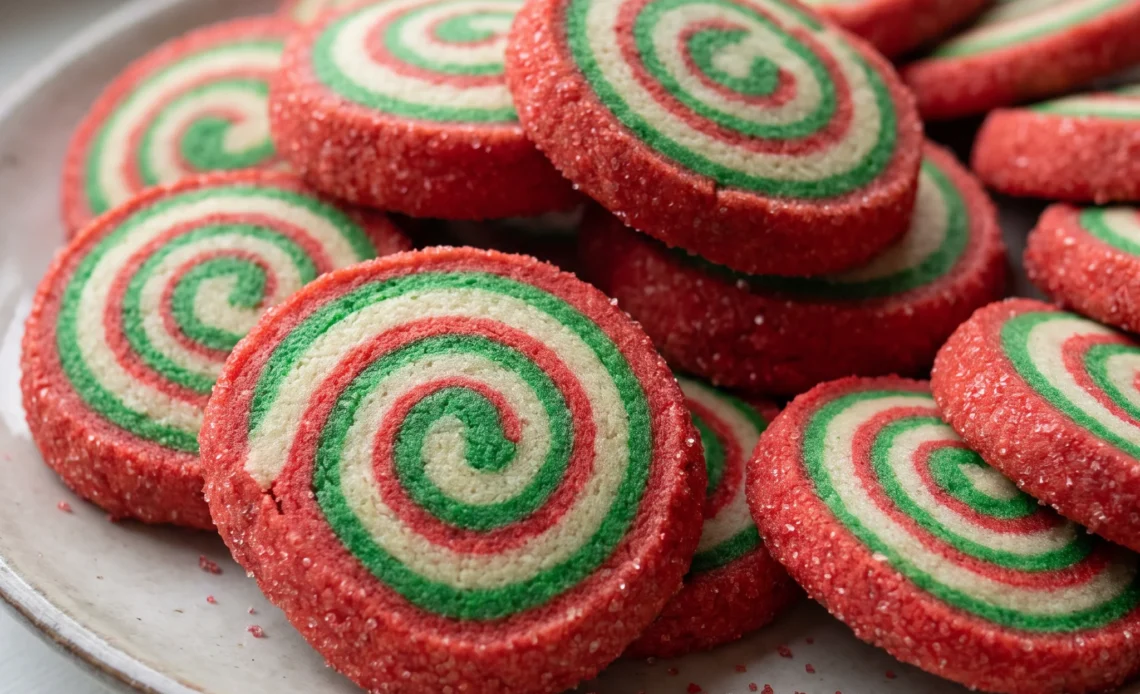
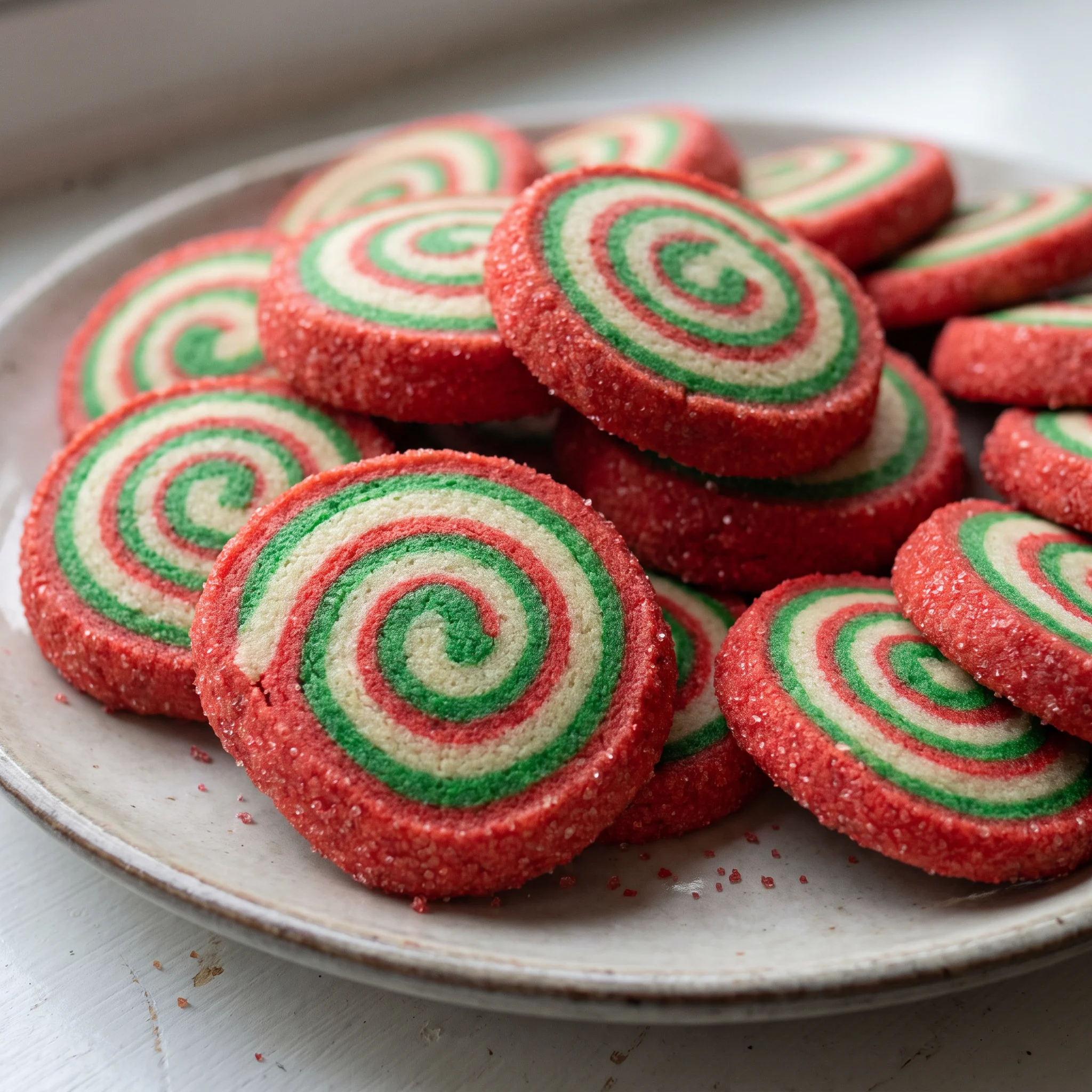
Christmas pinwheel cookies aren’t a sugar cookie you decorate after the fact. The color lives inside the dough, so the pattern is already there before anything hits the oven. Slicing into that chilled log is the moment the whole thing pays off: red, green, and plain spiral out in tight bands, and you realize one batch of dough did all of it.
What nobody warns you about is the rolling and stacking, where uneven sheets or a log that warmed up on the counter can pull the spiral crooked or smear the colors as the knife goes through. Work colder than feels necessary and the layers hold. You can build the log days ahead, which is most of the reason these land on holiday trays at all.
The sanding sugar rim, though, has a short life. Those grains start pulling moisture the moment they sit out, so the crunch you pressed on is the first thing to fade.
Three Doughs for One Pinwheel
Splitting the dough into three equal portions (red, green, and uncolored) gives you the classic pinwheel with two distinct colors and a neutral background. Two colors would create a simpler spiral but lose the contrast that makes the pattern pop. Each portion needs a rest in the fridge before rolling; this firms up the butter so the dough doesn’t stick to the parchment or tear when you layer it.
When you roll each color into a square first, you’re setting up even thickness across all three sheets, which is what keeps the spiral tight and uniform once stacked. A thinner spot in one sheet would throw off the whole roll.
Why Gel Coloring Wins
Gel food coloring packs intense color with very little liquid, so you get vivid red and green without slackening the dough. Liquid coloring would water down the mixture, making it tacky and prone to sticking during rolling and slicing. With gel, the dough stays firm enough to handle.
You’ll want to mix until the color is completely uniform; any streaks left will show as marbled patches in the baked cookie. A few quick pulses with the paddle usually do it, but scrape the bowl to catch any hidden pockets of white. The result is a clean, bold hue that carries through the whole spiral.
Freeze for Clean Cuts
Once the dough is rolled into a log, freezing is what gives you neat slices. A firm log means the serrated knife cuts through cleanly, without squashing the spiral or dragging the layers apart.
If the log is too soft, the pressure of the knife smears the colors together and the pinwheel pattern blurs. The cold also makes the dough rigid enough that the layers stay put as you slice.
You’re looking for slices that hold their shape and show a crisp contrast between red, green, and plain. A few seconds of pressure with a sharp blade is all it takes when the log is properly frozen.
Sanding Sugar on the Edge
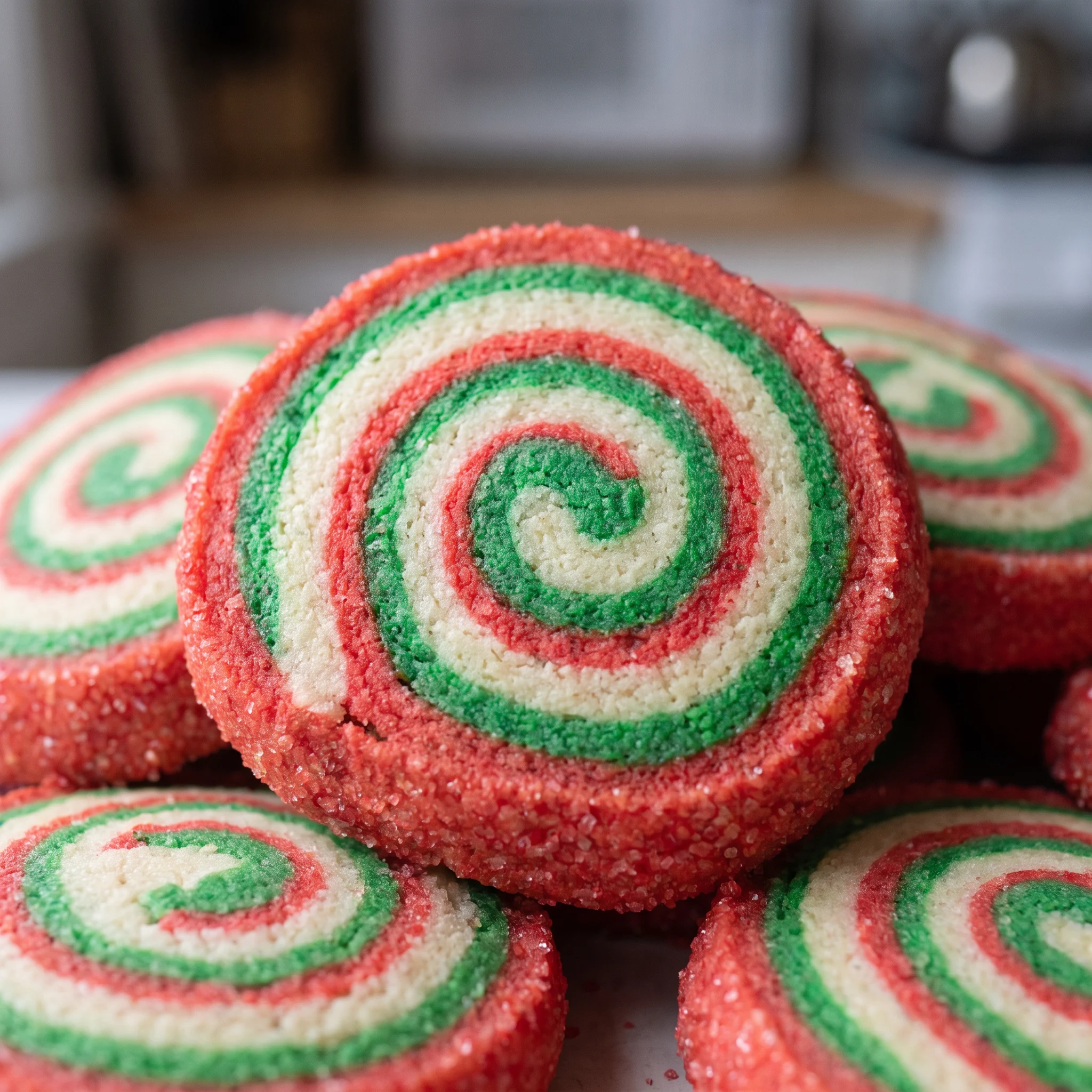
Rolling the edge of each slice in red sanding sugar adds a crunchy contrast to the soft cookie and a festive sparkle. The coarse grains don’t dissolve in the oven; they stay intact and catch the light.
Sprinkling sugar on top would just sit there and fall off, but pressing it onto the sticky edge of the dough makes it adhere. As the cookies bake, the sugar clings and creates a textured rim.
That rim also helps define the pinwheel shape, giving each cookie a finished look. When you bite in, you get a little crunch before the tender crumb.
What Matters in These Pinwheels
Unsalted butter: Softened means it dents under your finger but still holds its shape, not greasy or melted at the edges.
Red and green gel food coloring: Gel, not liquid, because it colors deeply without thinning the dough and turning it sticky.
Red sanding sugar: Coarse sanding sugar, not granulated or fine sugar, so the grains stay crunchy and visible after baking.
Judging the Dough at Every Turn
When the butter and sugar are ready
Creaming for 3 to 4 minutes on medium speed should leave the mixture pale and fluffy, with no visible grains of sugar. If it still looks gritty or the butter feels cool and firm, keep going. Under-creamed butter won’t hold air, so the cookies bake up flat and dense.
Stop as soon as it’s smooth and light; over-creaming can warm the butter too much.
Reading the dough after the flour goes in
With the mixer on low, add the flour in stages and stop the moment it disappears. The dough should come together without looking dry or crumbly. If it seems dry, add a teaspoon of water; if sticky, a tablespoon of flour.
Overmixing develops gluten, making the cookies tough instead of tender.
Rolling the squares to even thickness
Each color needs to be a 7-inch square, but the real test is thickness: all three should be the same. Press a ruler or your fingers at the corners and center. If one is thicker, the stack won’t roll evenly and the spiral will be lopsided.
Chill the squares for 15 minutes before stacking; they should be firm but still pliable, not hard.
Slicing the log without squashing
A serrated knife should glide through the frozen log with light pressure. If you have to press hard, the log isn’t cold enough; return it to the freezer for 10 minutes. Slices should be 1/3-inch thick and hold their shape.
Sawing or forcing will smear the colors and blur the pinwheel.
Pulling the cookies at the right moment
Bake for 8 to 10 minutes, until the edges are set and the centers no longer look wet. The cookies will be pale; that’s fine. Overbaking by a minute or two turns them crisp and dulls the colors.
Let them cool on the sheet for 1 minute before moving to a rack; they firm up as they cool.
Christmas Pinwheel Cookies with Red and Green Dough
Ingredients
Method
- In a stand mixer bowl equipped with the paddle attachment, cream the butter and sugar on medium speed until smooth, 3 to 4 minutes. Beat in the egg and vanilla until well incorporated, scraping down the bowl’s sides as necessary.
- In a medium bowl, whisk the flour, salt, and baking soda together. With the mixer running on low, add the flour mixture in stages and beat until just combined. Take the dough out of the bowl and split it into thirds.
- Put one third of the dough back into the mixing bowl, add red gel food coloring, and beat until the color is uniform. Remove the dough, clean the bowl, and repeat with a second third of dough and green gel food coloring. Leave the last third of dough uncolored. Form each portion into a ball, wrap in plastic, and chill for 1 hour.
- Take the dough out of the refrigerator and roll each ball between two sheets of parchment paper into a 7-inch square. Chill again for 15 minutes, leaving the dough between the parchment sheets.
- Layer the dough sheets on a piece of parchment paper, beginning with red, then green, then plain. Place another piece of parchment paper on top and roll out into a 12×8-inch rectangle. Remove the top parchment sheet. Starting from one long side, tightly roll the dough into a log. Wrap the log in parchment paper and freeze for 1 hour.
- Heat the oven to 350°F (175°C). Line two baking sheets with parchment paper and set aside.
- With a serrated knife, slice the dough log into 1/3-inch thick pieces. Roll the edge of each slice in red sanding sugar. Arrange slices 1 inch apart on the prepared baking sheets.
- Bake for 8 to 10 minutes, or until set. Allow the cookies to cool on the baking sheet for 1 minute, then move to a wire rack to cool completely. Once cooled, pack and store in an airtight container.
Storing and Serving Christmas Pinwheel Cookies
The sanding sugar rim is the first thing to go soft. Those coarse grains sit exposed on the edge, and in a humid kitchen they pull moisture from the air within a day, losing the crunch that made them worth pressing on. An airtight container at room temperature slows that down, but not forever.
Eat them within two days for the crisp rim and tender spiral you pulled from the oven. Past that, the interior softens gradually into something closer to a soft sugar cookie, still fine with coffee, just different.
Keep them layered between parchment so the sugar doesn’t rub off on the cookie below. For longer keeping, freeze the baked cookies in a single layer, then bag them; they hold for about a month.
Thaw at room temperature, uncovered, so condensation doesn’t undo the edge. Skip the fridge entirely. Cold dries the crumb and does nothing for the sugar.
To serve stored cookies, a few minutes in a 300°F oven brings the rim back partway.
When a Swap Keeps the Spiral Intact
Unsalted butter: Butter-flavored shortening or margarine, same amount by weight (151 g). Shortening handles warmer kitchens better and the dough will feel less greasy, but it carries no water, so the cookies bake up a touch drier and the flavor leans flat. Margarine brings its own salt, so cut the kosher salt to a scant 1/4 teaspoon.
Either one softens the color contrast slightly; the red and green still show, just a little less bright.
Large egg: One flax egg: 1 tablespoon ground flaxseed mixed with 3 tablespoons water, rested 5 minutes until gel-like. The dough will be slightly tackier and may need an extra tablespoon of flour to come together, but it rolls and slices without tearing. Expect a faint nutty taste and a slightly denser bite.
The pinwheel pattern holds; only the crumb changes.
Red and green gel food coloring: Paste or powdered food coloring. Powdered coloring gives the most intense hue and never thins the dough, so you can use a generous pinch.
Paste sits between gel and powder: start with a dab and add more until the color reads clearly. With either, the dough stays firm enough to roll, but powdered can leave tiny specks if you don’t work it in fully, so scrape the bowl once more than you think you need to.
All-purpose flour: Do not swap. Gluten-free blends and whole wheat change how the dough stretches and rolls. The 7-inch squares need to bend without cracking, and a different flour makes them brittle or sticky.
The spiral won’t stay tight and the slices crumble. If you must avoid wheat, this isn’t the recipe to adapt.
Tips
- Keep the stand mixer bowl and paddle in the freezer for 10 minutes before creaming the butter and sugar, and use a chilled marble or metal surface for rolling. The friction of the paddle and the warmth of a countertop soften the dough from the outside in, which is why the outermost layer of the log goes slack first and smears when sliced. A cold bowl and cold rolling surface buy you the working minutes you need without re-chilling between every pass.
When the assembled dough log is not firm enough, the pressure of the knife pushes the layers out of alignment instead of cutting cleanly through them. The red, green, and plain doughs have similar softness, so without solid chilling they merge at the edges and the spiral collapses. A serrated knife can only produce neat slices if the dough offers enough resistance to keep each layer distinct.
Frequently Asked Questions
Can I make the dough ahead of time and bake later?
Yes, and the dough actually behaves better for it. The freezer firmness is what gives you clean slices, so a log that sits overnight in the fridge or a month in the freezer is easier to handle than one sliced warm. If you’re freezing the log, wrap it tight and slice straight from frozen; for fridge storage, give it 15 minutes on the counter if it’s too hard to cut.
The baked cookies also freeze well, as the storage section notes.
Why did my pinwheel cookies spread and lose their shape?
The usual culprit is butter that was too warm when the dough went in the oven. If the log feels soft or greasy at the edges, the layers slump before the structure sets.
Another common cause is under-creaming the butter and sugar, which leaves the dough dense and heavy so it can’t hold its rise. Make sure your baking sheet is cool; a hot sheet from a previous batch will melt the dough from below.
How do these compare to classic slice-and-bake cookies?
These are a slice-and-bake at heart, but the layering and chilling steps set them apart. You’re building three separate sheets and rolling them into a log, which takes more time upfront than a single dough, but the payoff is the pinwheel pattern and the sanding sugar rim. The texture lands somewhere between a tender sugar cookie and a shortbread, with a crunch on the edge from the coarse sugar.
They’re more involved, but the visual impact is worth it for a holiday tray.
