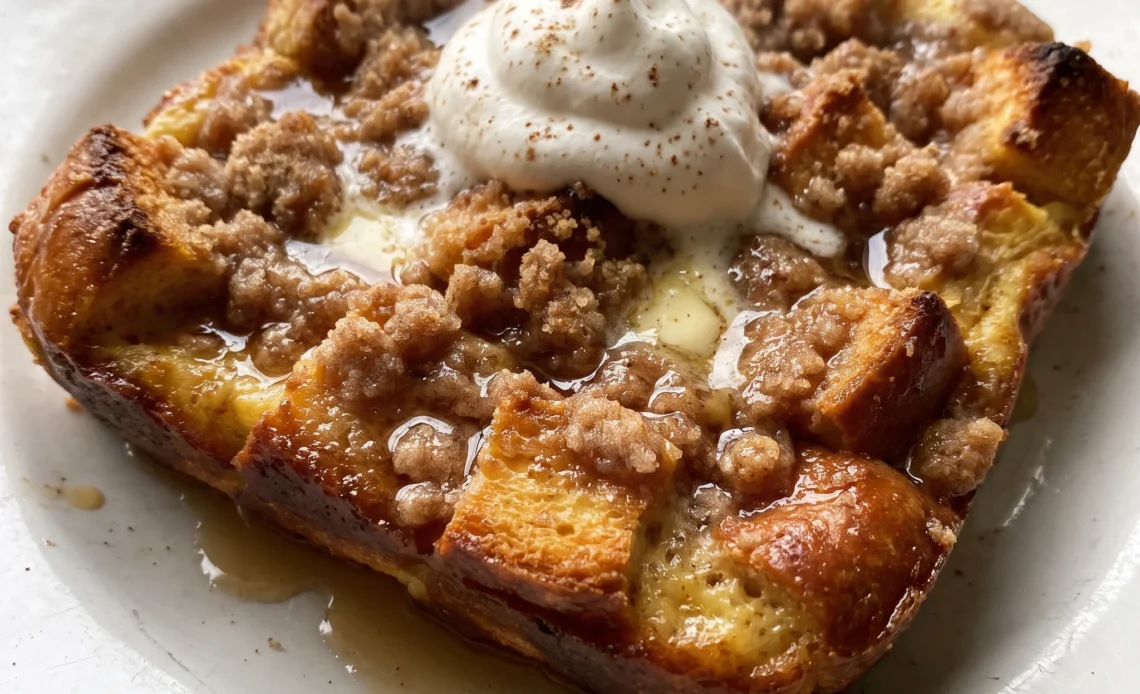
The hardest thing about an eggnog french toast bake isn’t the custard or the streusel. It’s patience. A saturated loaf needs time to drink evenly, and the gap between a center that’s set and one that’s still liquid is narrower than most people expect.
That’s the real difficulty here, and it’s also why this dish works so well for a crowd: you can assemble it the night before, let the bread hydrate on its own schedule, then bake it while the coffee brews. The topping stays crisp if you treat it right, and the custard tastes like the drink it’s named for rather than a vague, sweetened cream. It feeds a table without last-minute frying, and the texture lands somewhere between bread pudding and a proper baked French toast.
Worth making for a holiday morning, and worth making again once you’ve got the feel for the soak.
Bread Choice Determines Creamy or Soggy
A loaf with an open, slightly dry crumb is what separates a custardy bake from a wet one. Brioche or French bread soaks up the eggnog mixture without collapsing, because their structure holds up when saturated. Cut into bite-sized cubes, the bread gains more surface area, so the custard coats every piece evenly and the whole dish bakes at the same rate.
Press a cube to the touch after tossing, and it should feel damp but still spring back a little, not dissolve into paste. Soft, presliced sandwich bread lacks that scaffolding; it drinks the custard and then gives way entirely, leaving a dense, spoonable center that never sets into distinct pieces.
If you only have sandwich bread, leave it out overnight to dry, but expect a softer result. The right loaf gives you a bake where the bread still has some bite under the tender crust.
Crumb Topping Is a Crisp Shield
The streusel on top is more than a pretty finish; its balance of flour, two sugars, and butter creates a crisp lid that contrasts with the soft custard underneath. Brown sugar brings moisture and a faint caramel edge, while white sugar dries the mix out just enough to crisp in the oven. When you rub the butter in, aim for the texture of wet sand that clumps when you squeeze a handful.
That tells you the fat is evenly distributed and will melt into a cohesive crust rather than greasy patches. As it bakes, this layer insulates the bread, keeping the surface from drying out or scorching before the custard sets. You want a deep golden brown and a topping that shatters slightly under a fork.
If it browns too fast, tent with foil, but don’t skip the topping; it’s what makes each serving feel complete.
Eggnog Builds a Richer Custard
Eggnog isn’t just a flavor shortcut; its thickness, sugar, and spices change the custard’s water-to-fat ratio, giving you a richer, sweeter base without extra steps. The drink already contains eggs, cream, sugar, and nutmeg, so the custard tastes fuller and coats the bread more evenly than a plain milk-and-egg mixture would.
A splash of vanilla and an extra pinch of nutmeg reinforce that profile, adding warmth that stands out against the bread. Because eggnog is viscous, it clings to the cubes instead of running straight to the bottom of the dish, which means fewer dry patches after baking.
You’ll see the bread glisten evenly once tossed, with no pale, unsoaked corners. If you use a thinner liquid, the custard sets up watery and the bread turns spongy.
Stick with the eggnog and taste a cube before baking; it should be sweet and spiced, not eggy.
Make Ahead, Then Bake Uncovered
Assembling this the night before is a practical move that also improves texture. As it sits, the bread fully hydrates, so every cube bakes up tender rather than dry in the middle.
The topping, however, will soften as it absorbs moisture from the custard; that’s expected and doesn’t hurt the final result. When you’re ready to bake, take the dish out of the fridge and let the oven preheat.
Bake it uncovered, because a foil cover would trap steam and leave the streusel pale and gummy instead of crisp. The cold dish also means you’ll likely need the full time range to get the center set and the top golden. Start checking at the early end, but don’t pull it until the custard no longer jiggles in the middle and the topping is deeply browned.
A 5 to 10 minute rest before slicing helps it hold together.
A Strata, Not Stovetop French Toast
This is a strata: bread layered in a dish, soaked with a custard, and baked as a whole. That structure gives you a soft, spoonable interior and a crisp, sugared top, nothing like the crisp-edged slices you’d get from dipping and frying. Each serving is a cross-section of tender bread and custard, with the crumb topping adding crunch.
Because it bakes in one pan, it’s built for a crowd; a 9×13-inch dish serves 15, so it fits a holiday brunch without last-minute frying. The trade-off is that you lose the contrast of a fried crust, but you gain the ease of feeding everyone at once.
Serve it warm with whipped cream and a drizzle of syrup, and let people take as much or as little as they like. The texture is comforting and rich, but not heavy if you’ve used the right bread.
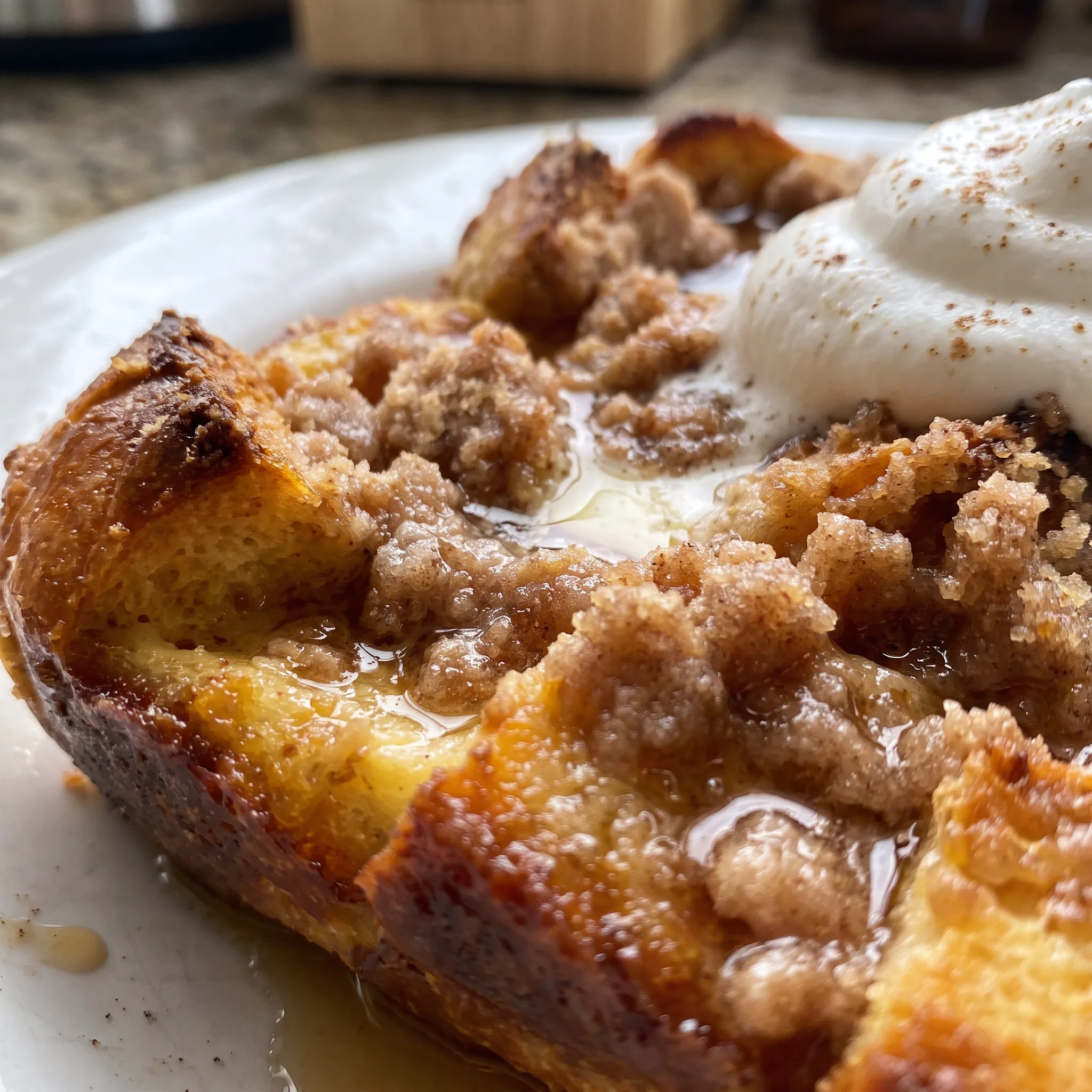
What to Buy and How to Prep It for This Bake
White bread, such as brioche or French bread: Choose a 15 to 18 oz loaf with a dry, open crumb; presliced sandwich bread soaks too fast and collapses into a dense center.
Eggnog: Use a thick, refrigerated eggnog with visible spices; the viscosity clings to bread cubes and gives a richer custard than milk would.
Nutmeg: Grate whole nutmeg if you can; pre-ground loses its punch, and you want that warmth to come through in both the custard and topping.
Brown sugar: Light or dark both work, but dark has more molasses and will push the topping toward a deeper caramel edge as it bakes.
Butter, melted: Let it cool slightly before adding to the dry mix; hot butter can melt the sugar into a paste instead of forming clumps.
Judging the Soak, the Set, and the Crust
How much custard the bread will take
The bread should look uniformly damp after tossing, with no dry patches. If you see pale, uncoated cubes, you have not distributed the egg mixture evenly.
Press a cube: it should feel wet but not disintegrate. If the bread is still hard in the center, give it a few more minutes to soak before baking. Too little custard means dry pockets; too much and the bread collapses into a dense layer.
You want the cubes to glisten without pooling liquid at the bottom of the dish.
When the topping is ready to scatter
After you add the melted butter, stir until the mixture looks like wet sand and clumps when pressed in your hand. If it feels greasy or has dry flour streaks, keep mixing.
Overmixing makes a paste that bakes into a hard slab; undermixing leaves dry patches that won’t crisp. The texture should hold together when squeezed but still crumble when you break it apart.
Scatter it in an even layer so every bite gets some crunch. If you can see bare bread, add more topping.
Reading the bake: jiggle versus set
At 32 minutes, check the center by gently shaking the dish. A slight wobble is fine, but if the custard ripples like liquid, it needs more time. The top should be deeply golden brown.
If the topping darkens too fast, tent with foil. The full 37 minutes is often needed, especially if the dish went in cold. Pull it when the center no longer jiggles and a knife inserted halfway in comes out clean.
Underbaked, the center stays wet; overbaked, the custard weeps and the bread dries.
The rest before slicing
After baking, let the dish sit for 5 to 10 minutes. This allows the custard to firm up so slices hold their shape. If you cut immediately, the layers slump and release liquid.
The wait also lets the topping set into a crisp crust. Use this time to gather whipped cream and syrup. The dish should be warm, not steaming, when you serve it.
A longer rest won’t hurt, but the topping may soften slightly.
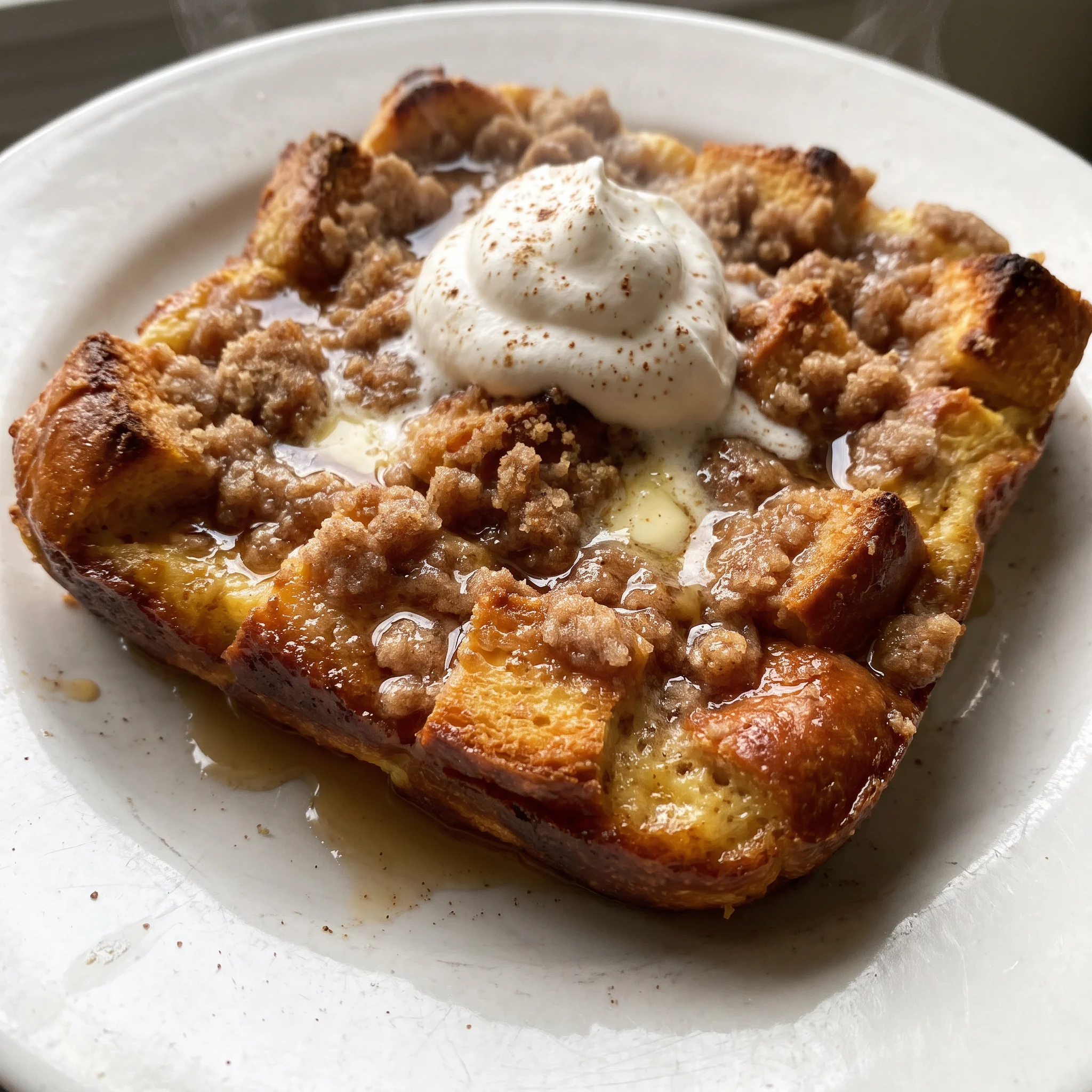
Eggnog French Toast Bake with Crumb Topping
Ingredients
Method
- Coat a 9×13-inch (3-quart) casserole dish with grease. If you intend to bake right away, heat the oven to 350°F (175°C).
- Slice the bread into bite-sized pieces and transfer them to the casserole dish.
- In a large bowl, beat the eggs, eggnog, nutmeg, and vanilla extract until combined.
- Drizzle the egg mixture over the bread, gently tossing if necessary so the bread is evenly moistened.
- Combine the flour, brown sugar, white sugar, nutmeg, and cinnamon by whisking.
- Add the melted butter and stir until the mixture looks like wet sand and clumps together when pressed in your hand.
- Scatter the topping over the French toast.
- For immediate baking, put the dish in the preheated oven and bake for 32–37 minutes, or until the surface is golden brown.
- To prepare ahead, cover with aluminum foil and chill overnight. When ready to bake, take it out of the refrigerator, preheat the oven to 350°F (175°C), and bake without covering for 32–37 minutes.
- Allow to cool for 5–10 minutes, then slice and serve accompanied by whipped cream and syrup.
How to Store and Reheat Without Losing the Crust
Leftovers keep in the fridge for up to 3 days, covered tightly. The topping softens overnight as it pulls moisture from the custard. That’s unavoidable, but you can bring back most of the crunch.
Reheat individual portions in a 350°F oven or toaster oven for 8 to 10 minutes, uncovered. The dry heat re-crisps the streusel and warms the custard through. A microwave makes the bread rubbery and the topping steamy, so skip it unless you’re in a hurry.
For the best texture, eat within the first day. After that, the bread continues to soften, though the flavor deepens. If you assembled the dish ahead, it holds in the fridge for up to 24 hours before baking; beyond that, the topping turns pasty.
Freezing isn’t recommended for the baked casserole. The custard separates and the topping never fully recovers.
Serve warm with whipped cream and syrup on the side. Add those at the table, not before storing, or they’ll thin out and soak in.
When You Swap the Eggnog or the Bread, the Custard Changes
Eggnog (1 3/4 cups): For a dairy-free version, use 1 1/2 cups unsweetened oat milk plus 1/4 cup full-fat coconut milk, and add 2 tablespoons sugar and a pinch more nutmeg. This mimics the thickness and sweetness of eggnog without dairy. The custard will be slightly less rich, but still sets well.
Taste the mixture before pouring; it should be sweet and spiced. If it tastes thin, add a little more sugar. The bread will soak similarly, but the final bake may be a touch less creamy.
White bread, such as brioche or French bread (15, 18 oz): Challah or a sturdy country loaf works as a direct replacement, same weight. If using gluten-free bread, choose a dense, dry variety and increase the eggnog to 2 cups. Challah has a similar open crumb and will absorb the custard without turning soggy.
Gluten-free bread tends to be thirstier, so the extra liquid helps avoid dry patches. Expect a slightly different texture, but the bake will still hold together. Avoid soft sandwich bread; it collapses and makes the center dense.
Eggs (5 large): For an egg-free version, use 5 tablespoons ground flaxseed mixed with 15 tablespoons water (or 1 1/4 cups aquafaba) instead of the eggs. The custard will be less set and more liquid, so reduce the eggnog to 1 1/2 cups to compensate.
The bake will be softer and may not slice as cleanly, but it will still taste good. Let it rest longer before serving to firm up.
Nutmeg (1/2 teaspoon in custard and 1/2 teaspoon in topping): If you don’t have nutmeg, use an equal amount of ground cinnamon in both places, or a mix of cinnamon and a pinch of ground cloves. Cinnamon brings warmth but lacks the peppery edge of nutmeg. The dish will taste more like classic French toast and less like eggnog.
Cloves add a similar pungency, but use sparingly; a little goes a long way. Start with the same amount and adjust after tasting the custard.
Tips
- Pour the custard in three or four additions rather than all at once, waiting about 30 seconds between each so the bread absorbs before the next pour. With 1 3/4 cups of liquid over 15 to 18 ounces of bread, a single dump floods the bottom of the dish and leaves the top cubes pale while the lower ones sit in a pool.
- After pouring, press down on the bread with a wide spatula or the back of a spoon, working from the corners toward the center, then stop as soon as the cubes stop springing back. Pressing past that point compacts the bread into a single mass, and the 9×13 dish will bake into one dense slab instead of distinct soaked pieces.
The custard needs bread with an open crumb and some dryness to absorb liquid while keeping its structure; brioche or French bread provides that, whereas soft presliced sandwich bread lacks the gluten network and starch retrogradation to hold up. When weak bread soaks, it disintegrates and releases water, so the interior never sets into distinct custardy cubes.
Frequently Asked Questions
Can I assemble this the night before and bake it in the morning?
Yes, and it’s the move that gives you the most tender center. The catch is the topping: it pulls moisture from the custard overnight and softens, so don’t expect the same shatter you’d get baking right away.
When morning comes, everything goes into a cold oven dish, which is why the full time range matters more than ever. The dish holds in the fridge up to 24 hours before baking; past that, the streusel turns pasty and you’ve lost the contrast that makes this worth making.
Why is my French toast bake soggy in the middle?
Nine times out of ten it’s the bread, not the custard. Soft presliced sandwich bread drinks the eggnog and then collapses, and no amount of extra baking fixes a center that’s already turned to a dense, spoonable layer. If you used brioche or French bread, then look at your soak: cubes should glisten evenly with no pooling liquid sitting at the bottom of the dish, and pressing one should feel damp without it dissolving.
The next check is the bake itself. If the center still ripples like liquid when you shake the dish, it hasn’t set, and pulling it early leaves you with wet custard no rest will rescue.
How do I know when the eggnog French toast bake is done?
Shake the dish gently and watch the middle: a slight wobble is fine, a ripple that moves like liquid means it needs more time. The surface should be deeply golden brown, and if the topping is darkening faster than the center is setting, tent it with foil so you don’t trade a raw middle for a burnt top.
A knife inserted halfway in should come out clean. The 5 to 10 minute rest after it leaves the oven matters too, because the custard firms as it sits and slices hold their shape instead of slumping and releasing liquid.
Can I use regular sandwich bread instead of brioche?
You can, but it won’t give you the same bake. Sandwich bread is soft and presliced, so it soaks the eggnog fast and gives way, leaving a dense, spoonable center rather than distinct custardy cubes.
If that’s all you have, leave the slices out overnight to dry, and expect a softer result with less bite. A sturdy country loaf or challah at the same weight is the better substitute if you’re shopping anyway.
What should I serve with eggnog French toast bake?
Whipped cream and a drizzle of syrup, added at the table rather than before baking, so they don’t thin out and soak into the topping. Beyond that, keep it simple: the bake is already rich and sweet, so what it wants is something cold and something acidic. A bowl of fresh berries or sliced oranges cuts through the custard nicely, and good bacon or breakfast sausage on the side gives you salt against all that sugar.
If you’re feeding a crowd, set the whipped cream and syrup out and let people take as much or as little as they like.
