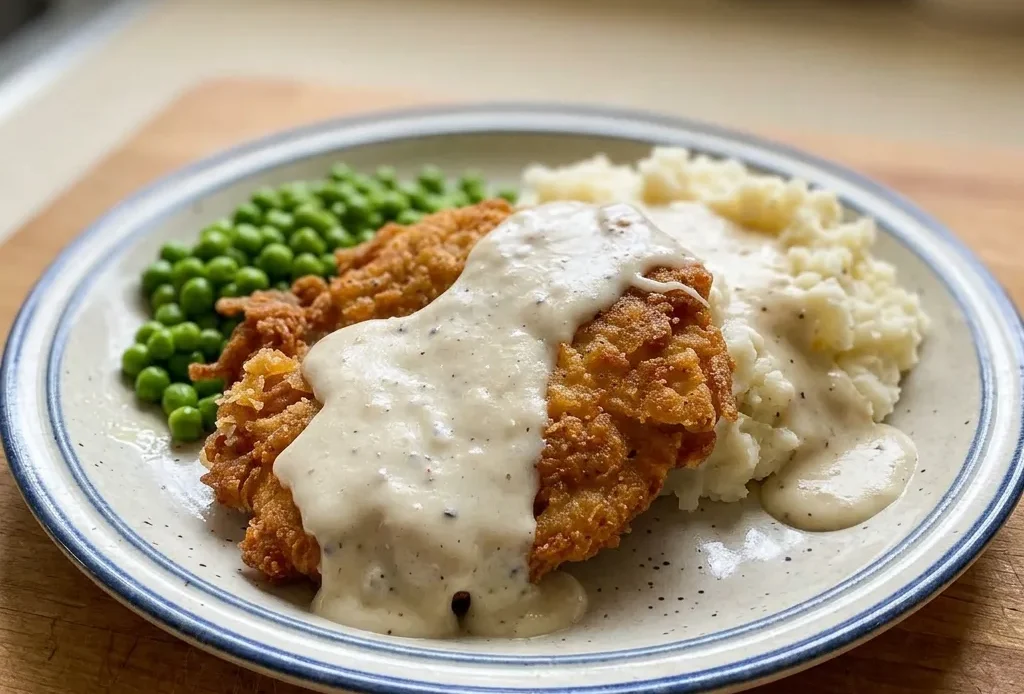
Getting the crust right on country fried steak with gravy means building a shell that stays crunchy even under a blanket of creamy gravy. That’s the whole challenge: one thin coating of flour turns to paste the moment gravy touches it, which is why the double-dredge method exists, and why you’ll see the difference the second you cut into the steak. The coating puffs and shatters instead of peeling off, and it holds that texture just long enough to get the plate to the table.
I see people skip the double dredge and wonder why their steak turns into a soggy mess under the gravy. You need that thick, crunchy armor.
Double-dredge for a crust that stays crunchy under gravy
A single coating of flour will steam and soften the moment gravy hits it. That’s why you go through the egg wash and flour twice.
The second layer builds a thicker shell that stays crisp even after a generous ladle of gravy. The flour mix includes baking powder, which releases tiny gas bubbles as it fries, creating a rough, airy crust that grabs onto the gravy without turning to paste. The egg wash gets a kick from Worcestershire and hot sauce, so the coating isn’t just crunchy, it’s seasoned through.
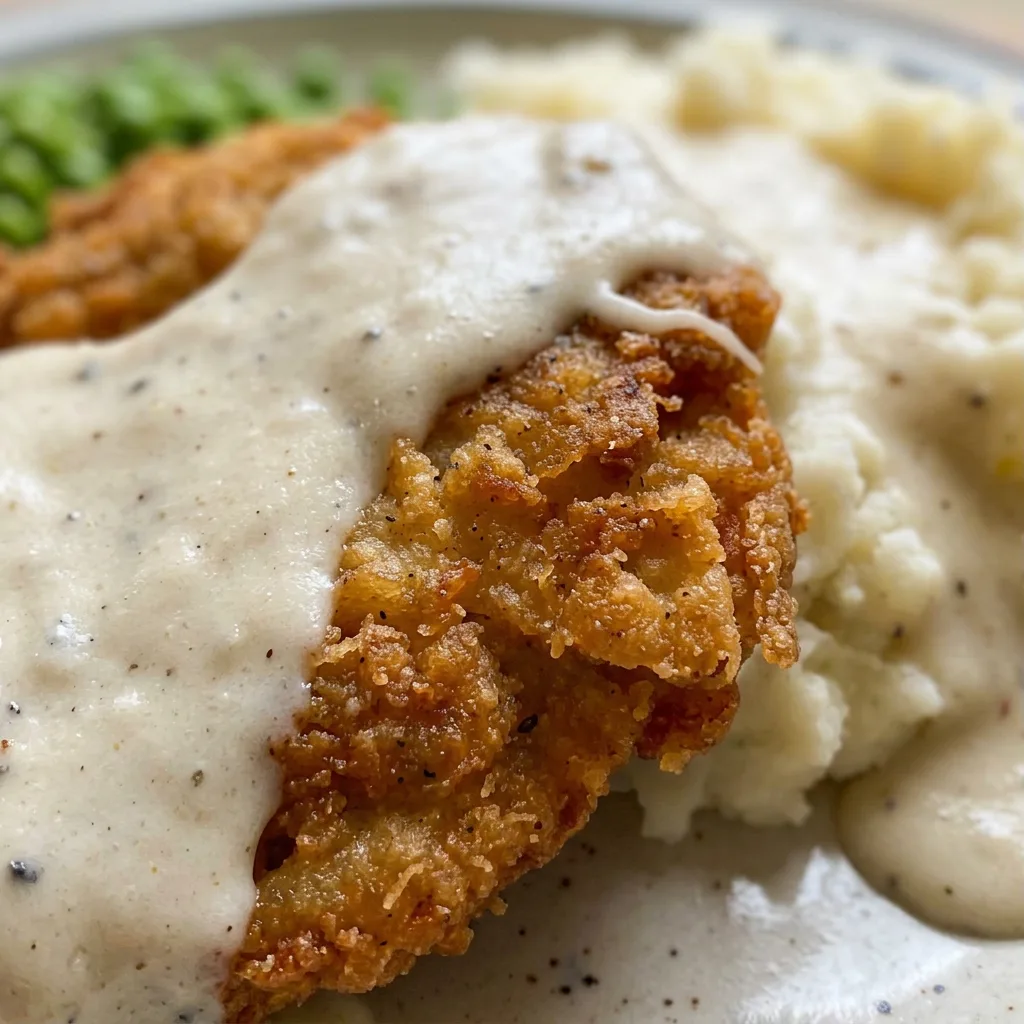
You’ll see the crust puff and brown nicely, and when you bite through, it should shatter, not peel off. This is the texture that makes country fried steak worth the extra step.
Build the gravy on a roux for a smooth, creamy finish
Whisking flour into hot butter and cooking it for about a minute kills the raw flour taste before any liquid goes in. That’s the foundation of a gravy that tastes cooked, not pasty.
Adding milk a half-cup at a time and whisking each addition until smooth prevents lumps from forming, you can see the mixture tighten and then loosen as you pour. Freshly ground black pepper is the dominant seasoning here, not salt, because the steak’s crust already brings plenty of salt. The finished gravy should coat a spoon and have a clean, peppery bite that balances the rich, crunchy steak.
Why cube steak is the cut that works here
Cube steak comes from the top round or sirloin, run through a mechanical tenderizer that breaks down tough fibers and flattens it into an even sheet. That pre-tenderizing means it cooks in minutes, no braising needed, and stays fork-tender even after a hot oil bath.
The thin, uniform thickness lets each piece cook through at the same rate, so you don’t end up with a raw center or a burnt outside. And the pockmarked surface from the tenderizer gives the flour something to grip, creating a more adherent crust than a slick cut of meat would. When you lift a finished steak, the coating should stay put, not slide off in a sheet.
Fry at 375°F for a crust that’s crisp, not greasy
If the oil isn’t hot enough, the coating soaks up fat like a sponge and turns heavy and slick. At 375°F, the exterior sets almost immediately, forming a seal that keeps oil out. You can see the bubbles roiling around the steak as it fries, that’s steam escaping from inside, which also keeps the crust light.
Keep an eye on the oil temperature between batches; adding cold steaks drops the heat fast. Fry in batches so the oil stays above the threshold.
A properly fried steak comes out golden and dry to the touch, with no oily residue on the paper towel. That’s the sign you got the temperature right.
Prep: 15 min · Cook: 12 min · Total: 27 min · Servings: 6 · Calories: 750 kcal
What to look for in these ingredients
Cube steaks: Buy pre-tenderized round or sirloin; they cook fast and the pitted surface helps the crust stick.
Baking powder: Make sure it’s fresh; expired baking powder won’t create that airy crunch in the crust.
Seasoning salt: Use a brand you trust; it carries the steak’s flavor since the gravy gets no salt.
Whole milk: Don’t go lower than whole; the fat is needed for a creamy gravy that doesn’t break.
Freshly ground black pepper: Grind it yourself; pre-ground pepper lacks the pungent kick this gravy needs.
Set up the dredging station for a smooth, mess-free workflow
Mix the dry ingredients
Whisk flour, seasoning salt, thyme, oregano, smoked paprika, and baking powder in a wide bowl. Baking powder makes the crust airy, you’ll see it bubble slightly in the oil.
Prepare the egg wash
Beat milk, eggs, Worcestershire, and hot sauce in another bowl until uniform. The Worcestershire adds deep flavor; you’ll smell it as the steaks fry.
Double-coat each steak
Dip a cube steak in egg wash, let excess drip, then coat in flour. Repeat: dip again in egg, then flour again. Press flour firmly so it adheres; the second layer ensures crunch under gravy.
Heat the oil to 375°F
Pour canola oil 3, 4 inches deep in a heavy pot. Use a thermometer, if oil smokes, it’s too hot; if bubbles barely form, it’s too cool. At 375°F, a pinch of flour sizzles immediately.
Fry in batches
Cook two steaks at a time for 3 to 4 minutes, flipping once. The crust should turn deep golden brown; if it darkens too fast, lower the heat. Drain on paper towels, they should come up dry, not greasy.
Start the gravy roux
Melt butter in a skillet over medium heat. Whisk in flour and cook for about 60 seconds, the mixture will bubble and smell nutty, not raw. This prevents a pasty taste.
Add milk gradually
Pour in milk 1/2 cup at a time, whisking until smooth after each addition. The gravy will tighten then loosen; keep whisking to avoid lumps. Simmer until it coats a spoon.
Season with pepper
Stir in 1 1/2 to 2 teaspoons freshly ground black pepper. Taste, the pepper should be bold, balancing the salty crust. Don’t add salt; the steak provides enough.
Country Fried Steak with Gravy
Ingredients
Country Fried Steak
- 6 cube steaks
- 2 cups all-purpose flour (250g)
- 3 tbsp seasoning salt
- pinch dried thyme leaves
- pinch dried oregano
- 1/2 tsp smoked paprika
- 3 tsp baking powder
- 1 1/4 cup milk (300ml)
- 4 large eggs
- 2 tbsp Worcestershire sauce
- dash hot sauce
- canola oil (for frying)
Pepper Gravy
- 6 tbsp salted butter (85g)
- 1/3 cup all-purpose flour (42g)
- 2 3/4 cup milk (650ml)
- 1 1/2-2 tsp freshly ground black pepper
Instructions
Country Fried Steak
Mix Dry Ingredients:
Combine 2 cups (250g) flour, seasoning salt, thyme, oregano, smoked paprika, and baking powder in a large bowl, whisking thoroughly.Blend Wet Mixture:
In another bowl, blend 1 1/4 cup (300ml) milk, eggs, Worcestershire sauce, and hot sauce until uniform.Coat Steaks:
One at a time, submerge a cube steak in the egg mixture, letting excess drip off, then dredge in the flour mixture, coating all sides. Repeat for a double coating. Place on a plate. Repeat with the remaining steaks.Heat Oil:
Pour canola oil into a large heavy-bottomed pot or Dutch oven to a depth of 3-4 inches (7.5-10 cm). Heat to 375°F (190°C).Fry Steaks:
Fry steaks two at a time for 3-4 minutes until golden and cooked through. Using tongs, transfer to paper towels to drain; pat dry.
Pepper Gravy
Make Roux:
In a large skillet over medium heat, melt 6 tbsp (85g) butter. Add 1/3 cup (42g) flour and whisk continuously for about 60 seconds to eliminate raw flour flavor.Add Milk & Simmer:
Gradually pour in 2 3/4 cup (650ml) milk, adding 1/2 cup at a time and whisking until smooth after each addition. Lower heat to medium-low and simmer until the gravy thickens.Season & Serve:
Mix in 1 1/2-2 tsp black pepper to taste. Spoon gravy over the steaks and serve.
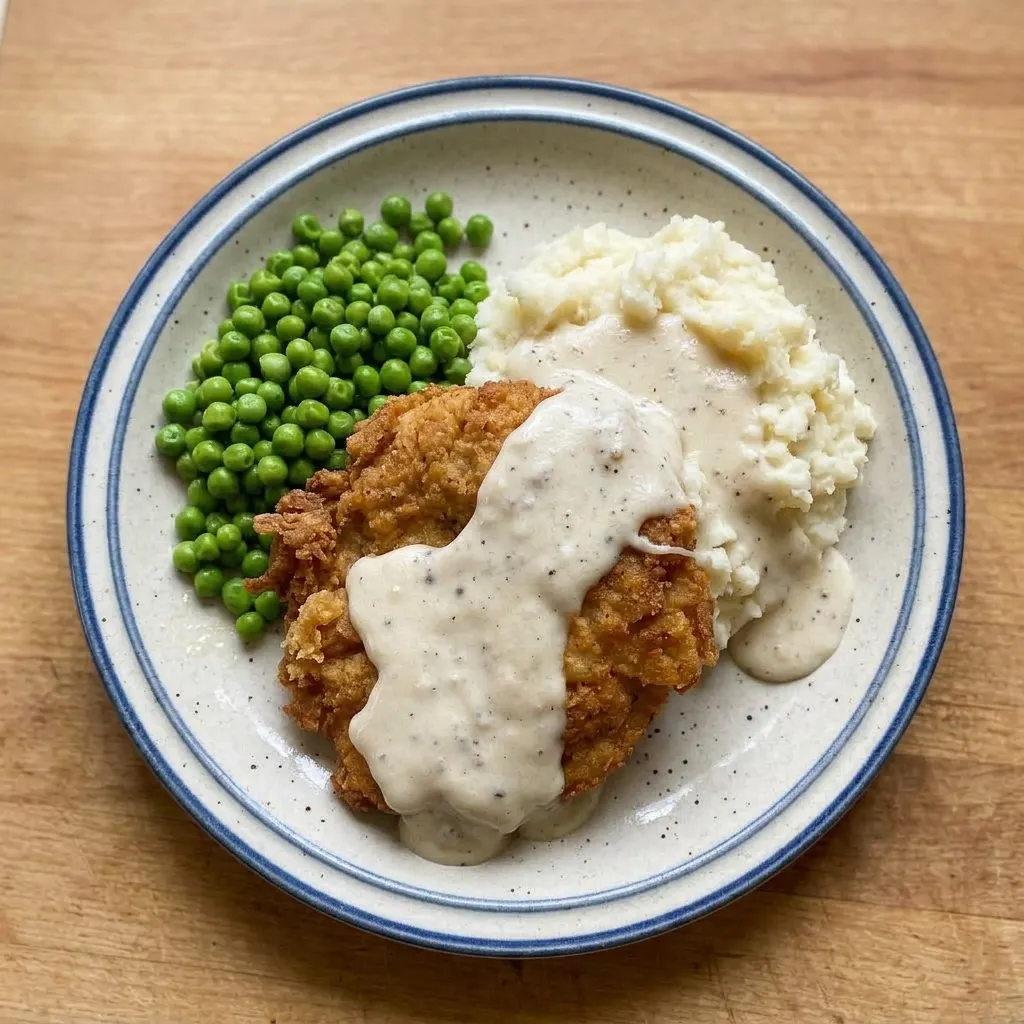
Swap cube steak for round steak pounded thin, but don’t swap out the double dredge
Cube steaks: Top round or sirloin steak, pounded to 1/4-inch thickness, then scored with a meat mallet. You lose the pre-tenderized texture, so pound it thin and rough up the surface with the mallet’s toothy side.
Without those crevices, the coating won’t cling as tenaciously. The crust may separate in patches, especially when you cut into the steak.
All-purpose flour: Gluten-free all-purpose flour blend (with xanthan gum). Gluten-free flours absorb moisture differently; the crust will be more delicate and less shatter-crisp. It browns faster, so watch the oil temp.
The baking powder still helps with puff, but the coating may feel a little sandy rather than flaky. Start with the same 2 cups, then adjust if the mix seems too dry.
Whole milk: Unsweetened oat milk or full-fat canned coconut milk (for dairy-free). Either swap changes the gravy’s body.
Oat milk yields a thinner gravy that may not coat the spoon as lushly, and it can separate if simmered too long. Coconut milk gives a richer texture but adds a faint coconut note that clashes with the pepper and Worcestershire.
Use the same 2 3/4 cups total, but expect a looser finish. For the egg wash, oat milk works fine; coconut milk may make the coating slightly greasy.
Miyoko’s) or refined coconut oil for dairy-free gravy. Vegan butter behaves nearly identically in the roux, same 6 tablespoons.
Coconut oil makes a thinner roux that doesn’t emulsify as well, so the gravy may look slightly oily. Both will lack the dairy flavor, so compensate with an extra pinch of black pepper. The gravy still thickens, just with a different mouthfeel.
Storage and Serving
Serve the steaks immediately after frying and spooning on gravy. The crust is crispiest within 10 minutes.
For leftovers, store steak and gravy in separate airtight containers in the fridge. The gravy keeps up to 4 days. The steak holds about 2 days before the coating softens noticeably.
To reheat steak, place on a wire rack over a baking sheet in a 350°F oven for 8 to 10 minutes, flipping once, until hot and the crust re-crisps. Microwave will make it soggy.
Reheat gravy on the stovetop over low heat, adding a splash of milk if it thickened. Freezing is not recommended; the gravy will separate and the crust will become gummy upon thawing.
Tips
- Let the double-coated steaks rest 5 minutes before frying: this allows the flour to hydrate and form a tighter bond with the meat, so the crust won’t separate during frying.

Frequently Asked Questions
Can I make the country fried steak ahead of time and reheat it?
Yes, but it’s best to fry the steaks no more than 2 days ahead and store them separately from the gravy. The gravy keeps up to 4 days in the fridge. Reheat the steak on a wire rack in a 350°F oven for 8 to 10 minutes, flipping once, to restore some crunch, microwaving will turn it soggy.
Reheat the gravy gently on the stovetop, adding a splash of milk if it thickened.
How do I keep the crust from getting soggy after adding gravy?
The double-dredge technique in this recipe is precisely for that: the second coating of flour, with baking powder, creates a thick, airy crust that resists softening. Fry at 375°F so the coating sets instantly and stays dry. Once you add gravy, serve within 10 minutes while the crust is still crisp.
What’s the difference between country fried steak and chicken fried steak?
The main difference is the gravy: country fried steak comes with a brown or pepper gravy made from the pan drippings, while chicken fried steak is served with a white or cream gravy. This recipe uses a peppery butter-flour roux gravy, which is the classic country style. The steak itself, cube steak, double-dredged and fried, is essentially the same in both.
Why did my gravy turn out lumpy and how can I fix it?
Lumpy gravy usually happens when you add milk too quickly or don’t whisk enough. The cure is to add milk a half-cup at a time, whisking until smooth after each pour. If lumps have already formed, strain the gravy through a fine-mesh sieve, then return it to the pan and continue simmering, it will smooth out.