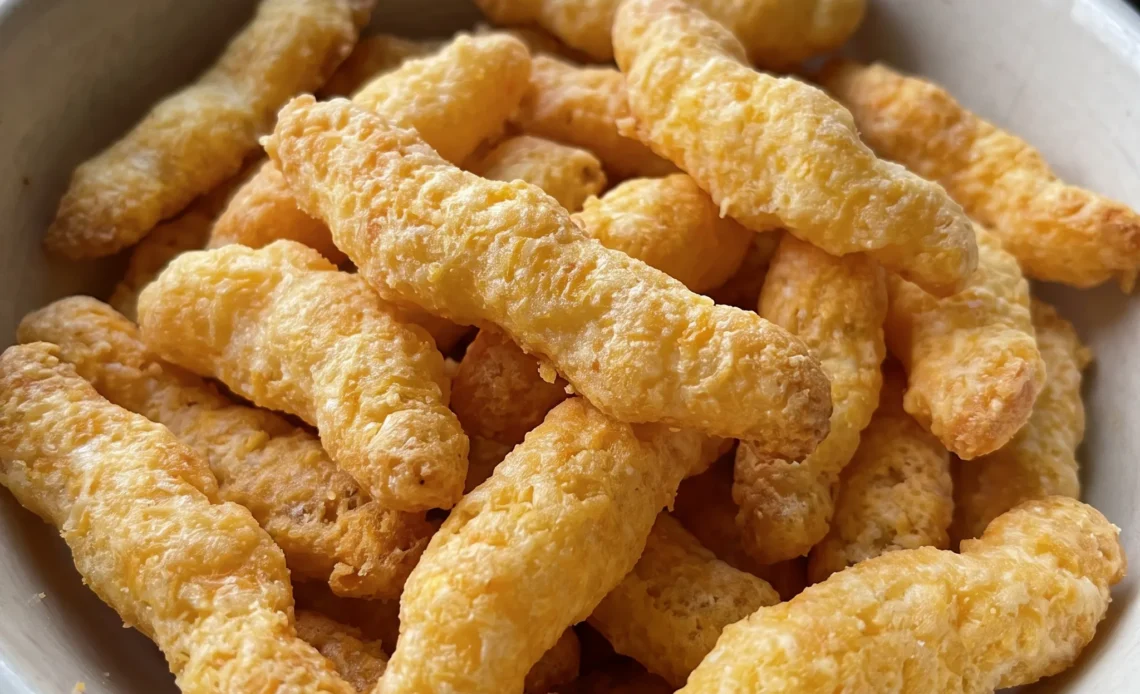
Most people fold the cheese straight into the egg whites, and the puffs bake flat as wafers. Cold matters here more than the ingredient list, and it’s the detail that separates something crisp from something greasy. These keto cheetos lean on a handful of sharp cheddar, egg whites, and superfine almond flour, but the cheese has to hit the food processor frozen solid, or it smears and drags the foam down with it.
Get that right and you’re piping strips that hold their shape and bake into hollow, shattering shells. The margin for error sits mostly in one bowl: once the last white streak disappears, you’re on the clock.
Go past that and nothing saves the batch. The rest is shaping and waiting.
Cheese is a fat-protein matrix that softens as it warms, so at room temperature the food processor’s blades deform it into a paste instead of fracturing it into discrete crumbs. Freezing the grated cheese first makes the fat rigid and brittle, so the blades shatter it into fine, separate particles that can be folded into whipped egg whites without collapsing the foam. If the cheese is processed warm, the resulting paste coats the egg-white bubbles, deflating the batter and producing dense, greasy puffs.
Frozen Cheese Crumbles Cleanly
Grated cheddar at room temperature smears into a greasy paste when the blades hit it. The fat warms, the shreds collapse, and you end up with a slick ball that refuses to break apart.
Freeze it solid and the same cheese shatters into distinct crumbs. Those crumbs stay separate when they hit the whipped egg whites, so you can fold them through without crushing the foam.
Warm cheese would drag the batter down, deflating it before it ever sees the oven. With frozen crumbles, you get a mixture that looks like coarse sand suspended in air, ready to pipe.
That even distribution matters later: each puff carries the same amount of cheese, so they brown at the same rate and taste consistent from first to last. The food processor turns frozen cheese into a fine, cold powder in seconds.
If you skip the freeze, you risk pockets of grease that leave bald spots in the batter and puffs that bake up limp and oily.
Egg Whites Provide All the Lift
There’s no baking powder, no yeast, nothing else to make these puffs rise. Stiffly whipped egg whites trap air that expands in the oven, and that’s the entire architecture.
If the whites are under-whipped, they stay loose and watery; they can’t hold the air, and the batter spreads flat on the sheet. Over-fold and you knock out the bubbles you worked to build, leaving a dense, rubbery strip. When you fold, you want to see streaks of white disappear into the cheese mixture with just a few turns of the spatula.
The batter should still look light and billowy, not soupy. That air is what gives the finished puff its crunch and its hollow center.
You can feel the difference in the bowl: a properly folded batter feels like a cloud, not a paste. If it pours like pancake batter, you’ve lost the structure. The oven heat sets the egg proteins around those air pockets, and what comes out is a crisp, airy shell.
Get this step right and the rest is just shaping and baking.
Almond Flour Soaks Up Moisture
Superfine almond flour isn’t just a low-carb stand-in for wheat; it’s there to drink up excess liquid. Egg whites and cheese both release water as they bake, and without something to absorb it, the puffs steam themselves soggy from the inside.
A coarse grind or a different nut flour leaves gritty bits that never fully hydrate, so you get a sandy texture instead of a smooth, crisp shell. The fine powder disappears into the batter, thickening it just enough to hold its shape on the piping bag.
It also adds a subtle nuttiness that complements the sharp cheddar. Skip it entirely and the mixture turns wet and slack, spreading into thin, brittle wafers rather than puffy strips. You want the batter to mound slightly when you lift the spatula, not run off in a stream.
That’s the almond flour doing its job. The result after baking is a dry, crunchy exterior with no damp pockets. If you’ve ever had a cheese puff that tasted greasy or left a film on your fingers, too much moisture was the culprit.
This small amount of flour keeps that from happening.
Piping Bags Create the Classic Shape
A piping bag with a small St. Honoré tip gives you control over the batter’s shape and size.
That tip’s wide opening and deep ridges mimic the look of store-bought cheese puffs, with a little extra texture for crunch. More importantly, piping ensures each strip is the same length and thickness, so they bake evenly.
Drop spoonfuls instead and you’ll get uneven blobs: some spread too thin and scorch at the edges, others stay thick and doughy in the middle. Leaving space between the strips lets hot air circulate around each one, drying the surface and preventing them from steaming. Crowd them and they’ll fuse together, turning into a single sheet with soft spots.
You’re aiming for strips about 2 inches long and a quarter to a half inch thick. When they come out of the oven, they should be uniformly golden and crisp, with no pale, chewy centers. That consistency is what makes them snackable straight from the tray, and it’s why the piping step is worth the extra minute.

The Ingredients That Make or Break a Cheese Puff
Sharp cheddar cheese: Buy a block and grate it yourself; pre-shredded cheese is dusted with starch that keeps the crumbs from clumping properly when frozen.
Egg whites: Let them sit out until they’re truly room temperature; cold whites whip up slower and don’t reach the same stiff volume.
Superfine blanched almond flour: Use the finest grind you can find; a coarser meal leaves tiny grit that never softens and shows up in the finished crunch.
Judging the Batter, the Pipe, and the Bake
Reading the fold: when the last white streak disappears
Stop folding when you see the final few streaks of white vanish into the cheese. That’s your cue to pipe.
If you keep going, the batter turns soupy and the air you built is gone. A properly folded mix looks billowy and holds a soft mound on the spatula. If it pours off in a stream, you’ve lost the structure and the puffs will bake flat.
You can’t fix it once it’s overfolded, so watch closely.
The pipe: judging thickness and spacing on the sheet
Aim for strips about 2 inches long and 1/4 to 1/2 inch thick. Too thin and they scorch before drying; too thick and the centers stay chewy. Leave at least an inch between strips.
If they’re closer, they’ll fuse and steam, leaving soft spots. The batter should hold its shape after piping, not spread.
If it spreads, the mix is too loose and the puffs will be flat wafers. You can’t fix a spread after it’s piped, so adjust your folding next time.
The bake: telling dry and crunchy from just golden
At 30 to 35 minutes, they should be golden and sound hollow when tapped. But color alone lies; a puff can look done and still be chewy inside. Break one open.
If it’s at all soft, switch off the oven and leave the trays inside for about 30 minutes. The residual heat pulls out the last moisture.
Skip this and they’ll soften as they cool. That final dry-out is what makes them crisp, not just baked.

Homemade Keto Cheetos with Cheddar and Egg Whites
Ingredients
Method
- Prepare a small baking sheet by lining it with parchment paper. Distribute the grated cheese uniformly and freeze until it becomes solid, approximately 1 hour.
- Set the oven to 300°F (150°C) to preheat. Use parchment paper to line two baking sheets.
- After the cheese has frozen, place it in a small food processor and pulse several times until it is finely crumbled. Set this aside.
- Pour the egg whites into the bowl of a stand mixer equipped with the wire whisk. Whip on medium speed until frothy, about 30 seconds, then switch to high speed and continue whipping until stiff peaks develop.
- With a silicone spatula, carefully fold the crumbled cheese and almond flour into the egg whites, preserving as much air as possible.
- Move the mixture into a large piping bag and pipe strips approximately 2 inches long onto the prepared baking sheets, spacing them slightly apart. Select any piping tip based on the design you want; for a traditional Cheetos appearance, use a small St. Honoré tip with a 5/16-inch opening. The puffs should measure about 2 inches long and 1/4 to 1/2 inch thick.
- Bake for 30–35 minutes, until they are golden, dry, and have a crunchy exterior. If any remain not fully crunchy, switch off the oven and leave them to dry inside the off oven for about 30 minutes (see note about cooking with the oven off). Take them out of the oven and allow to cool completely before consuming. Keep leftovers in an airtight container in the refrigerator or freezer.
Swap Sharp Cheddar and You Lose the Crunch, but Some Swaps Work
Sharp cheddar cheese: Aged gouda or Gruyère, grated from a block and frozen the same way. Both melt smoothly and bring a nutty, savory note, but gouda is milder, so the puffs taste less sharp. The structure holds because these cheeses have similar fat and moisture.
Skip pre-shredded versions of any cheese; the starch coating keeps the frozen crumbles from separating, and you’ll end up with clumps that don’t fold evenly.
Egg whites: There’s no good substitute for whipped egg whites here. Aquafaba can whip, but it won’t dry out the same way in the oven and the puffs turn leathery. If you’re avoiding eggs, this recipe isn’t the one to adapt.
The entire lift depends on egg white foam. A flax or chia egg won’t trap air, so the batter spreads into flat wafers. For a egg-free cheese crisp, look for a recipe that uses a different structure, like baked cheese slices.
Superfine blanched almond flour: For a nut-free version, use an equal weight of superfine coconut flour, but start with half the amount (1 tablespoon) and add more only if the batter looks too wet. Coconut flour drinks up far more liquid than almond flour, so using the full 2 tablespoons will leave the batter stiff and dry, making the puffs dense and crumbly.
The flavor turns mildly coconutty, which can clash with sharp cheddar. If you go this route, fold gently and pipe immediately, as the batter thickens fast.
Superfine blanched almond flour: Any coarser nut flour or meal, like regular almond meal or hazelnut meal. The gritty bits never soften, so the finished puffs have a sandy crunch instead of a clean snap.
They also don’t absorb moisture as evenly, leaving some spots greasy. Stick with superfine blanched almond flour for the texture this recipe is built on.
Crisp Today, Soft Tomorrow: Storing and Serving the Puffs
These are at their best the day they’re baked, within a few hours of cooling. The shell is dry and shattering then, and that’s the texture worth planning around.
Once they cool completely, move them to an airtight container. In the fridge they soften within a day, because cold pulls moisture back into the shell.
Freezer life runs longer, up to a month, and the puffs come out firm rather than limp. To revive either, spread them on a sheet and warm at 300°F for 5 to 8 minutes, then let them cool a minute so the crisp sets.
Serve them straight from that rewarm, not after they sit out. Any finishing salt or seasoning goes on right after the oven, while the surface is still warm enough to grip it.
Tips
- Pull one puff at the 30-minute mark and let it cool for a full minute before you bite it. A puff straight from the oven feels soft and steamy because the interior moisture is still moving outward, so a hot sample reads as underdone even when it isn’t. Once it cools, the shell should snap and the inside should be hollow and dry. If it bends or the center is chewy, leave the tray in for the remaining 5 minutes or use the off-oven dry-out.
- If you break that test puff open and the inside looks webby or slightly damp, put the trays back for 5 minutes rather than jumping straight to the off-oven dry-out. At 300°F the puffs are still setting, and 5 more minutes of active heat drives off more moisture than 30 minutes of residual warmth. Save the off-oven step for puffs that are already golden and crisp outside but still soft at the center.

Frequently Asked Questions
Can I make these keto Cheetos ahead of time?
They’re at their best the day they’re baked, within a few hours of cooling. If you need to work ahead, the fully baked puffs keep in the freezer for up to a month, and they come out firm rather than limp.
To bring them back, spread them on a sheet and warm at 300°F for 5 to 8 minutes, then let them cool a minute so the crisp sets. Serve them straight from that rewarm, not after they sit out.
Why did my cheese puffs turn out hollow or flat?
Hollow is what you’re after, a crisp shell with an airy center. Flat means the batter lost its air before it hit the oven, usually from folding past the point where the last streaks of white disappear.
The mix should look billowy and hold a soft mound on the spatula; if it pours off in a stream, the structure is gone and the puffs bake as thin wafers. As a secondary check, look at your cheese crumbles: if they were warm or clumpy, they dragged the foam down as you folded. You can’t fix an overfolded batter, so watch closely next time.
How do I keep them crispy after baking?
The crunch comes from driving off the last of the moisture, and that happens after the golden color shows up. Break one open at the end of the bake; if it’s at all soft inside, switch off the oven and leave the trays in for about 30 minutes.
The residual heat pulls out that final dampness, and skipping it means they soften as they cool. Once they’re fully cool, move them to an airtight container, and rewarm at 300°F for 5 to 8 minutes before serving if they’ve been stored.
Any finishing salt or seasoning goes on right after the oven, while the surface is still warm enough to grip it.
What’s the difference between these and regular Cheetos?
The ingredient list is short: sharp cheddar, egg whites, and superfine blanched almond flour. There’s no cornmeal, no oil, no artificial color, so the puff is a dry, shattering shell with a clean cheese flavor rather than an oily one. The shape comes from a piping bag with a small St.
Honoré tip, which gives you the same ridged look and a little extra texture for crunch. At 10 calories per serving, they’re a lighter snack, but the trade-off is that they don’t have the shelf stability or the uniform neon color of the store-bought version.
