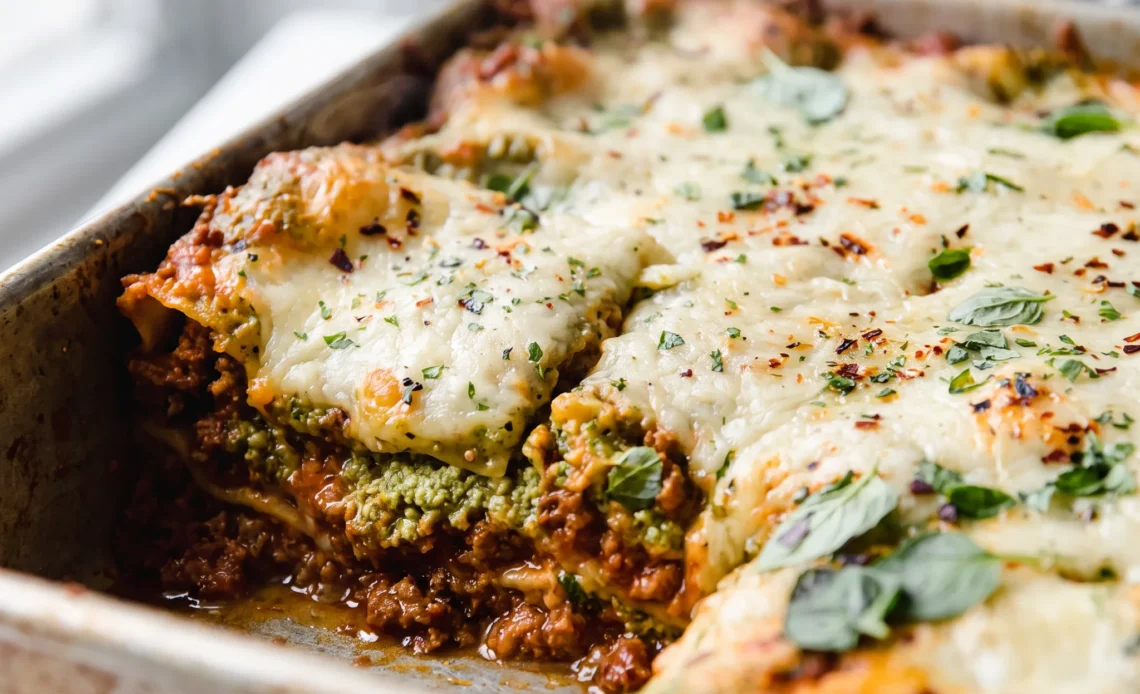
Most cooks pull this lasagna from the oven too soon, and the noodles are still chalky in the middle. The problem isn’t the bake; it’s the rest. A lasagna bolognese built with dry sheets and a wet, meat-heavy sauce needs cold time before it ever sees heat, or the layers slide and the pasta stays stiff.
The pesto ricotta is the other wild card. If it’s loose going in, it weeps, and you get a puddle under the first slice. Get both right and you cut a clean square: deep brick-red meat, bright green-flecked ricotta, a crust that shatters.
This one feeds a crowd, but the real reward is a pan that feels solid when you lift it, not sloshy.
Start with a thin layer of bolognese
A thin layer of bolognese sauce at the bottom of the pan serves two purposes. It stops the first sheet of pasta from sticking to the dish, which would tear when you slice, and it gives the noodles immediate moisture to begin softening.
No-boil sheets are dry and rigid; without a wet base, they stay that way. Spread the sauce to the edges, but keep it thin. The noodles should sit on a slick surface, not float.
After the rest and bake, that bottom layer becomes indistinguishable from the rest of the filling, but its work is essential. Without it, the first serving would lift out in ragged pieces, and the pan would need soaking.
Alternate meat sauce and pesto ricotta
You want each bite to have both the deep, savory bolognese and the bright, creamy pesto ricotta. If you spread all the ricotta in one thick band, the lasagna turns into a custardy block; if you use only bolognese, it tastes flat and heavy. So you alternate: sauce, noodles, ricotta, cheese, then repeat.
The pesto ricotta, with its eggs and parmesan, sets up during baking, holding the layers apart just enough. The bolognese, rich with pork and beef, seeps into the pasta.
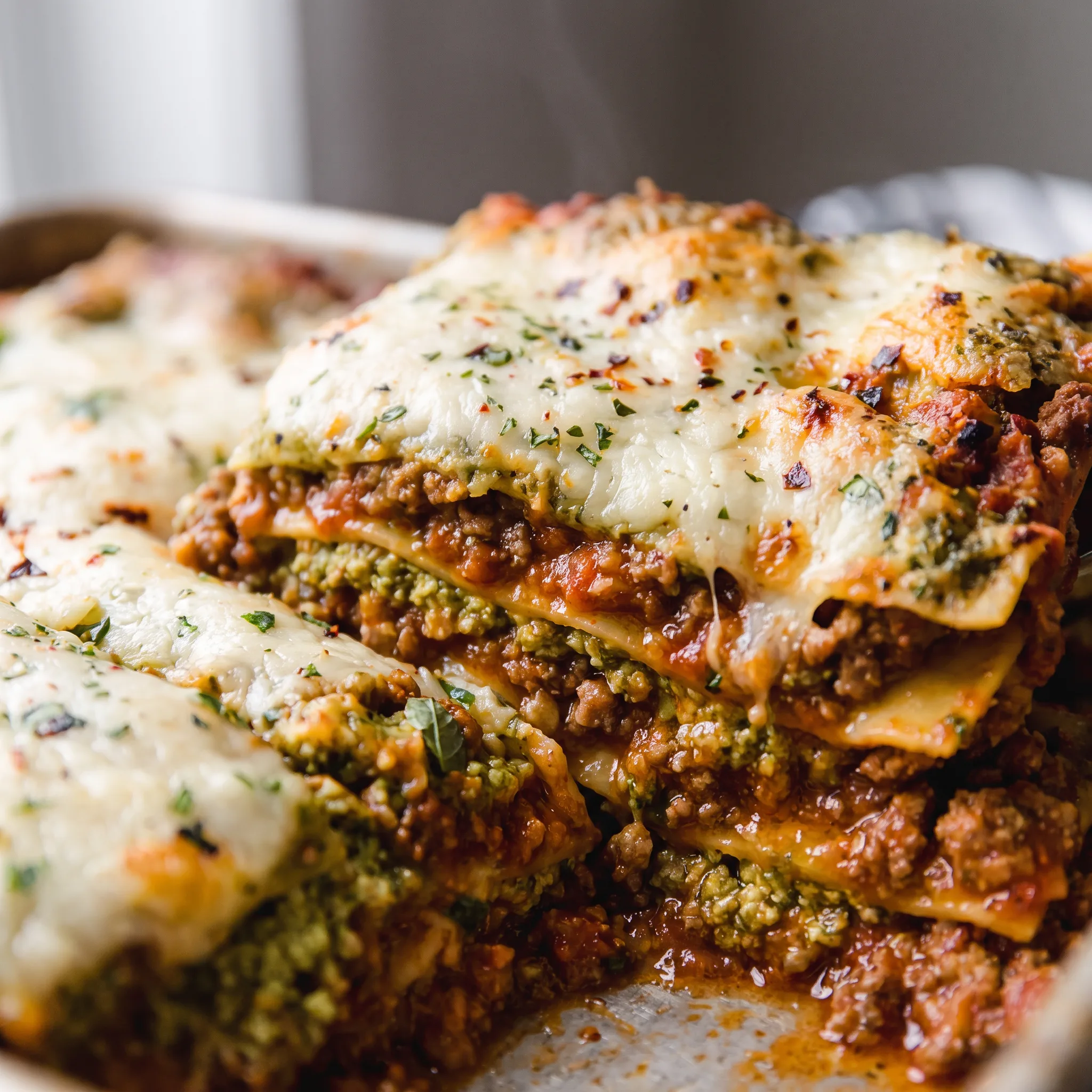
After the rest, the two fillings marry, but you can still see the strata when you cut a square. That’s the goal: a cross-section with distinct bands that eat as one.
Reserve enough cheese for the top
Cheese does more than flavor the layers. The final handful scattered over the top melts into a bubbly, golden crust that seals in moisture. If you use all the mozzarella and Italian blend between the layers, the surface stays bare, and the oven dries out the top noodles, leaving a leathery skin.
Hold back at least a cup of the shredded mix. During the last ten minutes of baking, with the foil off, that cheese browns and crisps at the edges, while the center stays soft. When you pull the pan from the oven, the top should be uniformly bronzed, not patchy.
That crust is the first thing people see, and it keeps the interior saucy.
Let it rest overnight in the refrigerator
This lasagna spends at least 12 hours in the fridge before baking, and that’s not a suggestion. No-boil noodles are dry and brittle; they need that long, slow soak in the wet sauces to turn tender. Skip it, and you’ll pull a pan from the oven with noodles that are still crunchy in the center, even after an hour of baking.
The rest also firms up the ricotta and bolognese, so when you slice, the layers hold together instead of sliding apart. I once rushed a lasagna to the oven straight after assembly, and the slices collapsed into a puddle on the plate. The flavor also deepens: the pesto, the meat sauce, and the cheeses mingle, tasting more unified.
After the rest, the assembled dish feels heavy and set, like a solid block.
Ingredients that carry this lasagna
Pancetta: Buy it in a single chunk and chop it rough; pre-diced pieces are often dry and won’t render the same rich fat.
Red wine: Use a medium-bodied Chianti you’d drink; anything harsh or overly oaked will taste sharp after the wine reduces.
Parmesan rind: Drop in the rind if you have one; it dissolves into the sauce and gives a deeper savory note without extra salt.
Ricotta: Whole-milk ricotta gives the creamiest set; if yours looks watery, drain it in a sieve before mixing.
DeLallo No-Boil Lasagna: These sheets are dry and rigid, so they need the full overnight rest to soften; other no-boil brands may vary in thickness.
Low-moisture mozzarella: Shred it yourself from a block if you can; pre-shredded bags are coated with starch and melt less smoothly.
The most common mistake is baking the lasagna right after assembling it. No-boil noodles need hours of contact with the wet sauces to hydrate and become tender; without that time, they stay crunchy and absorb liquid unevenly. Meanwhile, the ricotta mixture and bolognese never firm up, so the layers slide apart and release excess moisture, turning the dish watery and structurally unsound.
Judging the Bolognese, the Ricotta, and the Bake
When the soffritto is browned, not burnt
After 15 to 20 minutes, the vegetables should be a deep, even brown and smell sweet and toasted. If you see black spots or smell acrid, the heat was too high; pull the pot off the burner for a minute and lower the flame. Burnt bits will make the whole sauce bitter.
Push the vegetables to the edges and let the pot cool slightly before adding the meat.
Reading the bolognese after 90 minutes
The sauce should be thick enough that a spoon dragged through leaves a trail that fills in slowly. If it’s watery, simmer uncovered for another 15 minutes; if it’s stiff and dry, add a splash of broth. The color darkens to a deep brick red.
Taste for salt now, before the cream goes in. Under-seasoned bolognese stays flat no matter how much cheese you add later.
Judging the pesto ricotta
After mixing, the ricotta should hold soft peaks when you lift the spoon. If it’s runny, the eggs were too small or the ricotta was watery; drain it in a fine sieve for 10 minutes, then remix.
A loose mixture will weep during baking and make the layers slide. Taste a dab: it should be bright with basil and salty enough to season the whole layer.
When the top cheese is ready
In the last 10 minutes with the foil off, watch the cheese. It should turn golden brown and bubble at the edges, but not darken past that. If it’s browning too fast, tent it loosely with foil.
If it’s pale after 10 minutes, a minute or two under the broiler will finish it. Pull it when the center is set and a knife slides in without resistance.
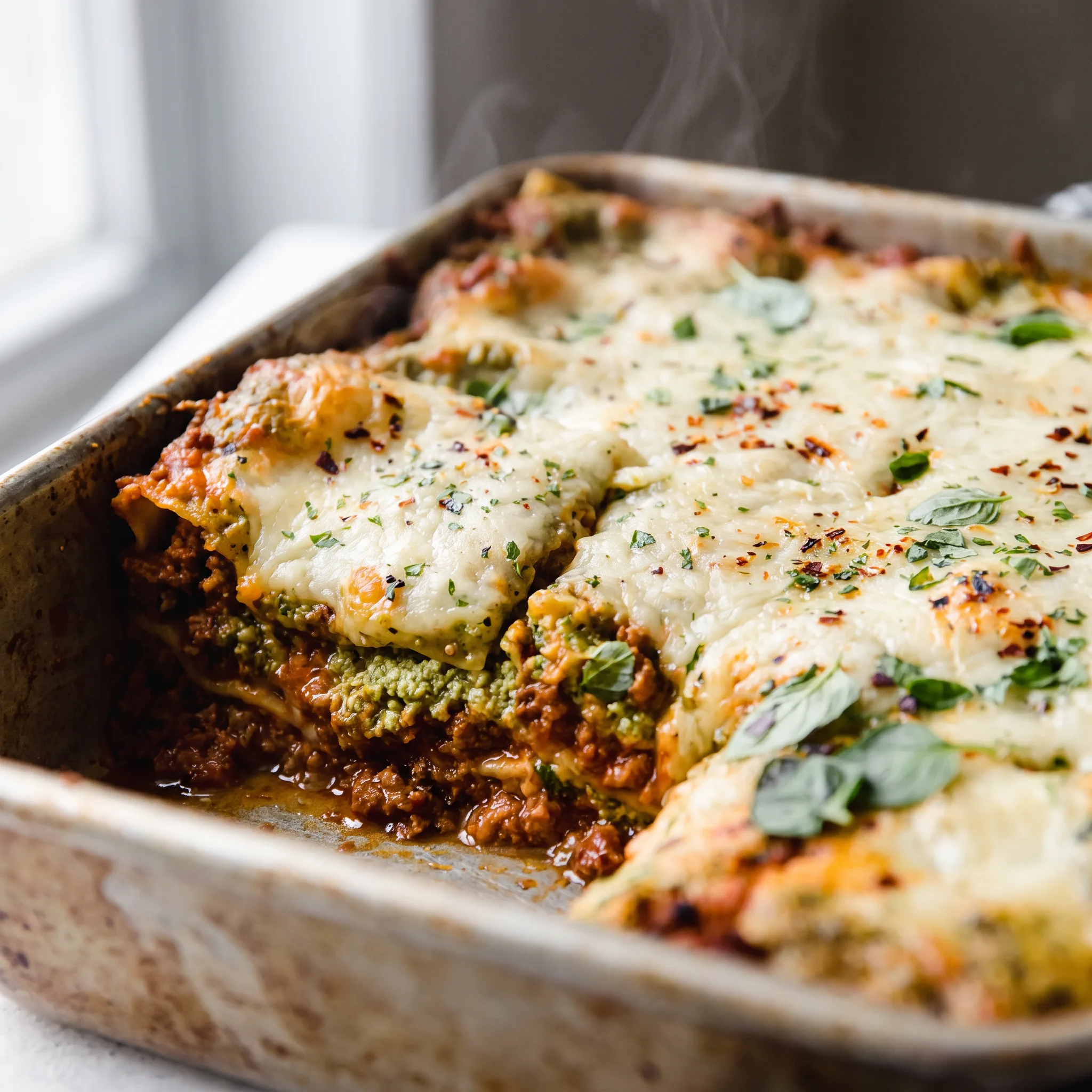
Lasagna Bolognese with Basil Pesto Ricotta
Ingredients
Method
- Soffritto: Put the roughly chopped carrot, celery, and onion into the bowl of a food processor. Pulse until the mixture is broken down into fine pieces. Do not purée; you should still see small pieces of carrot, celery, and onion. Move to a medium bowl and set aside.
- Pestata: Put the pancetta and garlic into the bowl of the same food processor used for the soffritto (no need to wash it!). Pulse until the mixture is broken down into fine pieces. Set aside.
- Cook the pestata: Pour the olive oil into a heavy-bottomed pot (at least 4-quart capacity) over medium heat. Once hot, carefully add the pestata mixture from Step 1 and cook, stirring occasionally, until the pancetta renders and the garlic is fragrant, 4-5 minutes.
- Brown the soffritto: Add the soffritto mixture from Step 1 to the pot with the pestata. Season with 1 teaspoon kosher salt, and stir to combine. Cook, stirring occasionally, until deeply browned and fragrant, 15-20 minutes. If the veggies begin to brown too quickly, reduce the heat to medium-low or low. Once browned, push the pestata and soffritto mixture to the outer edges of the pot.
- Brown the meat: Generously season the beef and pork with 1 teaspoon kosher salt each. Add the meat to the center of the pot with the soffritto and pestata mixture. Do not touch the meat for 2-3 minutes, allowing it to brown deeply. Turn the meat over and brown the second side for 2-3 minutes. Once browned on both sides, use a wooden spoon to break the meat apart into fine crumbles. Stir to combine with the soffritto mixture. Cook, stirring occasionally, until browned completely, 8-10 minutes. Add the tomato paste, stirring to coat the meat and soffritto mixture. Cook for 2-3 minutes to brown.
- Deglaze: Increasing the heat to medium-high, pour the red wine into the pot. Stir constantly, using a wooden spoon to scrape up any browned bits that may have formed at the bottom of the pot. Cook for 4-5 minutes, until the wine is almost completely absorbed into the meat mixture.
- Aromatics: Tie the herbs together using kitchen twine (or finely chop if you do not have twine), then add to the pot with the bay leaves and parmesan rind, if using. Add the crushed tomatoes and broth or water, stirring to combine.
- Simmer: Reduce the heat to medium-low and simmer, stirring occasionally, for 90 minutes. If the bolognese begins to reduce too much (losing too much of its liquid too quickly), feel free to add in a splash more broth/water, reduce the heat further, and/or cover the pot.
- Finish the bolognese: Stir in the heavy cream and grated parmesan. Taste and season with additional kosher salt and ground black pepper, as desired. Remove from the heat and set aside, or store in an airtight container in the refrigerator for up to 5 days.
- Mix the basil pesto ricotta: Meanwhile, as the bolognese sauce simmers, prepare the basil pesto ricotta. Add all listed ingredients to a medium mixing bowl, seasoning with ½ teaspoon each kosher salt and ground black pepper, or to taste. Stir until combined. Set aside, or store in an airtight container in the refrigerator for up to 3 days.
- Assemble the lasagna: Spray a large piece of foil with nonstick cooking spray and set aside. Spray a 9×13 baking pan with nonstick cooking spray (see Recipe Notes, below). Ladle about 1 cup of the bolognese sauce into the baking dish, spreading it out to evenly coat the bottom. This prevents the pasta from sticking to the bottom of the dish as the lasagna bakes. Build your lasagna layer by layer:
- Layer 2: Arrange a second layer of lasagna. Top with ½ of the prepared basil pesto ricotta, spreading into an even layer. Sprinkle some the mozzarella and Italian cheeses over top, using about ¼ of the cheese.
- Layer 3 and 4: Repeat Layers 1 and 2, creating 4 alternating layers of bolognese and ricotta. Finish with one last generous sprinkling of cheese, using any remaining mozzarella and Italian cheese.
- Rest: Top with the prepared foil. Transfer to the refrigerator to rest for at least 12 hours before baking.
- Bake the lasagna: Preheat the oven to 375 degrees F, ensuring an oven rack is positioned in the center of the oven. Remove the lasagna from the refrigerator, and set the baking dish on a large rimmed baking sheet. Transfer to the oven and bake the lasagna for 60 minutes, carefully removing the foil from the baking dish in the last 10 minutes of baking to brown the top. If desired, turn the broiler on in the last 5 minutes to give the cheesy top an especially golden brown and crispy finish.
- Rest, slice, and serve: Carefully remove the lasagna from the oven. Set aside to rest for 10-15 minutes before slicing into 12-15 squares and serving. Enjoy!
Storage, Reheating, and the Serving Window
Eat the baked lasagna within 30 minutes of its 10 to 15 minute rest. That window gives you the best texture: cheese still molten, ricotta set but soft, noodles tender without turning slack. Leftovers keep in an airtight container in the refrigerator for up to 5 days.
Reheat covered at 350 degrees F until the center is hot, 20 to 25 minutes for a large portion, less for a single square; uncovered heat dries the top cheese into a leathery sheet. The bolognese alone holds up to 5 days refrigerated and freezes well for 2 to 3 months. The pesto ricotta is the fragile component: use it within 3 days, and don’t freeze it.
The eggs and dairy separate on thawing, and the mixture weeps when baked. Freeze assembled, unbaked lasagna only if you accept softer noodles; the sauce’s water expands and the sheets can break down.
Skip freezing the finished baked pan. The cheese crust and ricotta turn grainy, and reheating never restores the original set.
Tips
- Buy pancetta as a whole slab and dice it yourself into pieces about the size of a peppercorn. Pre-diced pancetta is cut thin and often dried at the edges, so it releases less fat when it hits the olive oil, and the pestata in step 3 will not render the same savory base for the soffritto. A thick slab also lets you control the dice so it breaks down evenly in the food processor with the garlic.
- Grate parmesan from a wedge on the fine holes of a box grater rather than using the pre-shredded kind. Pre-shredded parmesan is dusted with cellulose and potato starch to keep it from clumping, so it will not melt into the bolognese in step 9 or the pesto ricotta the way fresh-grated does; it stays grainy and the ½ cup in each will taste flatter. A real wedge of Parmigiano-Reggiano also gives you the rind for step 7, which is the same savory depth in a different form.
When Swapping Pancetta, Meat, and Herbs in the Bolognese
Pancetta: Bacon (same weight, 4 oz) or omit entirely and add another tablespoon of olive oil. Bacon brings a smokier note and often more salt, so taste before you season the meat.
If you skip the pancetta, the sauce loses its cured-pork backbone; a tablespoon of olive oil keeps the vegetables from sticking, but the bolognese will taste leaner. Adjust salt at the end.
Ground beef and ground pork: Ground turkey (1 lb) or an all-beef mix (2 lbs total). Turkey dries out faster and has a milder flavor, so brown it in batches and add an extra tablespoon of olive oil. An all-beef version tastes beefier but less complex; a mix of 80/20 beef and pork gives the best balance.
If using turkey, bump up the herbs by half.
Fresh rosemary, thyme, and bay leaves: Dried herbs: 1 tsp dried rosemary, 1 tsp dried thyme, and 2 dried bay leaves. Dried herbs are more concentrated, so start with half the amount and add more after the 90-minute simmer.
Bay leaves stay as is. The sauce will lack the bright, piney top notes of fresh, but the long cook softens the difference.
3 oz). Different pestos vary in salt, oil, and cheese, so taste the ricotta mix before adding extra salt.
A chunkier pesto might need a quick pulse in the food processor to avoid lumps in the ricotta. If yours is very oily, drain off some oil first.
Frequently Asked Questions
Can I skip the 12-hour rest in the fridge?
You can, and you’ll notice the difference in the first slice. The assembled pan needs that cold time so the dry no-boil sheets soak up the wet bolognese and pesto ricotta; without it, they stay stiff and the finished lasagna cuts with a ragged, sliding edge.
If you’re short on time, give it as many hours as you can spare rather than none, and bake it in a pan set on a rimmed sheet to catch any weep. What you’re buying with the full rest is a pan that feels heavy and set when you lift it, not sloshy.
Why is my lasagna watery after baking?
Nine times out of ten it’s the ricotta. If yours was loose or watery to start, it weeps during the bake and the liquid pools at the bottom of the pan.
Drain it in a fine sieve before mixing, or check that the pesto ricotta holds a soft peak on the spoon. The other common cause is a bolognese that never reduced enough: it should be thick enough that a spoon dragged through leaves a trail that fills in slowly.
If your sauce was still soupy going into assembly, simmer it down further before you build.
How do I know when the lasagna is done baking?
The top tells you first. With the foil off for the last stretch, the cheese should be golden and bubbling at the edges, and a knife slid into the center should meet no resistance from the noodles. If the top is browning faster than the middle is setting, tent it loosely with foil to slow things down.
The pan should feel heavy and the center shouldn’t wobble when you give the dish a gentle nudge. Pull it when both signs line up, then let it sit before you cut.
What makes this lasagna different from a classic lasagna?
The pesto ricotta is the real departure. Instead of plain seasoned ricotta, this one folds in a jar of basil pesto, which brings a bright, herby edge that cuts through the heavy bolognese and the blanket of mozzarella.
The bolognese itself is built like a long-simmered ragù, with a soffritto and pestata cooked down until deeply browned, then finished with cream and parmesan for body. That combination, a slow meat sauce against a sharp pesto ricotta, is what separates a square of this from the standard version. The no-boil sheets are a convenience, not the point.
