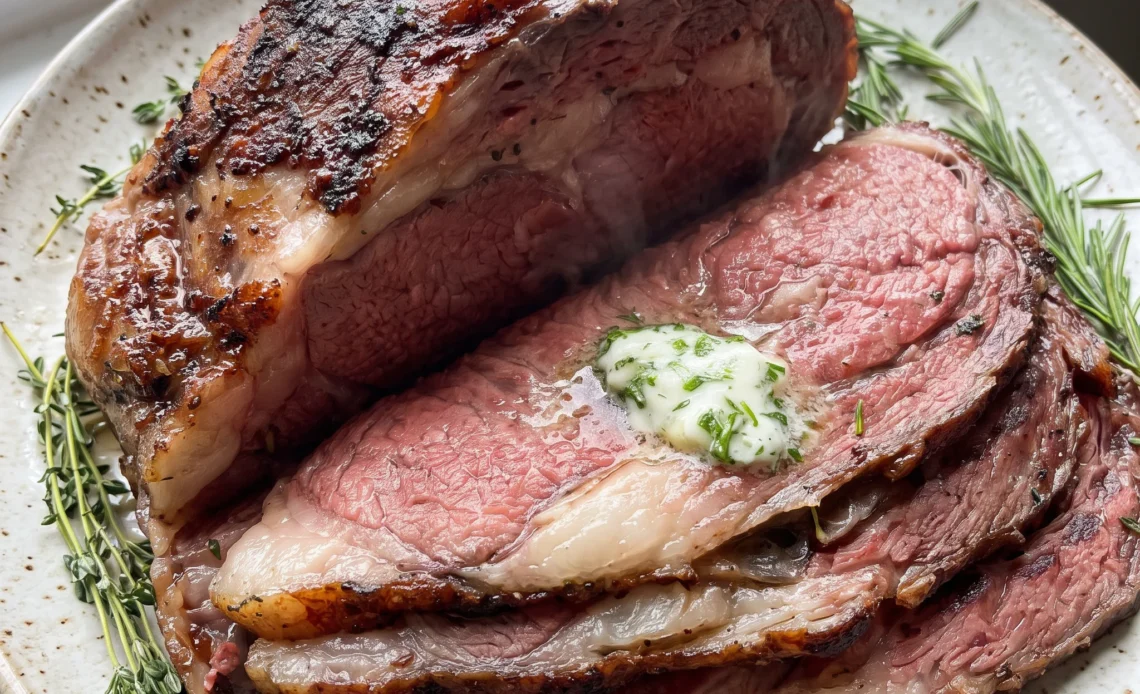
The most common mistake with smoked prime rib is pulling it when it looks done. It won’t.
A roast that reads right in the smoker will blow past that number once it hits the skillet and the cutting board, and you end up with gray slices from a piece of beef that deserved better. The window between rosy and overdone is narrow, and it sits at the end of the cook, not the middle. Anyone can hold a smoker at temperature for a few hours.
The skill is knowing the roast is not finished when you take it off, and trusting that last stretch of carryover to land where you want it. Get that part right and you get a crust worth carving into and an interior that stays even from edge to center.
Why Pull at 118°F
Pulling a prime rib from the smoker at 118, 120°F might look alarmingly rare, and that’s deliberate. The roast still has two stages left that will push the temperature up another 10 to 15 degrees: a hard sear in a screaming-hot skillet and a 15-minute rest. During the sear, the surface climbs fast, and that heat conducts inward.
The rest continues the climb as the outer layers equalize with the center. Aim for 130, 135°F on your final reading for medium-rare. If you wait until the roast hits 130°F in the smoker, the sear alone can shove it past 140°F, into medium or worse.
The meat turns from rosy and juicy to gray and tight. By pulling early, you leave room for those final steps. The window is small, so trust your probe.
When the number reads 118, 120°F, get it out. You’re not serving it yet.
You’re setting up the finish.
The Butter Coat That Guards the Crust
Before the roast ever sees smoke, it gets a full coating of softened butter mixed with chopped parsley, thyme, and rosemary. That butter isn’t only for flavor. In a low, dry smoker, the outer surface of a rib roast can dry out and toughen before the center comes up to temperature.
A fat layer slows that moisture loss, so the exterior stays supple instead of leathery. As the roast smokes, much of the butter melts and drips onto the pan below, carrying some herb flavor with it. Don’t discard those drippings.
That rendered fat and butter is exactly what you’ll use to sear the roast later, and it brings a deeper, roasted flavor to the crust. The herbs themselves cling to the surface and crisp during that final sear, forming a savory, green-flecked shell. When you carve, each slice gets a bit of that herb crust.
Rack and Pan Setup
A wire rack inside a sheet pan isn’t just a place to park the roast. It lifts the meat so hot air and smoke can move underneath, which helps the bottom crust cook evenly instead of steaming against the pan. That airflow also lets rendered fat drip away cleanly, and those drippings collect on the pan below.
You’ll need them for searing, so a pan with a rim is important. Set the roast fat side up. As it smokes, the fat cap slowly renders, basting the surface and keeping it moist.
The result is a crust that browns evenly on all sides and a pool of flavorful fat waiting in the pan. When you’re ready to sear, spoon some of that fat into a skillet. The roast gets a head start on flavor, and you get a better sear because the surface isn’t sitting in its own juices.
Rest, Then Carve
After the sear, the roast needs 15 minutes off the heat. This isn’t a suggestion.
During cooking, heat drives moisture toward the center. If you slice immediately, those juices run out onto the board, leaving the meat drier and the slices unevenly cooked. Resting gives the heat time to even out and the juices time to redistribute.
The internal temperature also continues to rise, usually another 5 to 10 degrees, which is what carries it from the 125, 128°F you hit in the skillet to the final 130, 135°F target. Set the roast on a cutting board or platter, tent it loosely with foil, and leave it alone.
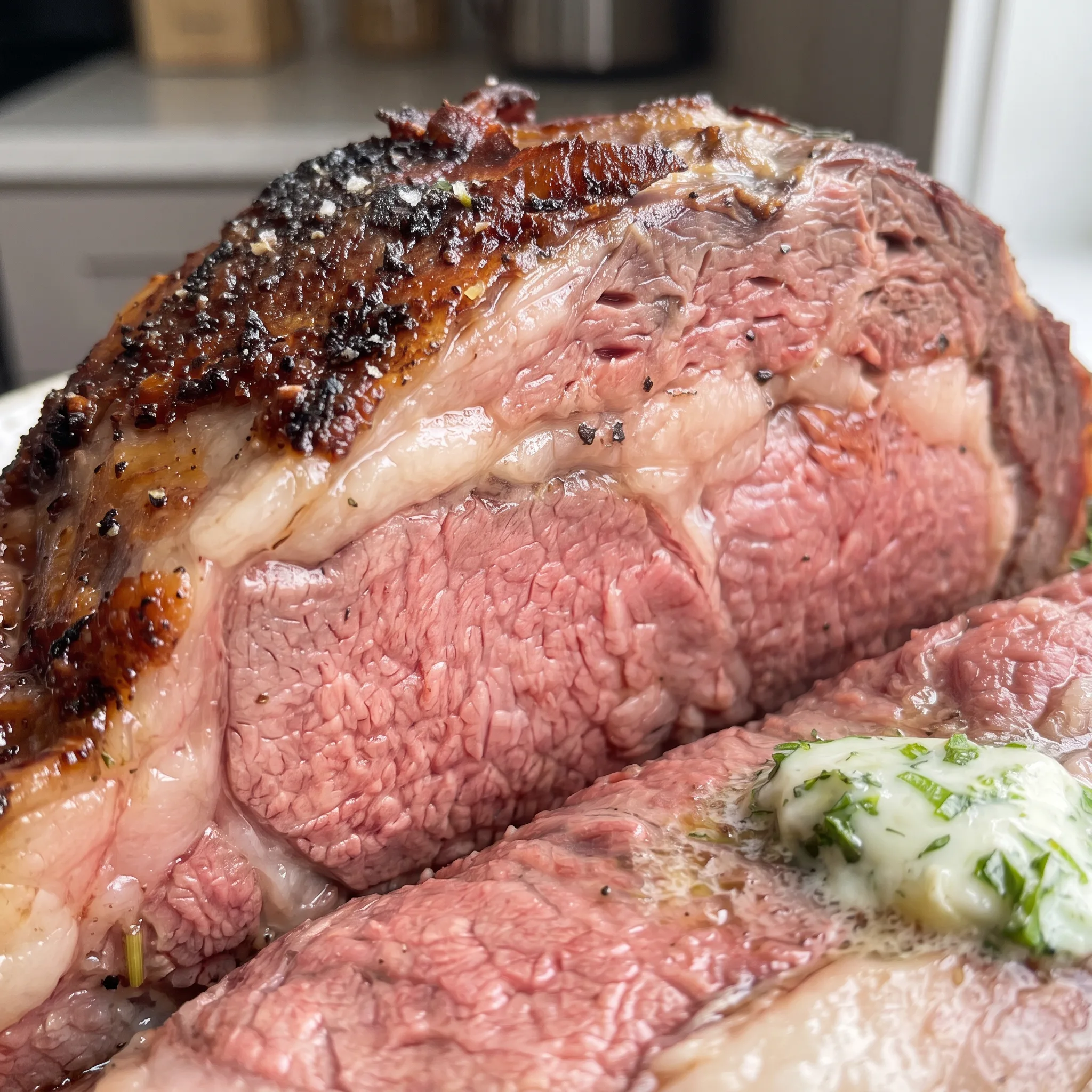
When you carve, the slices should be rosy from edge to center and hold their juice. A quick test: press the meat.
It should feel springy, not tight. If it’s still firm, give it a few more minutes.
What to Look For Before This Roast Hits the Smoker
Prime rib roast: Look for a roast with a thick, even fat cap across the top, since that fat bastes the meat as it smokes.
Butter or ghee: Ghee holds up better in a low smoker than regular butter, which can brown and drip off before the roast finishes.
Fresh herbs: Parsley, thyme, and rosemary chopped fine enough to cling to the butter coat instead of falling off onto the pan.
Rendered fat from the baking sheet: That pool of dripped butter and beef fat is the searing medium, so a rimmed pan keeps it from running off.
Reading the Roast: What to Watch at Every Stage
Judging the dry surface before you season
Blotting the roast isn’t busywork. A wet surface keeps salt and pepper from sticking, and later it steams in the smoker instead of forming a crust.
Run your hand over the meat after blotting. It should feel tacky, almost like it’s been floured.
If it’s still slick, pat again with fresh paper towels. The drier the surface, the better the seasoning adheres and the better the bark sets. This step takes two minutes and pays off in texture.
The butter coat: when it’s thick enough, when it’s too thick
Softened butter should go on in a thin, even film, not a shaggy blanket. If it’s cold and tearing the meat, let it sit out longer.
You want every crevice and the fat cap covered, but no clumps thicker than a quarter inch. Too much and it drips off in the smoker, wasting flavor and creating a greasy pan.
You’ll know it’s right when the roast looks glossy and the herbs cling evenly. If it feels patchy, use your hands to smooth it out.
The stall: when the temperature climbs in fits and starts
At 225°F, the internal temp often rises steadily then seems to stop for 20 or 30 minutes. That’s normal. The smoker is still working; moisture evaporating from the surface cools the meat just as fast as heat penetrates.
Don’t panic and crank the heat. Wait it out. If the stall drags past an hour with no movement, check that your probe isn’t in fat or bone.
Otherwise, let the smoker do its job. The roast will start climbing again on its own.
The sear: reading the crust and the final temp
In the skillet, the butter should sizzle hard the moment the meat goes in. If it’s quiet, the pan isn’t hot enough. You’re looking for a deep brown crust, not black.
Two to three minutes per side does it. But the real judge is the probe: pull it at 125, 128°F. If you’re below that after searing all sides, keep going one minute per side.
Go past 130°F and you’re into medium. The window is narrow, so check after every turn.
The rest: when the roast stops fighting you
After the sear, the roast is still cooking. Those 15 minutes let the heat equalize, and the temp will climb another 5 to 10 degrees. Press the meat: it should feel springy and give slightly, not firm or tight.
If it’s still firm, give it five more minutes. Cutting early and the juice runs out, leaving dry slices.
Wait until the roast relaxes. Then carve.
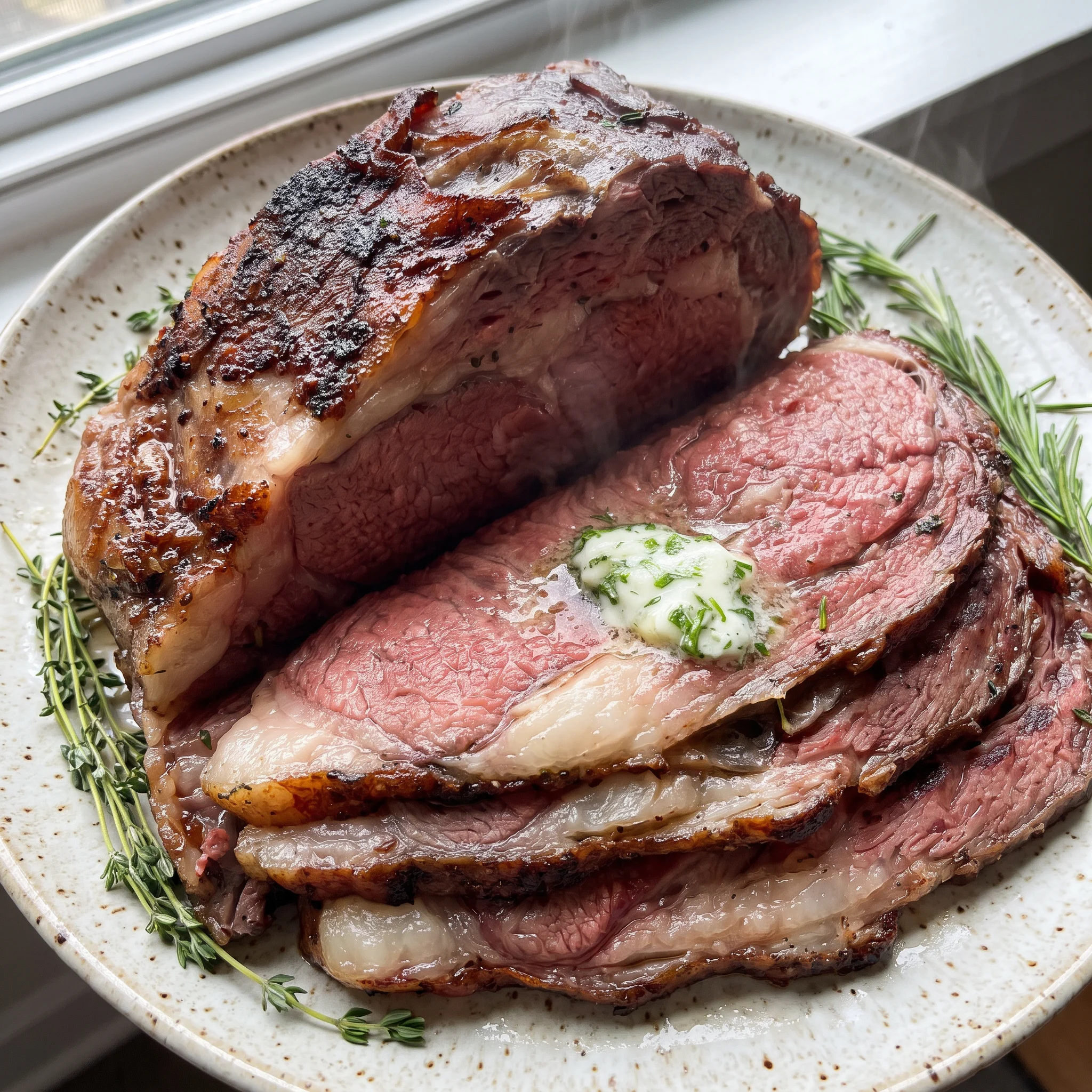
Smoked Prime Rib with Herbed Butter
Ingredients
Method
- Use clean paper towels to blot the 4–6 lb prime rib roast until dry. Apply kosher salt and ground black pepper liberally. Allow it to sit and reach room temperature, roughly 1 hour.
- In the meantime, in a small bowl, stir together 4–5 tbsp (56–70 g) softened butter or ghee with 2 tbsp fresh herbs. Coat the entire prime rib with this herbed butter. Set the prime rib on a sheet pan that has a wire rack, with the fat side facing up.
- Set smoker temperature to 225°F (105°C).
- Move the prime rib (still on the wire rack-lined baking sheet) into the smoker. Place a probe in the thickest section of the roast to monitor internal temperature. Smoke until the internal temp reaches about 118–120°F (48–49°C) for a medium-rare finish—be aware that a true medium-rare finish is 130–135°F (54–57°C), which will be achieved in the next step with the sear and resting time. This may take anywhere from 2 hours 45 minutes to 4 hours (or 35–40 minutes per pound).
- Heat a large cast iron skillet over high heat and add 2–3 tbsp of the rendered fat/butter from the baking sheet. Sear the prime rib for about 2–3 minutes per side while spooning the rendered butter over it. Before taking it out of the skillet, check the internal temp again at the thickest part and confirm it is at or around 125–128°F (52–53°C). If it is not, keep searing 1 minute per side until it reaches that.
- Take it out of the skillet and allow it to rest 15 minutes before carving—the internal temp will keep rising during this time.
- Serve alongside prime rib horseradish sauce or some prime rib au jus.
Storage and Serving: How Smoked Prime Rib Holds
Carve smoked prime rib close to serving. The crust is at its best within 30 minutes of the rest, and it softens as the roast sits. For leftovers, cut the meat off the bone, slice it, and refrigerate in a shallow container within two hours.
It keeps three to four days. The seared crust gives up its crispness by day two, and the meat reads drier cold, so reheat gently: a covered skillet over low heat with a spoonful of water or beef broth, or a 300°F oven for 10 to 15 minutes.
Skip the microwave; it tightens the proteins and the crust goes leathery. Horseradish sauce, being dairy-based, holds two to three days and separates as it sits, so stir before serving.
Au jus keeps four days and freezes well on its own for two months. The sliced meat itself freezes poorly, since the sear and smoke are what you paid for and thawing drains them.
Serve leftovers sliced thin, warm, with the cold sauce alongside.
Trade the Roast, the Fat, or the Herbs Without Wrecking the Smoke
Bone-in prime rib roast: Boneless prime rib roast of the same weight. A boneless roast cooks faster and more evenly because there’s no bone to insulate the meat. Start checking for doneness 30 minutes earlier than the bone-in timing suggests.
The bone adds flavor and a bit of insulation, but boneless is easier to carve and gives you more uniform slices. If you go boneless, tie it with kitchen twine at 1-inch intervals to keep it compact so it cooks evenly.
Butter: Ghee (same amount, 4, 5 tablespoons). Ghee has a higher smoke point and less water, so it won’t brown or drip off as quickly in the smoker.
The herb coating will cling a little better and the crust will be slightly crisper. If you use regular butter, watch for early dripping and baste with the pan drippings if the surface looks dry.
Fresh herbs (parsley, thyme, rosemary): Dried herbs, using 1 tablespoon total instead of 2 tablespoons fresh. Dried herbs are more concentrated, so you need less. They also won’t cling to the butter as well; they may fall off during smoking.
Crush them to the touch before mixing to release their oils. The flavor will be more bold but less bright, and you might see specks of dried herb on the crust instead of fresh green flecks.
Kosher salt and black pepper: Coarse sea salt and freshly cracked black pepper, same amount. Coarse sea salt dissolves a bit slower, so give the seasoned roast the full hour at room temperature to let it penetrate.
Freshly cracked pepper has more aroma and a coarser texture that adds to the crust. Neither changes the cooking process, just the final seasoning punch.
Tips
- Salt the roast as soon as you blot it dry, not right before it goes into the smoker. The hour at room temperature is the only window where the salt has time to dissolve on the surface and draw moisture back in as a concentrated brine. Salt applied at the last minute sits on top as granules and drops off onto the rack, so the meat under the fat cap stays flat-tasting.
- Set the roast on the rack fat side up and leave it there for the full hour rather than moving it from a plate to the pan at the end. Every transfer smears the herb butter you just applied and leaves a bald patch that smokes up gray instead of brown. Build the butter coat once, on the rack, and slide the whole pan into the smoker.
The hard step is the moment the roast hits 118, 120°F in the smoker. A probe should read that temperature and the meat should feel firm but still yielding when pressed; if it feels springy or the temperature climbs past 120°F, carryover during the sear and rest will push it into medium or beyond. It is too late to correct once the internal temperature exceeds 125°F before searing, because the subsequent sear and rest will add another 10, 15°F.
Frequently Asked Questions
Can I smoke the prime rib ahead of time and sear it later?
Yes, and it works in your favor. Smoke the roast to 118, 120°F, then pull it off and let it cool uncovered on the rack until it stops steaming, maybe 20 minutes, then wrap and refrigerate. Cold meat takes the hard sear without the interior climbing past rare, so you get a deeper crust with less gray ring.
When you’re ready, bring it back to room temp and sear in the rendered fat, then rest 15 minutes before carving. Carve close to serving either way, since the crust softens as the roast sits.
Why did my smoked prime rib come out dry?
Slicing too soon is the usual culprit. Those 15 minutes off the heat let the juices redistribute; cut into it early and they run onto the board instead of staying in the meat.
The other check is your final pull temp: if the probe read past 130, 135°F after the sear, the roast went to medium or beyond, and the slices will look gray and tight rather than rosy edge to center. Press the rested roast before carving.
It should feel springy and give slightly. Firm and unyielding means it needs a few more minutes, not less.
How is smoked prime rib different from traditional oven-roasted prime rib?
Smoke does two things an oven can’t. It lays a faint campfire note over the beef and it dries the surface during those hours at 225°F, so the crust sets up firmer before the skillet ever touches it.
The butter and herb coat behaves differently too: in a dry smoker a lot of it melts and drips onto the pan, and that pooled fat becomes your searing medium, which is why the finished crust tastes roasted and beefy rather than just browned. Oven-roasted rib tends to come out cleaner and more uniform, with a softer exterior. Smoked reads smokier, crustier, and a little less predictable from roast to roast.
