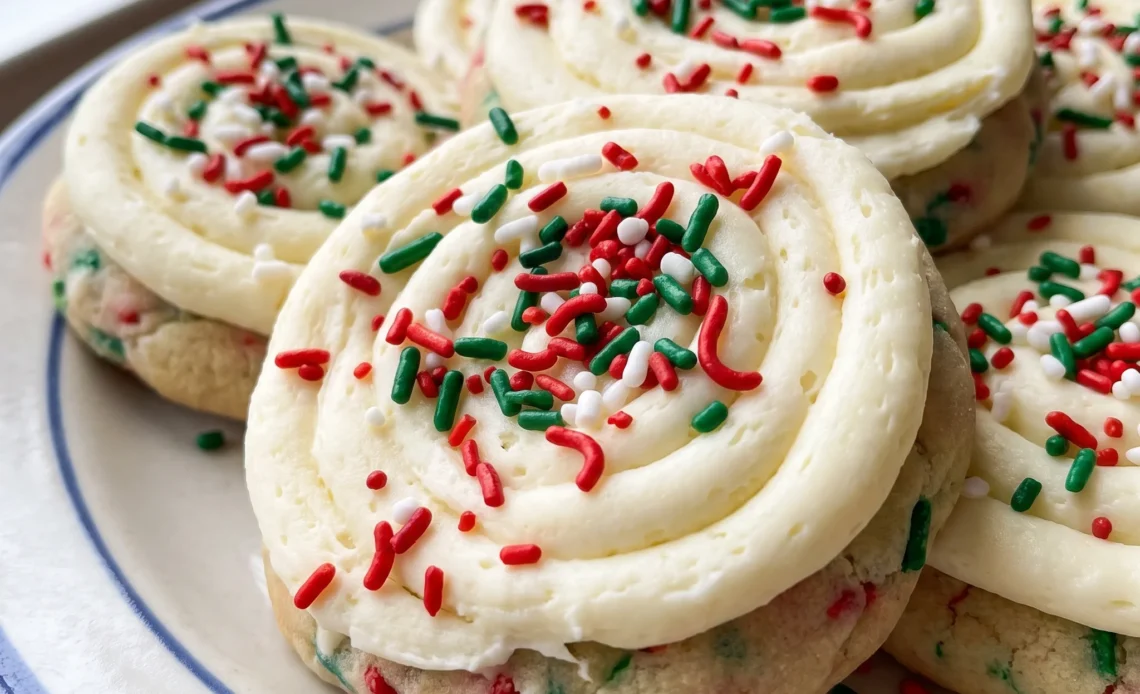
A tall spiral of buttercream sits on a cookie soft enough to dent under a thumb, and the whole thing smells faintly of yellow cake mix. That flavor comes from a bottle, and it walks a narrow line: push the extract and the batch tastes like perfume, pull back and you’ve made sugar cookies with sprinkles. Salt does quiet work against that sweetness, though the dough itself is slack and buttery, quick to spread if it sits.
Frosting brings its own tension. Build it loose and the swirl pools at the edge within the hour; build it stiff and it never pipes smooth. These cake batter cookies reward attention to texture more than to timing, and the payoff is a bite that lands somewhere between batter and a soft, sprinkle-flecked cookie.
The dough should feel cool and slightly firm when portioned; if it feels warm or sticky, the butter is already softening and the baking powder is beginning to react. Once the dough is dropped onto the sheet, the clock is running, waiting even a few minutes allows the leavening to start, and the cookies will spread excessively in the oven. The visual cue of over-leavening is flat, greasy edges that set before the centers, and at that point the texture is compromised.
Cake Batter Extract, Not Vanilla
Cake batter extract carries the whole point of these cookies. Its flavor is sweeter, rounder, and more overtly dessert-like than vanilla, closer to the smell of a yellow cake mix straight from the box.
But that concentration cuts both ways: too much and the cookies taste like perfume, too little and they just read as sugar cookies with sprinkles. The extract’s alcohol base also means it can turn sharp if it isn’t balanced.
That’s why the dough leans on a full teaspoon of salt, which pulls the sweetness back into focus and keeps the extract from tasting flat or chemical. The frosting uses the same extract for a reason. A vanilla buttercream would be fine, but it wouldn’t reinforce the theme; the cookie and the frosting need to agree.
When you taste the finished cookie, the flavor should land somewhere between raw cake batter and a soft sugar cookie, with the extract as the through-line.
Pressed Flat Before Baking
This dough is soft, buttery, and slack. It has plenty of sugar and fat but not much structure, so a dropped scoop will bake into a domed, uneven mound if you leave it alone. Pressing each portion with the bottom of a glass flattens it into a disk of even thickness, which does two things: it encourages the cookie to spread evenly rather than puff upward, and it gives you a flat surface for frosting later.
Skip the press and you’ll get cookies with thick centers and thin, overcooked edges, and the frosting will slide off the dome. Chilling the dough, which many cookie recipes call for, isn’t used here because cold dough would fight the press and bake up tight rather than spread. The texture you’re after is soft and slightly cakey, not crisp, so the dough goes into the oven soon after mixing.
A finished cookie should be flat enough to hold a piped spiral without the frosting pooling at the edge.
High Leavening, Soft Crumb
Three teaspoons of baking powder is a lot for four cups of flour, and it’s deliberate. That much leavening gives the cookies a soft, cake-like crumb instead of a chewy or crisp one. The baking powder works with the butter and sugar to create lift, but the ratio matters: too much butter and the cookies spread before the leavening can set, too little and they bake up dense.
Because the dough is soft and warm from mixing, it should go into the oven soon after it’s made. Letting it sit gives the baking powder a head start and the butter a chance to soften further, both of which push the cookies toward over-spreading. If you see edges that are flat, greasy, and dark before the centers are set, the leavening has spent itself too early.
The goal is a cookie with a tender interior and edges that hold their shape, not a puddle. A properly baked cookie will feel light for its size when you lift it off the sheet.
Frosting Built for Piping
The frosting uses more powdered sugar than butter, which gives it enough body to hold a piped spiral without sagging. A softer, more buttery frosting would taste rich but spread into a puddle the moment it sat at room temperature.
The small amount of cream, just a few tablespoons, loosens the mixture enough to pipe smoothly while keeping it thick enough to hold its shape. Salt is there to cut the sweetness, and without it the frosting would taste flat and cloying against the already sweet cookie. It’s important to frost cookies only after they’ve cooled completely; warmth from the cookie will melt the frosting and cause it to slide.
When the frosting is right, a piped spiral will stand with soft edges and a slight peak, and it won’t weep or pool after an hour on the counter. The texture should be smooth and dense, not airy or whipped.
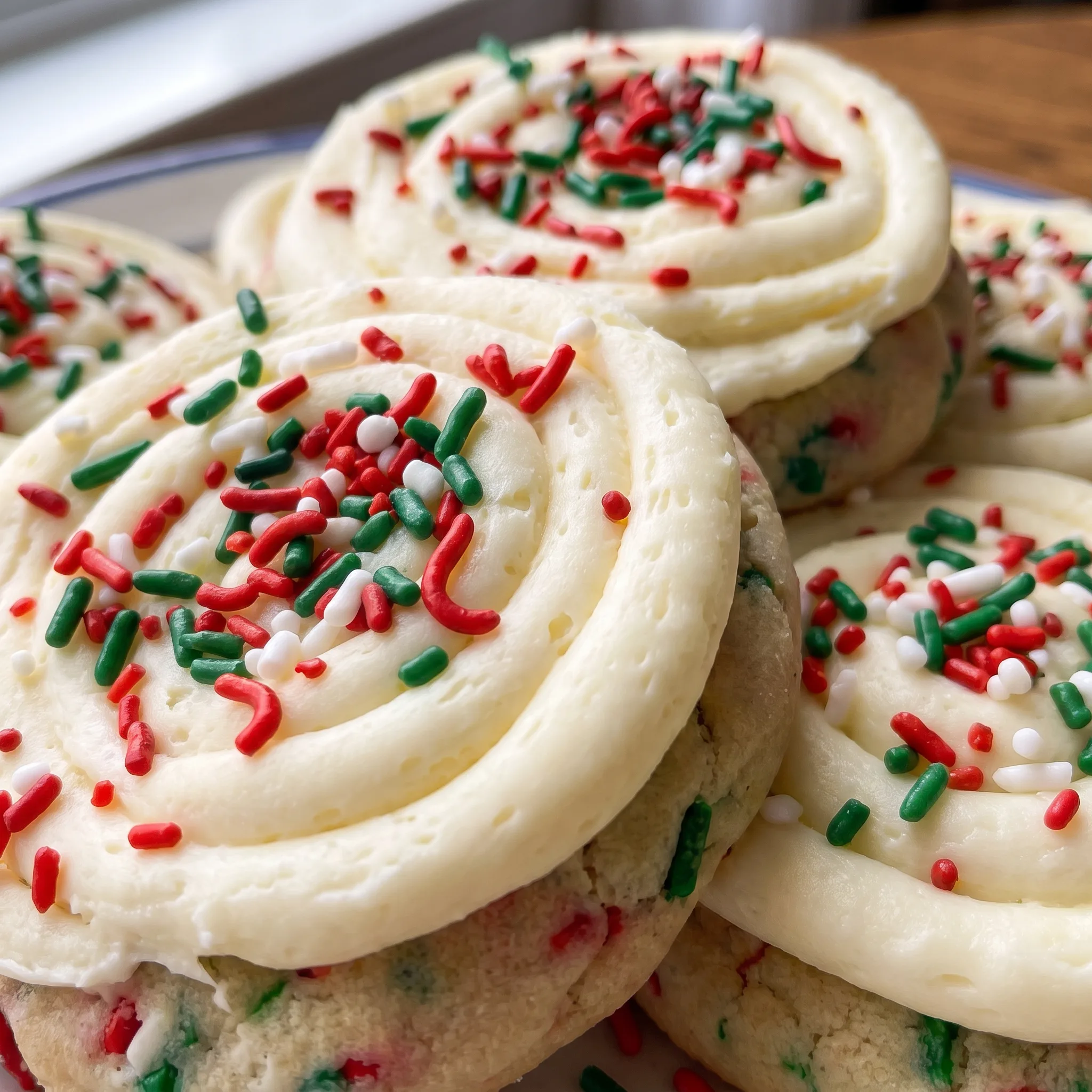
What to Buy (and Not Skip) for Cake Batter Cookies
Cake batter extract: You need 2 tsp in the dough and ½ tsp in the frosting, and imitation versions read sweeter and rounder than the real stuff.
Unsalted butter: The dough calls for 1 ½ cups softened and the frosting 1 cup, so buy enough and leave both out until they dent under a finger.
Sprinkles: Use jimmies, not nonpareils or sanding sugar, since the flat waxy kind holds shape in the oven and won’t bleed color into the dough.
Powdered sugar: 5 cups sounds like a lot, but the frosting needs that much body to pipe a spiral that stays put.
Light brown sugar: Just ¼ cup packed, and it’s there for moisture and a faint caramel edge, so don’t leave it out or swap in dark.
Heavy whipping cream: You’ll use 2 to 4 tablespoons, so buy a small carton rather than a pint you’ll never finish.
Judging Cake Batter Cookies: doneness, spread, and frosting consistency
When the butter and sugar are ready to cream
Let the mixer run until the mixture turns pale and visibly thickens, clinging to the paddle in soft peaks. It should feel lighter than when you started. If it still looks grainy or slick, the sugar hasn’t dissolved enough and the cookies will spread too much.
Stop and scrape down the bowl, then mix another minute. You’re after a texture that holds a ribbon when you lift the beater.
The point where the dough stops being shaggy
As you add the flour, watch for the moment the dough pulls away from the sides of the bowl and forms a cohesive mass. It should be soft but not sticky, and it will feel slightly tacky.
If you keep mixing past that, the cookies will turn tough. If it’s still crumbly, add a teaspoon of water at a time.
The sprinkles go in last, folded just until they’re evenly scattered.
Reading the bake: edges set, centers no longer shiny
At 13 to 16 minutes for 2-tablespoon cookies, or 18 to 20 minutes for 3-tablespoon cookies, the edges should be lightly golden and the centers should look dry, not wet or glossy. If the centers still shine, they need another minute.
Pull them too early and they’ll collapse; too late and they’ll crisp. The cookies will feel soft on top but firm at the edge.
Let them cool on the sheet for 5 minutes before moving.
Frosting that pipes without pooling
After adding 2 tablespoons of cream, beat the frosting until it’s smooth and fluffy. It should hold a soft peak when you lift the beater, and a spoonful dropped back into the bowl should disappear slowly, not instantly.
If it’s too stiff, add cream a teaspoon at a time; if too loose, add powdered sugar a tablespoon at a time. The right texture pipes a spiral that stays put without sagging.
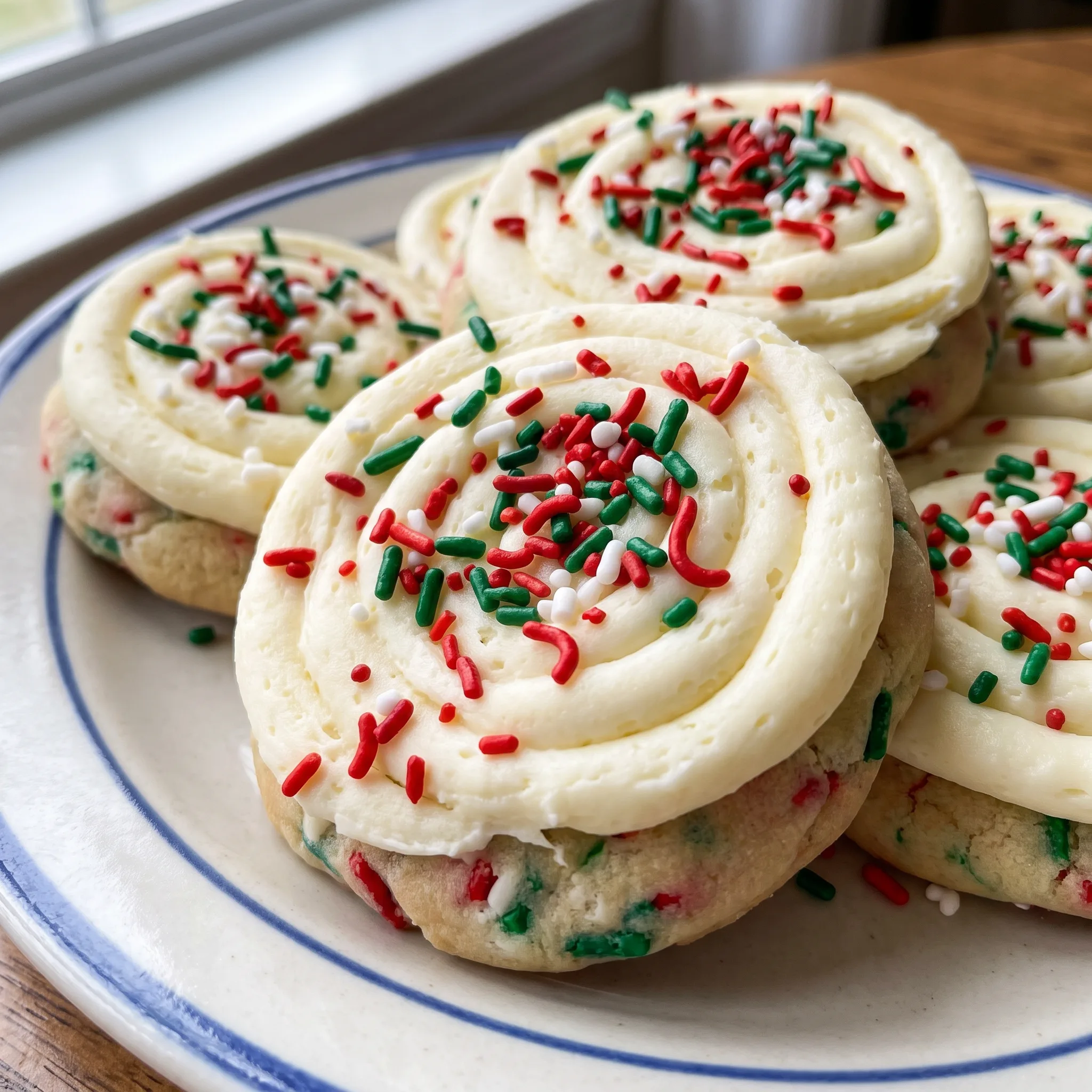
Cake Batter Cookies with Sprinkles and Frosting
Ingredients
Method
- Heat oven to 350°F (175°C). Prepare a second cookie sheet by lining it with parchment paper or a silicone baking mat.
- In a stand mixer bowl equipped with the paddle attachment (or a large bowl using a hand mixer), combine the softened butter, granulated sugar, and brown sugar on low speed until light and fluffy. Add the egg and cake batter extract, mixing on medium speed until fully incorporated.
- Stir in the baking powder and salt, then add the flour in increments, mixing just until the dough is smooth and cohesive, scraping down the bowl as necessary. Gently fold in the sprinkles.
- Prepare a cookie sheet by lining it with a silicone baking mat or parchment paper. Drop 2- or 3-tablespoon portions of dough onto the sheet, leaving 3–4 inches between them depending on size. Use the bottom of a drinking glass to lightly press each portion flat.
- Bake for 13–16 minutes for 2-tablespoon cookies or 18–20 minutes for 3-tablespoon cookies, until the edges are lightly golden and the centers are no longer shiny. Allow to cool completely before adding frosting.
- For the frosting: In a very large bowl, beat the butter with a stand or hand mixer until smooth. Gradually incorporate the powdered sugar until the mixture becomes crumbly, then add the salt and extract. Pour in 2 tablespoons heavy cream and beat until smooth and fluffy, adding additional cream as needed to achieve the desired consistency.
- Spread frosting over the cooled cookies as desired and garnish with additional sprinkles. To frost in the style of Crumbl, transfer frosting to a pastry bag fitted with a round tip and pipe in a spiral pattern.
- Keep cookies in an airtight container for up to 3 days. For longer storage, freeze for up to 3 months.
Storage and Serving
Frost these cookies only after they cool completely, and serve them the same day for the best texture. The soft, cakey crumb and piped buttercream are at their peak within a few hours of frosting, when the spiral still holds a defined edge and the cookie underneath is tender rather than damp. Keep frosted cookies in an airtight container at room temperature for up to 3 days.
Over that window the frosting slowly slackens and the crumb takes on moisture from it, so day three eats softer and sweeter than day one. For longer storage, freeze frosted cookies for up to 3 months.
Freeze them on a sheet until the frosting sets, then stack with parchment between layers. Thaw in a single layer at room temperature, uncovered, so condensation doesn’t bead on the frosting and make it weep. Don’t thaw in the fridge; the cold draws moisture to the surface and the spiral slumps.
If you’re frosting ahead, keep the buttercream chilled and bring it to room temperature before piping.
Tips
- Weigh the flour at 492 g rather than scooping four cups. A cup of all-purpose flour scooped straight from the bag can weigh 140 g or more, so four packed cups could put you 70 g over, and that extra flour absorbs liquid the soft dough needs; the cookies then bake up tight and dry instead of cakey.
- Check the baking powder by stirring a half teaspoon into a few tablespoons of hot water. It should foam right away. Three teaspoons is doing the structural work in this dough, and powder that’s been open past its date or clumped in the tin will fizz weakly, leaving the cookies flat and dense even though you measured correctly.
Swap the Flavor and the Cream, but Leave the Bones Alone
cake batter extract: Equal parts vanilla and almond extract, or an extra teaspoon of vanilla if that’s all you have. You’ll lose the boxed-cake flavor that defines these cookies. The dough will taste like a sugar cookie with sprinkles, and the frosting won’t reinforce the theme.
Use the same 2 teaspoons in the dough and ½ teaspoon in the frosting; you’ll get a fine cookie, just not this one.
heavy whipping cream: Whole milk or half-and-half. Both thin the frosting with more water, so start with 2 tablespoons and add more by the teaspoon until it pipes without pooling.
The frosting will feel slightly less rich and may take a touch more powdered sugar to hold a spiral. Skim milk works in a pinch but makes a leaner frosting that can turn slack faster.
unsalted butter: Don’t reduce or replace it. If you must go dairy-free, use a stick-style vegan butter, not a tub spread or coconut oil. Butter carries the structure and spread in both the dough and the frosting.
Cutting it back gives you a dry, crumbly dough that won’t press flat, and a frosting that never firms up. Stick-style vegan butter behaves closest, but the cookies will taste slightly different and the frosting may need a few extra minutes of beating to thicken.
powdered sugar: Leave the amount as written. For a less sweet frosting, add a pinch more salt and a squeeze of lemon juice rather than cutting sugar. That 5 cups is what gives the frosting enough body to hold a piped spiral without sagging.
Reduce it and you’ll get a soft, buttery frosting that tastes good on a spoon but slides off the cookies within an hour.
Frequently Asked Questions
Can I make the dough ahead of time and bake later?
You can, but the dough loses some lift the longer it sits. The baking powder starts working as soon as it hits the butter and eggs, so a batch mixed and baked right away gives you the softest, most even crumb. If you need to hold it, press the portions flat first, then refrigerate them on the sheet and bake straight from cold.
Expect a slightly tighter spread and a chew that’s a touch firmer.
Why did my cookies spread too much in the oven?
Your butter was probably too soft or the dough sat too long before baking. This dough has 1 ½ cups of butter and only 4 cups of flour, so it has little room to spare. If the butter slumps past room temperature or the baking powder gets a head start, the edges go flat and greasy before the centers set.
Press the portions flat and get them into the oven soon after mixing. A properly baked cookie should feel light for its size and hold a soft, cakey interior.
How do I get the frosting to stay in a tall swirl like Crumbl?
That frosting gets its height from the ratio: 5 cups of powdered sugar to 1 cup of butter, with only a few tablespoons of cream to loosen it. Beat it until it holds a soft peak, then pipe with a round tip in a spiral, building upward as you go. The spiral should stand with soft edges and a slight peak, and it won’t weep or pool after an hour on the counter.
Frost only completely cooled cookies, or the warmth will melt the base of the swirl and it will slide.
What’s the difference between these and funfetti cookies?
Funfetti cookies usually get their flavor from vanilla and a boxed cake mix, which brings its own leavening and sweetness. Here the flavor comes from cake batter extract in both the dough and the frosting, and the structure comes from 3 teaspoons of baking powder in 4 cups of flour. That gives a soft, cake-like crumb and a frosting that tastes like the batter rather than plain buttercream.
The result is a cookie that reads as cake batter from the first bite to the last.
