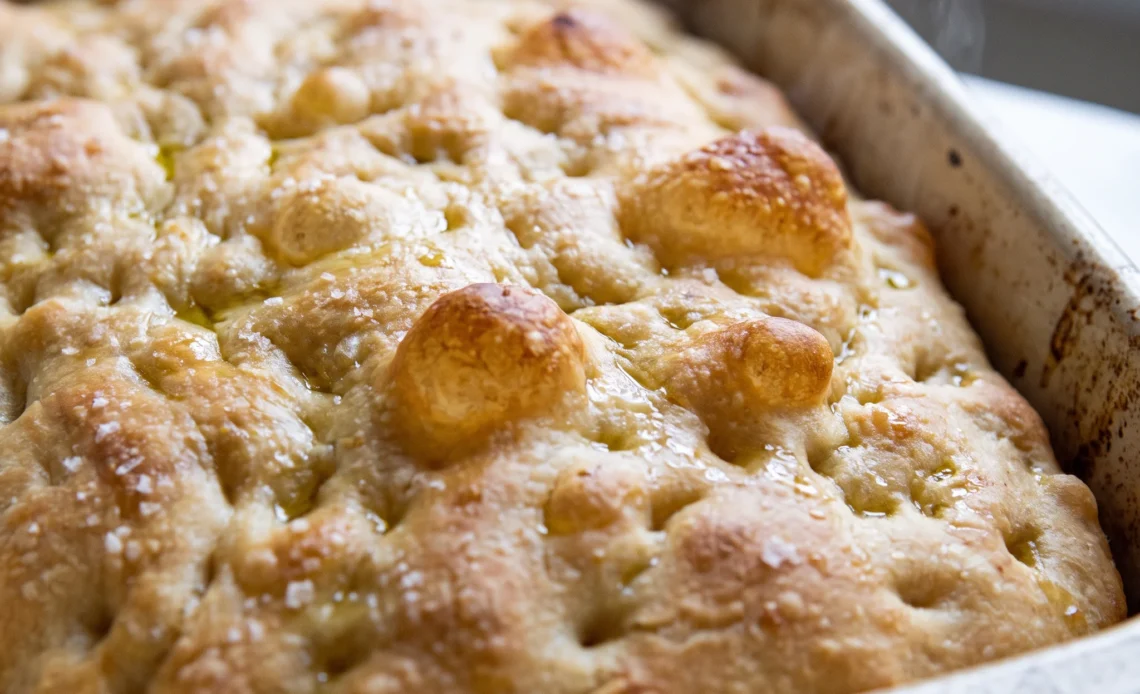
The mistake that sinks most sourdough focaccia isn’t the recipe, it’s baking when the dough looks busy rather than doubled. You can nail the mix and still pull a dense slab out of the oven, and the culprit is almost always a bulk rise that stalled short of puffy because the starter was sluggish or the room ran cool. Sourdough focaccia rewards patience over precision: the dough, not a timer, tells you when it’s ready.
Get past that and the payoff is a pan of dimpled bread with an olive-oil-crisped base and a crumb that stays open. A starter that never doubles anything is the usual hidden cause, and there’s a quick way to check before you commit a single gram of flour to the bowl.
When Bulk Fermentation Takes Its Time
Sourdough focaccia’s bulk rise can run anywhere from 4 to 18 hours, and that span is not a flaw in the recipe. It’s the dough telling you how fast it’s working.
A lively starter in a warm kitchen might double in 6 hours; a sluggish one in a cold room could need 18. The clock is a poor guide because it can’t feel what’s happening.
Watch the dough instead: when it has doubled in volume, it’s ready. A straight-sided vessel makes this call easier because you can see the level rise from the original line. Skip the oven with the light on; that warmth pushes the dough too fast and can leave it exhausted before it develops flavor.
Rely on your eyes and the feel of the dough. The window is wide, but it closes when the dough has clearly doubled, so check it after a few hours and then more often as it nears the top.
Olive Oil as Builder of Crust and Crumb
Olive oil isn’t a finishing touch here; it shapes the bread from the pan up. A generous pool in the pan essentially fries the bottom of the dough as it bakes, giving focaccia its crisp, golden base that shatters when you bite.
The dough gets folded envelope-style right in that oil, which coats it and keeps the surface from drying out. Turning it seam-side down means the smooth top faces up, ready for more oil.
That top oil, plus the dimpling that follows, creates the characteristic dimpled surface and keeps the crust from turning leathery. Flaky sea salt goes on after dimpling and before baking so it sits in the indentations instead of dissolving into the dough.
Each bite gets a hit of salt and oil, and the crust stays crisp rather than soft.
The Final Proof in the Pan
After shaping, the dough needs a second rise in the pan before it hits the oven. This stage is separate from the bulk ferment, and it’s where the focaccia gets its airy, open crumb.
Leave it uncovered at room temperature. A refrigerator would slow everything down and leave the dough cold and tight, so it wouldn’t puff properly.
Watch for the dough to become puffy and nearly doubled in the pan. That visual cue tells you it’s ready to dimple. If you rush this stage, the dough won’t have enough gas to create those irregular holes, and you’ll end up with a dense, flat bread.
Give it the full 4 to 6 hours, or whatever it needs to look right. The dough should look alive, jiggly, and full of promise before you press your fingers into it.
Dimpling to Shape Texture and Flavor
Dimpling is not just for looks. When you press all ten fingers into the dough, you’re stretching it to fit the pan and creating the pockets that define focaccia’s texture. Those indentations catch olive oil and flaky salt, so every bite has concentrated flavor.
But the dough must be relaxed and puffy before you start. If it springs back when you press, it needs more rest; forcing it will tear the gluten and deflate the structure. Done right, dimpling gently pushes down the largest air bubbles while leaving the overall airy network intact.
You’re not knocking the dough down completely, just taming it. The result is a bread with a crisp, oily top, a soft, open crumb, and little pools of salt and oil in every dimple.
That’s what makes focaccia unmistakable.
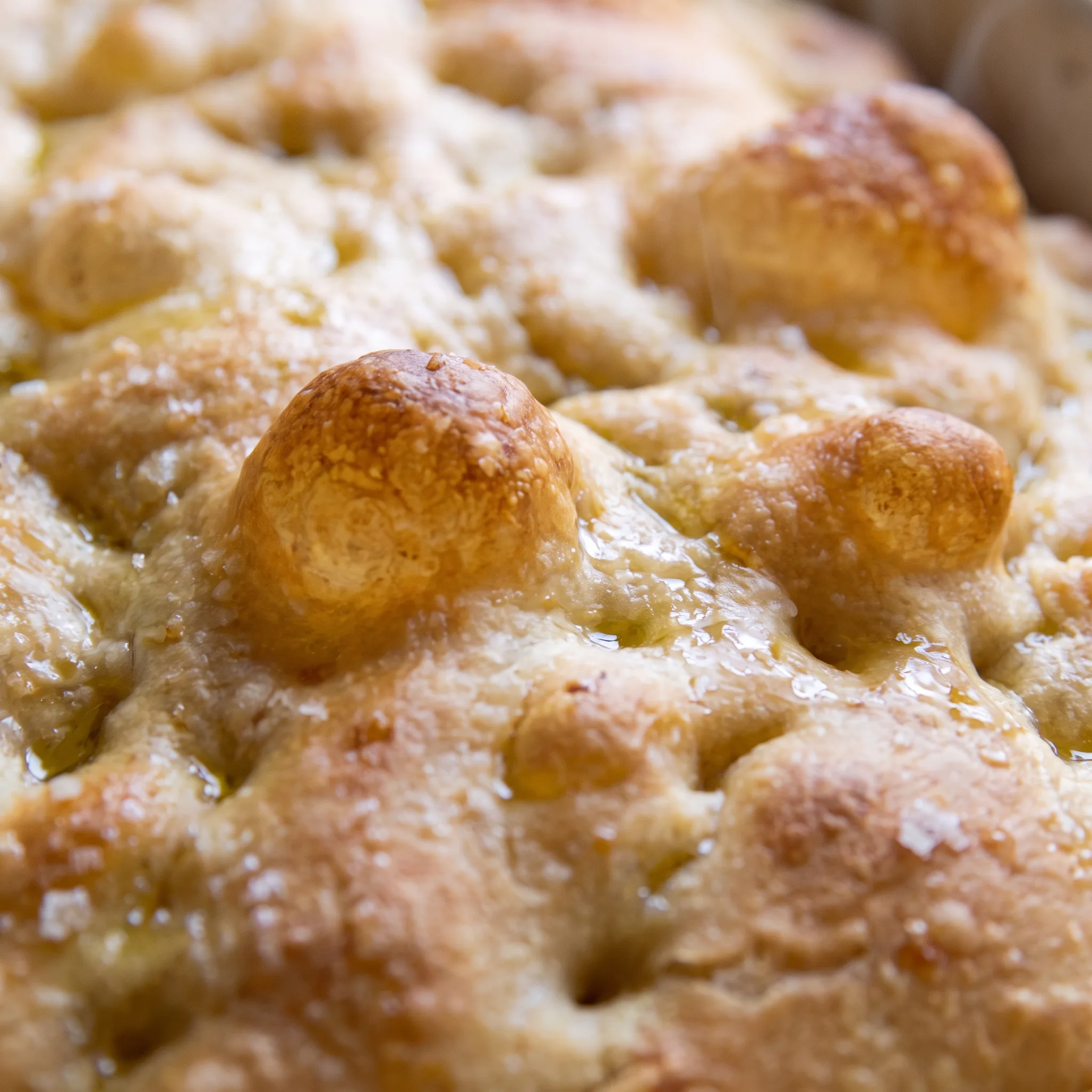
What Actually Matters in These Five Ingredients
Active starter: Use it when it’s peaked and domed, not hungry and collapsed, because 50 g of weak starter drags the rise out past 18 hours.
Bread flour: At 512 g it needs real protein, so check the label for 12 percent or higher rather than grabbing all-purpose.
Extra-virgin olive oil: The 3 tbsp split between pan and dough should taste green and peppery on its own, since the bottom crust carries that flavor straight to the bite.
Flaky sea salt: Maldon or a similar flake sits on top of the dimples instead of dissolving, so skip fine table salt for the finish.
Judging Sourdough Focaccia: The Moments That Decide the Bread
Reading the dough, not the clock, at the end of bulk
When the dough has doubled in volume, it’s ready. In a straight-sided vessel, you can see the level rise from the starting line.
If you wait too long, it will overproof: sticky, slack, and prone to collapsing when you deflate it. If you catch it early, it’ll be tight and spring back when poked. The window is wide, but it closes.
Check after a few hours, then more often as it nears the top. The visual doubling is the judge, not the number of hours.
Knowing when the dough is relaxed enough to dimple
After the final rise in the pan, the dough should be puffy, jiggly, and nearly doubled. Press a finger in: if it springs back quickly, it needs more rest.
If it holds the indentation, it’s ready. Forcing it too early tears the gluten and deflates the structure, leaving a dense bread.
If it’s overproofed, it will feel fragile and may collapse when you dimple. The 4 to 6 hours is a guide, but your finger is the real test.
Judging the bake by color, not just the timer
At 425°F, the focaccia should turn golden all around in about 25 minutes. But ovens vary, and the visual cue matters more.
If the top is pale, give it a few more minutes; if it’s browning too fast, tent it with foil. The bottom should be crisp and golden, not burnt.
Pull it when the color is even and the bread sounds hollow when tapped. Underbaked, it’ll be doughy in the center; overbaked, it’ll be dry and hard.
Cooling long enough to set the crumb
The bread needs at least 20 minutes on a rack before slicing. Cut too soon, and the interior will be gummy and stick to the knife.
The crust also crisps as it cools. Waiting lets the steam escape and the structure firm up. If you can’t wait, you’ll still have bread, but the texture won’t be what focaccia should be.
The 20 minutes is a minimum, not a suggestion.
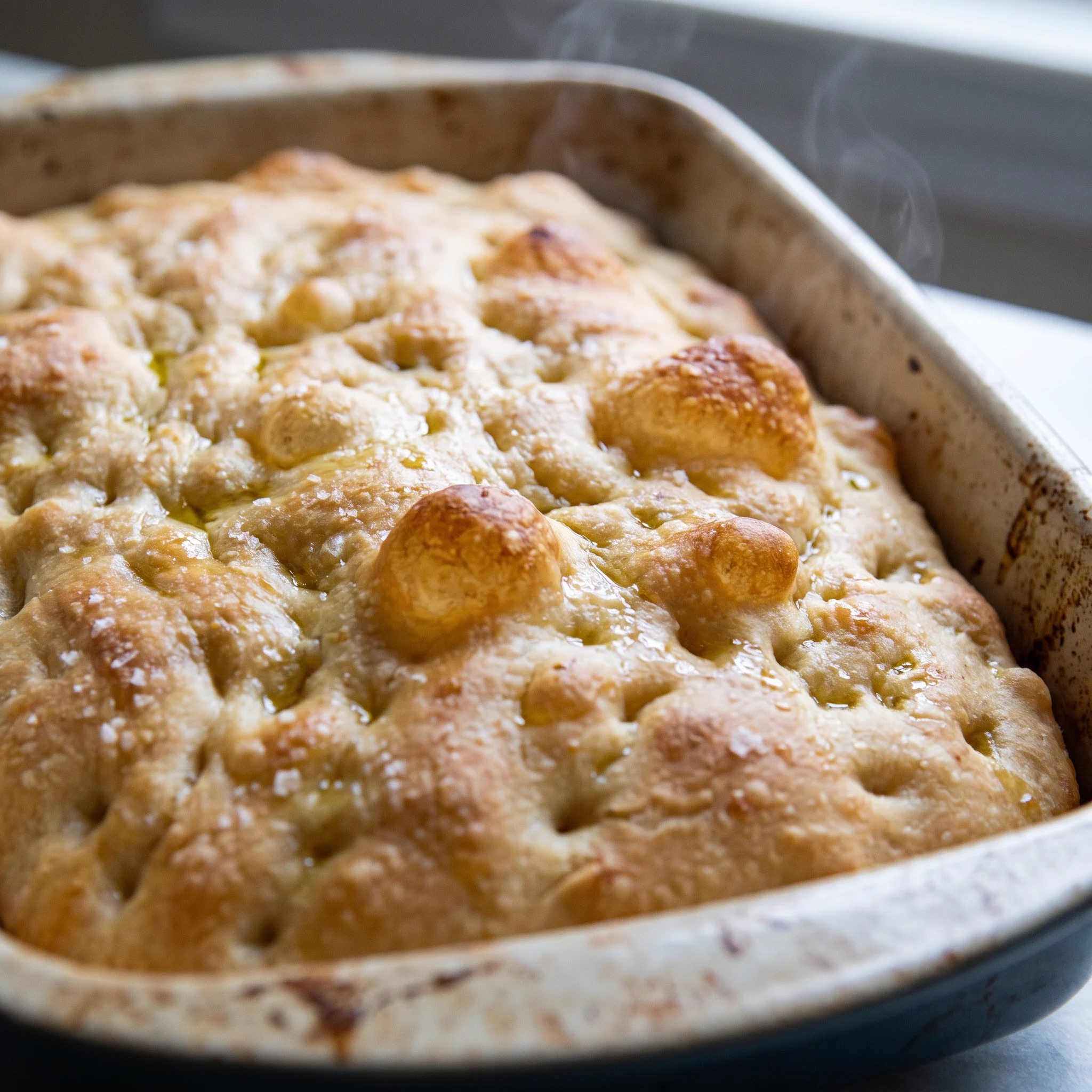
Sourdough Focaccia with Olive Oil and Sea Salt
Ingredients
Method
- In a large bowl, combine the starter, salt, and water; stir with a spatula until just mixed—uniformity is not necessary. Add the flour and mix until fully incorporated.
- If time allows, perform one fold: 30 minutes after mixing, reach into the bowl, pull the dough up and into the center. Rotate the bowl a quarter turn and repeat 8–10 times. See video for guidance.
- Drizzle with a splash of olive oil and rub to coat. Cover the bowl with a tea towel or bowl cover and let rise at room temperature (70°F (20°C)/21°C) for 4–18 hours. Timing varies with season, starter strength, and kitchen temperature—for example, in summer the dough may double in 6 hours, in winter in 18 hours. Do not use an oven with the light on for bulk fermentation; it will be too warm. Rely on visual cues (doubling in volume) rather than time. A straight-sided vessel makes monitoring easy because you can see when the dough has truly doubled.
- When the dough has doubled, pour 2 tbsp olive oil into a 9×13-inch pan. (I use this USA Pan, which I love, with no sticking issues. If using a glass pan, you may want to butter it first as a precaution—I have had sticking disasters with oil alone in other vessels.)
- Drizzle the dough with 1 tbsp olive oil. Gently deflate the dough with your hand and release it from the sides of the bowl. Scoop the dough into the center of the oil pool in the prepared pan. Fold the dough envelope-style from top to bottom and side to side to form a rough rectangle. Turn the dough seam-side down. See video for guidance.
- Rub the top of the dough with oil. Let rest uncovered for 4–6 hours, or until puffy and nearly doubled.
- Heat oven to 425°F (220°C). Lightly oil your hands and, using all ten fingers, gently press into the dough to dimple and stretch it to nearly fit the pan. Sprinkle generously with flaky sea salt. Bake for about 25 minutes, or until golden all around. Remove the pan from the oven and transfer the bread to a cooling rack. Cool at least 20 minutes before slicing.
Where Swaps Change This Focaccia and Where They Break It
Bread flour: All-purpose, cup for cup at 512 g. You’ll get a tighter, less chewy crumb and a crust that won’t have the same bite. Bread flour at 12 percent protein or higher builds the stretch this wet dough needs; all-purpose sits lower and the gluten network comes up short, so the crumb closes in and the chew goes soft.
If all-purpose is what you have, use it. The bread still bakes, it just loses the chew that makes focaccia worth the long rise.
Better to seek out a bag labeled bread flour or a high-protein all-purpose.
Active starter: Instant yeast, about 2 tsp for the 50, 100 g of starter. The whole timeline changes. With instant yeast there’s no wild culture driving the rise, so the 4 to 18 hour bulk no longer applies.
Expect the dough to double in roughly 1 to 2 hours at room temperature, sometimes faster in a warm kitchen. The flavor loses the tang and depth the starter brings, and the crumb is more uniform, less open.
Watch the dough, not the clock, and move to the pan as soon as it has doubled. Don’t let it sit for hours waiting for a sour flavor that won’t come.
Kosher salt and flaky sea salt: Leave both as written. Kosher salt at 10 g is doing structural work in the dough, not just seasoning, and cutting it back for dietary reasons changes how the gluten behaves and how the bread tastes. Table salt is finer and packs more sodium per spoon, so a straight volume swap oversalts the dough.
The flaky sea salt on top needs its size and shape to sit in the dimples; fine salt dissolves into the surface and the little salty hits disappear. If you must reduce sodium, cut the topping first and keep the dough salt intact.
Storage and Serving: Why Focaccia Is a Same-Day Bread
Focaccia is at its best the day it’s baked, and that position governs everything here. The oil-fried bottom is crisp only while the crust holds its moisture balance, so eat it within a few hours of cooling; by evening the base has softened and the top has lost its shatter. Once cooled completely, cover leftovers loosely at room temperature, not tightly, since trapped steam is what kills the crust first.
They keep about two days that way. For anything longer, freeze slices in a single layer, then bag them; the freezer holds the bread for a month or two, though the crust won’t fully return. Skip the microwave entirely, it steams the bottom into a limp, oily slab.
Instead, reheat in a 400°F oven for 5 to 8 minutes, directly on the rack or a sheet pan, until the base crisps again. Serve in wedges as is, or split and fill.
Any flaky salt goes on after the final dimpling, before baking, never at the table.
Tips
- Before you mix, drop a spoonful of your starter into a glass of room-temperature water. If it floats, it’s active enough to lift this dough; if it sinks, feed it and wait until it passes. A starter that fails the float test is the usual reason a 50 g portion never doubles the dough, no matter how many hours you give it.
The bulk fermentation in this recipe can legitimately take anywhere from 4 to 18 hours, so any fixed timer will be wrong in most kitchens. The mistake is tempting because a number feels controllable, but dough doubles in volume at a rate set by temperature and starter activity, not by the recipe’s suggested window. Pulling the dough before it has truly doubled means the gluten network and gas cells are underdeveloped, and no amount of oil or dimpling will rescue the crumb.
Frequently Asked Questions
Can I make sourdough focaccia in one day?
Not in a typical day, no. 5 hours, and that’s before the 25-minute bake. If you start early in the morning, you could conceivably bake close to midnight, but you’d need a fast starter and a warm kitchen.
Otherwise, plan to start the day before you want to eat it.
Why did my focaccia turn out dense and flat?
The most likely cause is that the dough never fully doubled during bulk, and you baked it anyway. If your starter was sluggish or your kitchen cool, the dough can sit for hours and still look tight rather than puffy and jiggly. Check the dough after a few hours and then more often as it nears the top of the vessel.
A second possibility: you overproofed it, and the dough collapsed when you deflated it. Look for stickiness and slackness before you panic; those are signs it went too far, not too little.
How do I know when the dough has finished its bulk rise?
It has doubled in volume. In a straight-sided vessel, you can see the level rise from the starting line. If you’re using a bowl, mark the starting level with a piece of tape or a rubber band.
The dough should look puffy and jiggly, not tight. Don’t rely on the clock; the card gives a range of 4 to 18 hours, and the visual doubling is the judge.
Can I prepare the dough ahead of time and bake it later?
You can, but the storage section says focaccia is best the day it’s baked. If you need to, let the dough go through its bulk rise, then shape it and put it in the pan. Cover and refrigerate overnight; the cold will slow the final proof.
The next day, let it come to room temperature and finish the final rise before dimpling and baking. Expect the crust to be slightly less crisp than a same-day bake.
What makes sourdough focaccia different from regular focaccia?
The starter brings a tang and a longer timeline. Regular focaccia often uses commercial yeast, which can double the dough in an hour or two; here, the bulk rise can run from 4 to 18 hours.
That slow fermentation develops more flavor and a more open crumb. The trade-off is that you have to watch the dough, not the clock, because the starter’s strength and your kitchen temperature decide the pace.
