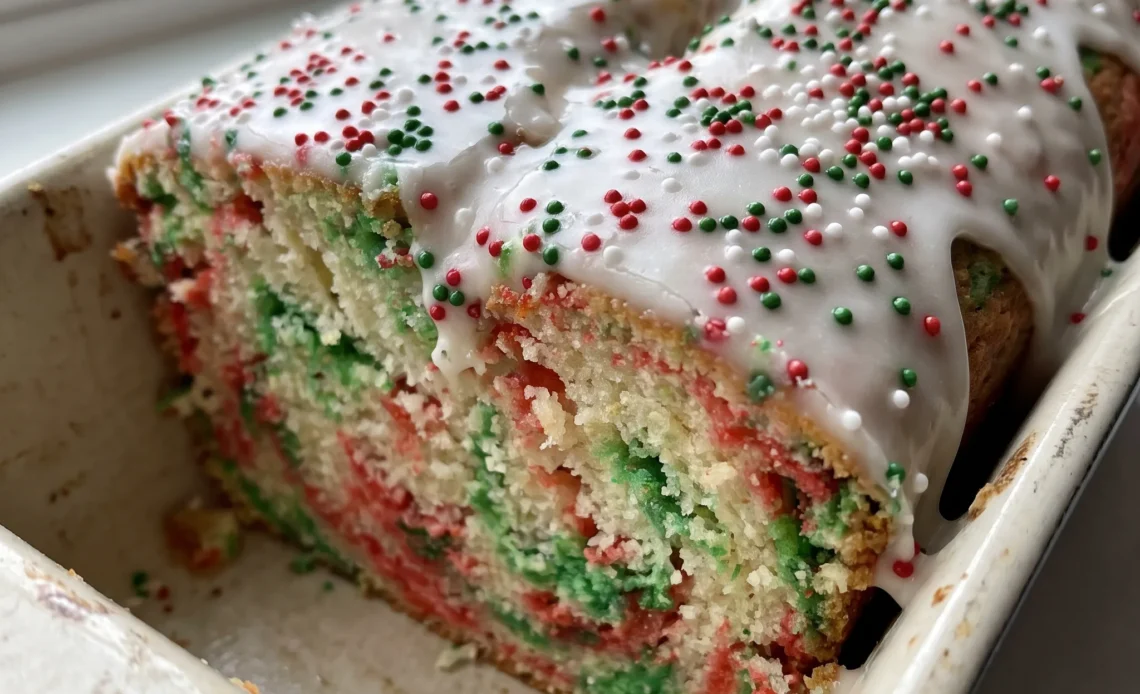
Sprinkle bread usually looks better in the pan than on the plate, and the reason is almost always the batter’s thickness. Get it right and this christmas sprinkle buttermilk bread comes out of the oven looking like a bakery window display, crumb pale and studded with color, glaze poured over the top in slow ribbons. Get it thin and every sprinkle migrates south, leaving a gray streak along the bottom and a plain top.
Buttermilk and melted butter give you some room here, but the margin isn’t wide. The flavor is quiet enough that the look carries the loaf, which is why the almond extract is measured with a light hand. One bowl, one pour-over glaze, and the whole thing reads festive without much fuss.
Why Buttermilk and Melted Butter Make a Tender Loaf
Buttermilk and melted butter both work on the flour in ways you can taste. Buttermilk’s acidity tenderizes the gluten, and it reacts with the baking soda for lift, so the crumb stays soft instead of tough.
Melted butter, not softened or creamed, coats the flour proteins and limits how much gluten develops, giving a close, even texture that holds sprinkles without tearing. When you fold in the sprinkles, do it gently so they don’t bleed color into the pale batter.
The batter will be thick, almost like a soft dough, and that’s what keeps the sprinkles suspended rather than sinking to the bottom. During baking, the loaf rises steadily, and the top sets to a light golden brown.
The result is a slice that’s tender but not crumbly, with sprinkles staying bright and evenly scattered. If you’ve ever had a quick bread turn out dry or rubbery, the balance here is what prevents that.
A Hint of Almond That Complements the Glaze
Almond extract brings a faint nutty sweetness that plays off the tang of buttermilk. It’s a background note, not a headline, so the sprinkles and glaze still lead.
The extract goes into the wet ingredients, where it disperses evenly through the batter with a few stirs. That way, every slice carries the same subtle flavor, and there’s no pocket of concentrated almond.
You’ll smell it when you open the bottle, but in the baked bread it’s gentler, more like a whisper. The glaze, with its powdered sugar and a touch of corn syrup, has a clean, vanilla-like sweetness that the almond quietly rounds out.
If you’re worried about it being too assertive, remember that a half teaspoon in a whole loaf is modest. The flavor should make you pause and wonder what that extra something is, not announce itself.
It’s a small addition that gives the bread a bit more character without distracting from the festive look.
How the Glaze Gets Its Shine and Staying Power
Powdered sugar alone makes a glaze that sets up dull and can crack when you slice. A tablespoon of corn syrup changes that.
It adds a glossy sheen and keeps the glaze slightly pliable, so it doesn’t shatter. The buttermilk, added a little at a time, thins the mixture to a thick but pourable consistency. You want it to ribbon off the whisk and coat the back of a spoon, not run like water.
When you drizzle it over the cooled loaf, it should cling to the top and drip down the sides in slow, uneven lines. The nonpareils go on right after, while the glaze is still tacky, so they stick and stay put. Once set, the glaze has a soft shine and a gentle sweetness that contrasts with the tangy crumb.
It’s the kind of finish that looks but holds up to slicing and serving.
Wait for Completely Cool Before You Glaze
A warm loaf will melt the glaze on contact. The powdered sugar will thin out, slide off the sides, and soak into the crumb, leaving you with a sticky, uneven surface instead of a clean coat. Let the bread cool on a wire rack until it’s room temperature all the way through.
That takes a while because buttermilk bread is dense, but it’s worth the wait. Once cooled, the glaze stays where you put it, and the nonpareils adhere without sliding.
You can tell it’s ready when the bottom of the loaf feels neither warm nor cool against your hand. The crumb also firms up as it cools, so slicing later gives neat pieces. If you glaze too early, you’ll see the glaze turn runny and the sprinkles drift.
Patience gives you a loaf that looks like it came from a bakery case, with a glossy top and a tender, even interior.
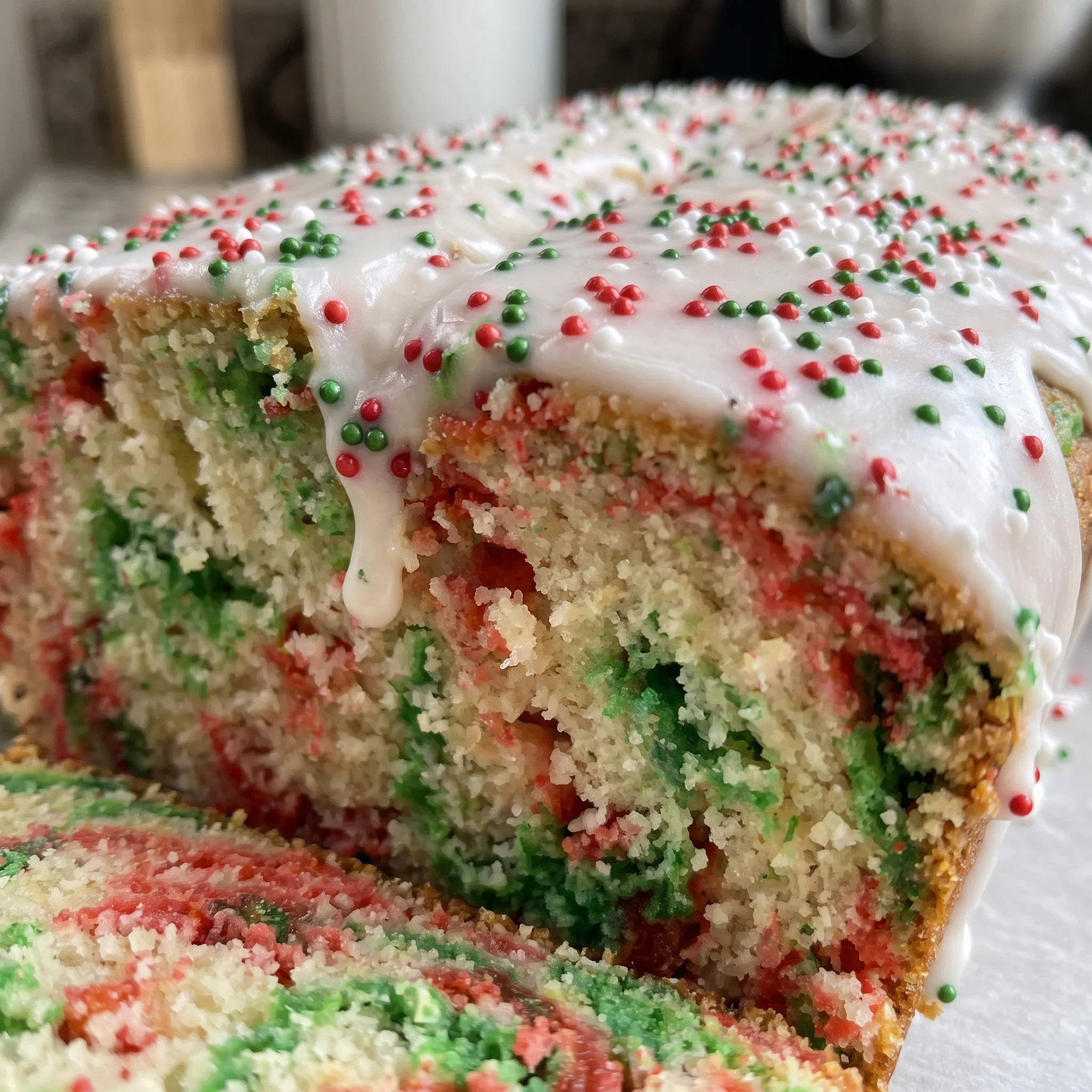
What to Buy and Watch Before You Start This Loaf
Sprinkles: Jimmies, not nonpareils, hold their shape and color in the batter, since the tiny round nonpareils are for the top.
Buttermilk: Shake the carton well, because the solids settle and a thin pour changes how the crumb sets.
Almond extract: Real almond extract, not imitation, since half a teaspoon of the fake stuff tastes like cherry candy.
Powdered sugar: Sift it before whisking, or the glaze stays lumpy and drags when you drizzle it.
Corn syrup: Light corn syrup only, not dark, which tints the glaze and brings a molasses note.
Judging the Loaf by Feel, Color, and Spring
Reading the batter before it goes in
The batter should be thick and scoopable, not runny. If it pours like cake batter, the flour is under-measured or the buttermilk over-poured; add a tablespoon of flour at a time until it holds a soft mound.
Sprinkles will sink in a thin batter. A thick batter keeps them suspended and bakes up even, so trust the resistance on the spatula.
Knowing when the center is set
At 45 minutes, press the center with a fingertip. It should feel firm and spring back, not leave a dent or feel spongy. If it’s still soft, give it 3 to 5 more minutes and check again.
The edges will be pulling from the pan and the top a light golden brown. Underbaked centers fall and taste raw; overbaking dries the crumb.
The 5-minute rest that sets the crust
After the pan leaves the oven, the loaf keeps cooking from its own heat. Five minutes in the pan lets the crust firm enough to hold together when you lift it out. Any longer and steam trapped underneath softens the bottom.
Use that window to run a thin spatula around the edges if any spots stick, then turn it out onto the rack.
Cooling completely before the glaze
A dense buttermilk loaf stays warm in the middle for a long while. Touch the bottom of the loaf; if it’s warm at all, wait.
Glaze on a warm surface melts, turns runny, and soaks in, leaving a patchy top. Room temperature all the way through means the glaze sits on the surface and the nonpareils stay where you put them.
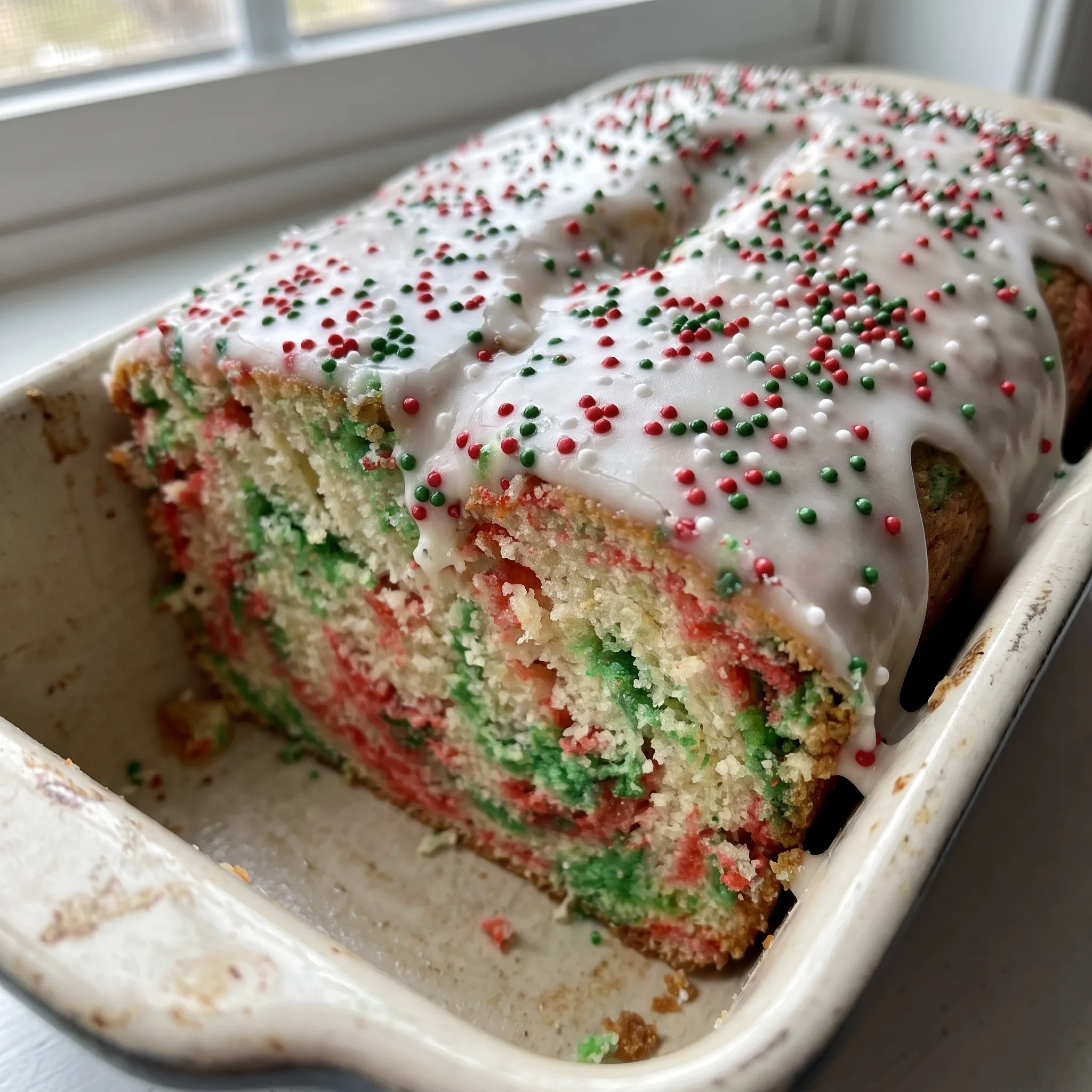
Christmas Sprinkle Buttermilk Bread
Ingredients
Method
- Set an oven rack in the upper third position and heat the oven to 350°F (175°C). Prepare a 9×5-inch aluminum loaf pan by lining it with parchment paper.
- In a large mixing bowl, combine the flour, granulated sugar, baking powder, baking soda, and kosher salt by whisking.
- In a smaller bowl, whisk together the egg, buttermilk, melted butter, and almond extract.
- Combine the wet mixture with the dry ingredients, stirring just until incorporated. Gently fold in the sprinkles.
- Pour the batter into the lined loaf pan and bake for 45–50 minutes, or until the center is firm.
- Allow to cool in the pan for 5 minutes, then move the bread to a wire rack to cool entirely. Because the buttermilk bread is dense, cooling will take 1–2 hours.
- After the bread has cooled completely, make the glaze: whisk the powdered sugar, buttermilk, and corn syrup together. Add more buttermilk as needed to achieve a thick yet pourable consistency.
- Drizzle the glaze over the bread and scatter nonpareils on top.
Storage and Serving: When to Slice, How Long It Holds
Glaze goes on only after the loaf is fully cool, and you should slice within a few hours of that for the softest crumb. Once glazed, the bread keeps at room temperature, loosely tented or in a cake keeper, for two days.
The fridge buys you about four days, but cold dulls the crumb and the glaze turns tacky and cloudy. Room temperature is where the texture stays best. Expect the glaze to soften and the nonpareils to weep color into it by day two; that’s cosmetic, not spoilage.
The sprinkles inside the loaf bleed as well, tinting the crumb. For a stored slice, let it sit out twenty minutes before eating, or warm it ten seconds in the microwave to relax the crumb. Unglazed bread freezes well, wrapped tight, for up to two months; thaw at room temperature, then glaze and add nonpareils just before serving.
A glazed loaf doesn’t freeze, since the glaze sweats and beads on thawing.
What You Can Swap and What You Shouldn’t in This Buttermilk Loaf
Buttermilk: Stir 1 tablespoon of lemon juice or white vinegar into 1 cup of milk and let it sit for 5 to 10 minutes, until it looks curdled and thickened. The acidity still tenderizes the crumb and reacts with the baking soda for lift, so the loaf bakes up close to the original. The tang is a touch sharper and less rounded than real buttermilk, but in a sweet bread with glaze, you won’t notice unless you’re looking for it.
Almond extract: Use the same 1/2 teaspoon of vanilla extract, or 1/4 teaspoon of orange extract. Vanilla fades into the background and lets the sprinkles and glaze lead, which suits a plain sweet loaf. Orange extract is louder, so 1/4 teaspoon keeps it from tasting like a cough drop; it pairs well with the buttermilk tang.
Either way, you lose the faint nutty note that makes people ask what’s in it.
Sprinkles: Jimmies work in the batter; nonpareils do not. If you only have nonpareils, save them for the top and skip adding any to the batter. Jimmies hold their shape and color through baking, so the crumb stays pale with bright flecks.
Nonpareils are tiny and their color bleeds into the batter, turning it gray or muddy, and they can dissolve into streaks. The loaf still tastes fine, but it loses the festive look. For the top, nonpareils are exactly what you want after glazing.
All-purpose flour, granulated sugar, and unsalted butter: Do not swap these. Keep the all-purpose flour, the full cup of sugar, and the 1/2 cup of melted butter.
Changing the flour to whole wheat or a gluten-free blend alters how the batter thickens and how the loaf sets; you’ll likely get a gummy or crumbly slice. Cutting the sugar makes the crumb dry and dull, and the glaze can’t make up for it.
Swapping butter for oil or a spread changes the tender, close texture that holds the sprinkles. This loaf is built on that balance, so leave those three alone.
Tips
- Cut a parchment strip about 5 inches wide and long enough to overhang the two short sides of the 9×5 pan by 3 inches, then press it in before the batter goes in. The overhang becomes a sling you can grab after the 5-minute rest, so you lift the dense loaf straight up instead of tipping the pan and risking a cracked top or a torn edge.
- If you only have a dark nonstick or glass 9×5 pan, drop the oven to 325°F and start checking at 40 minutes. Dark metal and glass absorb and hold more heat than the aluminum pan the recipe calls for, so the crust sets and browns before the middle firms, and the loaf can read done while the center is still raw.
A powdered sugar glaze is a supersaturated sugar solution held thick by undissolved sugar and corn syrup; warmth from the bread raises its temperature and fluidity, so it drains down the sides and absorbs into the porous crumb rather than clinging. Because this buttermilk loaf is dense and retains heat for a long time, the interior can still be warm even when the crust feels cool, and any residual warmth will thin the glaze on contact. Letting the loaf reach true room temperature on the rack first gives the glaze a cool, stable surface to set against.
Frequently Asked Questions
Can I make this Christmas sprinkle buttermilk bread ahead of time?
Bake the loaf up to two days ahead, but leave the glaze off until you’re ready to serve. An unglazed loaf keeps at room temperature under a loose tent, and the crumb actually settles into a slightly firmer, neater slice on day two. Glaze it the morning you plan to eat it, because once the glaze and nonpareils go on, the clock on that glossy top starts ticking.
If you need more lead time than that, freeze the unglazed loaf instead, then thaw it at room temperature and finish it just before serving.
Why did my sprinkles bleed into the batter?
You almost certainly used nonpareils in the batter instead of jimmies. Nonpareils are the tiny round beads, and their color dissolves on contact with the wet ingredients, streaking the pale crumb gray or muddy before the loaf even hits the oven. Jimmies are the short rods, and they hold their shape and color through baking, so you get bright flecks instead of a bruised-looking slice.
The fix is simple: pick the nonpareils out for the top only, and keep jimmies for folding in. If you only have nonpareils on hand, skip them in the batter entirely and save them for the glaze.
How is this different from a classic buttermilk bread?
A classic version leans on buttermilk for tang and a close crumb, and that part stays intact here. What changes is the almond extract, which adds a faint nutty note you’d never find in the plain loaf, plus the sprinkles folded through the batter for color and a little crunch. The glaze is the other shift: powdered sugar and buttermilk with corn syrup for shine, finished with nonpareils on top, where a classic might get a simple sugar drizzle or nothing at all.
Same tender, dense slice underneath, just dressed for the holidays.
