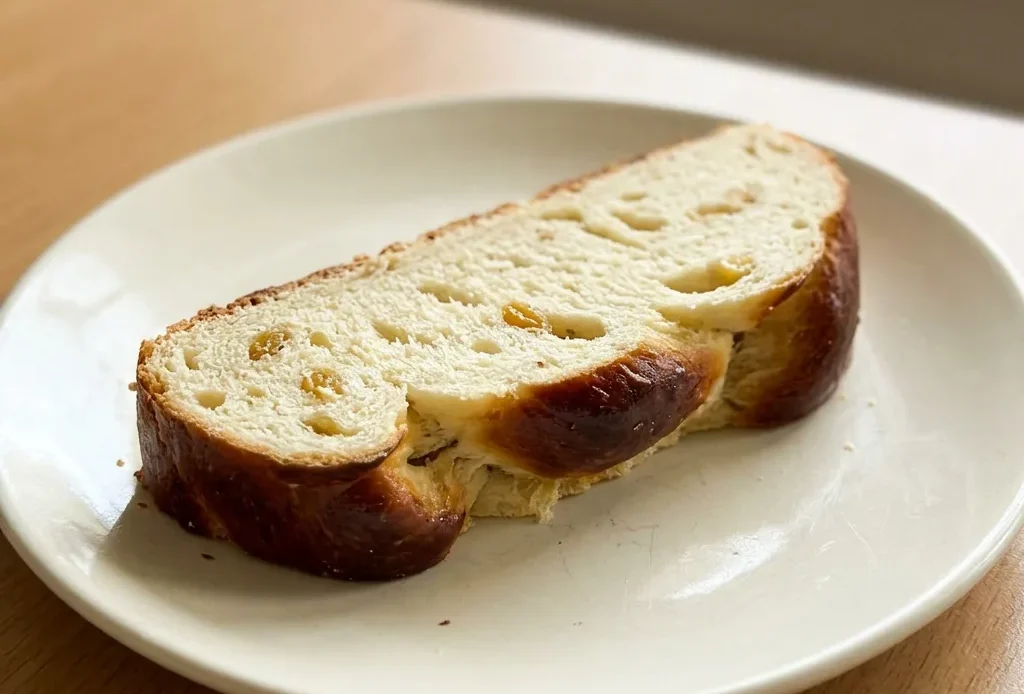
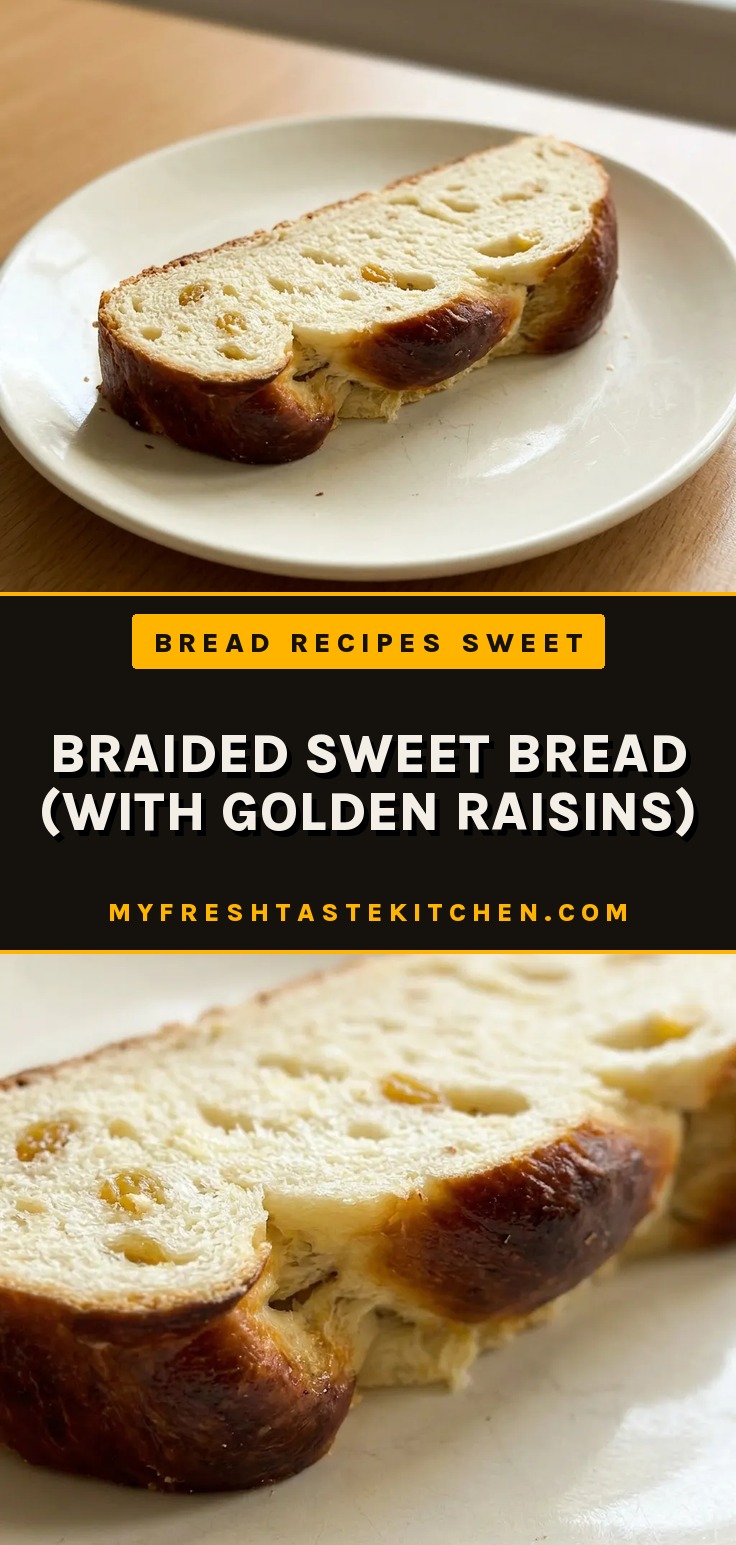
A four-strand braid is the right call here. It lays flat so heat reaches the center evenly, and the raisins stay suspended rather than sinking.
The two-hour first rise is important, enriched doughs need that time to ferment fully, or the crumb turns dense. This braided sweet bread with golden raisins rewards patience with a tender, airy loaf that feels special without being fussy.
Soaking raisins keeps them plump
Golden raisins start out fairly dry. If you add them straight to the dough, they absorb moisture from the batter during baking and end up hard and shriveled. The hot water soak rehydrates them in advance so they stay soft and juicy in the finished loaf.
Fifteen minutes is enough; any longer and they can get waterlogged and burst. After draining, rinse off the excess surface sugar, otherwise it can stain the dough a pinkish-brown as it bakes.
You’ll see the raisins plump up noticeably after the soak, and they’ll feel tender when you bite into the bread.
Why the dough needs a full two-hour rise
Enriched doughs are heavy with butter, eggs, and sugar. Yeast has to work harder in that environment, so rising takes longer.
Two hours in a warm spot, around 75, 80°F, gives the yeast enough time to fully ferment, producing gas bubbles that create a light, airy crumb. A tripled volume is your cue that fermentation is complete. Stop too early and the bread will be dense, almost cakey.
You’ll also get more complex flavor from the extended rise, as the yeast develops those yeasty, slightly tangy notes that balance the sweetness.
Four strands make a better loaf
A four-strand braid lays flatter and wider than a three-strand one. That shape lets heat reach the center more evenly, so the crumb bakes through without the outside over-browning.
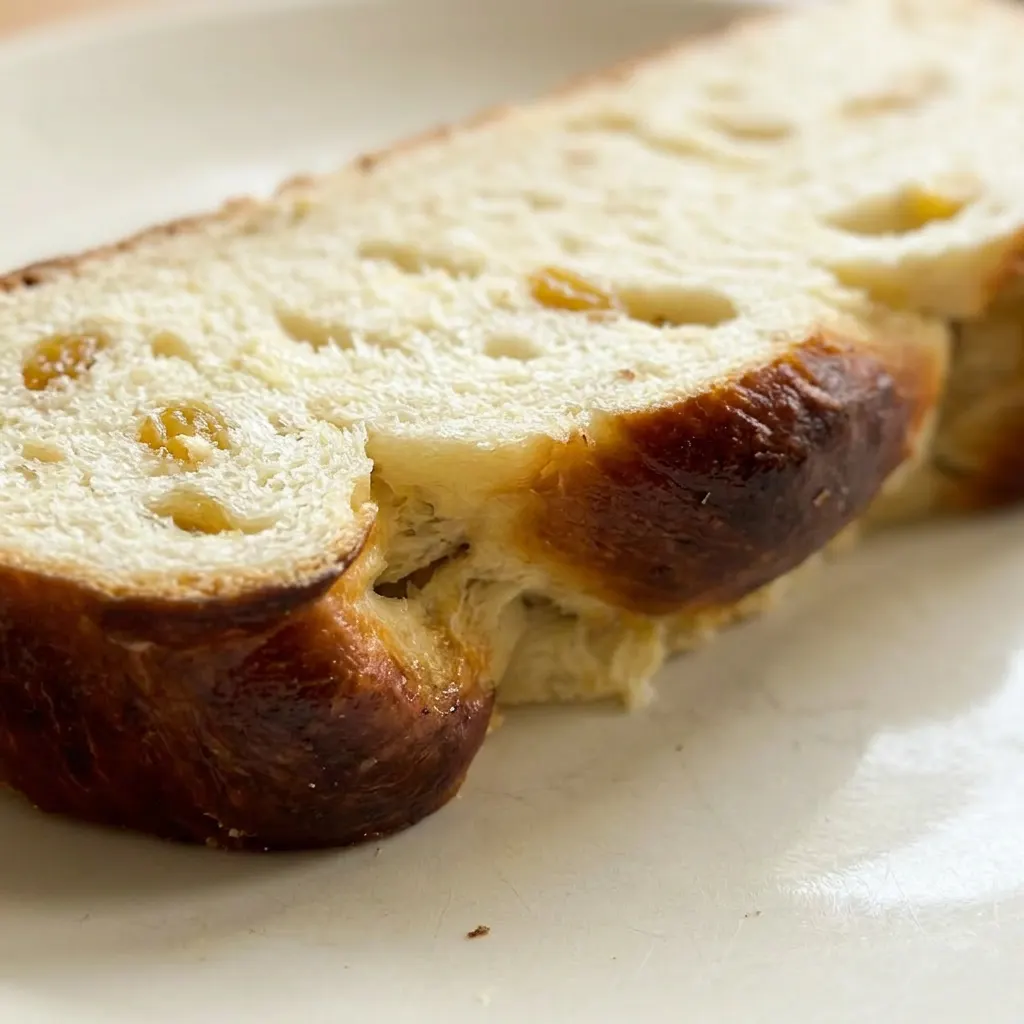
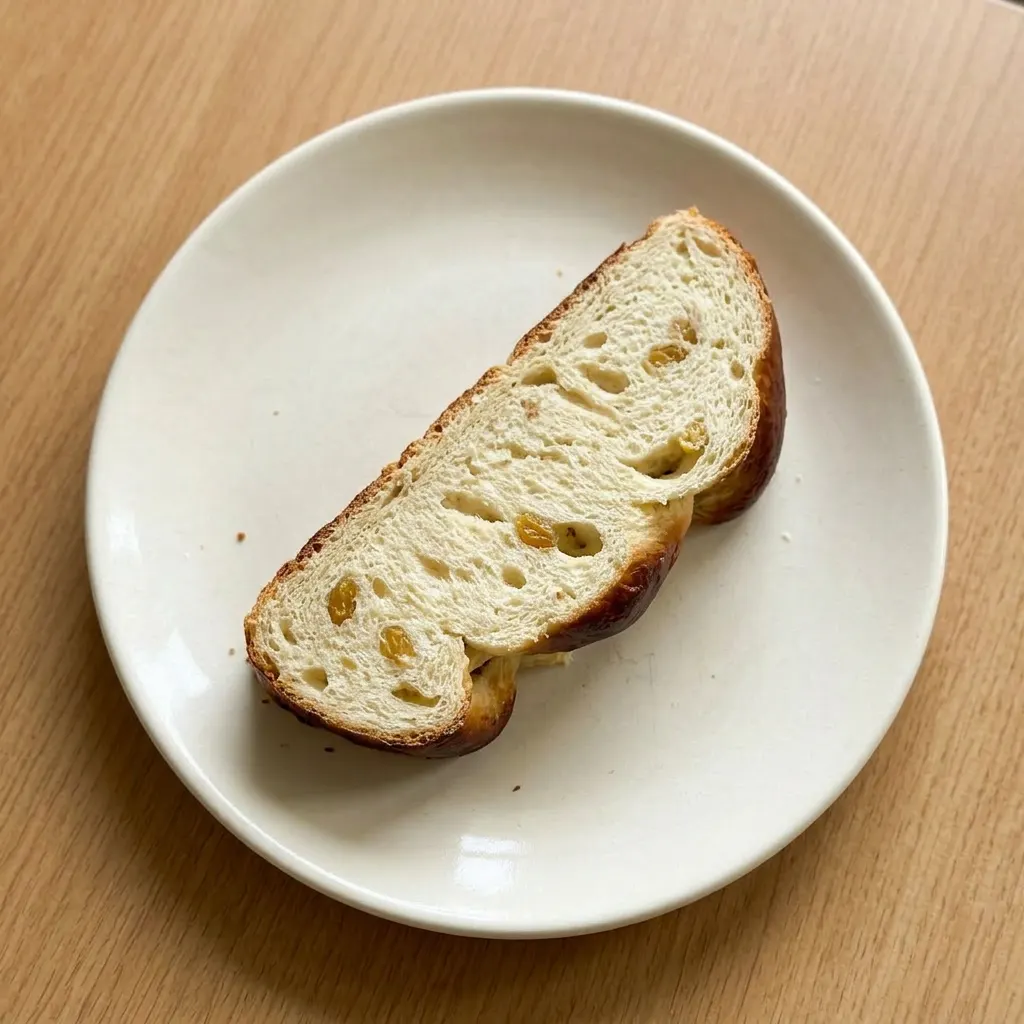
The braiding also helps suspend the raisins throughout the dough; with fewer strands, the fruit tends to sink to the bottom. Pressing the ends together firmly seals the braid, so it doesn’t unravel during the second rise or in the oven. You’ll end up with a loaf that has a consistent, tender crumb and raisins distributed evenly in every slice.
Prep: 3 hr 35 min · Cook: 25 min · Total: 4 hr 15 min · Servings: 2
A few things about the ingredients
Golden raisins: Soak them in boiling water for 15 minutes, then drain and rinse to keep them plump and avoid pink dough.
Active dry yeast: Proof it in lukewarm milk with a pinch of sugar until bubbly; if flat, the milk was too hot or yeast dead.
Unsalted butter: Melt and cool to room temperature; warm butter can cook the eggs when added.
All-purpose flour: Add one cup at a time during kneading; you may need a tablespoon more if dough is sticky.
The dough is ready when it feels silky and springs back
Soak the raisins
Pour boiling water over the raisins and let them sit for 15 minutes. They’ll plump up noticeably. Drain and rinse, skipping the rinse can tint the dough pink.
Activate the yeast
Warm the milk until it’s barely warm to the touch, then stir in sugar and yeast. After 15 minutes, the mixture should be bubbly and smell yeasty. If it’s flat, the milk was too hot or the yeast is dead.
Whip eggs and sugar
Beat eggs and sugar on high for 10 minutes until the mixture is frothy and pale yellow. It should thicken enough to leave a ribbon trail when the beater is lifted.
Combine wet ingredients
With the mixer on low, add the yeast mixture, then salt and vanilla. Pour in the cooled melted butter, if it’s warm, it can cook the eggs. Fold in the raisins by hand.
Knead the dough
Add flour one cup at a time, kneading with the dough hook for about 15 minutes. The dough should pull away from the bowl and feel smooth and elastic. If it’s sticky, add a tablespoon more flour at a time.
First rise
Cover the dough and let it rise in a warm spot for 2 hours. It should triple in volume, if it only doubles, give it more time. The dough is ready when it holds an indentation from your finger.
Shape the braids
Divide the dough in half, then each half into four logs about 1.5 feet long. Press the ends together, braid, and seal the other end. The braid should lie flat and even.
Second rise
Brush with egg wash and let rise for 45 to 60 minutes until puffed and the gaps fill in. The dough should feel airy and spring back slowly when poked. Don’t over-rise or the braid may collapse.
Bake
Bake at 350°F for 25 minutes for one pan, or 30 minutes for two pans, rotating halfway. The loaf should be deep golden brown and sound hollow when tapped on the bottom.
Cool
Cool on the pan for 15 minutes, then transfer to a wire rack. The bread firms as it cools, slicing too early will give you a gummy crumb.
Braided Sweet Bread with Golden Raisins
Ingredients
Dough
- 2 cups golden raisins
- 1 ½ cups lukewarm whole milk 355 ml
- ¼ cup granulated white sugar 50 g
- 1 tbsp. active dry yeast
- 4 oz. unsalted butter 113 g, melted and cooled
- 4 large eggs room temperature
- 1 cup granulated white sugar 200 g
- ½ tsp. sea salt
- 1 tsp. vanilla extract
- 6 cups all-purpose flour 720 g
Egg Wash
- 1 large egg
- 1 tbsp. whole milk
Instructions
Dough
Soak Golden Raisins:
Put 2 cups golden raisins into a small bowl; add boiling water to submerge. Let sit for 15 minutes, then drain and rinse; set aside.Activate Yeast Mixture:
Warm 1 ½ cups whole milk in a small saucepan over high heat for roughly 30 seconds until lukewarm (barely warm). Pour into a small bowl; mix in ¼ cup sugar until dissolved. Scatter 1 tbsp active dry yeast on top of the milk-sugar mixture, stir, and leave in a warm spot for 15 minutes until bubbly and aromatic.Melt Unsalted Butter:
Melt 4 oz unsalted butter in a microwave or on the stovetop; allow to cool.Beat Eggs and Sugar:
Using a stand mixer bowl, beat 4 large eggs and 1 cup sugar on high speed for 10 minutes until frothy and light yellow.Combine Wet Ingredients:
Lower speed to low; gradually incorporate the yeast mixture. While still on low, add ½ tsp salt and 1 tsp vanilla extract. Next, pour in the cooled melted butter. Lastly, fold in the soaked raisins.Knead Dough:
Attach the dough hook. Gradually add flour, 1 cup at a time, until all 6 cups are used. Knead until dough is smooth and elastic, about 15 minutes.First Rise:
Cover the dough with a kitchen towel or plastic wrap; allow to rise in a warm location for 2 hours until tripled in volume.Divide and Shape Logs:
Turn dough out onto a floured surface; cut in half. Roll one half into a log, then cut into 4 equal portions. Roll each portion into a thin log about 1.5 feet long and 1 inch thick.Braid Challah Loaves:
Press the ends of the 4 logs together, braid them evenly, then press the opposite end together. Set on a greased baking sheet. Repeat with the remaining dough half.
Egg Wash
Prepare Egg Wash:
Whisk together 1 large egg and 1 tbsp whole milk. Brush liberally over both braided loaves.Second Rise:
Allow the braided challahs to rise in a warm spot for 45 minutes to 1 hour until puffed and the gaps fill in.Bake Challah:
Preheat oven to 350°F (175°C). Bake one pan for 25 minutes, or both pans for 30 minutes, rotating pans 10 minutes before the end of baking.Cool Loaves:
Take out of the oven; cool on the pan for 15 minutes, then move to a wire rack to cool completely.
Swapping raisins and adjusting for gluten-free or dairy-free
Golden raisins: Dark raisins or dried cherries (same amount by volume, 2 cups). Dark raisins are sweeter and less tangy; the bread will be slightly darker in spots.
Dried cherries add a tart pop, but they’re smaller, soak them the same way to plump. Don’t swap in currants or other tiny dried fruit; they’ll disappear into the dough and you’ll lose the fruit pockets.
Whole milk: Unsweetened oat milk or full-fat canned coconut milk (same amount, 1½ cups). Oat milk behaves closest to dairy: the dough rises similarly and the crumb stays tender.
Coconut milk adds a faint tropical note and a bit more richness; the bread will be slightly denser but still good. Avoid almond or rice milk, they’re too thin and the dough won’t hold its structure.
All-purpose flour: Gluten-free 1:1 flour blend with xanthan gum (same weight, 720g). The dough will feel stickier and less elastic; don’t over-knead or it’ll turn tough. The braid won’t hold as sharp a shape, and the crumb will be more cakey.
Let the second rise go the full hour even if it looks puffy, gluten-free dough needs that time to set. Skip the swap if you want a chewy, pull-apart texture; this bread was built for gluten.
Storage and Serving
Cool the braids completely before storing, about 2 hours on a wire rack. Wrap each loaf tightly in plastic wrap, then foil, or place in an airtight container.
At room temperature, the bread stays soft for 3 days. After that, the crumb begins to dry out and the raisins may harden. To refresh, toast slices in a 350°F oven for 5 minutes, or in a toaster.
The crust turns crisp and the interior softens. For longer storage, freeze the whole loaf or slices. Wrap in plastic and foil, or use a freezer bag, and freeze for up to 3 months.
Thaw at room temperature, still wrapped, for 4 hours. The texture after thawing is nearly as good as fresh. Do not refrigerate; the bread stales faster in the fridge.
Serve the braid at room temperature, or warm slices in the toaster. The egg wash glaze keeps the top shiny for the first day; after that it dulls but doesn’t affect taste.
This bread is best eaten within 24 hours of baking for peak softness.
Tips
- If your kitchen is cool, place the bowl of dough on the oven’s proofing setting or near a warm stovetop to maintain the 75 to 80°F range needed for the 2-hour rise. A too-cold environment can double the rising time and produce a denser crumb.
- When braiding, keep the logs evenly tensioned but not stretched tight; if they are too taut, the braid will spring back and lose its shape during the second rise. Work on a lightly floured surface and re-roll any log that shrinks back.
I see so many people pull the dough off after an hour when it’s barely doubled, and then they wonder why their challah is a brick.
Frequently Asked Questions
Can I make the dough the night before and bake it the next day?
Yes, after the first rise (the 2-hour tripling), punch it down, wrap tightly in plastic, and refrigerate overnight. The next day, let it sit at room temperature for about 30 minutes before shaping and doing the second rise. The flavor may deepen slightly, but the texture stays soft.
My dough didn’t triple in size after 2 hours, what went wrong?
Most likely the spot wasn’t warm enough. Dough needs a draft-free area around 75, 80°F; a cooler kitchen slows yeast activity. Check that your milk was lukewarm (barely warm to the touch) when proofing the yeast, too hot kills it, too cold delays it.
If the yeast mixture didn’t turn bubbly and aromatic in 15 minutes, start over with fresh yeast.
How do I know when the braided bread is fully baked?
The loaf should be deep golden brown all over, especially in the crevices of the braid. Tap the bottom: it sounds hollow when done. An instant-read thermometer inserted into the center should read 190°F.
If the top browns too fast, tent loosely with foil for the last 10 minutes.