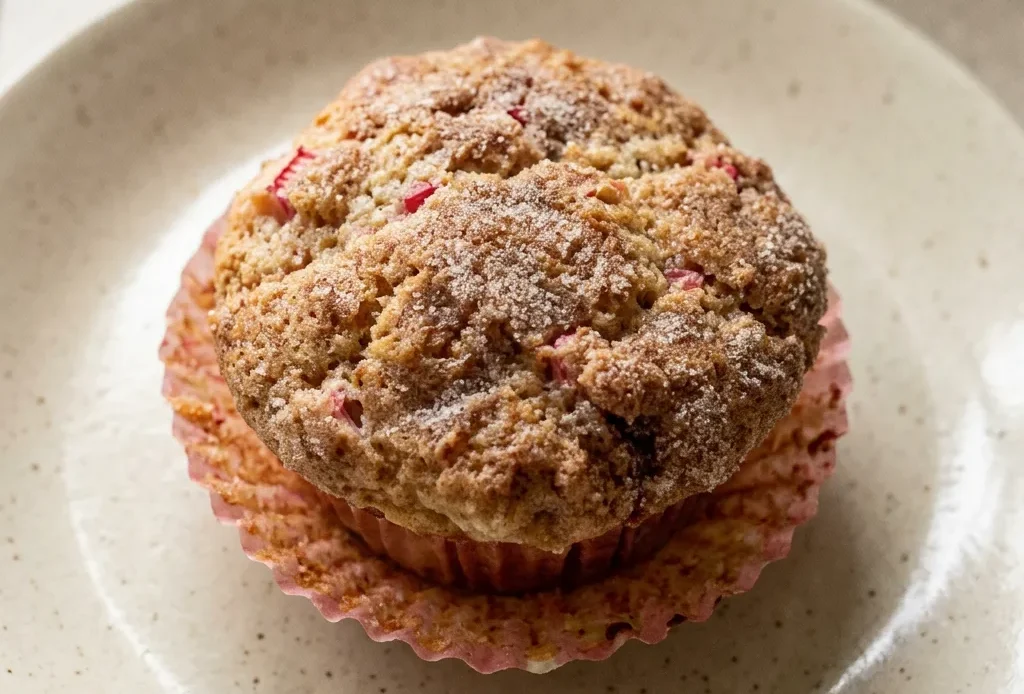
Dense batter is your friend here. It holds rhubarb chunks suspended and keeps the crumb tender, not tough.
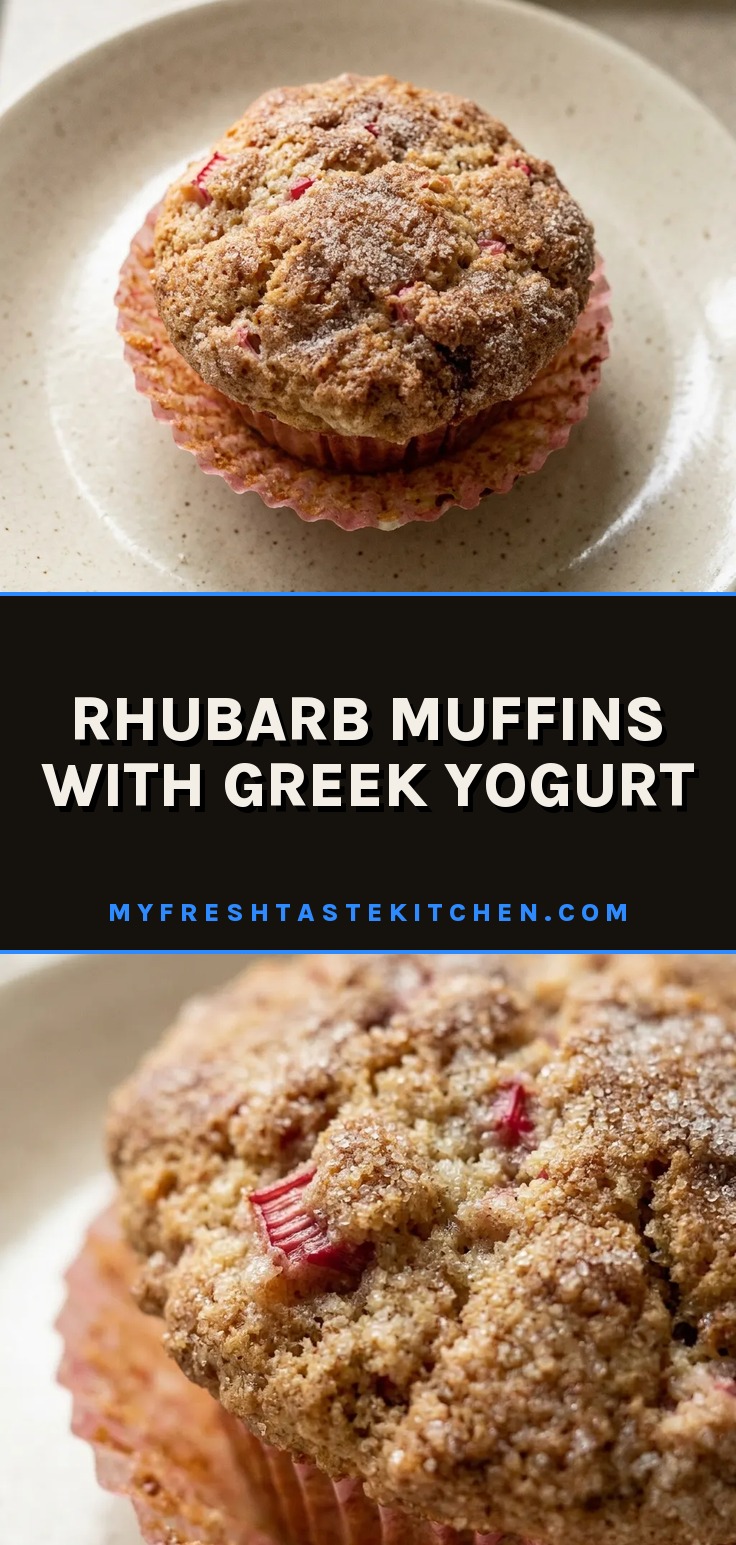
The challenge is folding just until combined, overmix and you lose that lightness. These rhubarb muffins with greek yogurt nail the balance: tart fruit, nutty whole-wheat, a crunchy cinnamon-sugar top that cracks when you bite.
They’re straightforward but reward a light hand.
Greek yogurt’s tenderizing trick
Greek yogurt replaces some of the fat while adding moisture and acidity. That acidity reacts with baking soda to create lift, giving these rhubarb muffins a light crumb. The yogurt’s thickness also helps bind the batter without overworking it, you can stir it just enough to combine, and the structure holds together.
Dense batters are actually what you want; they keep fruit suspended and produce a tender, moist muffin, not a tough one.
The flour split
A 50/50 blend of all-purpose and whole-wheat flours strikes a balance. All-purpose provides structure and tenderness, the familiar soft crumb you expect from a muffin. Whole-wheat adds nuttiness and fiber, but too much makes the texture heavy and dry.
Here, half whole-wheat keeps things substantial without compromising tenderness. The result is a muffin that tastes heartier than all-purpose alone but still feels light.
Rhubarb in a thick batter
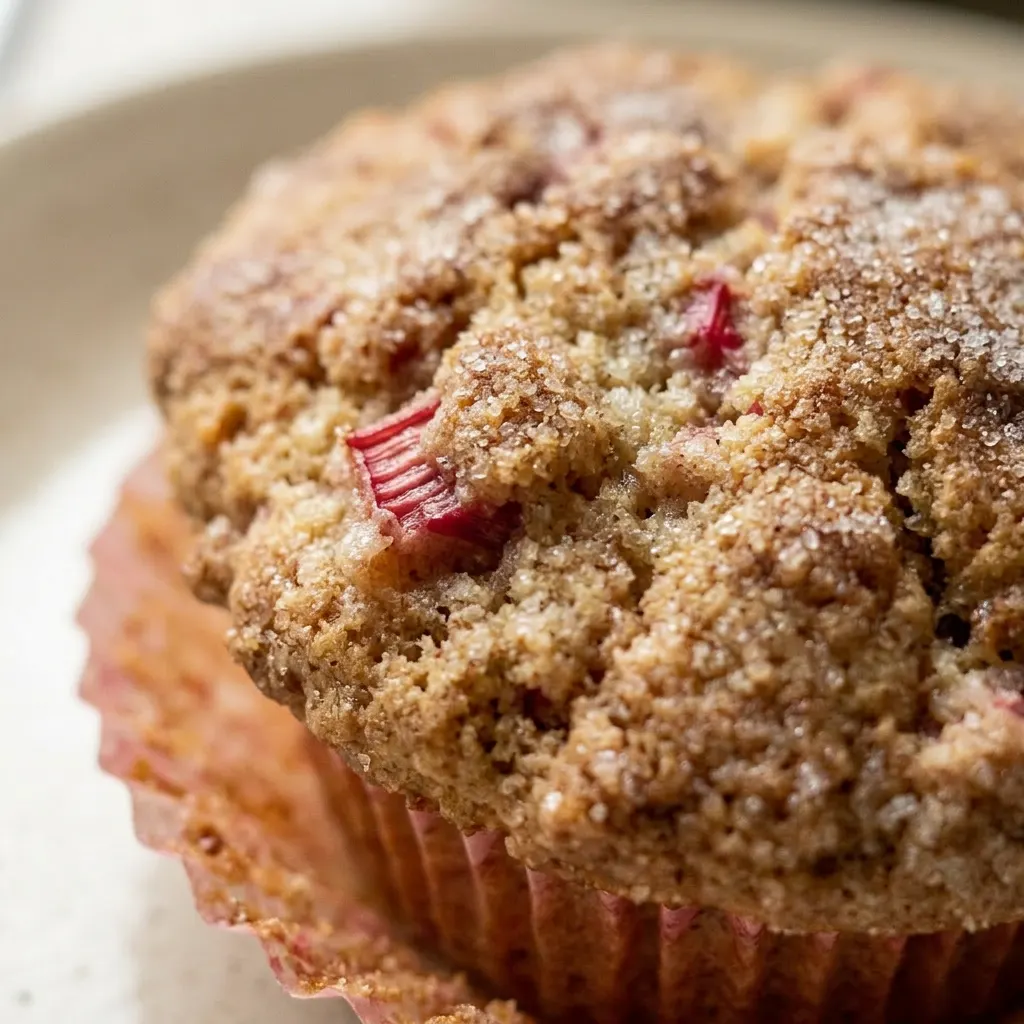
Rhubarb is diced into 1/4-inch pieces so it disperses evenly and stays tender after baking. The thick, dense batter is key, it suspends those rhubarb chunks so they don’t sink to the bottom. That density also means you don’t need to toss the rhubarb in flour; it stays put on its own.
The tartness of the rhubarb cuts through the sweet, spiced crumb, creating a bright contrast in every bite.
Crunchy cinnamon-sugar crust
Before baking, each muffin gets a sprinkle of cinnamon-sugar, 3 tablespoons sugar to 1/2 teaspoon cinnamon. That ratio gives a balanced sweetness without overwhelming the rhubarb.
Pressing it lightly into the batter ensures it sticks and forms a crisp, sugary shell as the muffins bake. The topping caramelizes into a crunchy crust that cracks when you bite, adding texture against the tender interior.
Prep: 15 min · Cook: 20 min · Total: 35 min · Servings: 12 · Calories: 230 kcal
What to know about these ingredients
Greek yogurt: Use 2% plain Greek yogurt. Full fat works too, but avoid nonfat; it’s too thin and won’t bind as well.
Rhubarb: Fresh or frozen works. If frozen, don’t thaw; toss them in straight from the freezer to keep the batter from turning purple.
Whole-wheat flour: Standard whole-wheat flour is fine. White whole-wheat gives a milder flavor if you want less wheaty taste.
Butter: Unsalted butter gives you control over salt. Melt it and let it cool slightly so it doesn’t cook the eggs when mixed.
I see so many people stirring until the batter looks smooth, then wonder why their muffins come out like hockey pucks. The batter is supposed to be dense and lumpy.
From dense batter to tender crumb
Mix the dry ingredients
Whisk flours, sugar, baking powder, cinnamon, baking soda, and salt in a medium bowl until evenly distributed. No lumps left. Set aside.
Combine the wet ingredients
Whisk yogurt, melted butter, eggs, and vanilla in a large bowl until smooth. It will look slightly separated but that’s fine. Don’t worry.
Fold wet into dry
Pour dry mixture into wet and fold with a spatula just until no streaks of flour remain. Batter will be thick, that’s correct. Stop folding the moment it comes together.
Add the rhubarb
Scatter diced rhubarb over the batter and fold gently to distribute. The batter should hold the pieces suspended, not let them sink. Fold only two or three times.
Fill the muffin cups
Divide batter among 12 lined cups. Mound it slightly above the rim, these muffins rise high, and the dense batter won’t overflow. Level with a small offset spatula if needed.
Top with cinnamon sugar
Sprinkle about 1/2 teaspoon of the cinnamon-sugar mix over each muffin. Press it lightly into the surface with your fingertips so it sticks and forms a crust.
Bake and rest
Bake at 400°F for 20 to 22 minutes. The tops should be golden and a toothpick inserted in the center should come out clean. Let cool in the pan for 5 to 10 minutes, then transfer to a wire rack.
Rhubarb Muffins with Greek Yogurt
Ingredients
- 1 cup all-purpose flour 120g
- 1 cup whole-wheat flour 120g
- 3/4 cup granulated sugar 150g
- 2-1/2 teaspoons baking powder
- 1 teaspoon ground cinnamon
- 1/2 teaspoon baking soda
- 1/2 teaspoon kosher salt
- 1 cup 2% plain Greek yogurt (or sour cream, light or regular) 240g
- 8 tablespoons unsalted butter 113g, melted and cooled slightly
- 2 large eggs
- 1 teaspoon pure vanilla extract
- 1-1/2 cups 1/4-inch-diced rhubarb 180g
- 3 tablespoons granulated sugar 36g
- 1/2 teaspoon ground cinnamon
Instructions
Preheat oven and line pan:
Set the oven to 400°F (205°C). Fit a 12-cup muffin pan with paper or foil liners.Whisk dry ingredients:
In a medium bowl, combine the all-purpose flour, whole-wheat flour, 3/4 cup sugar, baking powder, 1 teaspoon cinnamon, baking soda, and salt using a whisk.Mix wet and fold dry:
In a large bowl, mix the Greek yogurt, melted butter, eggs, and vanilla with a whisk until uniform. Fold in the dry mixture with a spatula until barely combined; take care not to overwork. Gently incorporate the rhubarb cubes. The batter will be dense.Fill muffin cups:
Portion the batter equally into the muffin cups, heaping them slightly above the rim.Make cinnamon-sugar topping:
Stir together the 3 tablespoons sugar and 1/2 teaspoon cinnamon in a small bowl. Dust each muffin with a generous 1/2 teaspoon of this cinnamon-sugar blend, pressing it lightly into the surface.Bake until golden:
Bake until the tops turn golden and a tester inserted in the center emerges clean, 20–22 minutes.Cool and serve:
Allow the muffins to rest in the pan for 5–10 minutes, then move them to a wire rack to finish cooling. Serve warm for best flavor.
Substituting yogurt and rhubarb without breaking the crumb
Greek yogurt: Sour cream (full-fat or light) works measure-for-measure. Or use 3/4 cup buttermilk plus 2 tablespoons melted butter (reduce the melted butter in the recipe by 2 tablespoons).
Sour cream mimics the tang and moisture; the muffin stays just as tender. Buttermilk makes a slightly wetter batter that rises a touch higher, but the crumb is less sturdy, handle gently when folding.
Rhubarb: Diced apples (tart ones like Granny Smith) or fresh cranberries (halved). Use the same volume. If using frozen cranberries, do not thaw.
Apples soften and add sweetness, so the muffin is less tart. Cranberries keep the tart punch but turn the batter pink in spots.
Both stay suspended without sinking.
All-purpose flour: Gluten-free 1-to-1 blend (with xanthan gum). Replace both flours with 2 cups (240g) of the blend. Crumb is more delicate and slightly grittier; the muffin won’t dome as high.
Rhubarb may sink a bit because the batter is looser. Still edible, just less structure.
Butter: Neutral oil like avocado or canola. Use 1/2 cup (100g) oil instead of 8 tablespoons butter.
Muffins stay moist longer but lack the buttery richness. The crust won’t crisp as much; the cinnamon-sugar topping may not adhere quite as well.
Tips
- Rotate the muffin pan 180 degrees halfway through baking, at the 10-minute mark. The dense batter and high sugar content can cause uneven browning; rotating ensures the back row doesn’t overbake while the front catches up.
- Use a cookie scoop or two spoons to portion the batter into the cups rather than pouring. The batter is thick and sticky; a scoop gives clean, even mounds that bake uniformly, and you avoid dragging batter across the liners.
Storage and Serving
These muffins are best the day they’re baked, when the cinnamon-sugar crust is crisp and the crumb is tender. If you wait, the topping softens as moisture from the rhubarb and yogurt migrates into the crust. To make ahead, bake and cool completely, then store in an airtight container at room temperature for up to 2 days.
Beyond that, the texture turns dense and the top loses its crunch. For longer storage, freeze the muffins in a zip-top bag for up to 3 months. Thaw at room temperature or reheat directly from frozen in a 300°F oven for 5 minutes; this restores some of the crispness to the top.
If you plan to freeze, skip the cinnamon-sugar topping until after reheating, as it stays crunchier when added fresh. The serving window for peak texture is within 4 hours of baking. After that, consider toasting split halves to revive the crust.
Frequently Asked Questions
Can I make these muffins ahead of time?
Yes, but the crust softens after 4 hours. Bake and cool completely, then store airtight at room temp for up to 2 days.
For longer, freeze in a zip-top bag for up to 3 months, skip the cinnamon-sugar topping until after reheating to keep it crunchy. Reheat frozen muffins in a 300°F oven for 5 minutes to restore some crust crispness.
Why did my rhubarb sink to the bottom of the muffins?
The batter might have been too thin. This recipe makes a dense batter that should suspend rhubarb without flour dusting.
If yours was runny, you likely overmixed or used a different yogurt (nonfat is too thin). Next time, fold just until combined and use 2% or full-fat Greek yogurt; the thick batter is what holds the fruit in place.
Can I use frozen rhubarb instead of fresh?
Yes, add it frozen without thawing. Thawing releases extra liquid that can turn the batter purple and make it wetter.
Frozen rhubarb may also sink slightly more because the batter gets colder and thicker, but it still works. Keep the dice size the same and fold gently.
How do I know when the muffins are done baking?
The tops should be golden and a toothpick inserted in the center should come out clean. Bake at 400°F for 20 to 22 minutes.
If the toothpick has wet crumbs, give them another minute. The crust will feel firm when pressed lightly, and the edges will just start to pull away from the liner.