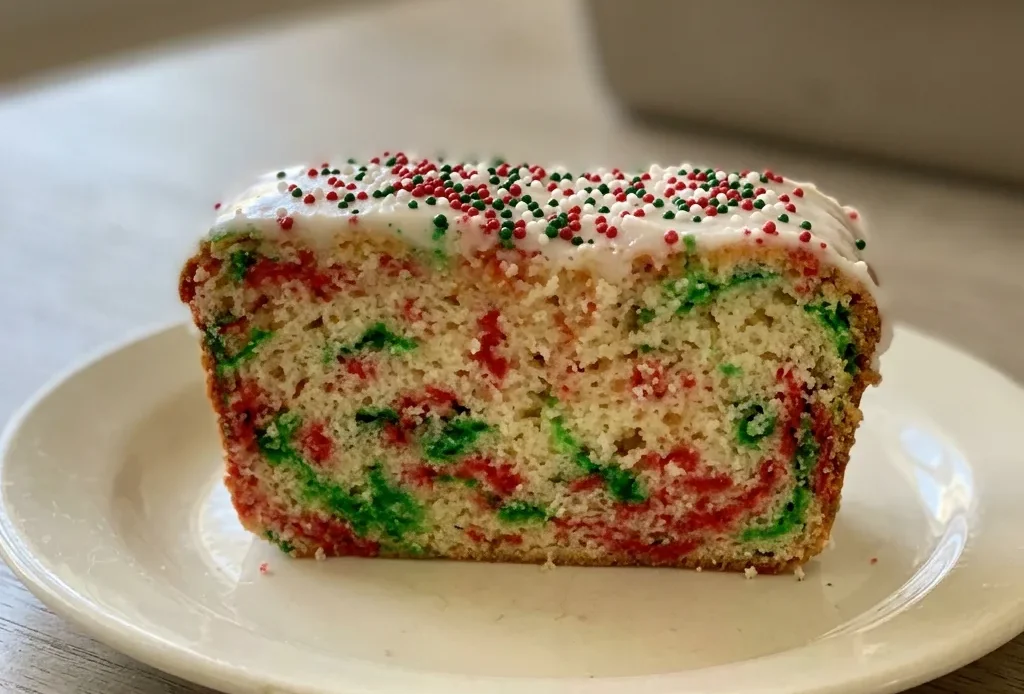
The moment you fold in the sprinkles, the batter stiffens into something almost like a stiff cookie dough, not a pourable cake batter. That thickness is deliberate: it keeps the jimmies suspended rather than sinking into a colored sludge at the bottom.
This christmas sprinkle buttermilk bread looks like a party, but the real work is in trusting that stiff batter and a full 45-minute bake. The glaze needs corn syrup to stay flexible, or you’ll crack the surface when you slice.
It’s a straightforward loaf, but the margin for error is smaller than it looks.
Understand how buttermilk shapes this loaf
Buttermilk’s acidity tenderizes gluten strands, which is why this bread stays soft despite being dense. That same tang cuts through the sugar and sprinkles, so the sweetness doesn’t cloy. And because the acid reacts with the baking soda, you get a reliable lift without a metallic aftertaste.
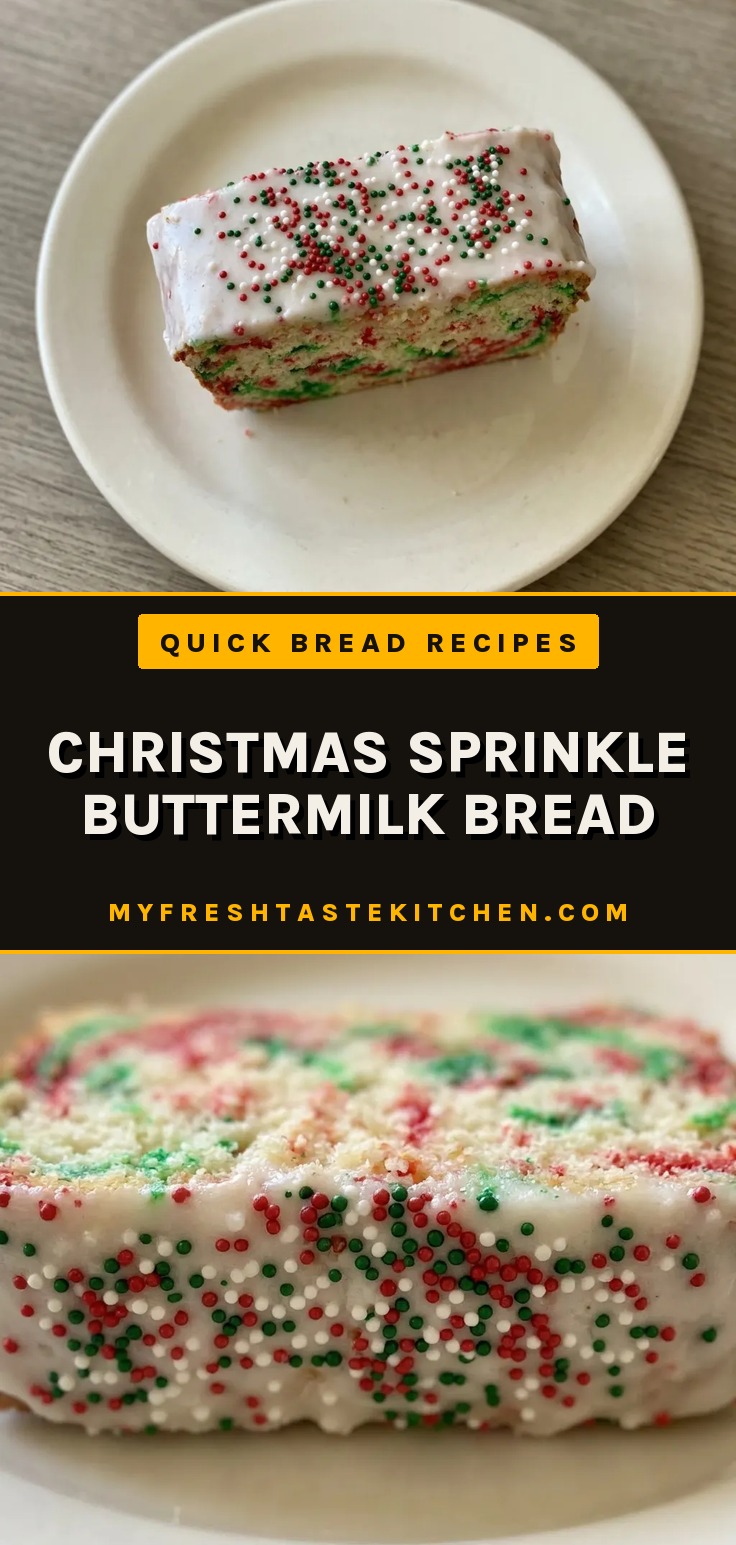
You can see the effect in the crumb: fine, even, and pale inside, not tough or domed. The tang isn’t sharp, it’s a clean note that makes the almond extract pop.
Fold sprinkles gently to keep their color intact
Overmixing sprinkles isn’t just about distribution. When you beat them hard, they start to dissolve and streak the batter with red, green, and blue swirls.
Worse, the batter gets deflated, and then the loaf doesn’t rise as tall. Fold them in with a few broad strokes, and you’ll see the sprinkles stay whole, suspended evenly. If your batter looks like it could be thinner than usual, this one is stiff, that’s actually good; the thick batter holds the sprinkles in place, so they don’t all sink to the bottom.
For sweet bread recipes, that even pop of color makes the difference.
Corn syrup gives the glaze a glossy finish
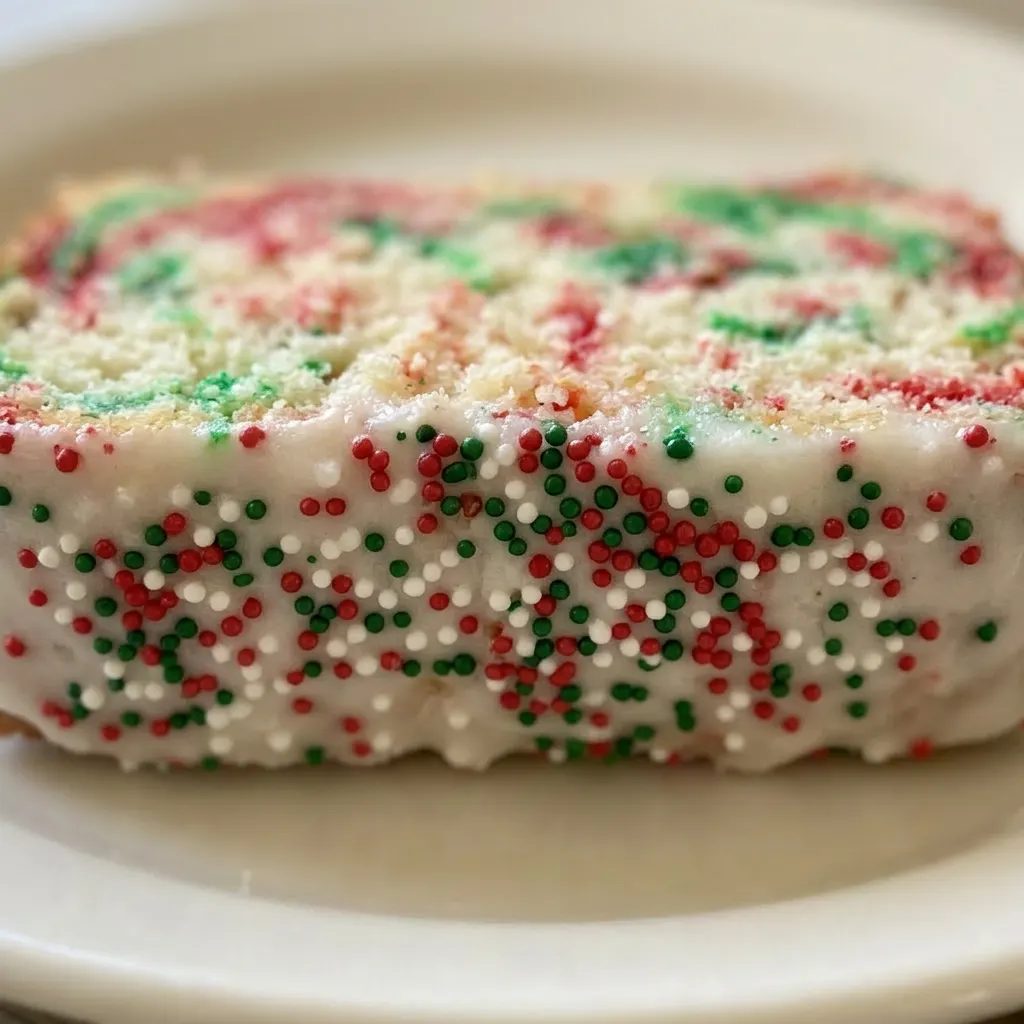
A glaze that sets too hard cracks when you slice the bread. Corn syrup prevents sugar crystals from forming, so what you get is smooth, shiny, and flexible.
It still firms up, but it stays tender enough to cut through cleanly. The buttermilk in there echoes the tang of the loaf, so the whole thing tastes coherent, not like separate sweet and sour layers. Watch for that gloss as it sets, it should look wet but not runny.
That’s the clue that the corn syrup is doing its job.
Prep: 10 min · Cook: 45 min · Total: 55 min · Servings: 8 · Calories: 510 kcal
The ingredients that matter most here
Buttermilk: Use full fat buttermilk, not low fat. The fat keeps the crumb tender and the acidity reacts with the baking soda.
Almond extract: Pure almond extract, not imitation. It gives a distinct flavor that holds up against the sugar and sprinkles.
Sprinkles: Use jimmies, not nonpareils or sanding sugar, which bleed color. Jimmies hold their shape and color in the batter.
Corn syrup: Light corn syrup only. Dark corn syrup would change the color and flavor of the glaze.
I still fold the sprinkles in with just a few strokes, even though it feels like I’m not mixing enough, but I know from past rainbows that going gentle is the only way to keep the colors distinct.
Watch the batter and glaze for visual cues
Mix the dry and wet separately
Whisk the dry ingredients together to break up clumps, especially the baking soda. In another bowl, whisk the buttermilk, egg, melted butter, and extract until smooth. The butter should be cool enough that it doesn’t cook the egg, feel the bowl, it should be just warm.
Combine and fold in sprinkles
Pour the wet into the dry and stir with a spatula only until no flour streaks remain. The batter will be thick and stiff, that’s correct.
Fold sprinkles in with three broad strokes. If you see the batter change color, you’ve overmixed; stop sooner next time.
Bake until set
Bake 45 to 50 minutes. The loaf should be golden brown and a toothpick inserted in the center should come out clean or with a few moist crumbs.
If the top browns too fast, tent with foil after 30 minutes. Cool in pan 5 minutes, then turn out onto a rack and let it cool completely, 1 to 2 hours.
Glaze and finish
Whisk powdered sugar, 3 tablespoons buttermilk, and corn syrup until smooth. The glaze should be thick but pourable, add buttermilk a teaspoon at a time if needed.
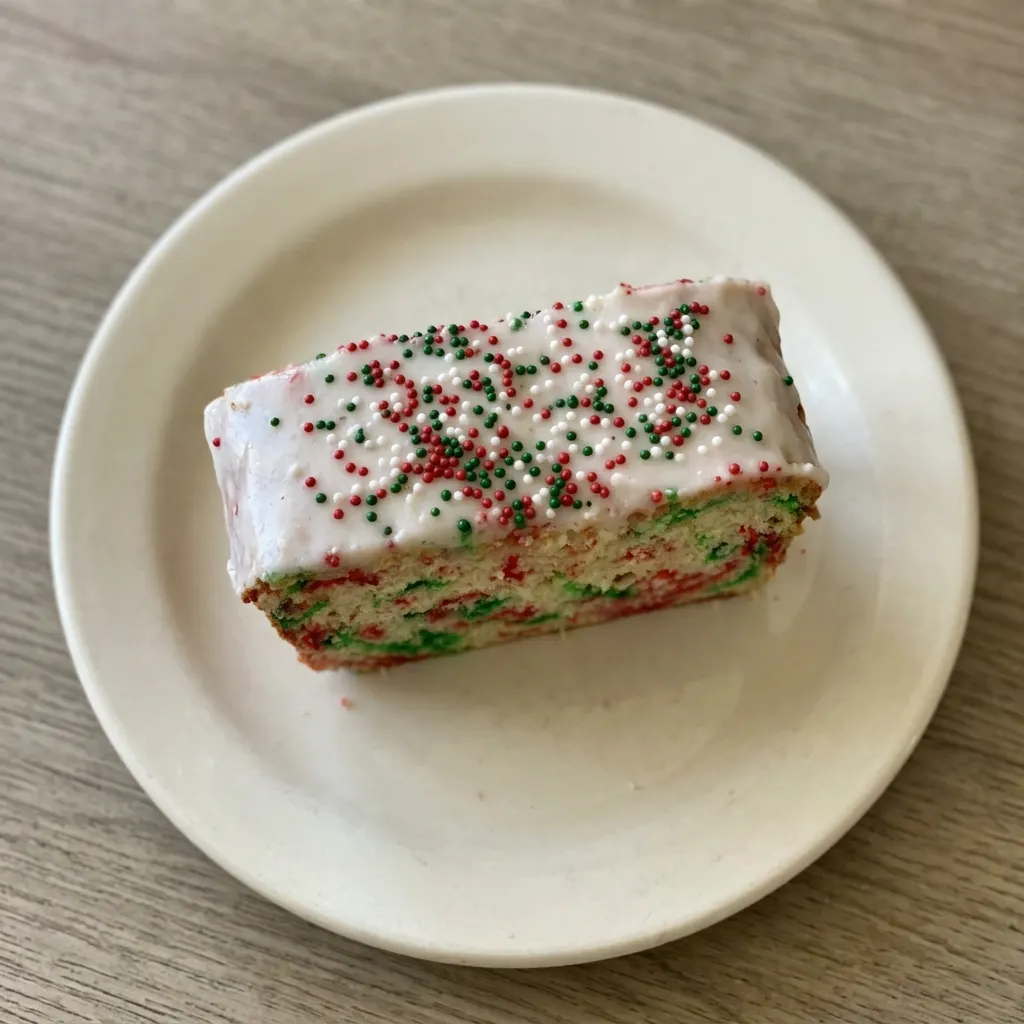
Drizzle over the cooled loaf and scatter nonpareils on top while the glaze is still wet. The glaze will set glossy and flexible.
Christmas Sprinkle Buttermilk Bread
Ingredients
Bread
- 2 cups all-purpose flour 250 g
- 1 cup sugar 200 g
- 1 1/2 teaspoons baking powder
- 1/2 teaspoon baking soda
- 1 teaspoon kosher salt
- 1 cup buttermilk 240 ml
- 1 large egg lightly beaten
- 1/2 cup unsalted butter 113 g, melted and cooled
- 1/2 teaspoon almond extract
- 1/2 cup sprinkles 80 g
Glaze
- 2 cups powdered sugar 240 g, sifted
- 3 tablespoons buttermilk 45 ml, plus more as needed
- 1 tablespoon light corn syrup 15 ml
- Nonpareils
Instructions
Bread
Preheat oven and prepare pan:
Position the oven rack in the upper third and heat to 350°F (175°C). Line a 9×5-inch aluminum loaf pan with parchment paper.Mix dry and wet ingredients:
In a large bowl, whisk together flour, sugar, baking powder, baking soda, and salt. In a separate bowl, whisk buttermilk, egg, melted butter, and almond extract. Pour the wet mixture into the dry and stir until just combined. Gently fold in sprinkles.Bake and cool loaf:
Pour the batter into the prepared pan and bake for 45-50 minutes, until the center is set. Let cool in the pan for 5 minutes, then turn out onto a wire rack and cool completely (1-2 hours, as the loaf is dense).
Glaze
Make glaze and garnish:
When the bread is fully cool, prepare the glaze: whisk together powdered sugar, 3 tablespoons buttermilk, and corn syrup. Add more buttermilk if needed to reach a thick pourable consistency. Drizzle over the bread and garnish with nonpareils.
Buttermilk and almond extract define this bread; swap them carefully
Buttermilk: Thin plain yogurt or Greek yogurt with whole milk to a buttermilk consistency (for 1 cup, use about 2/3 cup yogurt + 1/3 cup milk, or more milk to match the pourability). Or add 1 tablespoon vinegar or lemon juice to a scant cup of milk and let sit 5 minutes. The acid is what tenderizes the gluten and reacts with the baking soda.
Yogurt version works well, texture stays soft, but the tang is milder. The quick-soured milk option also works, but the crumb might be slightly less tender.
Don’t use low-fat buttermilk or milk; the fat keeps the loaf from drying out. For dairy-free, use unsweetened almond or oat milk + 1 tablespoon vinegar; the crumb will be a touch denser and the flavor less rich.
Almond extract: Vanilla extract (1 teaspoon) or 1/2 teaspoon vanilla + 1/4 teaspoon almond extract if you still want some nuttiness. Almond extract gives this sweet bread its signature flavor. Vanilla alone makes it taste more like a standard vanilla loaf, good, but not the same.
The almond cuts through the sweetness and pairs with the buttermilk tang. If you skip it, the sprinkles become the only distinct note.
All-purpose flour: Gluten-free all-purpose flour blend (with xanthan gum) measured by weight, not volume. Use exactly 250 g.
The texture will be more tender and slightly more crumbly. The loaf won’t rise as high and may sink a little in the center. Let it cool completely before glazing to avoid it falling apart.
For a whole wheat swap, use 1 cup all-purpose + 1 cup white whole wheat; the loaf will be denser and nuttier.
Tips
- Test your baking powder by spooning a small amount into hot water; if it fizzes vigorously, it’s still active. Stale baking powder yields a dense loaf with poor rise.
- Use a kitchen scale to measure flour by weight (250 g) rather than volume. Scooping from the bag can pack in extra flour, making the bread dry and heavy.
Storage and Serving
The glaze is the most perishable part: it stays glossy and flexible for about 2 days at room temperature, then softens and can become tacky. For best texture, serve within 24 hours of glazing.
Store the bread in an airtight container at room temperature for up to 3 days; after that, the crumb starts to dry. You can wrap it tightly and freeze the unglazed loaf for up to 1 month.
Thaw at room temperature, then glaze and serve within a day. The glaze doesn’t freeze well; it will weep when thawed. If you’re making ahead, bake and cool the bread, then glaze the morning you plan to serve.
Leftover slices can be gently reheated in a 300°F oven for 5 minutes to refresh the crumb, but the glaze will not re-crisp.
Frequently Asked Questions
Can I make this bread ahead of time?
Yes, but glaze it the morning you plan to serve. The unglazed loaf can be baked a day ahead and kept at room temperature. If you need longer, freeze the unglazed loaf for up to 1 month; thaw at room temperature, then glaze and serve within a day.
The glaze doesn’t freeze well, it weeps when thawed.
Why did my sprinkles bleed into the batter?
Most likely you overmixed them. The batter is thick and stiff, so three broad folds are enough. If you stir more, the sprinkles start to dissolve and streak the batter.
Also check that you used jimmies, not nonpareils or sanding sugar, jimmies hold their shape and color best.
How is this different from a classic pound cake?
Classic pound cake uses equal weights of flour, butter, sugar, and eggs, giving a very dense, buttery crumb. This bread uses buttermilk and melted butter, creating a softer, more tender texture with a subtle tang. The buttermilk’s acidity tenderizes the gluten, so the crumb is fine and even, not tough or domed.