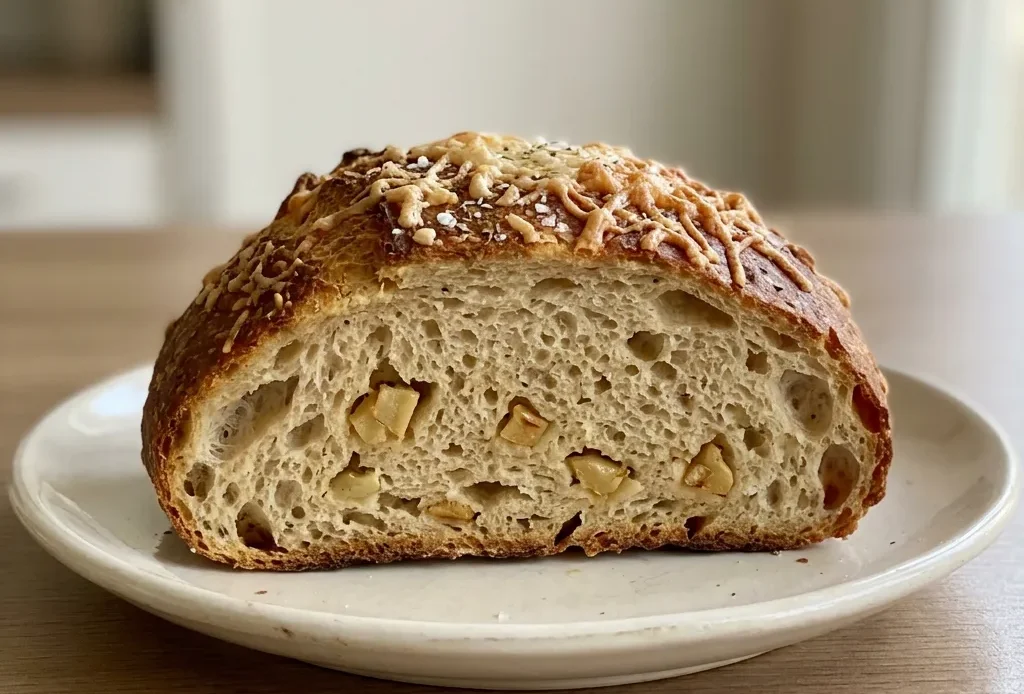
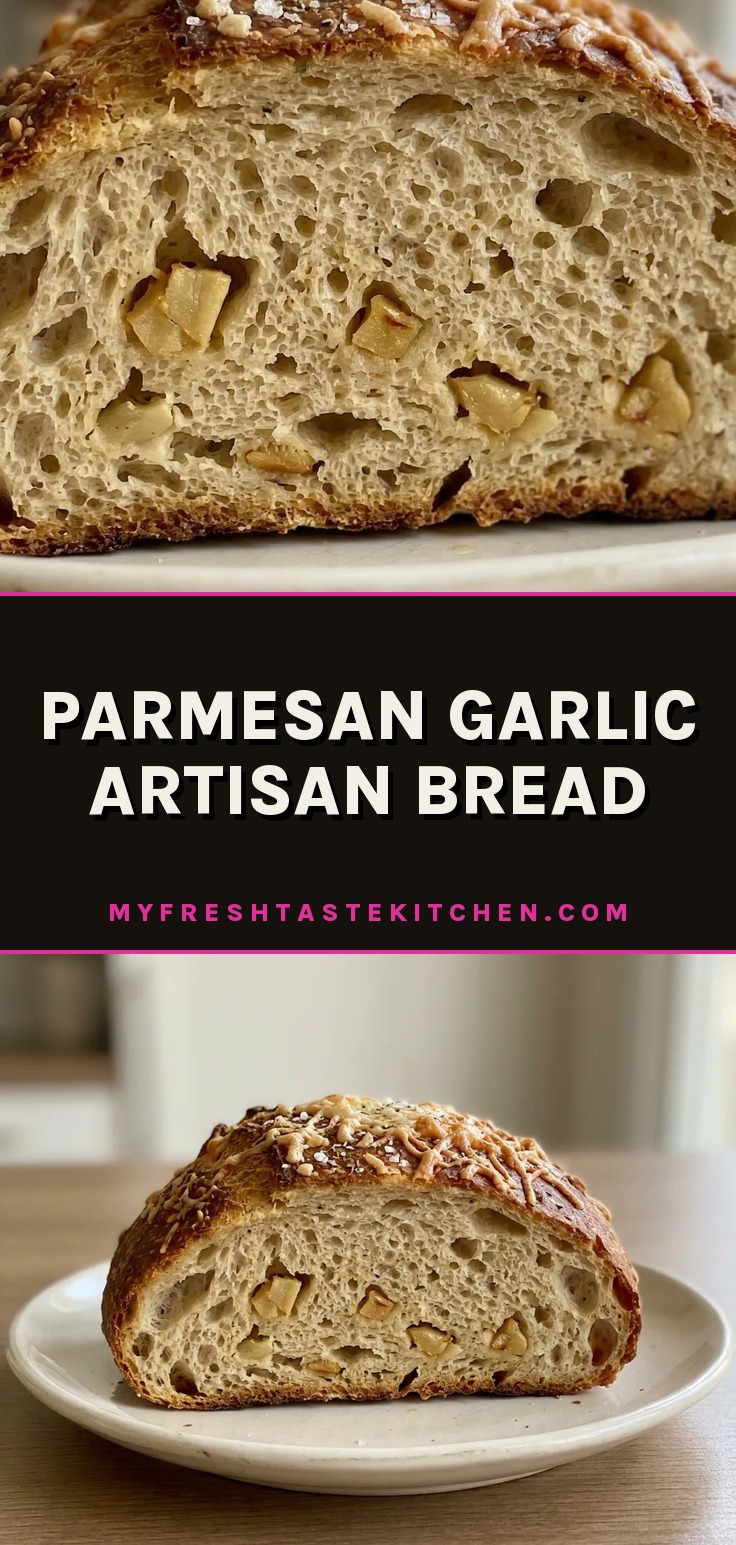
The crust shatters when you bite in, then gives way to a chewy, open crumb speckled with mellow roasted garlic and salty Parmesan. It’s the kind of bread you’d queue for at a bakery, but it comes from a bowl of flour, water, yeast, and a very long wait. No kneading, no stand mixer, no complicated folds, just a sticky dough that changes overnight into something you can’t stop tearing apart.
This parmesan garlic artisan bread proves that the hardest part is not slicing into it while it’s still warm.
Long fermentation builds flavor and structure
A 12- to 18-hour rest replaces kneading entirely. The high hydration dough slowly develops gluten networks on its own, creating an open, airy crumb typical of artisan-style loaves. During that time, enzymes break down starches into sugars that yeast feeds on, generating complex flavor.
The roasted garlic and Parmesan have hours to infuse the dough as it rises. You get a crisp, crackly crust and a tender interior without working the dough at all.
Just mix, wait, and shape. This is why no-knead yeast bread recipes easy enough for any day of the week still produce bakery results.
Steam is what makes the crust crackle
A preheated Dutch oven traps the moisture that evaporates from the dough as it bakes, flooding the chamber with steam. That steam keeps the surface elastic long enough for the loaf to spring up, creating a thin, shatteringly crisp crust.
When you lift the lid later, dry heat finishes browning the exterior to a deep golden color. This two-phase baking is the hallmark of any great crusty bread recipe. The closed pot gives you the steam you need; the open pot gives you the color you want.
No spritzing, no lava rocks, just a heavy pot with a lid.
Roasted garlic and Parmesan make a savory duo
Roasted garlic turns sweet and mellow, with none of the sharp bite you get from raw cloves. It melts into the dough, leaving pockets of gentle allium flavor. Parmesan brings saltiness and a nutty, crystalline texture.
Half goes inside the dough, where it disappears into the crumb; the rest stays on top, where it browns into a crispy, cheesy crust. The garlic powder and Italian seasoning in the base reinforce those notes without overpowering.
Each slice tastes deeply savory, almost rich, even though there’s no butter or oil beyond a single tablespoon. That combination keeps you coming back for another piece.
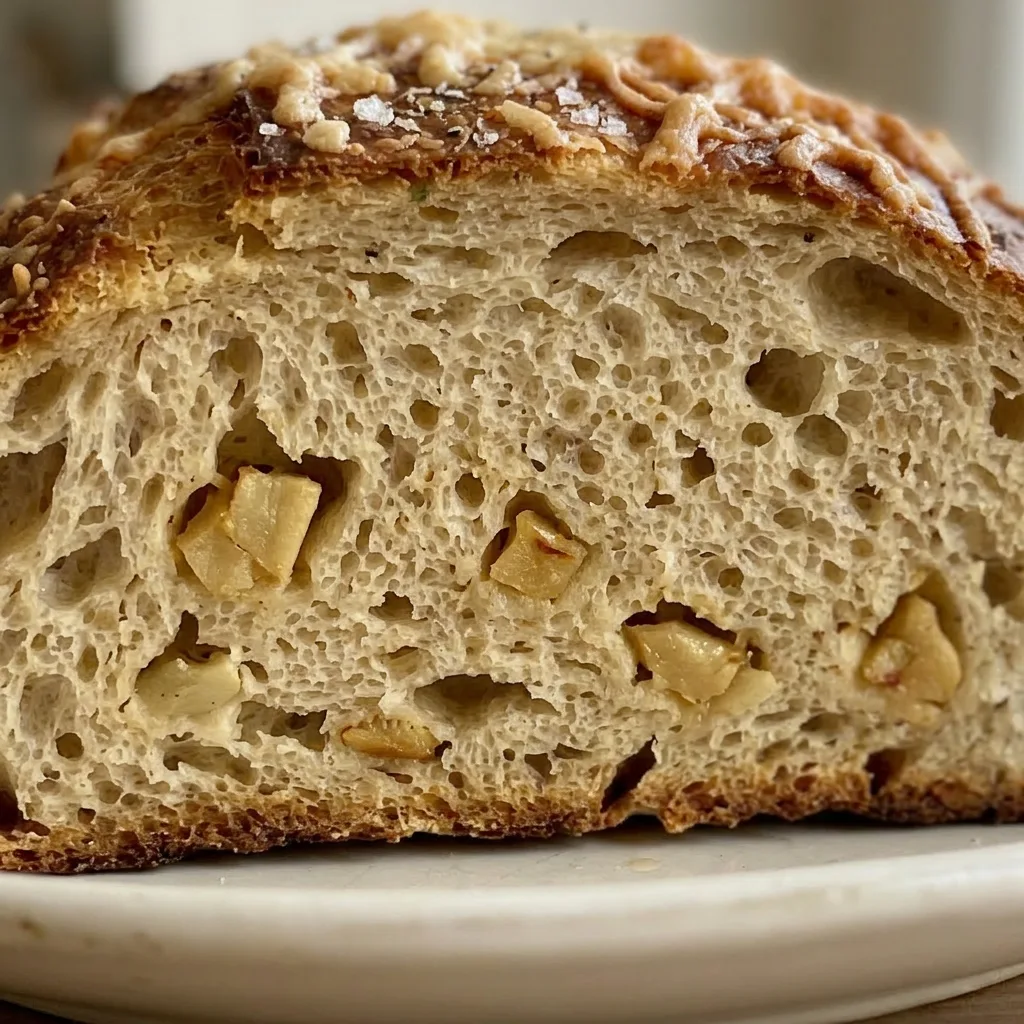
Prep: 15 min · Cook: 43 min · Total: 12 hr 18 min · Servings: 8 · Calories: 220 kcal
What to Know About the Ingredients
Bread flour: Bread flour’s higher protein builds stronger gluten for an airy, chewy crumb without kneading.
Instant yeast: Instant yeast dissolves and activates quickly in dry flour; no proofing needed.
Roasted garlic: Roast whole heads until soft and golden; raw garlic will be harsh and won’t mellow during the long rest.
Parmesan cheese: Use freshly grated Parmigiano-Reggiano; pre shredded contains anti caking agents that won’t melt evenly.
I still set a timer for 12 hours exactly and check the dough at the low end, because leaving it an extra hour in a warm spot made it fall flat.
Mix and rest: the dough does the work
Combine dry ingredients
Whisk flour, yeast, salt, garlic powder, and Italian seasoning together. Even distribution keeps the yeast from clumping and ensures consistent rise.
Add wet ingredients
Pour in warm water and olive oil. Stir until no dry flour remains, the dough will look shaggy and sticky. That’s correct; don’t add more flour.
Fold in add-ins
Fold in the chopped roasted garlic and half the Parmesan. The dough should still be soft and tacky. If it stiffens, you’ve overmixed.
Long rest
Cover tightly and let sit at room temperature 12 to 18 hours (or 4 to 6 hours if warm). You’ll see bubbles on the surface and the dough will double in size. If it doesn’t, your environment is too cool; move it to a warmer spot.
Shape the loaf
Turn the bubbly, risen dough onto a floured surface. Fold it over itself a few times, then shape into a ball.
The dough should be airy but hold a round shape. If it flattens completely, it’s overproofed, bake anyway.
Second rest
Place the shaped dough on parchment. Sprinkle remaining Parmesan and flaky salt on top. Let rest 30 minutes while the oven preheats.
The dough will spread slightly but not much.
Preheat Dutch oven
Put the Dutch oven and its lid inside the oven. Preheat to 450°F for at least 30 minutes. The pot must be screaming hot to create instant steam when the dough hits it.
Bake covered
Carefully lower the dough into the hot pot using the parchment as a sling. Cover and bake 25 minutes. Steam trapped inside makes the crust expand; you’ll hear a faint sizzle.
Bake uncovered
Remove the lid and continue baking 15 to 18 minutes. The crust should turn deep golden brown and sound hollow when tapped. If it’s pale, bake an extra 2 to 3 minutes.
Cool before slicing
Transfer the bread to a wire rack and cool at least 20 minutes. The interior continues setting; slicing too early yields a gummy crumb. Wait until the bottom feels firm.
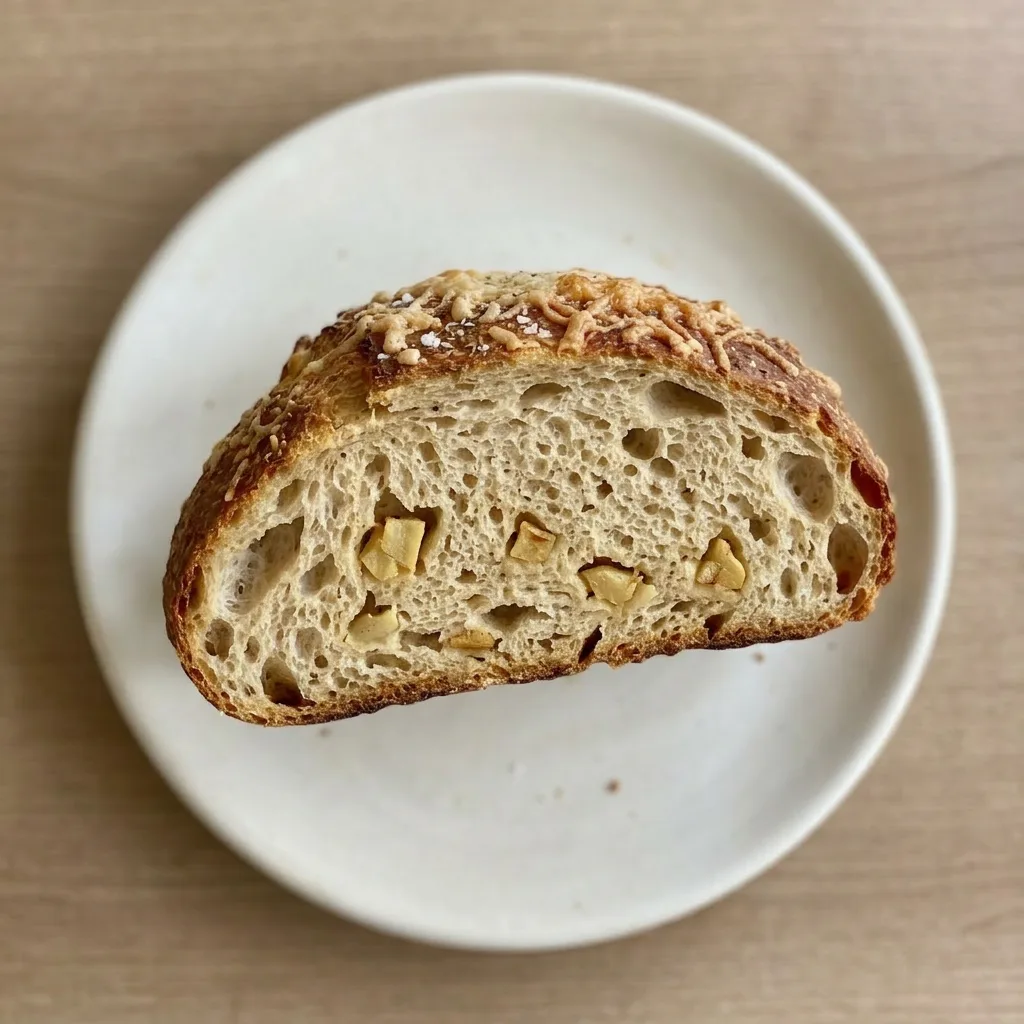
Parmesan Garlic Artisan Bread
Ingredients
- 3 cups bread flour 360g
- 1 tsp instant yeast
- 1 tsp fine sea salt
- 1 tsp garlic powder
- 1 tsp dried Italian seasoning
- 4 cloves roasted garlic roughly chopped
- ¾ cup Parmesan cheese 75g, freshly grated, divided
- 1½ cups warm water 355ml, around 110°F (45°C)
- 1 tbsp olive oil
- extra Parmesan and flaky salt for topping
Instructions
Whisk dry ingredients:
In a large bowl, combine flour, yeast, salt, garlic powder, and Italian seasoning by whisking.Add water and oil:
Add warm water and olive oil. Mix until a shaggy dough forms and no dry flour is visible.Fold in garlic and cheese:
Fold in roasted garlic and half of the Parmesan cheese.Cover and let rest:
Cover bowl tightly with plastic wrap. Let rest at room temperature for 12 to 18 hours, or 4 to 6 hours in a warm environment.Shape dough into ball:
Turn the bubbly, risen dough onto a lightly floured surface. Fold several times and shape into a round ball.Top with cheese and salt:
Place dough on parchment paper. Sprinkle remaining Parmesan and flaky salt on top. Let rest for 30 minutes.Preheat Dutch oven:
Put a Dutch oven with its lid inside the oven. Preheat to 450°F (230°C) for at least 30 minutes.Bake covered:
Carefully lower the dough into the hot Dutch oven using the parchment as a sling. Cover and bake for 25 minutes.Bake uncovered until golden:
Remove the lid and continue baking for 15 to 18 minutes, until the crust is deep golden brown.Cool on wire rack:
Transfer bread to a wire rack and cool for at least 20 minutes before slicing.
Bread flour, yeast, and cheese swaps that work, and one that doesn’t
Bread flour: All-purpose flour. All-purpose flour has less protein, so the crumb will be softer and less chewy, with smaller air pockets.
Use the same weight (360g); if measuring by volume, use 3 cups minus 2 tablespoons. The loaf won’t rise quite as tall, but it’ll still taste great.
Instant yeast: Active dry yeast. Active dry yeast granules are larger and need proofing to activate. Dissolve 1 tsp active dry yeast in the warm water with a pinch of sugar, let sit 5 to 10 minutes until foamy, then proceed.
The rise may take slightly longer, watch for doubled volume rather than the clock.
Parmesan cheese: Pecorino Romano. Pecorino is saltier and sharper than Parmesan.
Use the same amount (75g, freshly grated). Your bread will taste more aggressively savory, and the topping will brown faster, check the crust a few minutes early. Dial back the flaky salt on top if you’re sodium-sensitive.
Roasted garlic: Raw garlic (not recommended). Raw garlic stays harsh and pungent even after a long rest. It won’t soften or sweeten like roasted garlic does.
The raw bite can linger in the finished bread, clashing with the Parmesan. If you must, mince one small raw clove and add it with the water, but expect a sharp, almost spicy kick.
Tips
- Before shaping, gently poke the dough with a wet finger; if it springs back slowly and leaves a slight indentation, it’s ready. If it springs back quickly, let it rest longer. If it doesn’t spring back at all, it’s overproofed and should be baked immediately.
Storage and Serving
This bread is best the day it’s baked: the crust stays shatteringly crisp, and the crumb is tender. If you must store it, keep the whole loaf unsliced at room temperature, wrapped loosely in a kitchen towel, for up to 2 days.
The crust will soften, but you can re-crisp it in a 350°F oven for 5 to 10 minutes. Slicing ahead speeds staling, so cut only what you’ll eat.
For longer storage, freeze the whole loaf or individual slices in a zip-top bag for up to 3 months. Thaw at room temperature, then reheat in the oven to restore the crust.
Do not refrigerate; the fridge dries out bread faster than room temperature. The roasted garlic and Parmesan stay fresh for the duration.
Serve warm or at room temperature; if reheating, let the bread cool on a rack for a few minutes so the crust stays crisp.
Frequently Asked Questions
Can I let the dough rise for less than 12 hours?
Yes, but the crumb will be tighter and the flavor less developed. If your kitchen is warm (around 75°F), 4 to 6 hours can work, the dough should double in size and look bubbly.
Anything under 4 hours won’t build enough gluten, so the bread will be dense. The long rest is what makes this recipe no-knead; cutting it short means you lose that structure.
Why is my bread dense and not airy?
Most likely the dough didn’t rise long enough, look for a doubled, bubbly surface after 12 to 18 hours. If it did, your water might have been too cold (below 100°F), slowing the yeast, or too hot (above 120°F), killing it. Another cause: over-flouring the work surface when shaping, which deflates the dough.
The crumb should have irregular holes; a uniform, tight texture means gluten didn’t develop fully.
Can I make this bread ahead and reheat it?
Yes, but the crust is best the day it’s baked. To reheat, place slices or the whole loaf in a 350°F oven for 5 to 10 minutes to restore crispness. Avoid the microwave, it softens the crust instantly.
For longer storage, freeze the unsliced loaf up to 3 months, then thaw and reheat. Don’t refrigerate; it dries bread out faster than room temperature.